EN

Children’s Recycled Polyester Shorts with Elastic Waist and Side Pockets | OEM ODM Private Label Kidswear


- Overview
- Kids’ Recycled Polyester Shorts | OEM ODM
- Recommended Products
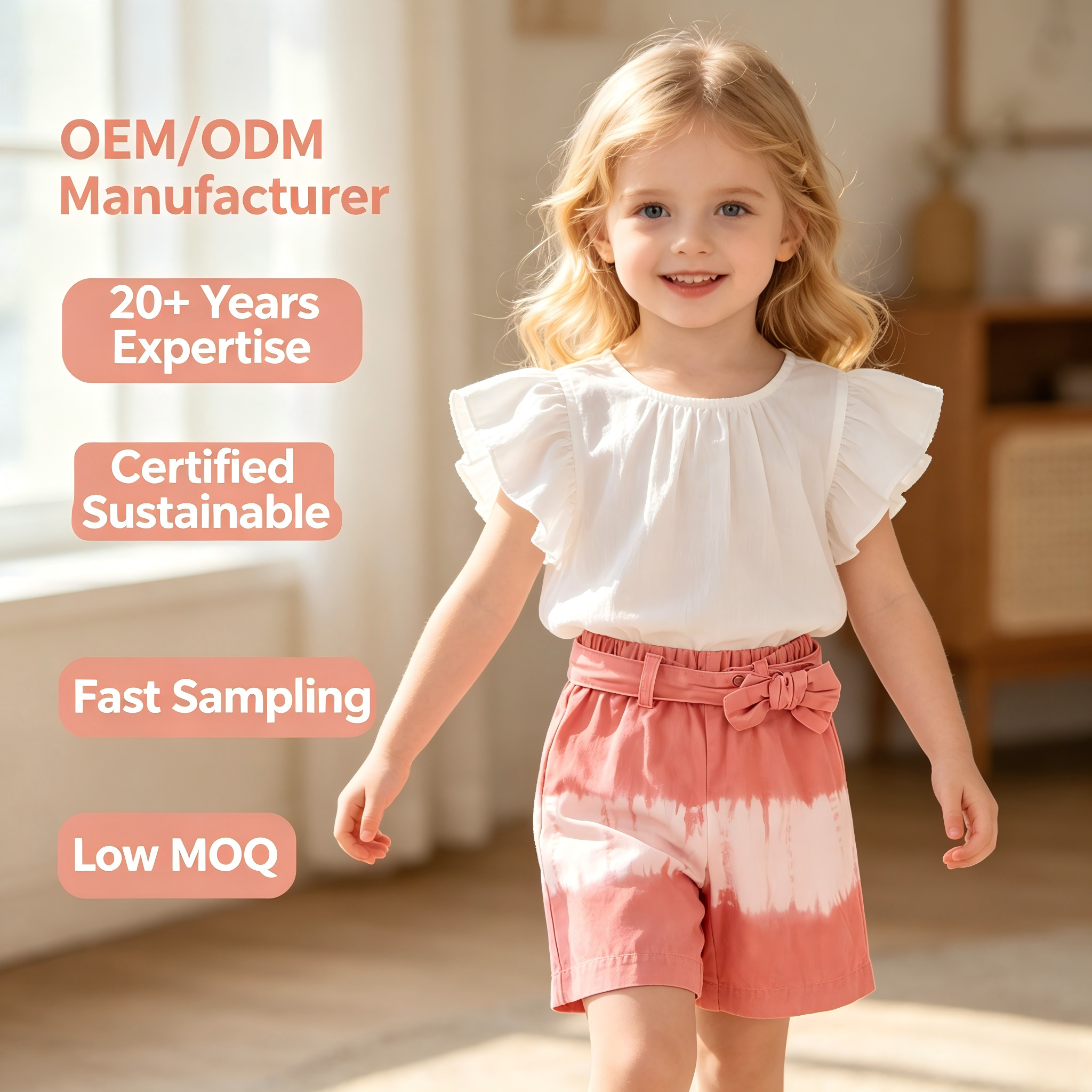
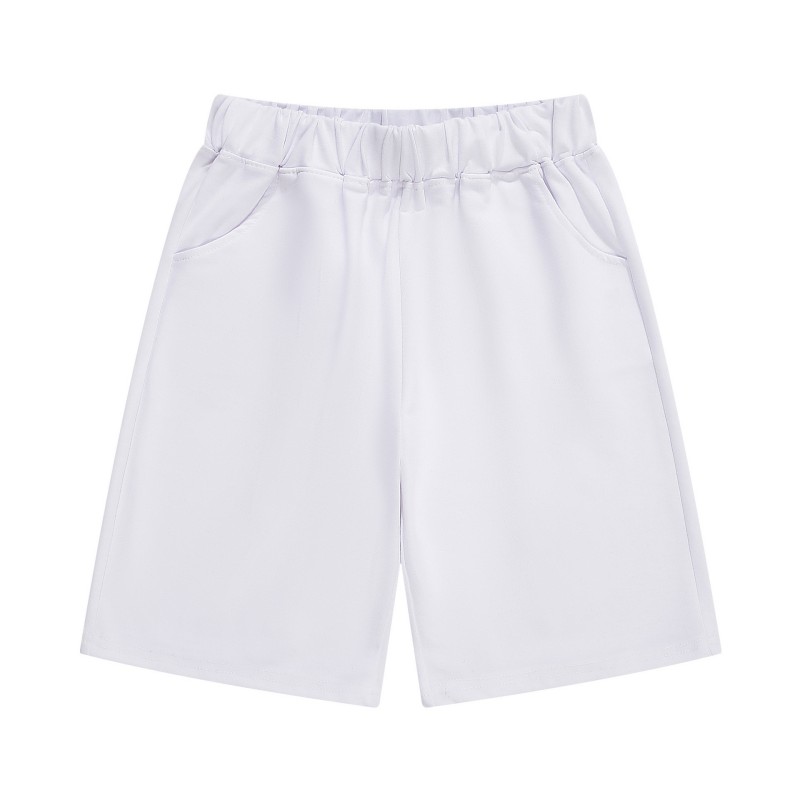
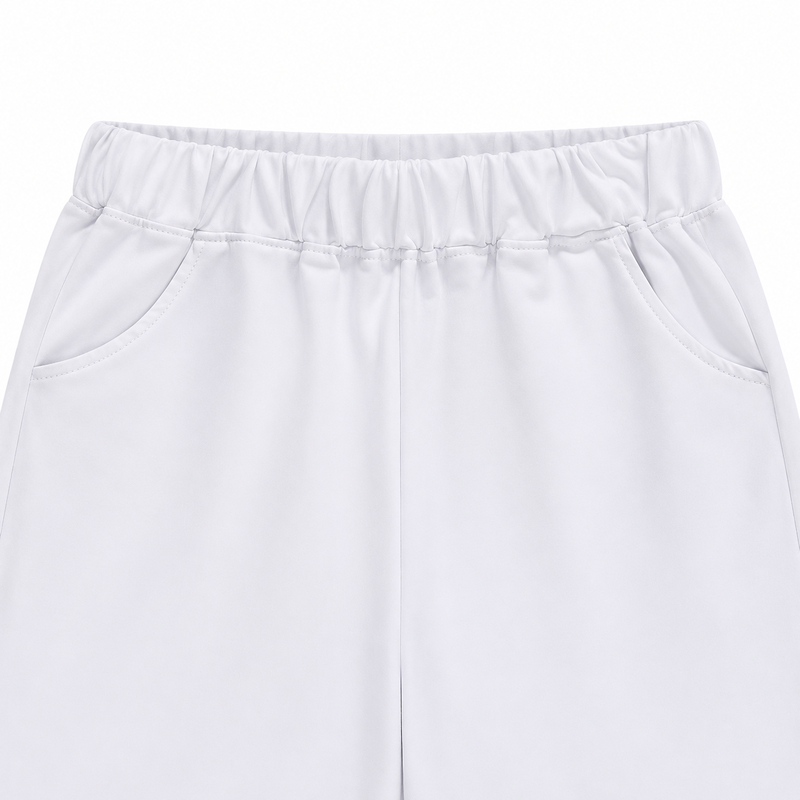
A pair of white shorts in a 100% recycled polyester woven: a wide gathered waistband over elastic, curved side pockets, a loose straight leg finishing above the knee. No fly, no drawcord.
A white woven short is judged by what shows through it. On a coloured ground a seam allowance is invisible and a pocket bag is a rumour; on white they read as grey lines and dark patches that look like defects and are not. Everything about this garment that is not the waistband is a decision about what the inside does to the outside.
At a glance

1. Fibre: recycled polyester in a woven, and the oil problem
- rPET is the same polymer from a different feedstock. In a woven it gives dimensional stability, low absorbency and quick drying; the recycled route changes the certificate file rather than the sewing floor.
- Polyester is oleophilic. It attracts and holds oil into the fibre rather than releasing it at the surface, which is why a grease mark on a polyester short sets where the same mark rinses out of cotton; that behaviour, not the colour, is what makes a white polyester short hard to keep clean.
- A soil-release finish is the answer, and it is a per-order decision. The finish makes the fibre shed oil at the wash instead of holding it, and it is the reason a white polyester short can be sold to a parent at all; whether it is applied, and to what durability, is confirmed at quotation.
- It does not absorb water, so the garment dries fast and stays light, but it also does not wick the way a knit does — a woven moves moisture through the openings between yarns, not along the fibre.
- The percentage is a chain-of-custody claim. GRS covers recycled content with processing controls and chemical limits, RCS covers the recycled content alone, and both run on transaction certificates, so the claim holds only while the certificate names the seller, the article and the percentage.
2. White woven: three things show through
- Seam shadow is the first. A dark overlocked allowance on a white ground reads as a grey stripe down the outside leg, and it looks like a stain to anyone who does not sew; the seam is therefore finished so the allowance is enclosed or laid flat, not merely overlocked and pressed.
- Pocket shadow is the second. A pocket bag hangs behind a single layer of white cloth, and the shape of the bag shows as a soft rectangle; that is unavoidable, so it is handled deliberately — the bag is cut from a lighter cloth and the pocket mouth is finished so the shadow starts at a line rather than at a smudge.
- The seat is the third. White woven is at its thinnest where it is stretched across the seat and at the inseam, and that is exactly where a child sits on the ground; the cloth weight is set for the seat, not for the leg, and a doubled seat panel is quoted as an option.
- Cast matters more than shade on white. Two lots of the same white differ in warmth rather than in depth, and on a full-length panel the difference reads as two garments on a rail; approval is taken on the sewn short, not on a swatch.
- Creases are visible in a way they are not on colour. A sharp pack crease on a white polyester woven catches light along its edge, so pressing and packing are specified rather than left as a finishing detail.
3. The paperbag waist: gathering a cloth that does not stretch
- The gathering is created, not inherent. A woven has no stretch, so the wide band is gathered onto a narrower elastic; the elastic is the only thing that gives, and the cloth above it is decorative volume.
- The band has to be cut wide enough to gather without pulling the waist. If the band is cut to the finished waist measurement, the gathers take up the difference and the shorts lose circumference; the band is cut over-measure and gathered down.
- Gather distribution is a visible variable. Uneven gathers put the bulk on one hip and read as a fit fault, so the band is gathered to marked quarters and checked around the full circumference, front, side and back.
- Elastic is specified by width and recovery. A wide elastic relaxes differently from a narrow one, and its recovery after washing is what keeps the shorts up without a drawcord; recovery is tested on the finished band rather than on the elastic tape.
- No drawcord is a compliance decision as well as a design one. Cord rules for children's clothing restrict cords at the waist for this age group, and an elasticated waist removes the need: the shorts hold by recovery, and nothing hangs at the front to catch.
- The band is a bulk point under a top. It sits at the natural waist and shows through a tucked tee, which is why the band height is set with the intended tee in mind.
4. Pockets, and what a pocket costs on white
- The pocket mouth is the finished edge a hand touches. A curved side pocket is finished with a facing or a turn-back so the curve holds its shape; a raw or single-turned curve ripples after the first wash, and on white the ripple shadows through the cloth.
- The bag has to be anchored. A pocket bag that is only sewn at the mouth swings inside the short and pulls the side seam out of line; the bag is secured at the waist seam and at the bottom so it stays where it was placed.
- The bag cloth is not the shell cloth. Using the shell for the bag doubles the shadow under the pocket; a lighter bag cloth keeps the silhouette clean at the front, which is where the eye goes.
- The pocket depth suits a child's hand and not an adult's, since a pocket that is too deep bunches at the hip and one that is too shallow loses what a child puts in it.
- The bag must not reach the hem of the leg, or it shows as a rectangle at the bottom of the short when the leg swings.
5. Construction: what a white ground changes
- Seams are chosen for the inside as much as the outside. French seams and bound seams both enclose the allowance and both are more expensive than an overlock; on white they are what stops the garment reading as grey-striped.
- The seam must be pressed to one side consistently, because a seam pressed open on white shows a line down the centre where the light passes through two layers differently.
- The hem is a shadow line too. A deep turn-back adds a band of double thickness that reads as a slightly darker strip; the hem depth is set with that in mind rather than copied from a coloured short.
- No fly means the front is a single panel, so the crotch seam carries the whole strain; it is sewn with a reinforced stitch and checked for grin-through on the seat.
- Needle control. 100% needle detection on finished pieces, one-for-one exchange at every break with the machine stopped, work within 2.5 m re-screened twice, needle-free area enclosed, 2 m deep, single entry.
6. Size: 2A–8A, and what the block has to hold
- The range steps across two chemical classes. The 2A size is for a child under 36 months and is assessed as Class I; 4A and above is Class II, with the certificate set issued to cover both or the range split into two orders with two limit sets.
- The waist has to work across a range of bodies, which is what an elasticated waist is for: it covers the variation that a fixed waistband cannot, so the grading concentrates on rise and leg length rather than on the waist.
- Rise is the dimension that fails first on a nappy. The 2A and 3A sizes are cut with extra rise so the shorts sit over a nappy without pulling at the crotch; the rise steps down as the size grows.
- Leg length and leg opening grade together, so the short stays above the knee at 8A as it does at 2A rather than becoming a knee short at the largest size.
- The sample is checked sitting and crouching, because a wide leg that looks right standing can gap at the back when a child sits on the floor.
7. Customization, sampling and what we need to quote
- Waist. Gathered paperbag band as shown; a flat elastic waist; a fixed waistband with a side zip.
- Pocket. Curved side pocket as shown; a patch pocket; a coin pocket added at the front.
- Leg. Wide straight leg as shown; a shorter culotte length; a turned-up cuff.
- Seam finish. Enclosed seams as shown; overlocked seams where the price point requires it.
- Finish. Soil-release finish as quoted; a water-repellent finish where the short is worn outdoors.
- Colour. White as shown; off-white without a brightener; other grounds with the same seam discipline.
- Packing. Polybag with size sticker; hanger with clips; woven or printed label, satin care label, hangtag.
- Sampling. 3–7 days from a confirmed tech pack, with the waist gathered and measured, and a wash trial on the finished short to check seam shadow and pocket shadow after laundering.
- Bulk lead time. 30–60 days from approval by quantity and dye lot schedule; rush production is quoted per order.
MOQ: 300 pcs for a custom development — custom fabric, colour, waist or fit; 50 pcs for a decorative process added to a stock body; 100 pcs for stock fabric with your own logo and label. Mixed colour and size orders are quoted per order. These are standing programme terms, confirmed against the current quotation.
Production runs with our production partner, Suzhou Shelmin Trade Co., Ltd.: 7,200 m² workshop, 8 lines, 200 staff, 6,000 pieces per day. Design confidentiality is held under NDA; buyer patterns and colourways are not re-used.
To quote, we need: target market; cloth weight and weave; whether a soil-release finish is in scope; the seam finish you will pay for; pocket bag cloth; waist band height and elastic width; whether a doubled seat panel is wanted; packaging; and whether certification runs in your brand name.