EN

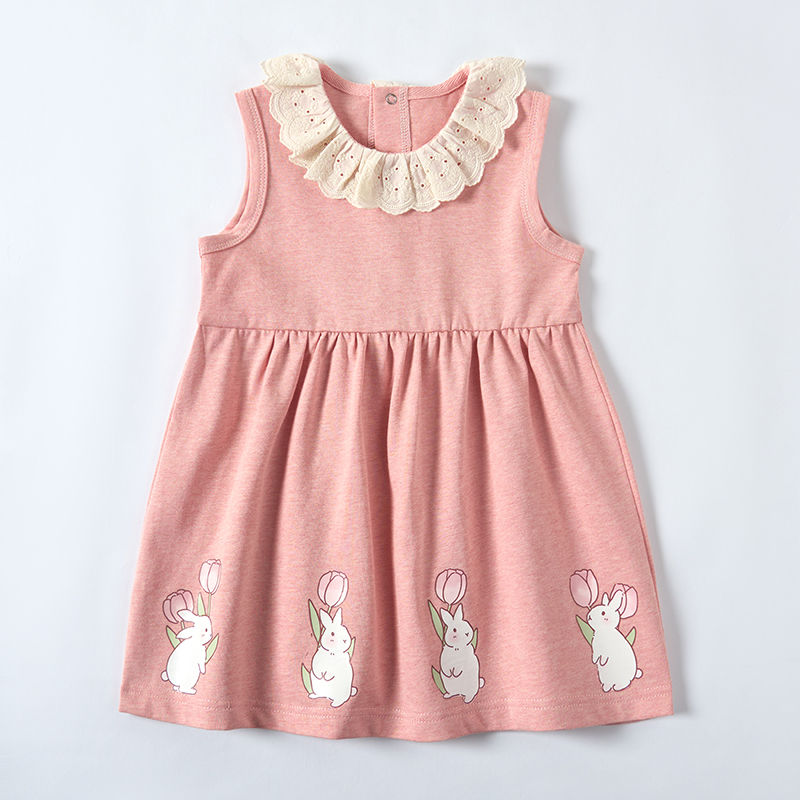
Cotton Baby Girl Sleeveless Dress with Lace Ruffle Collar | Plant-Dyed OEM ODM Baby Dress Manufacturer


- Overview
- Baby Sleeveless Cotton Dress with Embroidered Ruffle Collar
- Recommended Products
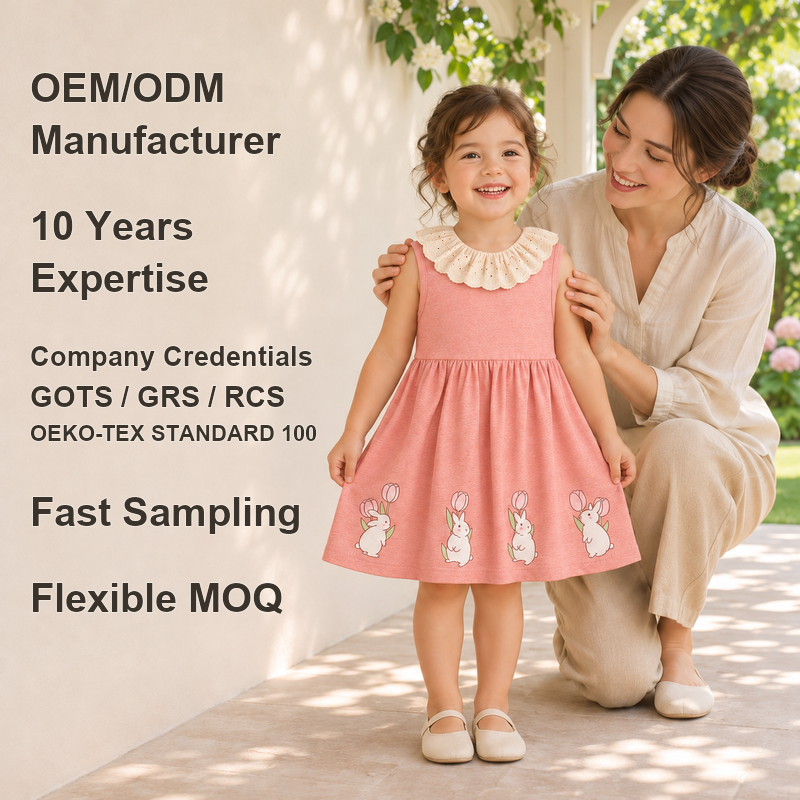
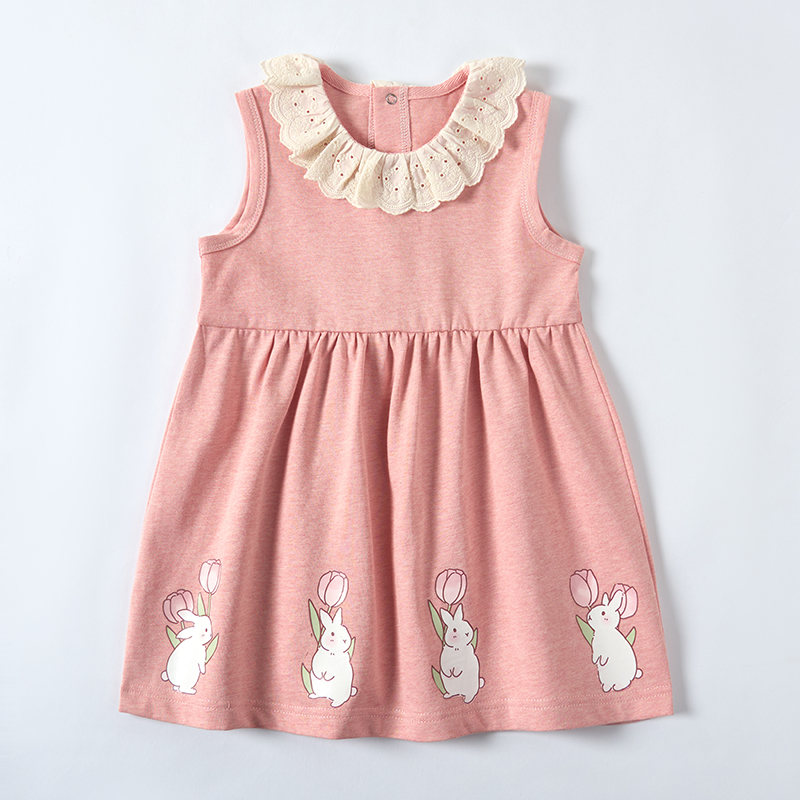
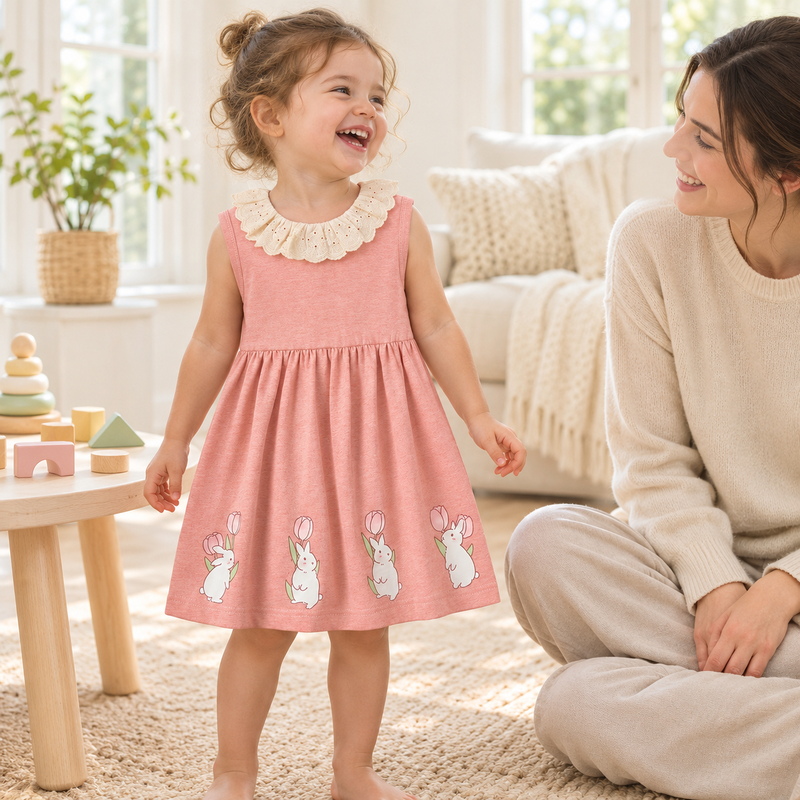
A sleeveless dress in 230 gsm cotton jersey, plant dyed to a dusty rose with madder and logwood: a cream eyelet lace collar at the neck, one button at the back, a gathered skirt from a high waist seam, and four rabbits printed along the hem.
The interesting thing about this garment is what has not been dyed. The collar is the most visible part of it and it carries no plant colour at all, because a clean cream is one of the few shades a plant bath cannot reliably give. That single fact decides how the collar is bought, how it is attached, and why it is the part of the dress that has to be specified most carefully.
At a glance
1. The cloth: 230 gsm jersey in a dress
- A dress uses jersey differently from a top. The bodice hangs from the shoulders and the skirt hangs from the waist seam, so the cloth carries weight rather than just covering a body; at 230 gsm it is light enough to fall in gathers without standing away.
- The gathers are the volume. The skirt is gathered onto the bodice rather than cut as a circle, which uses less cloth and gives a softer fall — and it makes the waist seam a line of concentrated bulk.
- The melange in the cloth shows through the dye. A heather yarn reads as flecks in the finished colour, and on a pale plant shade those flecks are more visible than they would be on a solid ground, so the yarn is specified rather than accepted as it comes.
- At this weight the cloth is opaque dry and slightly translucent when wet, which matters at the hem and the seat where a dress is thin; the skirt is a single layer by design and the bodice is finished so the neckline seam does not read through.
- A cotton jersey has stretch from its loop structure but no elastane to recover it, so the shape at the neck and the armholes is held by binding rather than by the cloth springing back.
2. Cream is the colour the bath cannot give
- A clean cream is not a plant-dye shade. What a plant bath produces at that depth is a warm ivory that drifts toward khaki under light, and it never reaches the flat, bright cream an eyelet lace needs to read as lace.
- So the collar is bought in, and that is the honest structure of the garment. It is a trim: specified, sourced and tested as a component, rather than dyed with the body.
- The contrast is doing design work. A cream collar lifts a muted rose that would otherwise read flat at the face, which is why the two elements are approved together rather than separately.
- The lace is a different cloth with a different shrink rate, so it is washed and measured on its own before the neckline is set; a lace that shrinks against a jersey neckline pulls the dress out of shape at the shoulder.
- The collar is also where dye transfer would show first. Cream against a madder and logwood ground is the pair most likely to cross-stain in the wash, so fastness is tested on the assembled dress.
3. The collar: a handle at the neck
- A wide flat collar is a handle. On a baby or a toddler it is the part that gets gripped when the child is picked up or pulled back, so its attachment at the neckline carries load that a decorative trim is not usually asked to carry.
- Attachment is therefore specified, not assumed. The collar is set into the neckline seam with the seam enclosed, and the join is checked by pulling the collar away from the body at four points rather than by eye.
- Eyelet lace has open holes and loose structure. A scalloped edge is a row of small loops, so the edge is inspected for raised threads and loose loops after washing, since that is where a loop forms.
- The collar sits against the neck. Its seam is pressed away from the skin and the collar is kept shallow enough that it does not bunch under a chin, which is where a wide collar is felt most.
- Its width is a reach question, not only a style one. A collar that extends past the shoulder line gets caught on a car seat harness and on a coat collar, so the outer edge is set inside the shoulder point.
4. Printing a motif across gathers
- The rabbits are printed on a flat panel that is gathered afterwards. The print is applied before the skirt is gathered, because printing on a gathered panel would distort the image and leave ink in the folds.
- So the placement has to anticipate the gather. A motif that spans a fold comes out narrowed where the cloth folds back on itself, which is why each rabbit sits within its own repeat rather than crossing a fold.
- The repeat is planned against the gather pitch. Spacing the four motifs evenly against the gathered width, not the flat width, is what keeps them looking evenly spaced on the finished dress rather than drifting to one side.
- The hem is where a child's eye and a buyer's eye both land, so the motif row is checked for level and for equal spacing on the finished garment, hanging, not on the flat panel.
- A pale print on a pale ground relies on outline, and on a heather cloth the outline is what separates the motif from the flecked ground.
5. Armholes, the back button and the lift
- A sleeveless dress is lifted by the armholes. An adult lifts a baby with hands under the arms, so the bound armhole is the point that takes the child's weight; the binding is a stretch binding, applied so it neither gapes nor cuts in.
- The binding is what holds the shape. With no elastane in the cloth, the armhole would relax after a few washes without it, and a relaxed armhole on a sleeveless dress exposes the vest underneath.
- The back button is the entry. One button at the centre back opens the neck enough to pass a head through a neckline that is otherwise closed, and it is checked with the button done up, since that closed measurement is what the pattern is set to.
- The button is a small part and is tested as one at the retention force the market requires — 70 N is the figure we work to for buttons and snaps — with the button and its thread assessed together.
- The armhole and the neckline are the two openings that have to be sized together, because a dress that passes the head but grips the arm is unwearable in the same way as one that does neither.
6. Size: 6M–36M, and what the block has to hold
- The range sits inside Class I, with 6M, 12M and 24M clearly under 36 months and 36M assessed as Class I because the article can be worn by a child under that age.
- The waist seam sits high on the smallest sizes, because a dress on a baby has to clear a nappy: the seam is placed above the nappy line at 6M and 12M and drops toward the natural waist as the child grows.
- Skirt length is graded with the rise, so the dress does not turn into a tunic at the largest size.
- The bodice is cut to a vest rather than to a bare chest, since the dress is worn over a bodysuit at this age; the armhole clearance is set with that layer in mind.
- The sample is checked sitting and being lifted under the arms, because the waist seam and the armhole binding are where a baby dress shows a fit fault first.
7. Customization, sampling and what we need to quote
- Collar. Cream eyelet lace as shown; a self-colour ruffle; a plain neckband; a pointed collar.
- Print. Four hem motifs as shown; a single centred motif; no print.
- Skirt. Gathered as shown; a circle skirt; a tiered skirt.
- Back. One button as shown; two buttons; a keyhole with no hardware.
- Shade. Dusty rose as shown; a warmer rose with more madder; a deeper mauve with more logwood, quoted with a light fastness note.
- Packing. Polybag with size sticker; hanger; woven or printed label, satin care label, hangtag.
- Sampling. 3–7 days from a confirmed tech pack, with a dyed strike-off, a wash trial on the lace and on the assembled dress, a collar pull check and a print registration check on the gathered skirt.
- Bulk lead time. 30–60 days from approval by quantity and dyebath schedule; the bath is planned per batch, so a split delivery is quoted as two batches.
MOQ: 300 pcs for a custom development — custom cloth, shade, collar or fit; 50 pcs for a decorative process added to a stock body; 100 pcs for stock cloth with your own logo and label. Mixed colour and size orders are quoted per order. These are standing programme terms, confirmed against the current quotation.
Production runs with our production partner, Suzhou Shelmin Trade Co., Ltd.: 7,200 m² workshop, 8 lines, 200 staff, 6,000 pieces per day. Design confidentiality is held under NDA; buyer patterns, shades and prints are not re-used.
To quote, we need: target market and the Class I tests it requires; the lace quality and whether it is pre-shrunk; the mordant route and the ratio of madder to logwood; whether the print is placed before or after gathering; the print method; cloth weight; packaging; and whether certification runs in your brand name.