EN

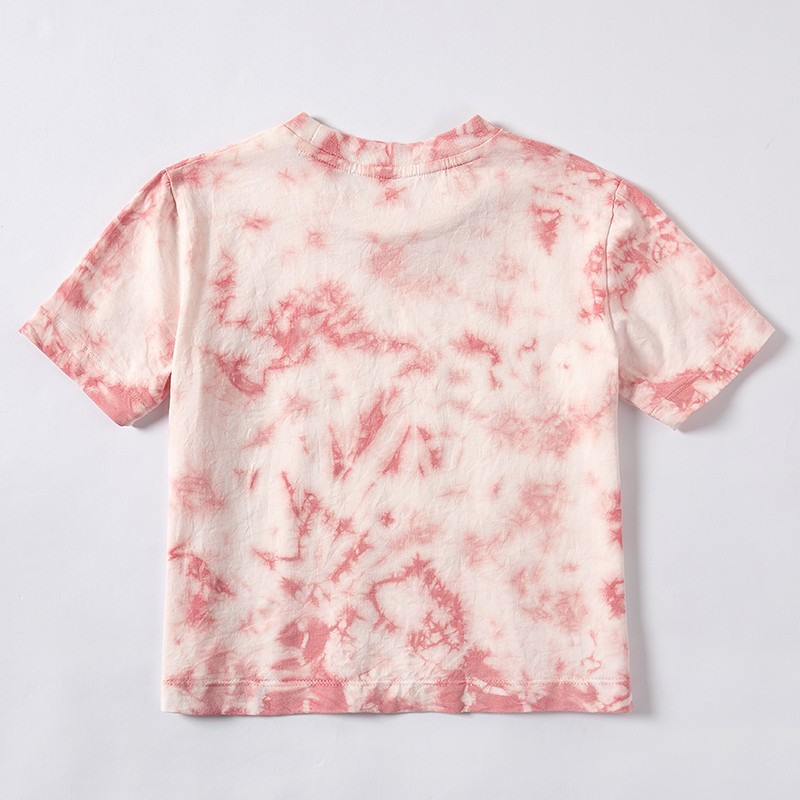
Kids Plant Dyed Cotton T-Shirt, Pink Tie Dye Short Sleeve Top for Children | Custom Natural Dye Kids Clothing Manufacturer OEM ODM Private Label


- Overview
- Kids Plant Dyed Cotton Tie Dye T-Shirt
- Recommended Products
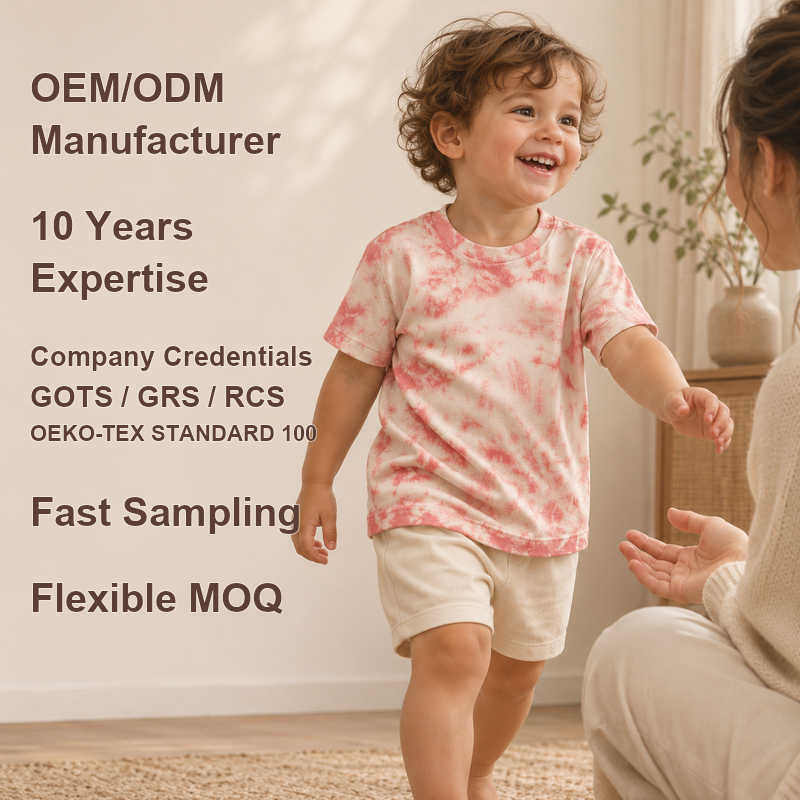
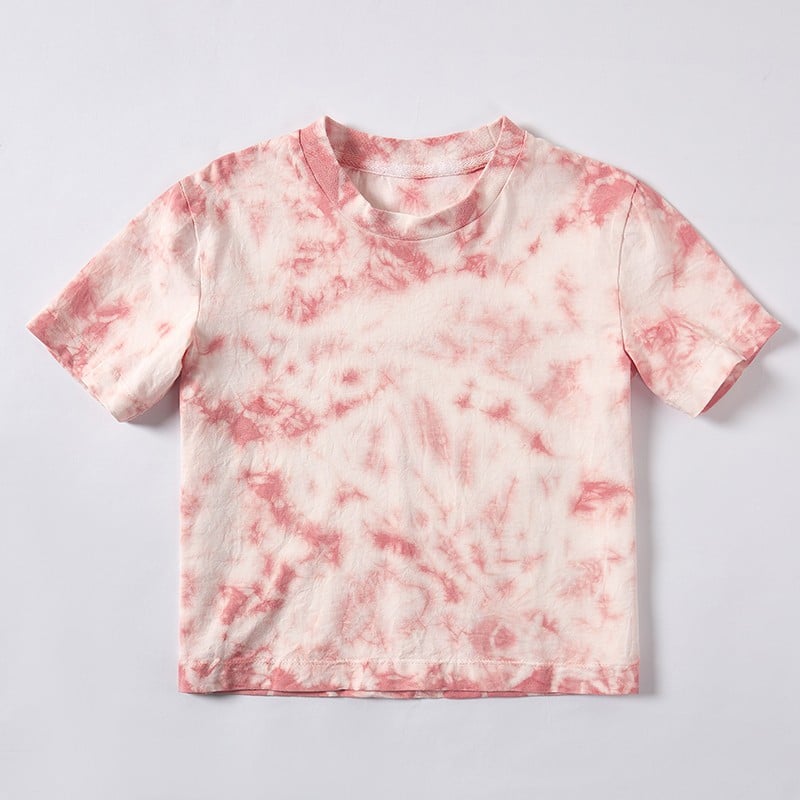
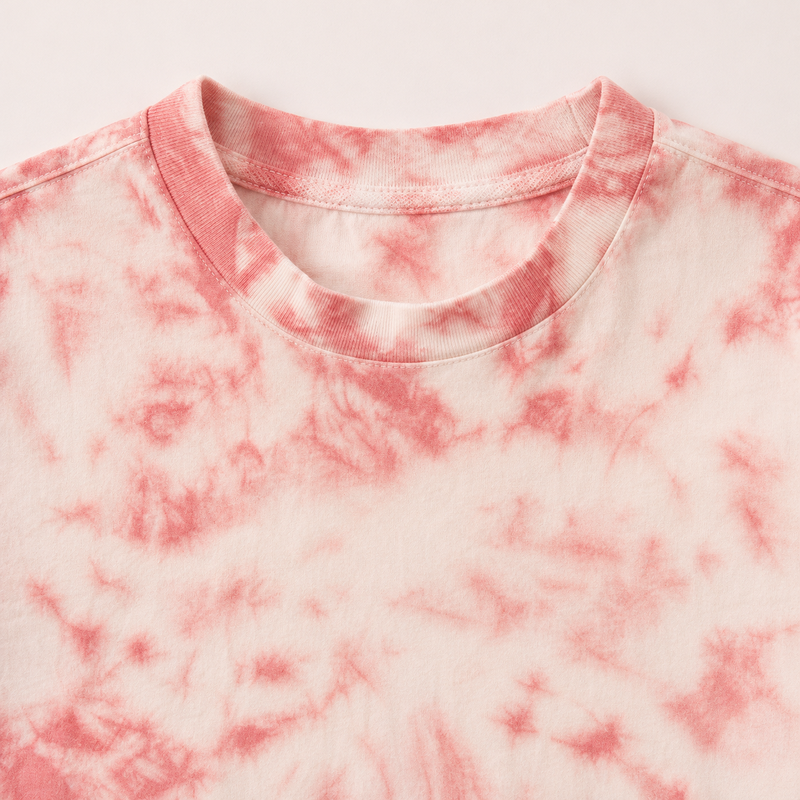
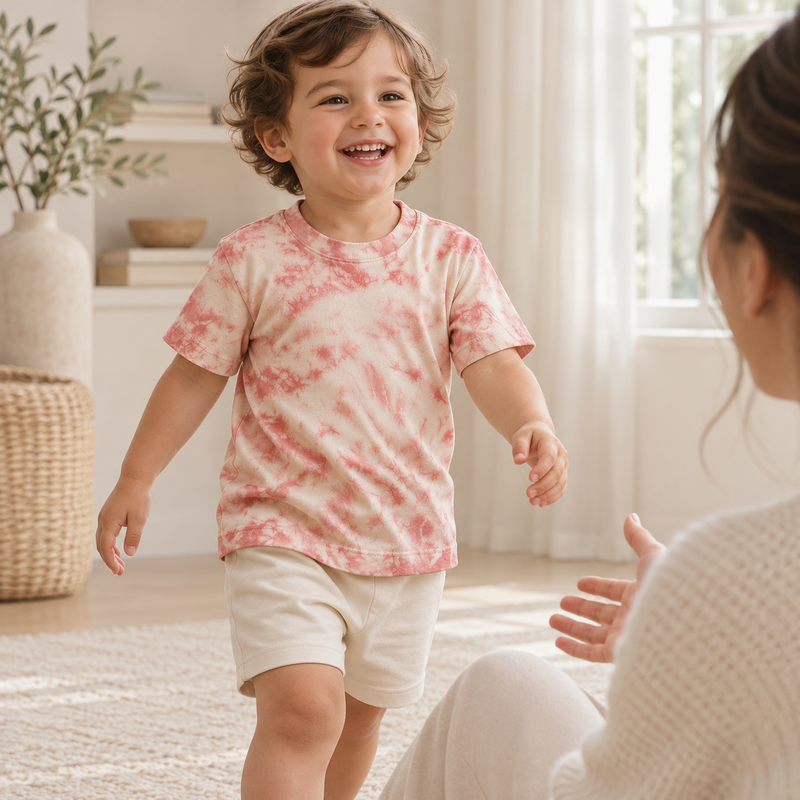
A short-sleeve crew tee in a 160 gsm cotton-spandex jersey, dyed with logwood (苏木) and madder (茜草) to a mottled rose on an undyed cream ground: self-fabric neckband, short sleeve with a turned hem, straight coverstitched hem.
The neckband is cut from the same cloth as the body, so it mottles with the shell and the neckline reads continuous — which is the colour advantage of this build, and the reason its ratio is set tighter than a rib band would be.
At a glance
1. Fibre: 95/5 at 160 gsm, and what the jersey does for a tee
- The spandex is what brings the neckline back. A tee goes over a head every morning: 5% spandex is the working figure for a kids' jersey, and it is the reason the crew recovers its shape rather than staying stretched.
- 160 gsm is a summer weight with drape. The cloth falls straight from the shoulder and stays cool against the skin; the same block in a heavier jersey reads as a long-sleeve top rather than a tee.
- Light cloth shows what sits under it. At this weight a wide seam allowance and an overlocked edge read as a line on the outside, so allowances are kept narrow, seams are pressed flat and thread is matched to the shell.
- Cotton shrinks, the spandex holds back. Length, chest and sleeve are measured after wash, which is how the hem stays level and the neckline keeps its width.
- Elastane sets the care rule. Heat and chlorine work on the spandex before the cotton, so the care label is written for the fibre that gives up first.
2. The neckband: self-fabric, and why the ratio is tighter
- A self-fabric band carries no contrast decision. With the body, the band goes through the same bath and mottles with the shell, so there is one colour to approve and the neckline reads as one piece.
- Jersey recovers less than rib, so the band is cut tighter. The band length is set as a ratio of the opening on the sample: tighter than a rib band would be, because jersey has the stretch but not the same snap back.
- The opening has to pass a head. A two-year-old's head is around 48 cm, an eight-year-old's around 53 cm; the finished opening is measured on a head form at both ends, and the band is what brings it back to size afterwards.
- A tape across the back neck holds the shoulder line. On a 160 gsm jersey the shoulder can creep under the weight of a wet sleeve; the neck tape stabilises it and keeps the crew sitting flat.
- The band seam sits at the back neck, pressed flat and positioned clear of the tape, so nothing rubs at the nape.
3. Shoulder, sleeve and hem: where a light jersey keeps its shape
- The shoulder seam is stabilised, not just sewn. A narrow tape in the seam stops the shoulder growing; it is the difference between a tee that still fits in June and one that has spread by August.
- The short sleeve is set to mid-upper arm, graded on arm length rather than body length, so it reads the same at 2A and at 8A.
- The sleeve hem is turned and coverstitched. At this weight a shallow turn flips up in the wash, so the depth is set against the washed sample, with a coverstitch that extends with the knit.
- The body hem is straight and coverstitched, with the same washed-sample rule for depth; a twin needle without stretch thread cracks along the fold over a season.
- Seams and needle control. Side seams flat-locked and pressed; 100% needle detection on finished pieces, one-for-one exchange at every break with the machine stopped, work within 2.5 m re-screened twice, needle-free area enclosed, 2 m deep, single entry.
4. The dye: logwood and madder on a light jersey
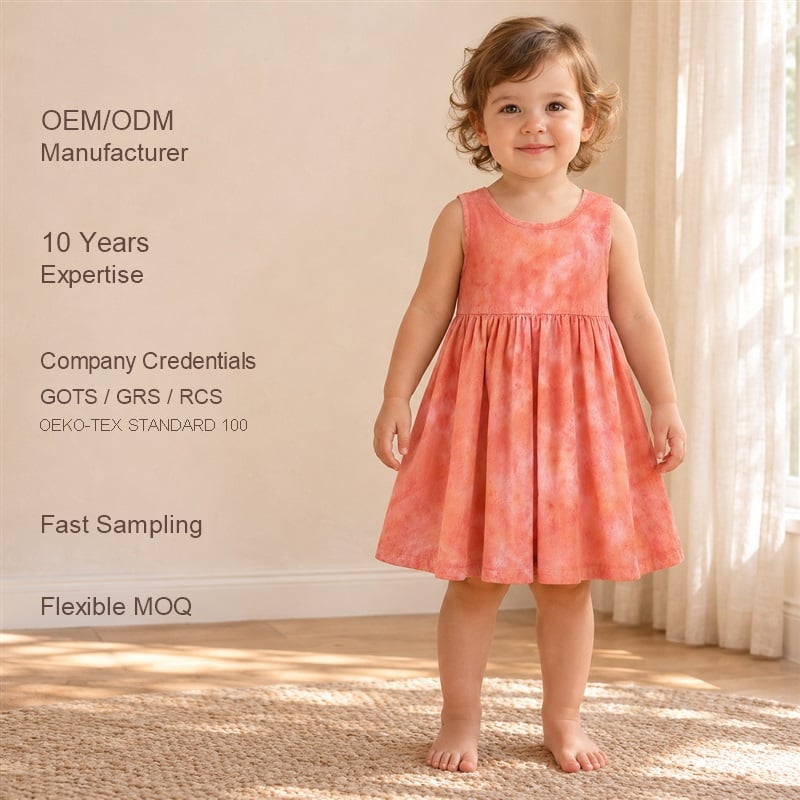
- Logwood (苏木) and madder (茜草) work as one bath. Logwood heartwood moves from violet to blue-black as pH and water change; madder root brings the rose and brick tones. On a cream cotton ground they give the mottled pink in the photo.
- Cotton holds plant colour through the tannins in the dyestuff. This recipe works that way, with no added mordant: the bath is logwood, madder and water, and the depth that comes out is the depth the plants give.
- The mottle reads finer at 160 gsm. The recipe that gives broad streaks on a 290 gsm terry breaks into a smaller pattern on a thin jersey, because the cloth moves differently in the bath — each weight is approved against its own reference.
- The spandex is watched through the bath. A plant bath runs warm and elastane has a temperature ceiling: the curve is set to dye the cotton without setting the spandex, which is what keeps the neckline recovering after washing.
- The neckline and sleeve hem are checked stretched as well as relaxed, because spandex takes colour differently from cotton and any pale cast shows first where the fabric is pulled.
- Packing, handling and drying set the pattern: a looser pack gives broader streaks, a tighter one a finer break, and both are recorded so a repeat order can be matched.
5. Colour control: buying a range, not a shade
- The approval object is a range. Depth, mottle scale and the amount of cream left showing are agreed against photographs of front, sleeve and hem from one accepted piece, plus a physical master sample.
- The batch is the unit of consistency. Dyebath volume, fabric weight per batch, temperature curve, dyestuff lot and water are recorded; 30–50 pieces is the working batch size at this weight.
- One colour to approve, not two. Because the band is self-fabric, there is no contrast trim to match; thread and labels are set against the shell's average tone and the shell carries the colour story alone.
- Deeper shades are a different recipe. Depth on cotton comes from dyestuff and time; a deeper rose is quoted after a dye trial rather than by lengthening the bath.
- A reference photograph settles the reading. Front, sleeve and hem are shot on one setup, so a piece can be compared with the master without a light-booth discussion.
6. Size: 2–8A, and a line at 36 months
- The range covers two chemical classes. The 2A sizes are for a child under 36 months and are assessed as Class I; 3A and up is Class II. The certificate set is issued to cover both, or the range is split into two orders with two limit sets.
- Age is merchandising, height is the spec. In the EU a kids' size is a height in centimetres, in the US an age band; both appear on the graded spec so a 2–8A run stays consistent.
- Body length grades fastest at this age. A tee that grades flat in length is short at 8A; chest width carries a modest grade because the jersey does the rest.
- The sleeve length grades on the arm, and the sleeve opening on the bicep, so the proportion holds across the range.
- The neckline is re-measured per size, not interpolated, because it is the dimension the garment is put on by.
7. Customization, sampling and what we need to quote
- Sleeve. Short as shown; a longer sleeve; a capped sleeve for a summer set.
- Neck. Self-fabric band as shown; a rib band; a bound neckline.
- Fit. Regular as shown; a boxier body; a longer tunic length.
- Hem. Straight coverstitch as shown; a curved hem; a side split.
- Mottle and colour. Broad streaks or a finer break; a madder-heavy brick; a logwood-heavy violet; a deeper shade quoted after a dye trial.
- Weight. 160 gsm as quoted; 180 gsm for a sturdier hand.
- Packing. Sold alone or as a set with the matching shorts; polybag with header, hanger card, gift box; woven or printed label, satin care label, hangtag.
- Sampling. 3–7 days from a confirmed tech pack plus a dye trial; a new shade, a new mottle or a neckband change adds a round, and the trial is booked against a batch so what you approve is what runs.
- Approval includes one wash, where shrinkage, neckline recovery, hem behaviour and fastness are checked together.
- Bulk lead time. 30–60 days from approval by quantity and dye batch schedule; rush production is quoted per order.
MOQ: 300 pcs for a custom development — custom fabric, dye recipe, colour or fit; 50 pcs for a decorative process added to a stock body; 100 pcs for stock fabric with your own logo and label. Mixed colour and size orders are quoted per order. These are standing programme terms, confirmed against the current quotation.
Production runs with our production partner, Suzhou Shelmin Trade Co., Ltd.: 7,200 m² workshop, 8 lines, 200 staff, 6,000 pieces per day. Design confidentiality is held under NDA; buyer patterns and colourways are not re-used.
To quote, we need: target market; whether the 2A sizes stay in the range; the mottle scale you want, with a reference photo if you have one; confirmation that the no-mordant recipe is fixed; the neckband type; the fit; packaging; and whether testing runs in your brand name.