EN

Kids' Recycled Polyester Hooded Jacket with Full Zip Closure | Lightweight Long Sleeve Children's Jacket | Custom Sustainable Kidswear OEM & ODM Manufacturer


- Overview
- Recycled Polyester Hooded Jacket for Kids
- Recommended Products
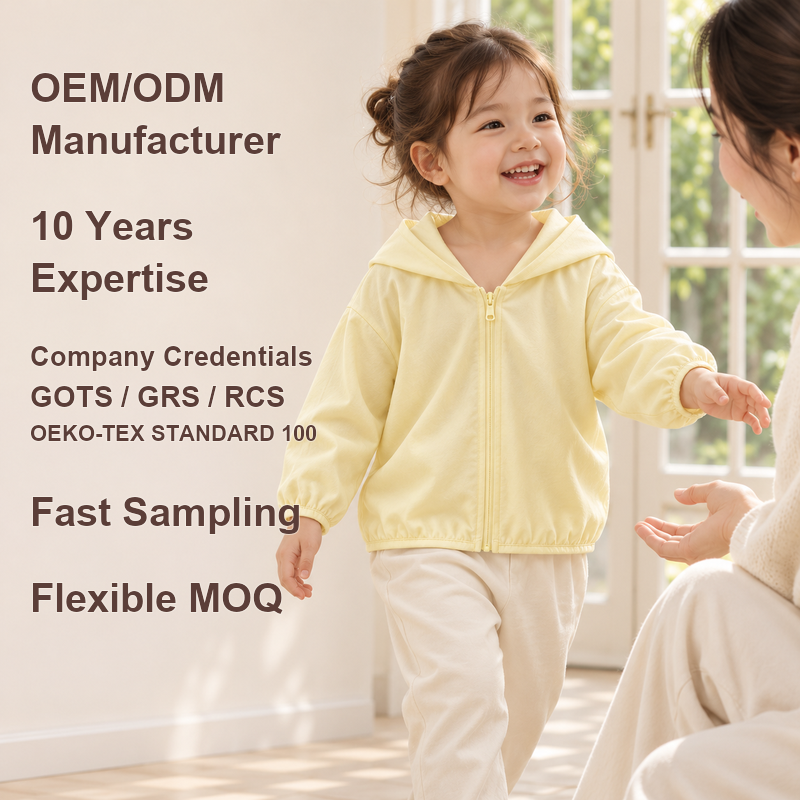
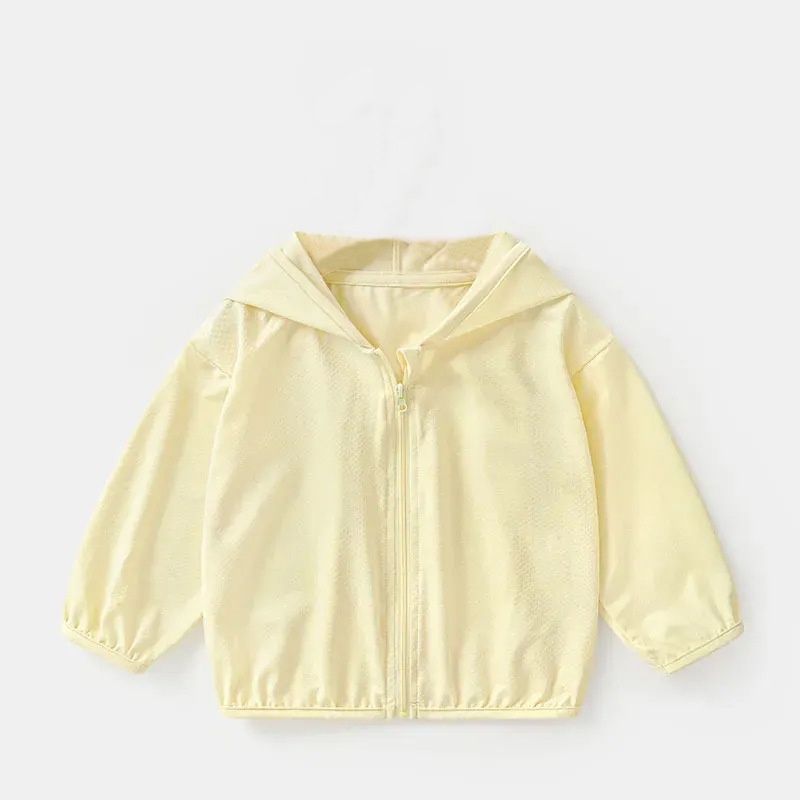
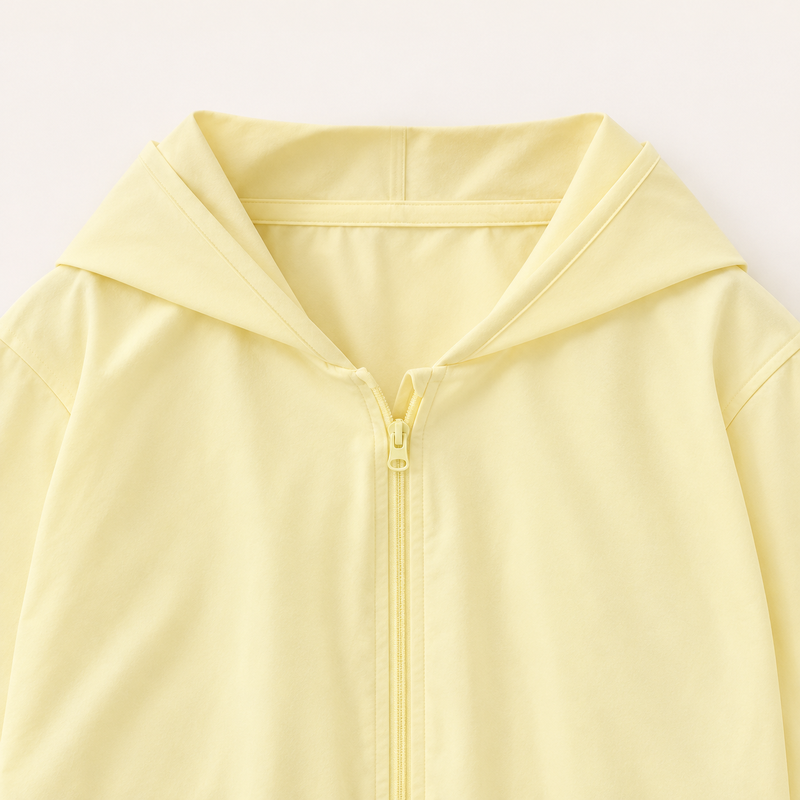
A hooded cover-up in a lightweight 100% recycled polyester shell: a full-length zip running to the top of the collar, elasticated cuffs and hem, an unlined body and a hood finished without a drawcord. Pale butter yellow.
A sun jacket is judged on one number and four openings. The number is the UV rating, and it is a property of the cloth as tested rather than of the fibre name. The four openings — hood, front, cuff, hem — are where protection is actually lost, and each one is closed by a different part of the pattern.
At a glance

1. Fibre: recycled polyester as a sun shell
- rPET is the same polymer from a different feedstock. In a lightweight shell that shows up as dimensional stability, low water absorbency, quick drying and enough abrasion resistance for cuffs and hem that rub all day.
- Polyester suits sun because it does not degrade under it. Polyester resists the UV-driven breakdown that eventually weakens cotton: the shell keeps its strength and its colour through a season of outdoor wear, which is the whole service life of this garment.
- The percentage is a chain-of-custody claim. Two schemes carry it — GRS, covering recycled content with processing controls and chemical limits, and RCS, covering the recycled content alone. Both run on transaction certificates, so the claim holds only while the certificate names the seller, the article and the percentage, and the feedstock source is declared rather than assumed.
- Recycled feedstock does not change how the polymer handles UV. Transmission is set by weave tightness, weight, colour depth and any UV absorber in the finishing bath. A recycled shell and a virgin shell at the same weight test alike; the difference sits upstream, in the certificate file.
- It does not absorb sweat. Polyester moves moisture along the fibre and dries, so comfort depends on airflow through the cloth and out of the openings — the fit and the venting do the work, not the fibre.
2. UV performance: four things set the number
- Tightness first. Porosity of the weave is the dominant variable: the same polymer at the same weight can test at very different ratings depending on how tightly the yarns sit.
- Weight second. A heavier cloth of the same construction blocks more; this is why a sun shell is specified by weight as well as by style.
- Colour third. Depth of shade changes transmission — a pale butter yellow at a given weight lets more through than a dark shade at the same weight. The test is therefore run on the production shade, never on greige.
- Finish fourth. A UV absorber in the finishing bath can lift a rating well above what the construction alone would give, and that finish is also the part most affected by washing.
- Stretch and wetness pull the number down. A shell tested flat is not the shell as worn: fabric drawn taut across the shoulder or the elbow opens its pores, and a soaked garment transmits more. That is why sleeves and shoulders are cut with ease rather than fitted tight, and why the rating is stated against the tested condition.
- Ratings are capped at the top. The main markets print 50+ as the highest claim, so a laboratory figure above that is reported in the file rather than printed on the label.
- Vents are openings. Where a mesh panel or eyelet is added, it is quoted as a vent zone; the rating applies to the solid shell.
3. Coverage: the four openings, and the one that decides
- The neck is the gap that matters. The zip runs to the top of the collar so the throat is covered when closed; on a jacket that stops at the collarbone, the neck is exposed no matter what the fabric tests at.
- The hood protects by staying up. With no drawcord, the hood holds by its cut — depth and opening size — not by a cord, so the pattern is what keeps it over the head rather than behind it.
- The cuff closes the wrist gap, which is why sleeve length is judged with the arms raised, not hanging: a sleeve that reaches the wrist at rest leaves the wrist bare at full reach.
- The hem keeps the back covered. Elastic at the hem stops the jacket riding up when a child bends or crouches, which is when the lower back is exposed.
- The shoulder is where the cloth works hardest. Fabric over the shoulder blades and elbows is stretched in use, and that is exactly where a flat test under-reports; seam placement and ease are set so the shell is never drawn taut across those two areas.
- Ease is a protective dimension, not a fit preference. A cover-up is worn over other clothes, so the block is cut with room for a t-shirt underneath; a tight shell both restricts movement and pulls the weave open.
4. Construction: what holds the openings shut
- Zip. A nylon zip runs full length to the collar top, with a chin guard so the slider cannot sit against the throat, and top and bottom stops that are checked on every garment. The puller is treated as a small part and tested as one.
- No drawcord at the hood. Cord rules for children's clothing restrict hood and neck cords, and this style is built without one: nothing at the neck can catch on play equipment. The hood is adjusted by shape, not by hardware.
- Elastic is specified by width and recovery, not by "elastic". Cuff and hem elastic is set on the tech pack, stitched into a casing, and its recovery is checked after laundering — an elastic that relaxes turns a closed cuff into an open one.
- Seams are finished for bare skin. The body is unlined, so seam allowances are bound or flat-felled; a raw overlocked seam on an unlined shell is what a child feels at the shoulder, and it is the first thing to fail under load.
- Ventilation is a per-order decision. As shown, the shell vents through the weave and through the open front. Where a market needs more, we add underarm eyelets or a mesh back yoke, and either is quoted as an option.
- Needle control. 100% needle detection on finished pieces, one-for-one exchange at every break with the machine stopped, work within 2.5 m re-screened twice, needle-free area enclosed, 2 m deep, single entry.
5. Colour: pale butter yellow
- Pale yellow is the least forgiving pale shade. It shows a lot change, a shift toward green or grey, and any unevenness in the dyebath before any other colour would — so approval is taken on bulk-dyed cloth rather than on a lab dip alone.
- Three substrates have to match, not two. Shell, zip tape and elastic take disperse dye differently: the tape is a different polyester, the elastic is an elastane blend, and pale yellow is where a mismatch reads first. The three are approved as a set under two light sources.
- Light fastness is the criterion here. This garment's entire life is UV exposure, so the dye is chosen for light fastness over shade brilliance; a yellow that fades toward grey has failed the only test that matters on a sun jacket.
- Pale shades are also where the finish shows. A UV absorber or a softener that is unevenly applied reads as a patch on a pale ground, so finishing is checked on the flat panels, not on a folded sample.
- Thread is matched to the shell's approved standard, not selected from a card.
6. Size: 2A–8A, and sizing by reach
- The range steps across two chemical classes. The 2A size is for a child under 36 months and is assessed as Class I; 4A and above is Class II. The certificate set is issued to cover both, or the range is split into two orders with two limit sets.
- A cover-up is sized by reach, not by chest. The chest is cut with ease over a t-shirt, and the sleeve is measured with the arm raised, because the sleeve has to still cover the wrist at full extension.
- Body length is set against the trouser waistband, so the lower back stays covered when the child bends or sits.
- The hood opening grades with the head, not with the body: a hood sized for 2A will not sit on an 8A head, and an 8A hood will not stay up on a 2A one.
- The sample is fitted at both ends of the range, where sleeve reach, hem coverage and hood depth are judged together rather than one at a time.
7. Customization, sampling and what we need to quote
- Hood. Fixed hood as shown; a higher collar in place of a hood; a fold-away hood.
- Closure. Nylon zip to the collar top as shown; a half-zip anorak; a press-stud placket for the smallest size.
- Venting. Solid shell as shown; underarm eyelets; a mesh back yoke.
- Cuff and hem. Elastic as shown; a bound cuff; a straight hem with a side split.
- Lining. Unlined as shown; a mesh body lining; a full lining for a padded version.
- Colour. Pale butter yellow as shown; further shades lab-dipped on shell, tape and elastic as a set.
- UV route. Quoted as a tested sun jacket, or as a plain windbreaker where the market does not support the claim.
- Packing. Polybag with size sticker; hanger; woven or printed label, satin care label, hangtag.
- Sampling. 3–7 days from a confirmed tech pack, with the shell fitted over a t-shirt at both ends of the range; UV testing is booked separately and its lead time is added to the schedule.
- Bulk lead time. 30–60 days from approval by quantity and dye lot schedule; rush production is quoted per order.
MOQ: 300 pcs for a custom development — custom fabric, colour, hood or fit; 50 pcs for a decorative process added to a stock body; 100 pcs for stock fabric with your own logo and label. Mixed colour and size orders are quoted per order. These are standing programme terms, confirmed against the current quotation.
Production runs with our production partner, Suzhou Shelmin Trade Co., Ltd.: 7,200 m² workshop, 8 lines, 200 staff, 6,000 pieces per day. Design confidentiality is held under NDA; buyer patterns and colourways are not re-used.
To quote, we need: target market and the UV standard it requires; the UPF level you intend to print; shell weight and weave; whether the range is split at 36 months for chemical class; hood depth you want; zip type and puller; elastic width and recovery; whether venting is added; packaging; and whether certification runs in your brand name.