EN

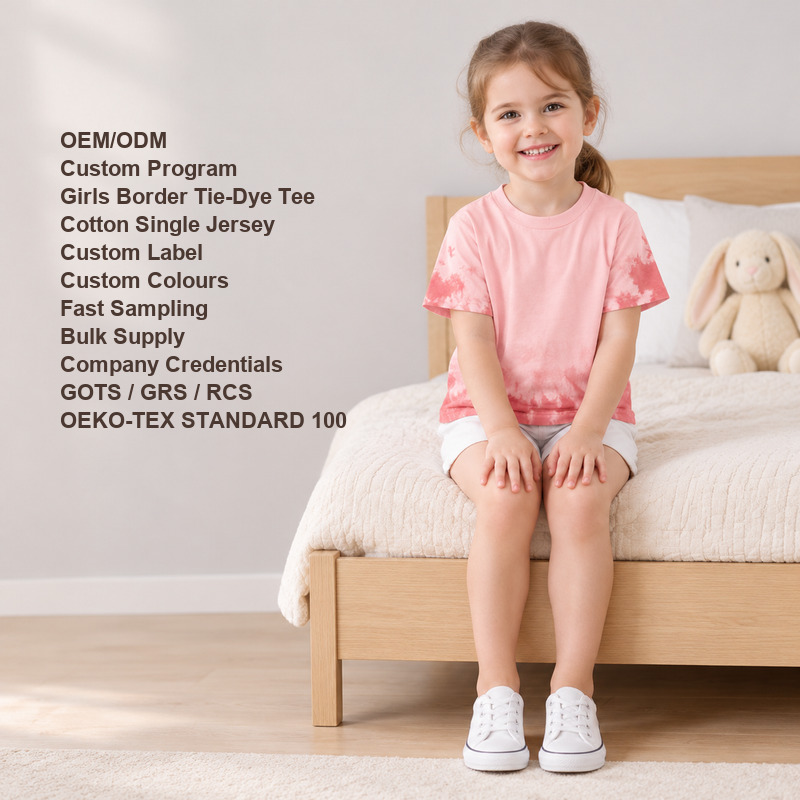
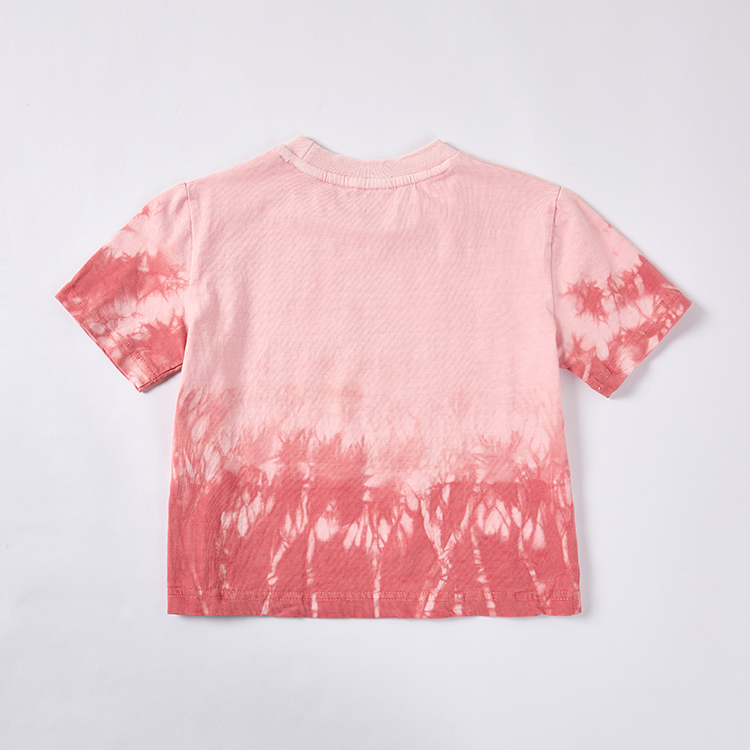
OEM/ODM Baby Pink T-Shirt | 100% Organic Cotton Plant-Dyed Toddler Tee | Eco-Friendly Non-Toxic Botanical Dye Dip-Dyed Infant Short Sleeve Top for Private Label | Sustainable Breathable Kids Apparel Wholesale


- Overview
- Custom Plant-Dyed Cotton Pink Baby T-Shirt
- Recommended Products
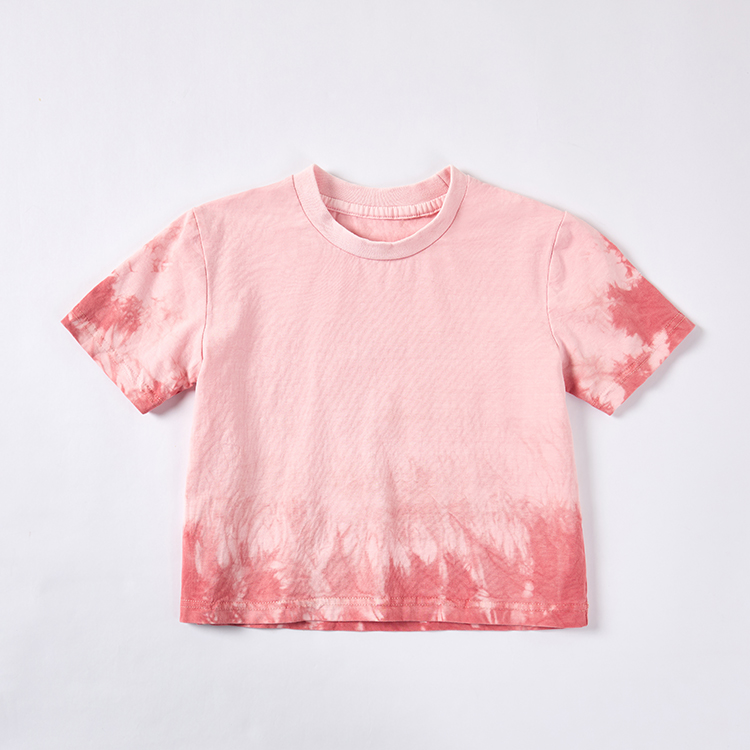
A boxy short-sleeve tee in a cotton single jersey, plant dyed with sappanwood (苏木) and madder (茜草), no added mordant: a rib neckband, a pale coral body, and deep coral arriving at three places — both sleeve hems and the body hem — not as a band with a straight edge but as a front that has climbed into the cloth in flame-shaped fingers.
That shape is the whole subject of this page. The deep zone on this tee is not a level that was set at a height; it is a front that travelled through the cloth, and where it stopped is a record of how the cloth was bunched, how long it stood and which way the knit let the liquor run.
At a glance

1. The deep zone is a front, not a level
- A dipped garment has a level line, where a liquid surface cuts the cloth, and it is straight or gently curved depending on how the cloth hangs.
- This tee has fingers instead, which means the liquor moved through the cloth by wicking and stopped where the cloth ran out of liquor or ran out of time.
- So the deep zone is not specified as a height, because there is no height to specify: what is specified is how far the front reached and what shape it left.
- The height is written as a range per opening, measured from the hem edge up to the tip of the fingers and to the base of the front, and both numbers matter, since the tips are what the eye reads and the base is what the eye measures against.
- The front is also not reversible, because wicking carries colour in one direction and a garment re-entered in the bath moves the front further rather than restoring it; that is why the range is approved at the sample and treated as one-way afterwards.
2. Three openings, three fronts, and they will not agree
- The tee has three openings at the bottom of the garment, two sleeve hems and one body hem, and each one grew its own front.
- They are not the same front: a sleeve holds a small circumference and bunches tightly, a body hem holds a wide one and bunches loosely, and the same liquor and the same time give a deeper front on the sleeve.
- So the three edges are compared before anything else, because a hierarchy of depth between sleeve and body is visible across the chest and reads as an error rather than as a design.
- Two routes exist, and the difference is cost: accept the hierarchy and write it down as the intended reading, or handle the sleeves and the body for the times each needs so the three fronts land together.
- Writing it down is the cheaper answer and the more honest one, because a hierarchy that is documented is a design decision, while the same hierarchy undocumented is the first thing a buyer queries on the sample.
- The three fronts are measured separately on the same garment, with the numbers written per opening, so a drift on the sleeve can be told from a drift on the body.
3. Why the front makes fingers
- A knit wicks faster along its wales than across them, so the liquor climbs vertically faster than it spreads sideways, and that is what turns a straight front into vertical fingers.
- The fingers are also where the cloth was bunched: a fold holds a reservoir of liquor against the cloth, so the front runs further under a crease and stops short between creases.
- That makes the finger pattern a record of bunching, not a pattern to be drawn; it is specified as a character rather than a copy — fingers pointing up, narrowing toward the tip, no finger reaching the chest, and no finger running sideways.
- The deepest plume in the sample is the reference, because the eye reads the extreme rather than the average, and a garment approved on its average front reads as blotchy when the extreme is what is seen.
- The paler streaks inside the deep zone are the same story in reverse, places where the cloth was pressed flat against itself and no liquor stood; they are read as part of the front rather than as missing colour.
4. The sleeve is the smallest panel, so it sets the depth
- The sleeve is the shortest panel on the tee, so a front of a given depth takes a larger share of it, and the smallest size is where that shows: at 3Y the sleeve is mostly deep.
- So the sleeve depth is approved first and the body hem is set to sit in the same visual proportion of its own panel, rather than both being given one number in centimetres.
- The sleeve also grows the least across the range, so a depth fixed in centimetres goes gradually from a large share of the sleeve to a moderate one, and the tee changes character between 3Y and 8Y.
- The hem allowance is part of the depth, because the turnback is folded and sewn before dyeing and the fold holds liquor: the very edge reads deepest, and the front sits above a hem that is already deep.
- The stitch line at the hem is a physical brake, since it compresses the cloth under the needle; the front is read either side of it and the line itself is not used as the datum.
5. The neck rib is the deepest thing nobody dyed on purpose
- The neckband is a rib, with more yarn per unit area than the jersey around it, so in the same bath it takes a step deeper.
- That is a structural result rather than a decision, and it means the neckband is the one deep element on the tee that was not placed by the process.
- It is read as a frame rather than a fault, because a rib neck one step deeper than the body is what a dyed tee looks like; a rib neck two or three steps deeper reads as a different garment.
- So the rib is specified with the body: the same bath, the same sequence, and the resulting step is measured and recorded rather than corrected.
- The neckband is also where the tee is checked for recovery, since rib that has been through a hot bath is the first place a neckline loses its shape; it is measured after the bath and after five washes.
6. Class II, and where the deepest point is tested
- Class II applies: 3Y, 5Y and 8Y are for children over 36 months and the scope for this cloth, colourway and rib is confirmed against the certificate at quotation; perspiration runs to ISO 105-E04, pH is measured on the garment and held between 4.0 and 7.5, and extractable heavy metals are tested on the finished garment.
- pH and fastness are read at the deepest point, not on the average, because the front is where the dyestuff is concentrated and where an unrinsed garment shows first.
- Crock is read across a front edge, at the place where the fingers meet the pale ground, since that is the only boundary on this garment that is both deep and thin.
- The rib neckband is tested as part of the garment, and it is declared with its own construction because a rib is not the same cloth as the body even where it is the same fibre.
- There is no cord, no drawstring, no fastener and no hardware anywhere on the tee, and the openings are plain hems.
7. Sizes, sampling and quoting
- Three sizes graded on measurements: 3Y, 5Y and 8Y move on chest, body length, sleeve length, neck opening, the depth of the front at each of the three openings, and the hem allowance at body and sleeve.
- Customization. Front depth at the sleeve and at the body, as a share of each panel; whether a hierarchy between the three openings is accepted and documented or corrected; finger length limit measured from the hem edge; the character of the pale streaks inside the deep zone; rib depth at the neck; hem allowance; and the option of a straight level front instead of a wicking front, which is a different process and a separate quotation, each sealed on its own reference set.
- Sampling: 3-7 days from a confirmed tech pack, covering a wicking strike-off with its reference pair, a made-up tee showing all three fronts measured separately, a read of the deepest plume against the finger limit, the rib step measured against the body, a wash-and-remeasure of all three fronts and of the neckline recovery, crock across a front edge, pH at the deepest point, and light on the deep and the pale zones separately.
- Bulk: 30-60 days from approval, planned per wicking run and per bath, with the garments bunched to a written method so that the bunching that produces the fingers is repeatable rather than incidental; AQL 2.5 major and 1.0 critical.
- MOQ: 300 pcs for a custom development covering cloth, shade, front or fit; 50 pcs for a decorative process on a stock body; 100 pcs for stock cloth with your own logo and label. Mixed colour and size orders are quoted per order.
Production runs with our production partner, Suzhou Shelmin Trade Co., Ltd.: founded 2017, 7,200 m² workshop, 8 lines, 200 staff, 6,000 pieces per day. Design confidentiality is held under NDA; buyer patterns, shades and prints are not re-used.
To quote, we need: target market and the Class II tests it requires; the front depth you want at the sleeve and at the body, as a share of each panel; whether the hierarchy between the three openings is accepted or to be corrected; the finger length limit; the neck rib and its depth; hem allowances; lot certificates for both plants; the pH target and the dyehouse water specification; packing method; and whether certification is to run in your brand name.