EN

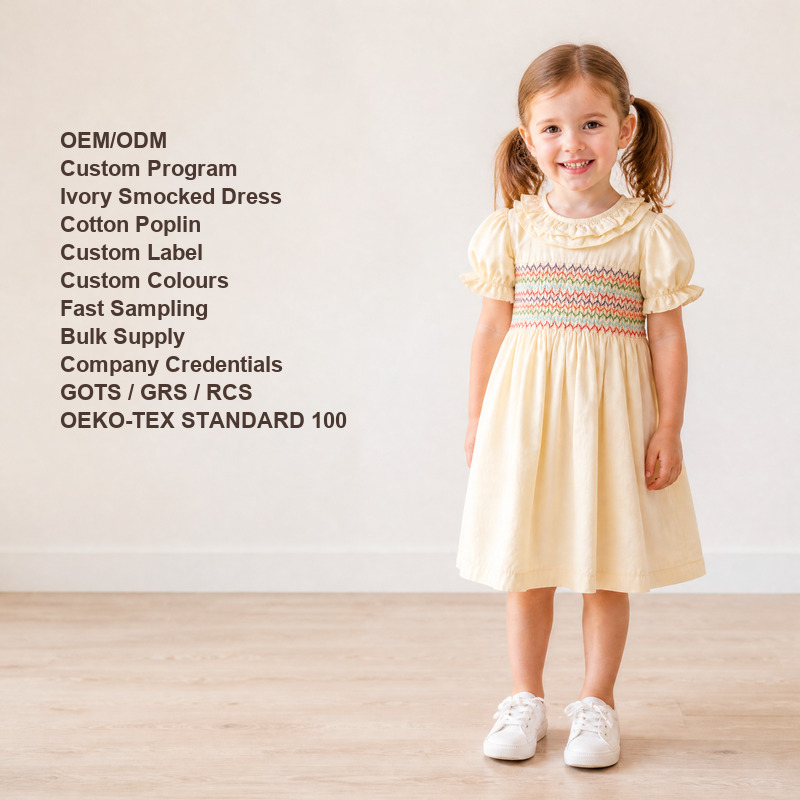
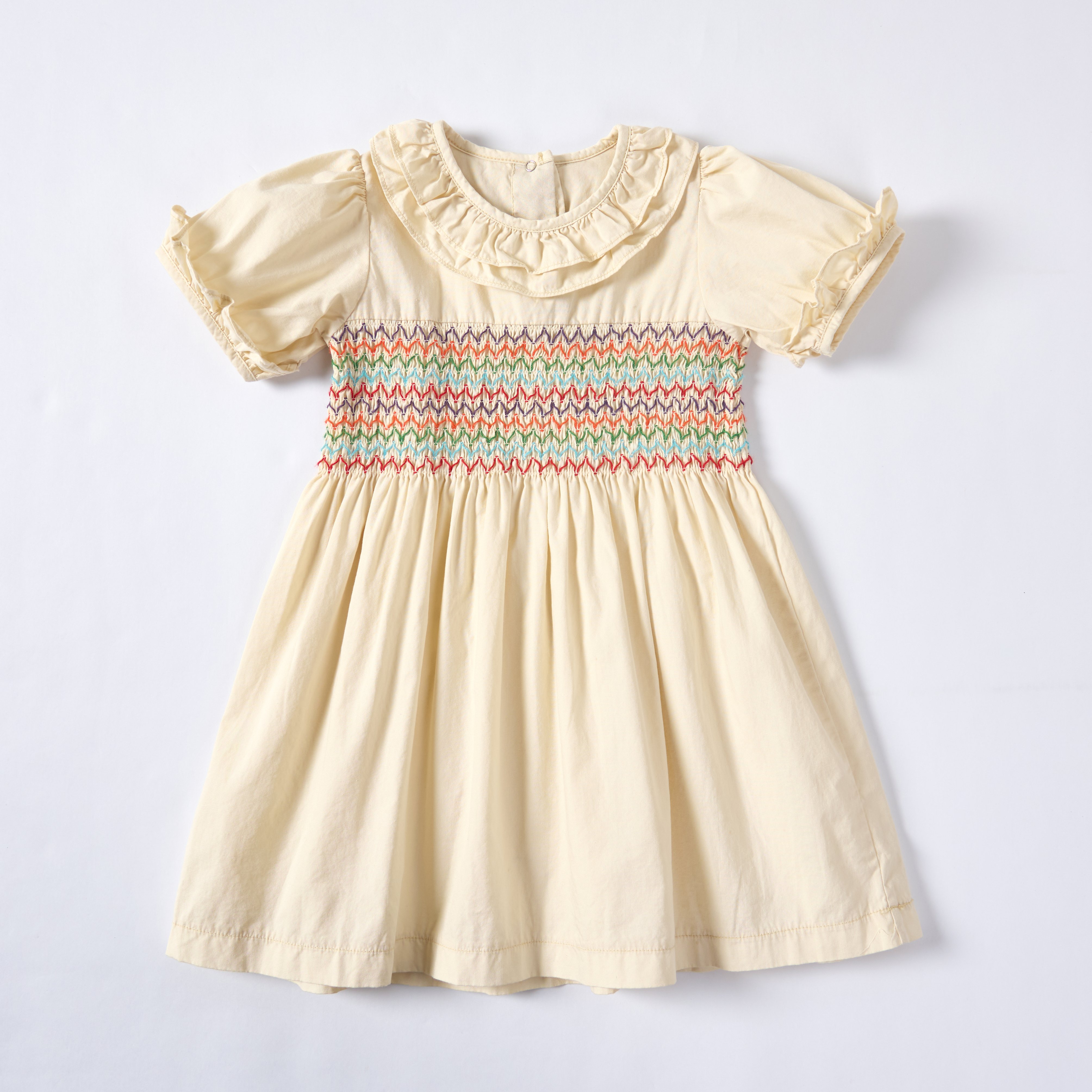
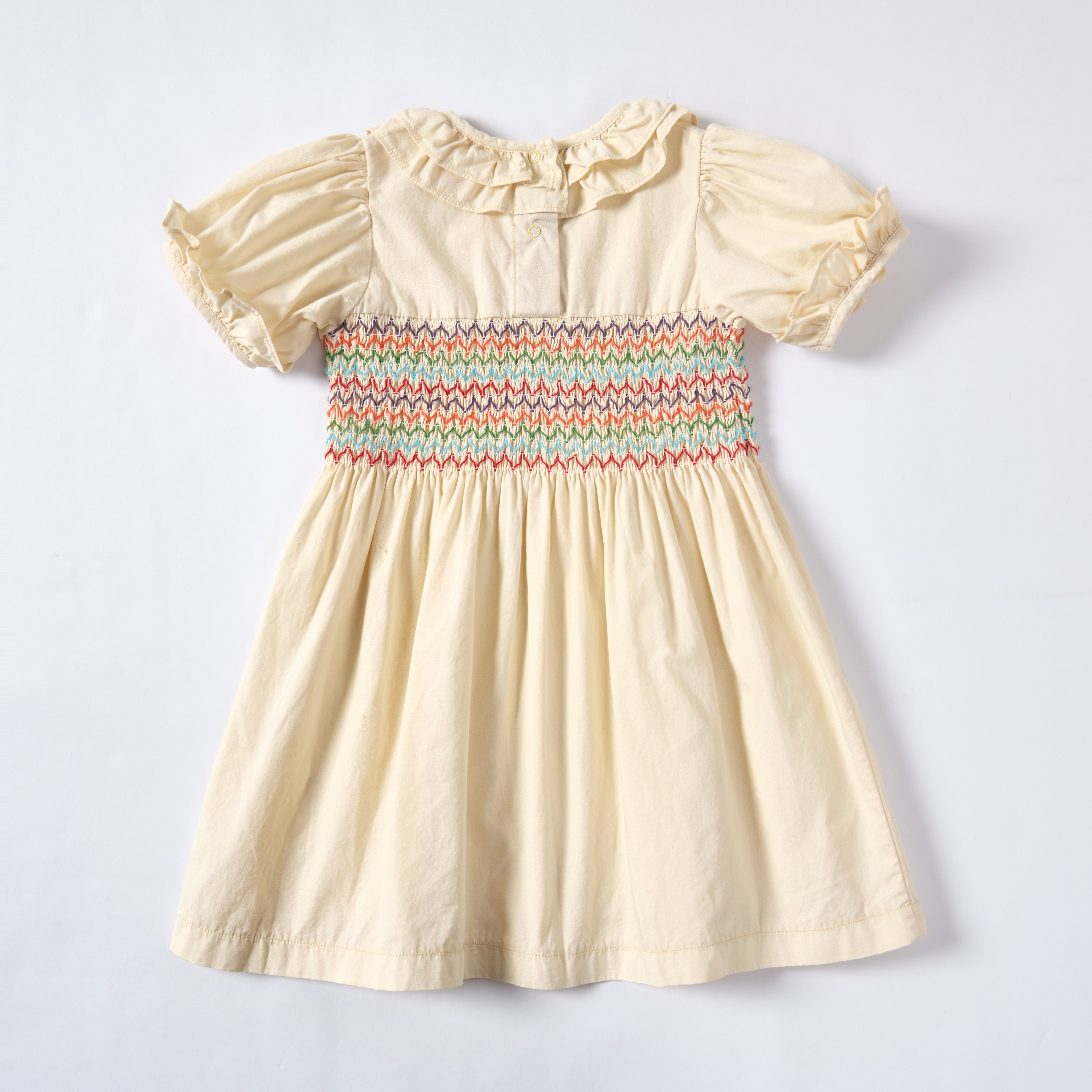
Light Yellow Sappanwood Madder Pomegranate Peel Dyed Short-Sleeved Embroidered Smock Dress


- Overview
- OEM/ODM Smocked Plant-Dyed Cotton Girl Dress
- Recommended Products
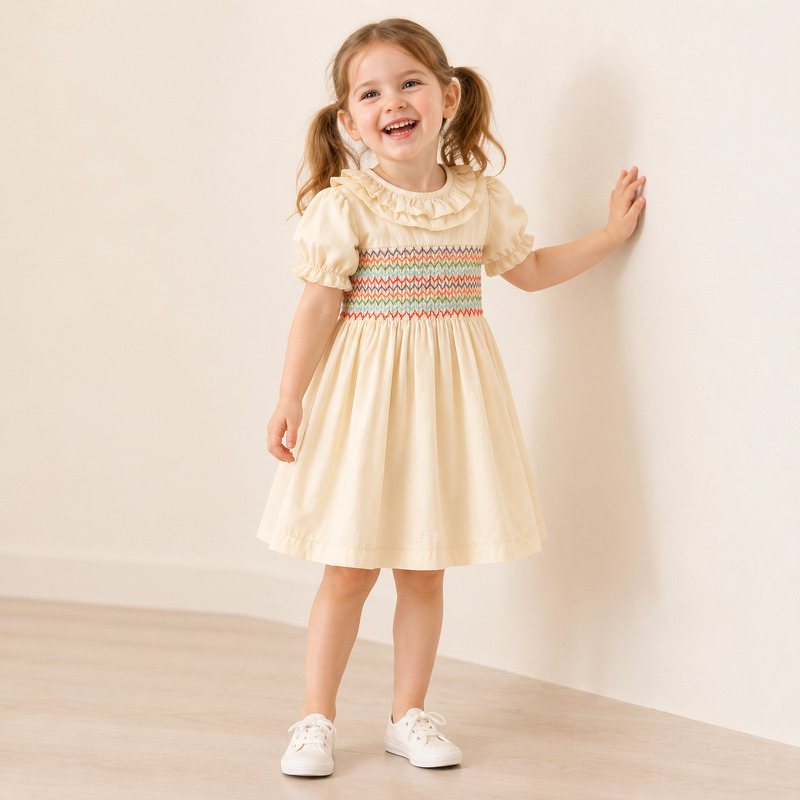
A short-sleeve smocked dress in 125 gsm cotton poplin, plant dyed to a pale straw with sappanwood (苏木), madder (茜草) and pomegranate rind (石榴皮): a ruffle collar, puff sleeves gathered into a ruffle cuff, a smocked bodice worked in rows of wave stitch, a short back placket with one button, and a gathered skirt hung from the smocked panel.
This page is about the pale end of the range, because pale is a different problem from deep. At low depth there is little dye to hide behind: mottling, an iron spot, a puckered seam or a row that drifts all read as faults, and the shade has to stay on the cream side of yellow through washing and storage. What follows is how that window is held.
At a glance
1. Pale is a narrow window, and it narrows further at the edges
- The rind sets the depth; the two reds set the temperature. At this lightness the pomegranate rind carries the body of the colour, madder supplies the warmth and sappanwood keeps it from going flat. Held back, the shade is cream; pushed 10% further it reads as a light tan — the working margin is small on both sides.
- A pale bath has less buffering of its own. Less tannin on the fibre means less of a cushion against a pH drift across the lot, so pH is logged per bath rather than per order, and a mid-lot correction triggers a re-read of the bath before more cloth goes in.
- Evenness fails visibly at low depth, not at high. A variation that would pass unnoticed on a mid-tan shows as a faint cloud on cream, so bath circulation, cloth-to-liquor ratio and the way the roll is turned are specified, and mottling is judged on a dried panel, never wet.
- Iron is the enemy of pale goods. A rust trace from a pipe run or a condensate drip off a steam line lands as a grey-blue spot that no re-rinse removes, so the dyehouse works to its own iron-free route for pale shades and the cloth is inspected for spotting under D65 with a light behind it.
- The rinse ends on a dry swatch. Residual tannin or soap reads as a yellow shift after a few weeks in a bag, and wet cloth always looks darker than it will dry, so the rinse endpoint is judged on a sample dried and compared to the sealed standard.
2. The smocked band reads deeper than the skirt
- Pleats hold shadow. The band compresses two and a half to three times its flat width into a narrow strip, and the light that falls into the pleats does not come back out, so the same dyed cloth reads a shade deeper as a band than it does hanging as a skirt.
- So the colour is approved on a made-up panel. The panel and the skirt are judged side by side on the same garment, and the depth is set so the band and the skirt read as one colour rather than two bands of one.
- Band depth comes from the row count and the pitch, not from the panel's height. Rows and spacing are fixed in the tech pack, and because the ground is pale, a row that drifts by a fraction of a millimetre shows as a light step across the panel.
- The panel has to stay rectangular. Rows that run down or gathering that varies across the width pull it into a trapezoid, and the skirt hangs off-centre; width is checked at three points per panel.
- The panel-to-skirt join carries the skirt. That seam sits under continuous tension, so it is specified with a reinforcing stitch and checked for puckering, which on a pale ground is a visible dark line rather than a suggestion.
3. Fit lives in the plain bodice above the band
- The band's position on the body is a measurement. Its upper edge sits at a fixed distance below the armhole per size, so the smocking lands on the torso rather than riding up under the arms; this is one of the dimensions that does not scale by percentage.
- The plain area above the band is where a fit error shows first. Long by a centimetre and the collar bunches at the neck; short and the band sits too high to stretch comfortably. It is checked against the measurement chart on the smallest and largest size.
- The collar ruffle adds weight to a narrow neckline. Two tiers on a curved seam pull the neckline back, so the neckline is stabilised and the upper tier cut narrower; a collar that gapes at the centre front is a weight problem before it is a sewing problem.
- The sleeve is gathered at the head and finished with a narrow ruffle cuff. Sleeve head gather is distributed against the armhole in two passes so the cap stays flat, and cuff band width — including whether the band carries elastic — is fixed in the tech pack because it changes finished sleeve length.
- One button, and it is tested as a small part. 70 N retention, checked against 16 CFR 1501 for the US market, on a placket faced so no raw edge sits against the neck.
4. On a pale ground, edges read as shadow
- The eye reads pale cloth by its shadows. A puckered seam, a needle mark, a hem that pulls or a gather that clumps all appear as shading long before they appear as a colour fault, which makes the making the visible part of a pale garment.
- Seams run at 12-14 stitches per inch and are pressed open and graded at the neckline and placket, because a pale poplin shows a ridge through the face side where a darker cloth would not.
- Ruffle hems are narrow and unforgiving. A narrow turned hem at 125 gsm shows its stitching if tension drifts, so hem width and needle size are fixed per ruffle and checked as a collar-and-cuff pair on the same garment.
- Needle discipline is a colour issue here. A blunt needle leaves a mark that does not wash out on cream cloth, so needles are changed at a set interval and one-for-one at every break with the machine stopped, and the smocked panel — dense stitching over many rows — is the heaviest user of needles in the garment.
- Pressing is specified with the packing. A fold pressed in during packing stays visible on pale poplin, so the press plan and the pack method are written together and the folded sample is checked after twenty-four hours in its bag.
5. What carries the colour is the thread
- The ground is plant dyed; the smocking is not. Five saturated tones across the bodice come from conventional dyed threads. On a pale ground those threads carry most of the visual weight of the garment, which makes the palette a design decision and not a detail.
- Thread sits against skin across the whole bodice, so it is specified and tested as a component to the same restricted-substance limits as the cloth, with a supplier declaration held per lot.
- Palette is approved on the smocked sample. A pale ground makes a red read warmer and a green read cooler than either does on a card, so the five tones are signed off on the worked panel, and thread count per row is fixed because a heavier thread covers more of the plant-dyed ground.
- A fully plant-dyed version is possible and narrower. It means sourcing plant-dyed thread, testing it and accepting one or two muted tones instead of five, quoted as a separate development rather than assumed as an option.
- Labels and fusible are declared separately from the 100% cotton shell in the fibre content and on the care label, per the destination market's rule.
6. What decides whether a pale colour is accepted
- Light is the first test, and the least forgiving at low depth. With little dye present, the relative change from fading is larger, so light fastness runs to ISO 105-B02 at the shipped depth — not at a deeper lab depth — and the expected shift is recorded before the shade is approved.
- Phenol yellowing is the second. Pale plant-dyed shades are the ones that turn in storage, so the check runs to ISO 105-X18 on a specimen carrying the actual packing fold, and packaging is specified free of BHT.
- Wash and rub are run on the made-up dress, not on a swatch: ISO 105-C06 with the smocked panel in the load, ISO 105-X12 in both directions across the smocked area, and a comparison of washed against unwashed panel for halo on the ground.
- Skin-contact tests run in the same pass: perspiration and saliva to ISO 105-E04 plus the destination market's saliva method, with pH measured on the garment and held in the 4.0-7.5 range that suits infant wear.
- A result is only accepted against the sealed standard, because "cream" and "slightly yellower cream" are both within a lab tolerance and only one of them is the approved colour.
7. Sizes, sampling and quoting
- Five sizes, graded on body measurements. 6-9M, 9-12M, 12-18M, 24M and 36M move on measured chest, length, head size and the band's drop below the armhole, and the smocked panel is re-set per size because stretch does not grade like a seam.
- Customization. Single or double ruffle collar; plain neckline; smocking row count and stitch; thread palette from one to five tones; puff sleeve, plain short sleeve or sleeveless; one or two buttons; gathered, pleated or plain skirt.
- Depth options within this recipe. A paler cream with less rind; the pale straw shown; a warmer biscuit with more madder and a touch more sappanwood. Each is sampled at its own depth and approved against its own sealed standard.
- Sampling: 3-7 days from a confirmed tech pack, covering a dyed strike-off, one smocked panel in the agreed palette judged against its skirt, a stretch-and-recovery check before and after five washes, crock, bleed and halo on the smocked area, a button pull test, and a fit check on the smallest and largest size.
- Bulk: 30-60 days from approval, planned per dyebath and per thread lot, with cloth released only after shrinkage, pH, mottling and fastness results are in hand.
- MOQ: 300 pcs for a custom development covering cloth, shade, smocking, trim or fit; 50 pcs for a decorative process on a stock body; 100 pcs for stock cloth with your own logo and label. Mixed colour and size orders are quoted per order, and terms are confirmed against the current quotation.
Production runs with our production partner, Suzhou Shelmin Trade Co., Ltd.: founded 2017, 7,200 m² workshop, 8 lines, 200 staff, 6,000 pieces per day. Design confidentiality is held under NDA; buyer patterns, shades and prints are not re-used.
To quote, we need: target market and the Class I tests it requires; the depth target and whether the sealed standard travels with the order; the thread palette and count; smocking row count and stitch; lot certificates for the three plants and for the thread; the pH target and the water and iron specification of the dyehouse; the packing method; and whether certification is to run in your brand name.