EN

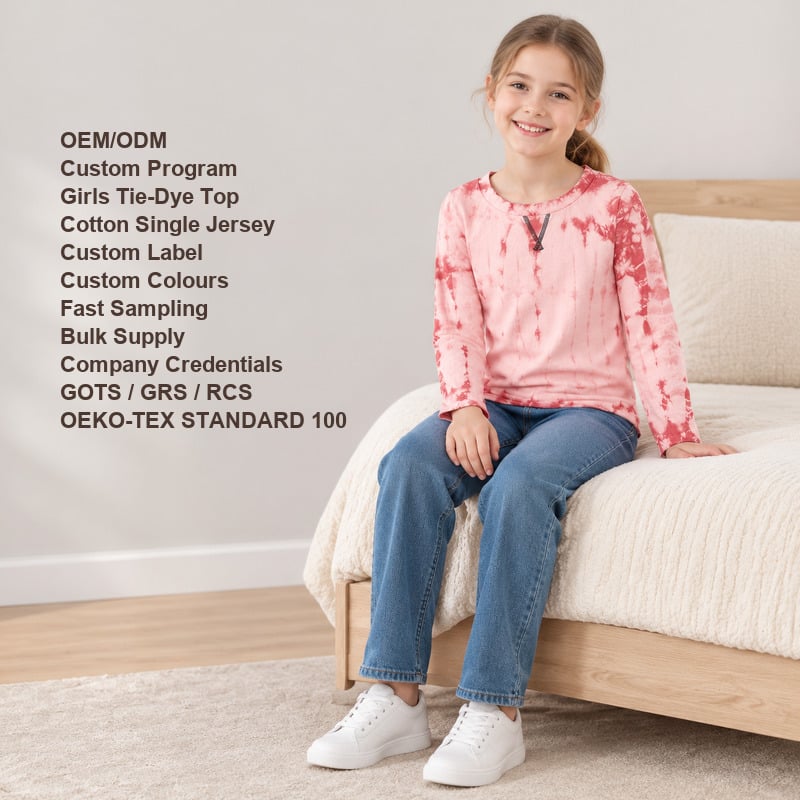
OEM/ODM 100% Cotton Girls Long Sleeve T-Shirt Natural Plant Botanical Dyed Tie Dye Kids Crewneck Tops with V-Stitch Detail Custom Wholesale Private Label


- Overview
- OEM Custom 100% Cotton Plant Dyed Girls Long Sleeve Tee
- Recommended Products
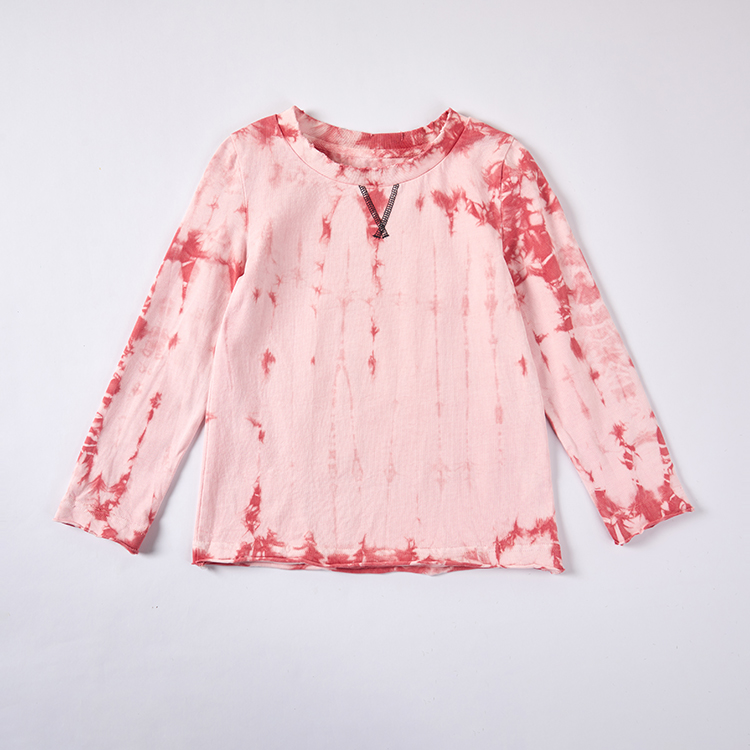
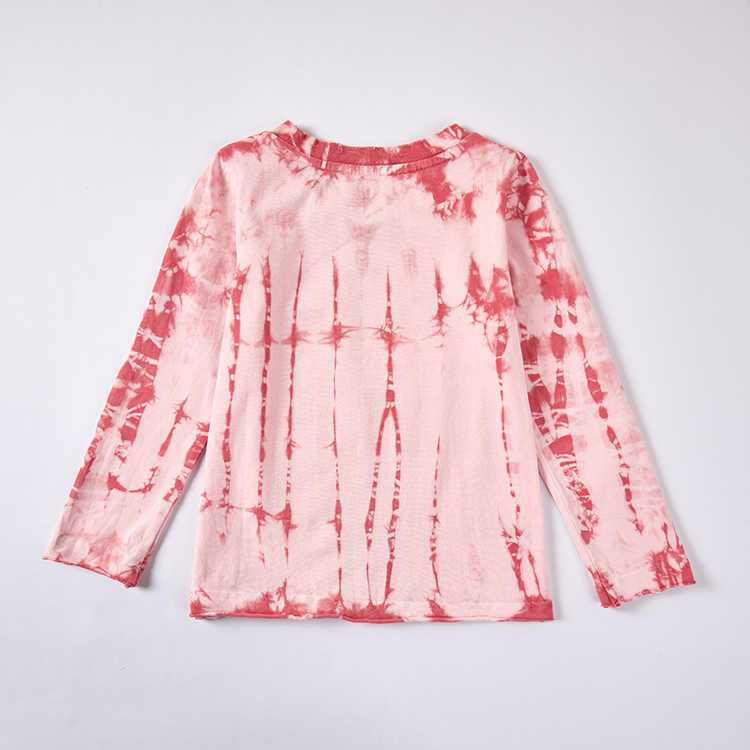
A long-sleeve top in a light cotton voile with a crinkle finish, pole-wrapped and plant dyed to a coral streak with sappanwood (苏木) and madder (茜草), no added mordant: a round neckline on a narrow band, long set-in sleeves, a narrow hem at the cuff and at the body, and a narrow scalloped braid set in a V at the centre front.
There is no solid panel anywhere on this garment. Every square centimetre carries the streak, so there is nothing on the piece to calibrate an eye against, and the pattern has to be approved as a direction and a range rather than as a look. That, together with a neckline which is the only way into a top with no closure, is what the rest of this page is about.
At a glance

1. An all-over resist has no neutral zone
- On a garment with solid panels, the solid is the control and the resist is read against it. Here the whole surface is patterned, so depth, direction and edge behaviour are each judged on their own.
- Direction comes first. The cloth is wrapped on a pole and bound before it goes into the bath, so the colour runs in the direction of the wrap, and on the body that reads as a vertical streak.
- Depth and interval come next: the deepest streak sets how strong the garment reads, and the distance between streaks sets how fast it reads. Short intervals look like a woven stripe from two metres away; long ones look like a stain.
- Edge quality comes last: a streak that fades out is the process working, while a streak that stops on a dead-straight line is a fold that held too much liquor.
- So approval is a pair of garments, not a photograph — the strongest acceptable and the palest acceptable, with the scale marked on both — because an all-over pattern approved from one image has been approved from one flattering angle.
2. The streak direction is a cutting decision
- Body panels are cut along the wrap and sleeves are not, so the streak runs down the body and drifts diagonally down the sleeve. That drift is the signature of a pole resist; a sleeve that runs dead straight has been cut on the same axis as the body and the garment reads flat.
- So the sleeve angle is set on the pattern, in degrees from the body axis, and sampled. Left to the cutting table, one sleeve comes out drifting forward and its pair drifts back.
- Side seams break the streak and are not matched. Matching a streak across a side seam on an all-over resist produces a mirror, and a mirror reads as a print. What is controlled is that the break does not become a hard vertical line down the whole seam.
- Streak scale is a consumption item. Cutting along the wrap fixes how many garments come out of a length of patterned cloth, so a finer scale at 8Y is a different layout and a different price from a larger one at 3Y.
- Scale is sealed per size band, because on a small body the streak count is what the eye reads first, and a pair sealed at 3Y does not carry the 8Y panel.
3. The neckline is the only way in
- There is no closure on this top, so the neck opening has to pass a head. That dimension, measured on the closed garment, is the first fit constraint on the pattern and is set per size from head circumference plus clearance rather than scaled from the chest.
- A narrow band is what keeps the opening usable, because every millimetre of band eats into the opening. The band is cut on the cross grain so it presses into the curve, set at a fixed width, and topstitched.
- The band is cut from the deepest end of the lot. It is a narrow piece that gathers nothing, so a pale band on a streaked body reads as a mistake at exactly the place the eye lands.
- The braid is the one fixed point on a moving surface. It is set on the centre line, its two legs cut to the same length, and its position checked against the neckline rather than against the streak.
- Its ends are the handling risk, since the braid is scalloped and narrow: they are turned under and secured, and checked for fray at the sample and again after washing.
4. Crinkle and resist act on each other
- The cloth is crinkled before it is dyed, so the surface that goes into the bath is not flat: liquor pools in the valleys and runs off the ridges, and the streak follows the crinkle instead of sitting on top of it.
- Pressing flattens both. Where a seam is pressed open the crinkle goes out of it, and the streak reads calmer and slightly paler along that line — the same optics as a bound edge, on a moving ground. It is written into the sample comments rather than treated as a defect.
- The hem is where the crinkle is judged, since a narrow hem on crinkled cloth wants to wave. It is set at a fixed depth with the cloth relaxed, and the edge is checked for a level line on the hanger and again after washing.
- Crinkle recovery is a measured property: it is checked before and after the wash sequence, because a crinkle that flattens in the first wash changes the hand and the way the streak reads at the same time.
- Crinkled cloth is cut after it rests, or the panel grows in length between cutting and sewing and the streak scale moves with it.
5. Pale ground, no mordant: where washing shows first
- The pale areas are not white; they are the same coral at low take-up, so a wash result is read as a pair, the deep streak and the pale ground, rather than as one shade.
- A shade built without a metal salt is the one to watch under light, and this garment is mostly pale, so the exposed area is large. Light is run to ISO 105-B02 and the pair is read together, since the contrast can close before the shade itself moves.
- Washing runs on the made-up top at the temperature that goes on the care label, with the shoulder seam and the braid in the load, and the pale ground is checked against its own unwashed counterpart.
- Rubbing covers the outside face, the inside face and the shoulder seam, because that seam is where two patterned surfaces are pressed together and where a strap sits.
- Phenol yellowing to ISO 105-X18 runs on a specimen carrying the packing fold, with packaging specified free of BHT, since a pale coral holding tannin is one of the shades that moves in the box.
6. Class II, and the one part that is not plant dyed
- 3Y, 5Y and 8Y sit in Class II, not Class I: the article is for children over 36 months, so Class II is the scope that applies, and the Class II scope for this voile, colourway and trim is confirmed against the certificate at quotation.
- The braid is conventional dyed, so it is declared as a separate component and tested as a skin-contact trim to the same restricted-substance limits as the cloth, with a supplier declaration held per lot.
- It is also a small part on a child's garment: attachment is checked at 70 N, the ends are checked for fray, and the trim goes through the small-parts cylinder after washing rather than before.
- A pale plant-dyed neckline makes the braid's own fastness visible, because a braid that bleeds shows there first; bleed is read against the ground with the cloth masked off.
- Labels and fusible are declared separately from the 100% cotton shell in the fibre content and on the care label, per the destination market's rule.
7. Sizes, sampling and quoting
- Three sizes graded on measurements: 3Y, 5Y and 8Y move on chest, body length, sleeve length, neck opening and cuff depth. The neck opening is set from head circumference plus clearance, not by a percentage step.
- Customization. Sleeve length and cuff depth; band width, or a plain self-fabric neckline; braid, plain centre front or a woven label; streak direction, scale and contrast, each sealed on its own reference pair; hem depth.
- Sampling: 3-7 days from a confirmed tech pack, covering a pole-wrapped strike-off with its reference pair, a made-up top with band, braid and both hems finished as production, a head-entry check on the 3Y with the neckline closed, crinkle recovery before and after five washes, crock on both faces and across the shoulder seam, light on the deep and pale areas, and a braid pull.
- Skin-contact tests run with the same lot: perspiration to ISO 105-E04, pH measured on the garment and held between 4.0 and 7.5, and extractable heavy metals tested on the finished garment rather than on the greige.
- Bulk: 30-60 days from approval, planned per wrap and per dyebath with the cutting layout made per lot, since the layout follows the streak; AQL 2.5 major and 1.0 critical on the finished garment.
- MOQ: 300 pcs for a custom development covering cloth, shade, resist, trim or fit; 50 pcs for a decorative process on a stock body; 100 pcs for stock cloth with your own logo and label. Mixed colour and size orders are quoted per order.
Production runs with our production partner, Suzhou Shelmin Trade Co., Ltd.: founded 2017, 7,200 m² workshop, 8 lines, 200 staff, 6,000 pieces per day. Design confidentiality is held under NDA; buyer patterns, shades and prints are not re-used.
To quote, we need: target market and the Class II tests it requires; whether the ground is this crinkle voile or a jersey, since that changes both the neck entry and the streak direction; the streak angle on the sleeve in degrees from the body axis; scale and contrast per size; band width and braid specification, or a plain neckline; lot certificates for both plants and for the braid; the pH target and the dyehouse water specification; packing method; and whether certification is to run in your brand name.