EN

OEM/ODM 100% Cotton Ruffle Baby Girl Dress | Eco-Friendly Plant-Dyed Toddler Sun Dress | Custom Sustainable Botanical Sleeveless Kids Pinafore | Wholesale Premium Private Label Boutique Children Apparel


- Overview
- OEM/ODM Ruffle Sleeveless Plant-Dyed Cotton Dress
- Recommended Products
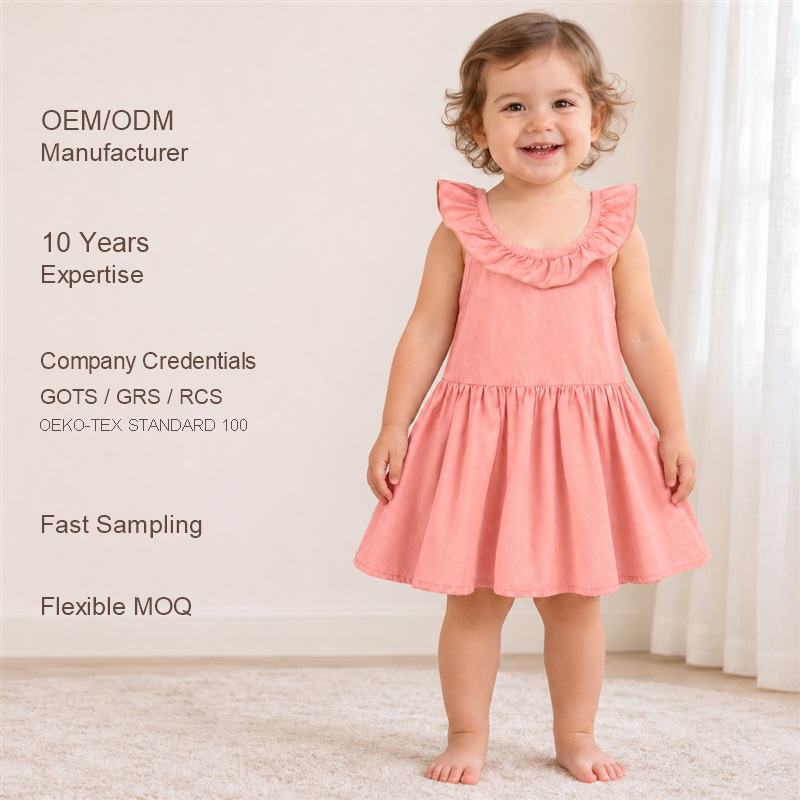
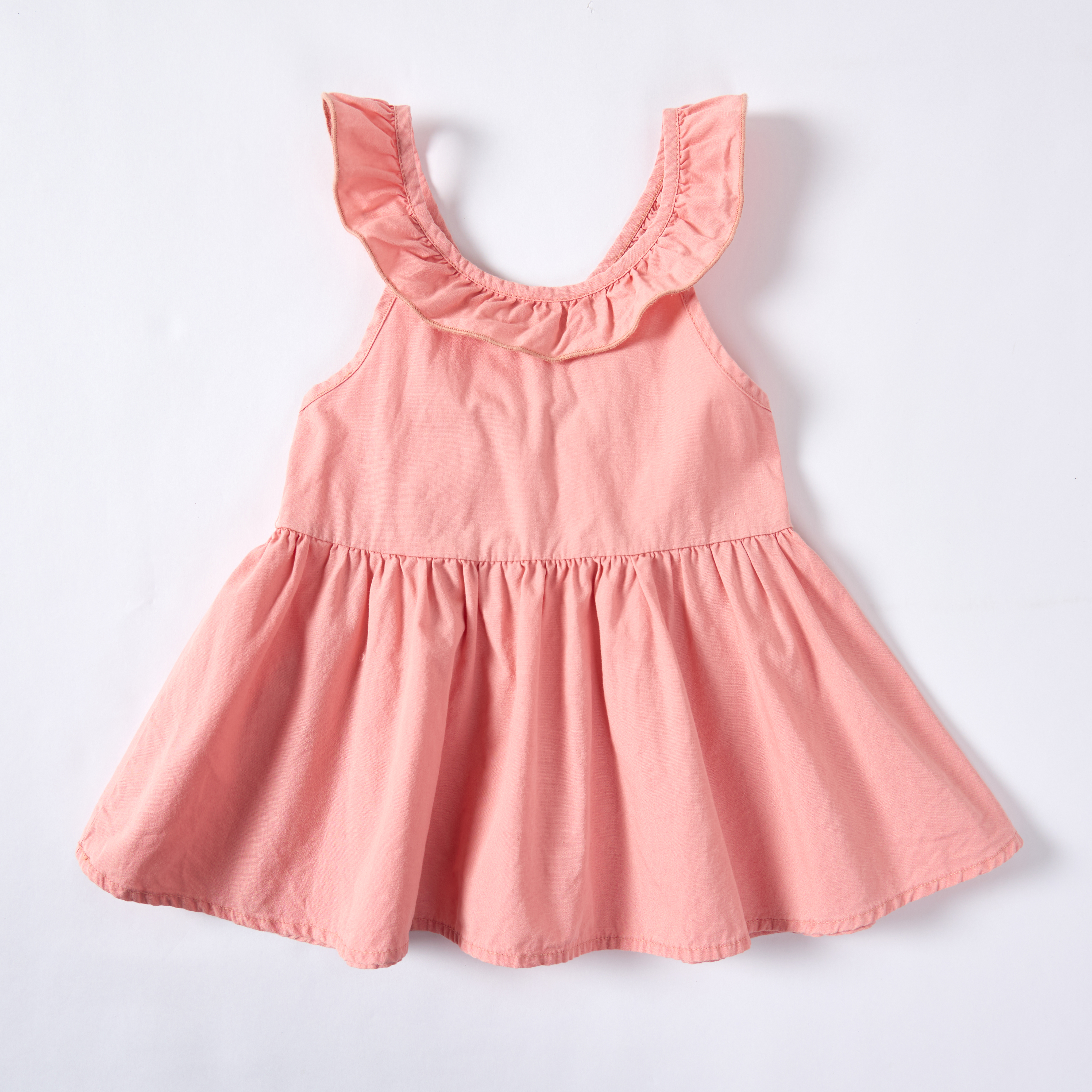
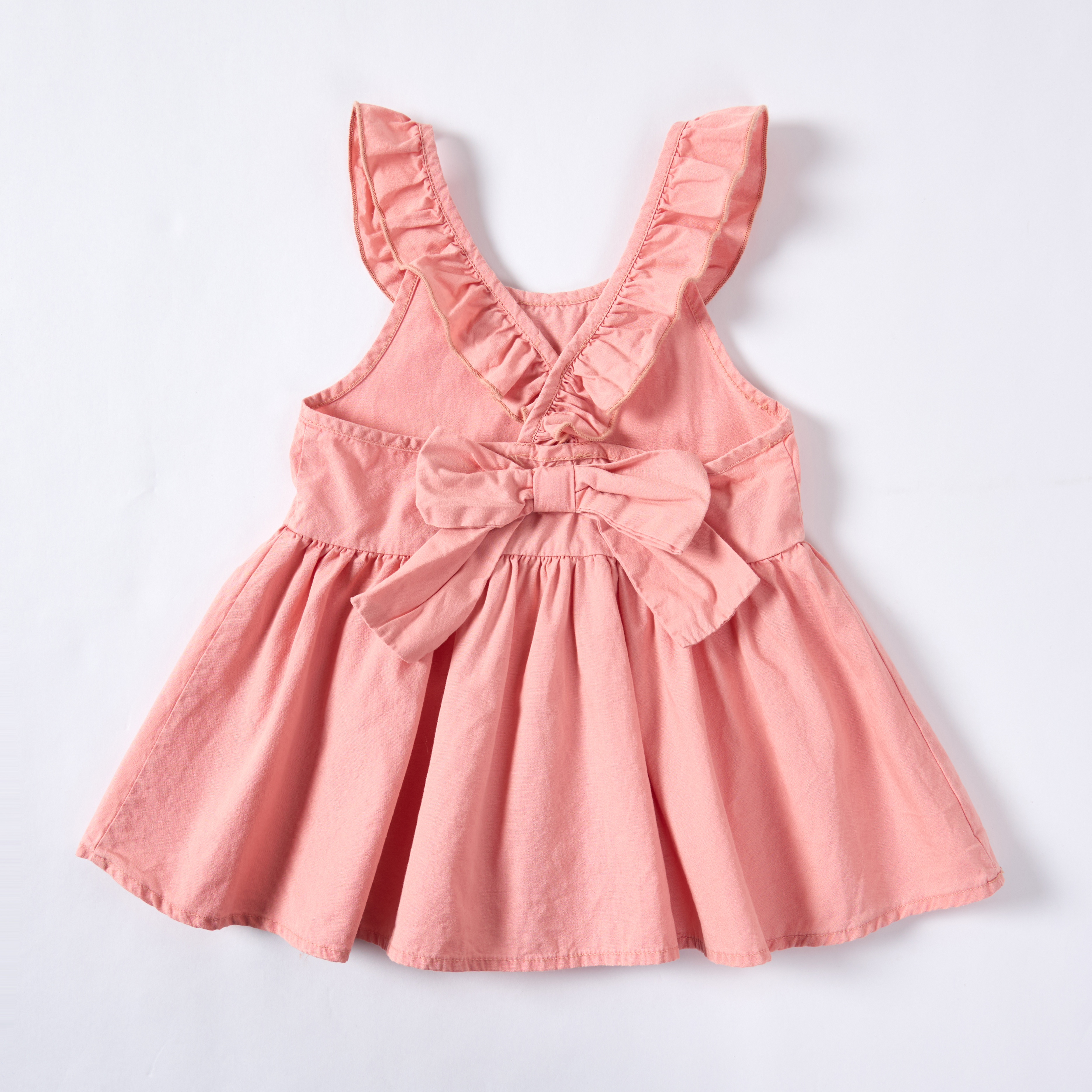
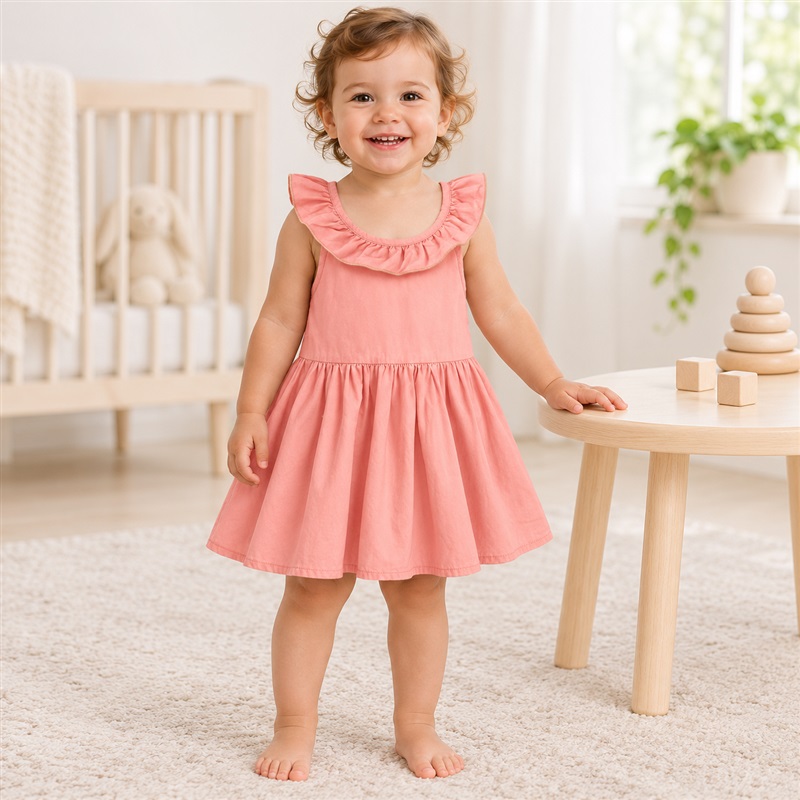
A sleeveless ruffle jumper dress in 125 gsm cotton poplin, plant dyed to a flat shell coral with sappanwood (苏木) and madder (茜草): a gathered ruffle following the neckline and armholes, a back that crosses and closes with one button, a stitched bow at the centre back waist, and a gathered A-line skirt from a waist seam.
This is the most demanding combination in the programme, and it is worth saying so plainly. There is no tannin layer and no metal salt, so the colour sits on the fibre by direct affinity. There is no pattern, so any difference between the four pieces of cloth is visible. And one of those pieces is a narrow bias strip that behaves differently in a dye bath from the panels beside it.
At a glance
1. The cloth: a flat colour carried by folds
- The gathers are the pattern. With a level shade and no print, the folds in the skirt and the ruffle are the only visual event on the garment, so gathering is distributed from marked quarters rather than by eye.
- A flat shade is judged across the dress. The eye compares bodice, skirt, ruffle and bow against each other, so a half-shade difference reads as a fault even where each piece alone would pass inspection.
- 125 gsm is what makes the folds read. Heavy enough to hold the bodice line without a lining, light enough that the skirt falls; a heavier poplin would gather into bulk and lose the fall that this shade depends on.
- A plain weave keeps the tone continuous. No pile and no twill line means there is no directional shading across a panel, so the only tonal variation is what the dye put there and what the folds create.
2. Two reds, no bridge: what holds the colour
- Cellulose has no ionic sites for these dyes, and in this recipe there is no tannin layer and no metal salt to act as a bridge, so the colour sits on the fibre by direct affinity.
- Preparation becomes the anchor. The cloth is scoured and fully wetted out before dyeing, because residual sizing, wax or a dry spot is exactly where colour fails to take — and on a flat mid-tone a miss shows as a pale patch, not as a soft variation.
- Depth is built in two draws. One concentrated bath on this chemistry deposits unevenly and rinses back; two lighter draws reach the same depth with a flatter result.
- The rinse is the second anchor. Unfixed dye comes off in the dyeworks rather than in the customer's first wash, so the cloth is rinsed until the water runs clear, and the wash test is run on the finished dress rather than on a swatch of the same bath.
- Fastness is a release item at the shipped depth: washing to ISO 105-C06 with a repeated-wash shade check, rubbing to ISO 105-X12, light to ISO 105-B02, perspiration and saliva to ISO 105-E04 and the destination market's saliva method.
3. The narrow strip behaves differently
- A bias strip wets through faster than a panel. It is narrow, it is handled more, and liquor exchanges at both edges, so the same bath can leave a ruffle slightly lighter than the bodice it will be sewn to.
- Its rolled hem exposes more cut edge. On a direct-dyed coral, cut edge is where colour releases first in washing, which is why a ruffle can look a shade pale after the first wash even when it matched on the table.
- The bow has the same issue in a different form. Folded and stitched through, it has more layers and more edges per gram than any other component, so it takes and releases dye at its own rate.
- The control is to dye the strip with the lot, not separately. Bias strips are cut before dyeing, bundled with the panels and dyed in the same bath, so they share the draw rather than being matched afterwards.
- Matching is then confirmed on the made-up sample, not on flat pieces. Because a ruffle reads differently once gathered and a bow reads differently once tied, the check is a sewn-up smallest size, viewed under D65 beside the bodice.
4. Four pieces, one lot: matching without a bridge
- Everything is cut from one dyed lot, and marker planning treats that as a hard rule. With a direct recipe there is no re-dye step to bring a stray component back into line, so the control has to be upstream.
- A second roll is a shade band, not a match. Where the order needs more cloth than one roll, the new roll is checked against the sealed sample before cutting, and components are not split across the boundary.
- Matching is checked at three points: greige before dyeing, dyed lot against the sealed sample under D65, and cut components side by side on the table before sewing.
- Thread and button follow the cloth. Trim is matched against the dyed poplin rather than a colour card, because on a flat coral a warm button reads as a different colour rather than as a variation.
- This is the style where the bridged route earns its cost. The same dress can be dyed with a pomegranate rind pre-treatment, which lifts wash fastness and gives the dyer a little more room on levelness; sampling both routes is the practical way to choose, and the quote says which is which.
5. Class I: what the article has to prove
- Class I is the class for articles under 36 months. 6-9M, 9-12M, 12-18M and 24M sit inside it by age; 36M is assessed as Class I because the article can be worn by a child under that age.
- The base fabric holds an OEKO-TEX Standard 100 certificate, and the Class I scope for this poplin, colourway and trim is confirmed against it at quotation, before any claim is published.
- Decoration adds file items, not just design items. Ruffle, bow, button and binding are listed as separate components, each with its own material and attachment test — the ruffle is a second layer against the skin, the bow is a part a baby can reach.
- Fastness is judged on the finished dress, including the ruffle and bow, since a narrow strip and a folded bow release colour at a different rate from a flat panel.
- Article items are checked on the finished dress: pH, formaldehyde and extractable heavy metals, with a nickel-release check where metal-touch trim is used.
- With no metal in the bath the dye file is short and the material file carries the weight: heartwood and root are agricultural, so heavy metals, pesticide residues and microbial load are screened at intake with a certificate of analysis per lot.
6. Ruffle, bow and the fit
- The ruffle is cut on the bias, because at 125 gsm a straight-cut ruffle stands stiffly away from the neck; bias gives the roll that falls, and the strip is graded down at the underarm where the curve is tightest.
- The rolled hem is the hardest seam in the garment and the first place a ruffle fails — waving or twisting — so hem width and press are fixed on the sample, not on the bulk.
- The ruffle goes on before the armhole binding is closed, so the gathered edge is enclosed rather than sitting on a finished edge, which keeps the inside clean against skin.
- The bow is stitched closed and tacked at four points to the waist seam. Tails are short and finished, and their length is measured and logged per size against the decorative cord and bow limits of EN 14682 rather than left to look right.
- It is an attachment rather than a closure, pull-tested as one at the same 70 N figure used for attached trim, with bow, stitching and waist seam as a single unit; the button is checked against 16 CFR 1501.
- The straps are still the fit, sitting on the shoulder blade and inboard of the armhole with a ruffle sewn in beside them, and the back opening is sized on head girth with that allowance placing the button.
- The waist is a seam, gathered and topstitched before the bow is tacked over it, and seams run at 12-14 stitches per inch with the ruffle seam and waist seam the two places checked on the finished piece.
7. Sizes, sampling and quoting
- Five sizes, graded from measurements. 6-9M, 9-12M, 12-18M, 24M and 36M move on body measurements rather than a percentage step, because head and chest grow on a different curve from the waist at this age.
- Back opening, strap position and ruffle length are re-set per size, since the head-girth allowance decides whether the dress goes on and the ruffle has to clear the underarm at every size.
- Customization. Ruffle at the neckline only, or neckline and armholes; ruffle width and gather ratio; crossover back or centre-back placket; bow, flat sash or no decoration; gathered, pleated or plain A-line skirt; lined bodice.
- Shade. Shell coral as shown; a rosier cast with more sappanwood; a warmer apricot-coral with more madder. Each is sampled and fastness-tested at its own depth.
- Sampling: 3-7 days from a confirmed tech pack, including a dyed strike-off, a sewn-up smallest size for component matching, the bow tail measurement, a first wash trial on the finished dress, and pull tests on button and bow.
- Bulk: 30-60 days from approval, planned per dyebath; a split delivery is quoted as two batches because the bath is the unit of shade control.
- MOQ: 300 pcs for a custom development — cloth, shade, trim or fit; 50 pcs for a decorative process on a stock body; 100 pcs for stock cloth with your own logo and label. Mixed colour and size orders are quoted per order, and terms are confirmed against the current quotation.
Production runs with our production partner, Suzhou Shelmin Trade Co., Ltd.: founded 2017, 7,200 m² workshop, 8 lines, 200 staff, 6,000 pieces per day. Design confidentiality is held under NDA; buyer patterns, shades and prints are not re-used.
To quote, we need: target market and the Class I tests it requires, including the retailer's own wash-fastness requirement; whether the bridged route is preferred for this style; the shade tolerance you will accept across the four components; lot certificates for the sappanwood and madder; the pH targets; the water specification; button material; packaging; and whether certification runs in your brand name.