EN

OEM/ODM 100% Cotton Ruffle Baby Girl Dress | Eco-Friendly Plant-Dyed Toddler Sun Dress | Custom Sustainable Botanical Sleeveless Kids Pinafore | Wholesale Premium Private Label Boutique Children Apparel


- Overview
- OEM/ODM Tank Sleeveless Plant-Dyed Cotton Dress
- Recommended Products
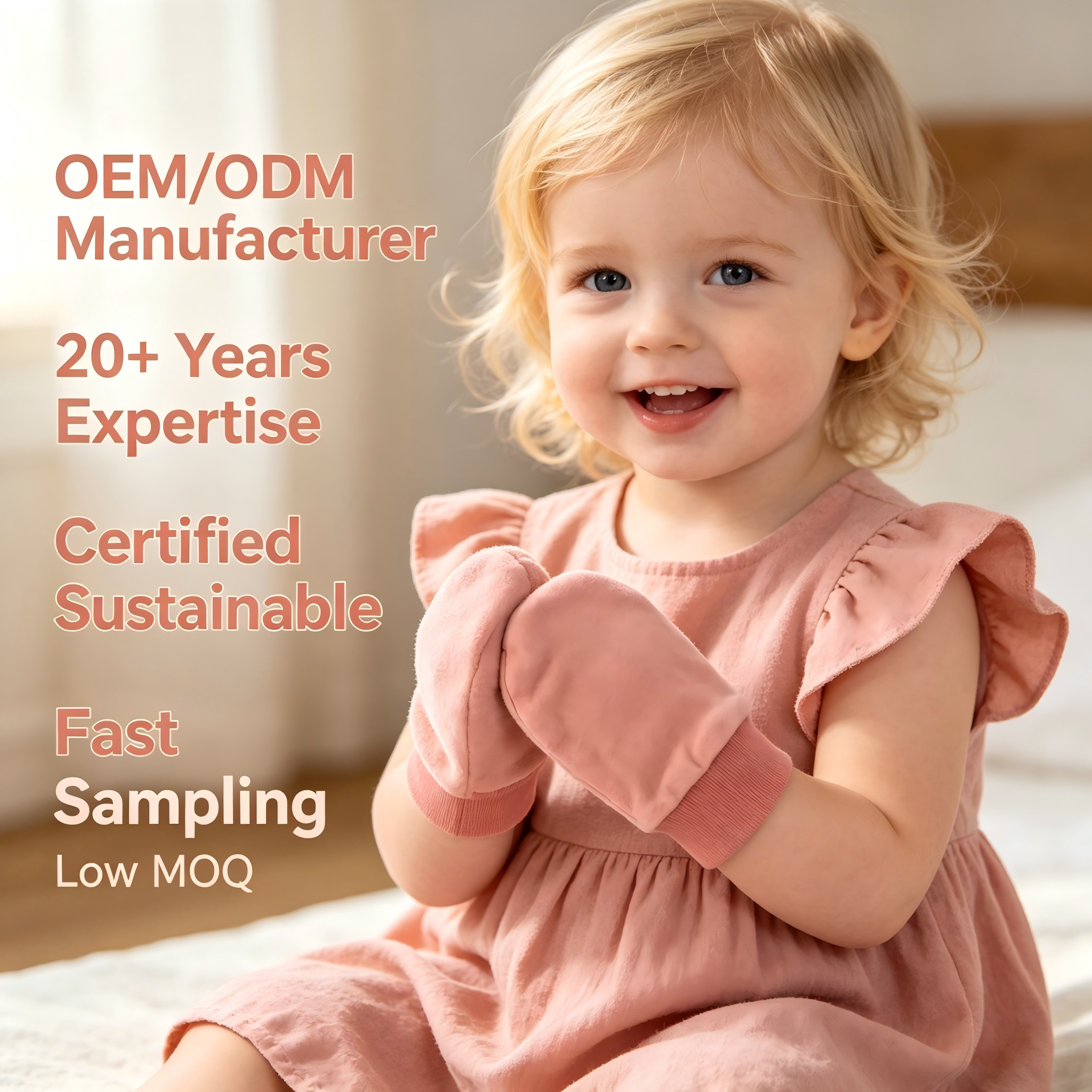
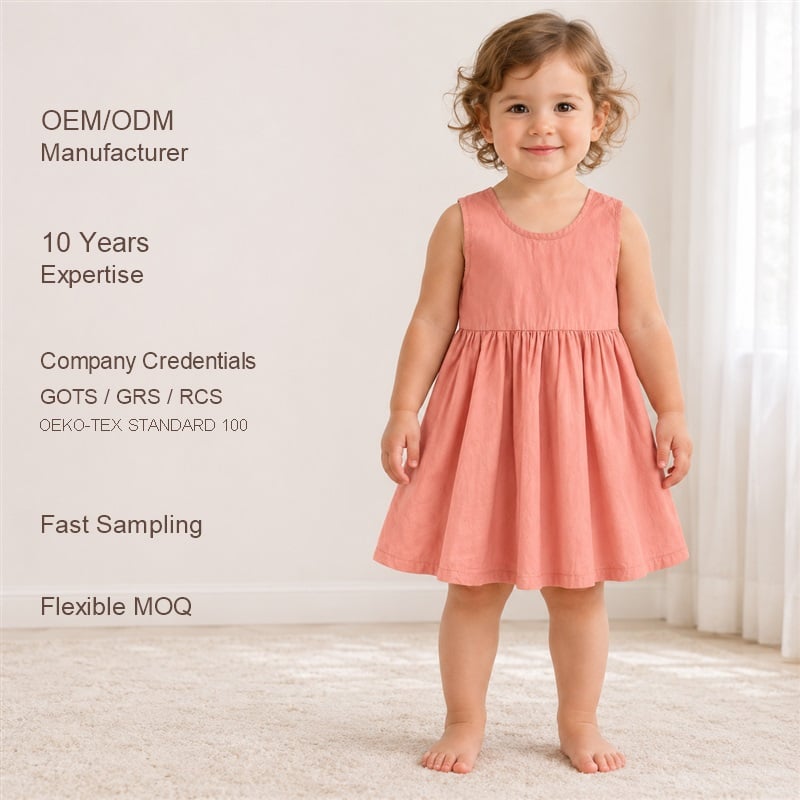
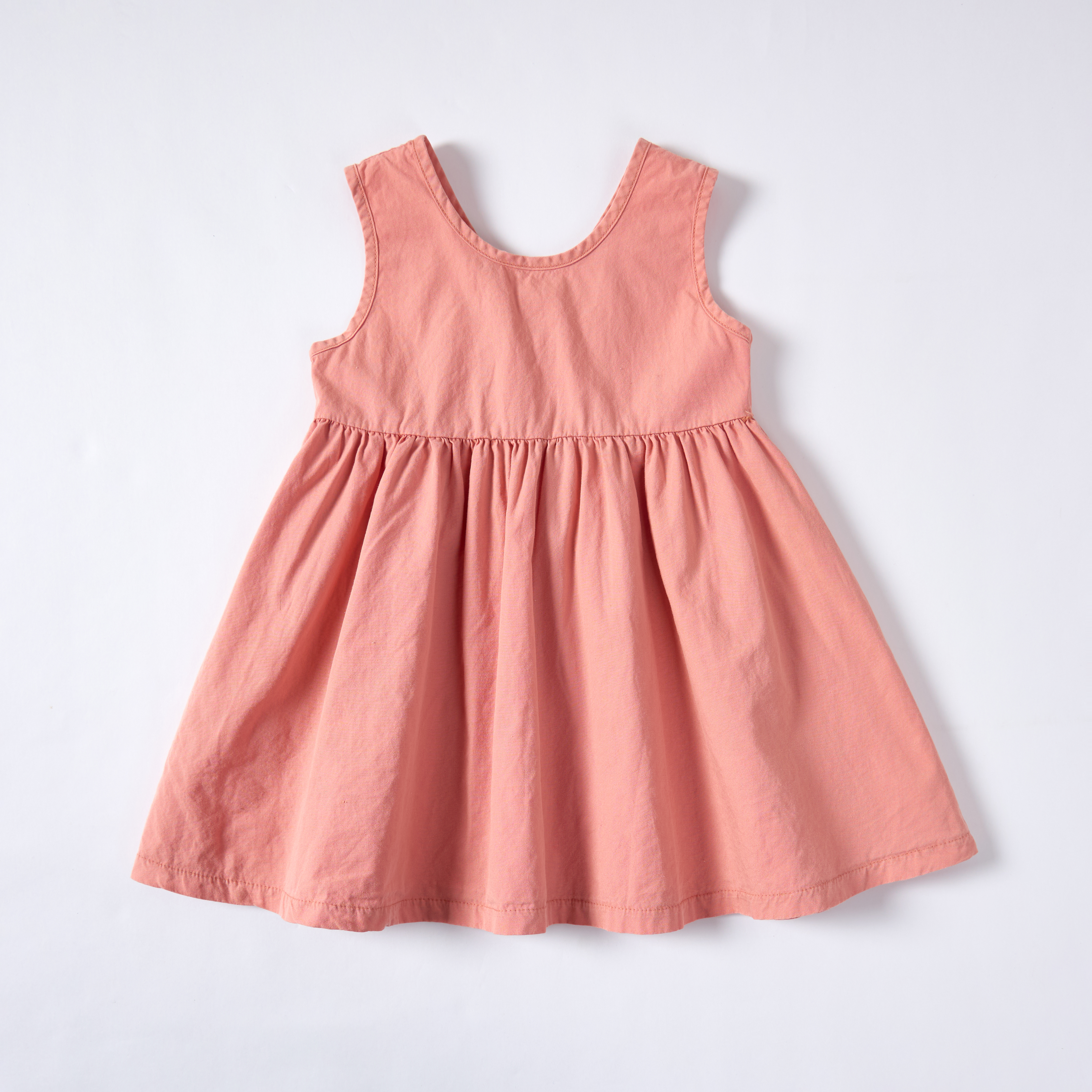
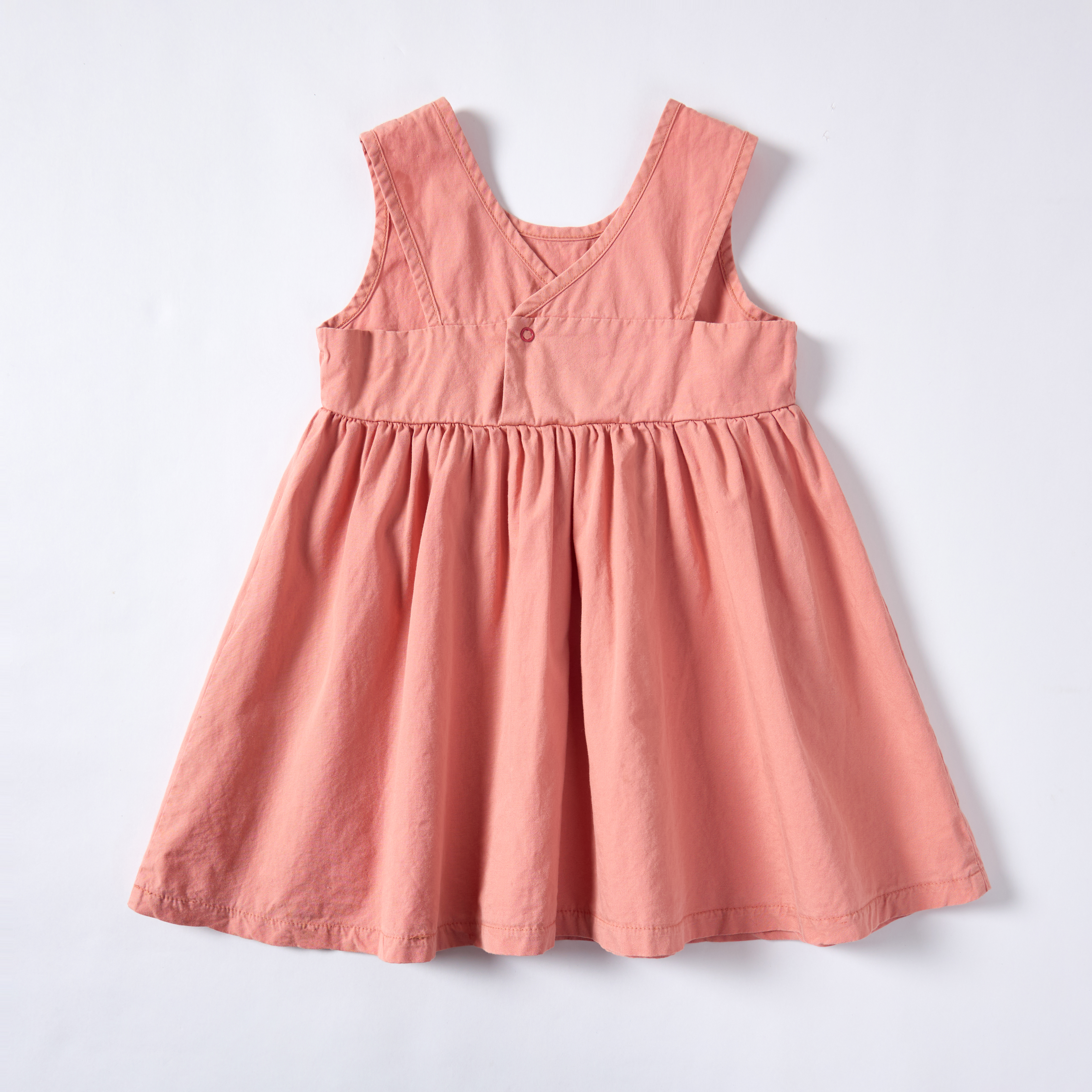
A sleeveless jumper dress in 125 gsm cotton poplin, dyed to a coral rose with sappanwood (苏木), madder (茜草) and pomegranate rind (石榴皮): a scoop front neckline, self-fabric shoulder straps, a back that crosses and buttons at the centre, and a gathered A-line skirt from a waist seam.
The shade is close to the coral we run as a two-plant recipe, and the difference is not in the colour card — it is in what holds the colour on the cloth. The rind adds a tannin layer before the two reds go on, so the same coral sits on a bridge rather than on direct affinity. This page is about that layer: what it buys, what it costs, and how a buyer chooses between the two routes for the same dress.
At a glance
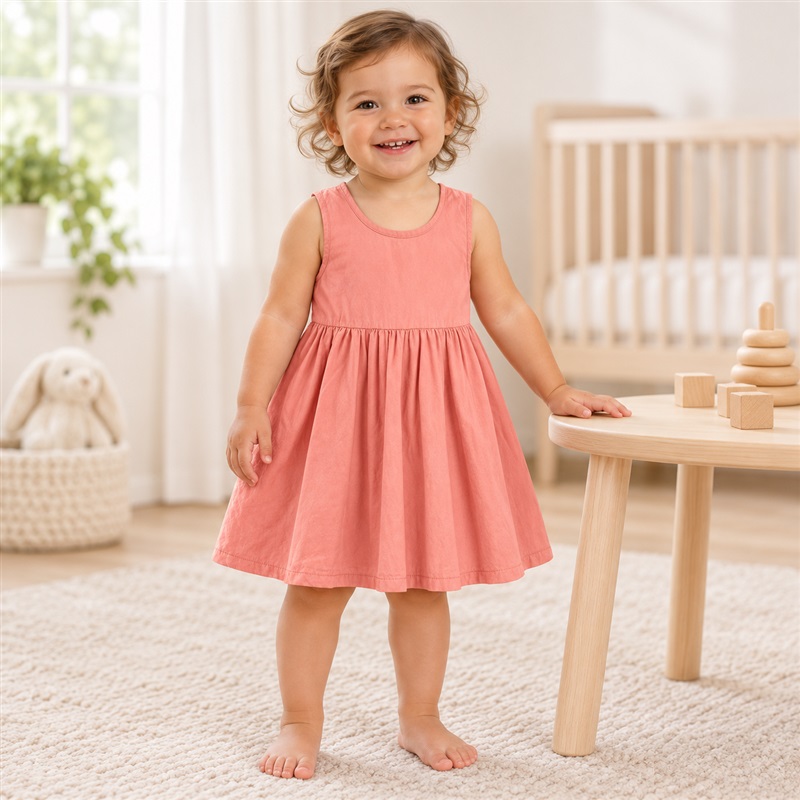
1. The cloth: coral on a single-layer bodice
- A warm mid-tone is where a cast is easy to read. Coral rose sits between pink and terracotta, so approval can say whether the cloth leans rose or leans clay — the judgement the sealed sample exists to settle.
- It is a forgiving tone for coverage. A seam allowance or a button back that would show through a cream stays hidden here, so the bodice works as one layer at 125 gsm without a lining.
- Poplin keeps the shape without help. A tight plain weave with no pile and no twill line means the scoop neckline and armhole sit as drawn lines and the bodice stands away from the chest.
- What this tone exposes is gathering. Folds turned away from the light read a shade deeper, so uneven distribution shows as a heavier panel on one side; the waist seam is therefore distributed from marked quarters rather than by eye.
- It is also unforgiving of repair. A needle mark takes the dye differently and reads as a speck, so faults are corrected in the cloth, not on the finished dress.
2. Three plants: a tannin under two reds
- The rind goes on first and is the base. Its ellagitannins give the buff that the two reds sit on, and at this depth that base is also what keeps the coral from reading thin.
- Sappanwood supplies the rose. Brazilin oxidises to brasilein and gives a soft pink-red on cotton rather than a dense red, which is what holds the shade on the coral side.
- Madder supplies the warmth that makes it coral rather than pink. Alizarin and purpurin build the warmer base, and the balance between the two reds is set on a strike-off.
- Rind load is a depth and cast control, not just a pre-treatment. More rind reads deeper and warmer, and pushed too far the shade crosses from coral into terracotta — the failure mode on this recipe.
- The order is fixed: rind, then colour. Colour applied first has nothing on the fibre to hold it, and most of it rinses away.
3. What the tannin buys, and what it costs
- It buys an anchor. The two reds attach to the phenolic groups the tannin leaves on the cellulose, so colour sits on a bridge rather than on direct affinity alone, and wash fastness is the item that moves most.
- It buys evenness. A tannin layer evens out the differences in how much dye a given area of cloth will take, which matters on a mid-tone where a cloud would show.
- It costs a stage and a rinse. The rind bath is a separate step with its own record, and the cloth has to be rinsed properly afterwards or the tannin reads as a slightly firmer hand and a duller surface.
- It changes the shade slightly, and predictably. The buff base sits under the reds, so the same recipe reads a touch deeper and warmer than the direct route — which is why the two shades are approved as separate sealed samples, not as one shade with a tolerance.
- No metal salt is used in either route. There are no mordant metal impurities to declare, which keeps the Class I file short; the plant material is the variable, screened per lot.
4. Holding the shade: pH, water and the rinse
- pH decides whether the coral stays coral. Madder moves orange in an acid bath, sappanwood goes straw as it acidifies, and an alkaline bath pushes both toward a deeper clay red — so bath pH is set and logged per batch.
- Calcium in the water acts on madder specifically, reading as a slightly deeper, less warm pink, so hardness is specified and recorded with the batch.
- The rinse is part of the colour, not housekeeping. Unfixed dye and residual tannin both come off in the dyeworks; the cloth is rinsed until the water runs clear and the finished piece is what gets washed in the test.
- Finished cloth returns to the infant pH window of 4.0 to 7.5 before release, so a bath run alkaline for hue is neutralised and rinsed back into that window.
- Fastness is a release item at the shipped depth: washing to ISO 105-C06 with a repeated-wash shade check, rubbing to ISO 105-X12, and light to ISO 105-B02, since sappanwood is the faster of the two plants and the shade ages toward pale rose rather than brown.
- Shade is matched under D65 against the sealed sample, on flat panels and on the finished dress, because gathers read a shade deeper than the cloth they came from.
5. Class I: what the article has to prove
- Class I is the class for articles under 36 months. 6-9M, 9-12M, 12-18M and 24M sit inside it by age; 36M is assessed as Class I because the article can be worn by a child under that age.
- The base fabric holds an OEKO-TEX Standard 100 certificate, and the Class I scope for this poplin, colourway and trim is confirmed against it at quotation, before any claim is published.
- Plant origin is not an exemption. The assessment is of the garment, and a tannin-bridged recipe is documented to the same limits as any other dye.
- Fastness is judged as an infant article: washing, rubbing, perspiration, saliva and light, to ISO 105-C06, X12, E04 and B02, plus the saliva method the destination market applies.
- Article items are checked on the finished dress: pH, formaldehyde and extractable heavy metals, with a nickel-release check where metal-touch trim is used.
- The material file carries the weight: rind, root and heartwood are agricultural, so heavy metals, pesticide residues and microbial load are screened at intake with a certificate of analysis per lot.
6. Fit and make: straps, crossover, waist seam
- The straps are the fit. With no sleeves, the strap has to sit on the shoulder blade and inboard of the armhole, wide enough that it does not roll when a child is lifted.
- The back opening is sized on head girth. A crossover back with one button passes over the head, so the opening is checked against head girth plus a working allowance on every size, and that allowance places the button.
- The crossover is a fixed overlap, not a tie. Two panels cross and button once; there are no free ends and no cord, so the style stays outside the cord and drawstring limits of EN 14682.
- The waist is a seam. Fit comes from the block rather than from elastic, and the skirt is gathered onto the seam with the allowance pressed down and topstitched, which at 125 gsm is what stops the gathers ridging through the bodice after washing.
- One button, tested as a small part at 70 N retention, with button, thread and buttonhole assessed as one unit and checked against 16 CFR 1501 for the US market. Trim is dyed to match against the dyed cloth, not chosen from a shade card.
- Seams run at 12-14 stitches per inch; neckline and armholes are finished with self-fabric binding, which keeps a sleeveless edge from stretching on a hanger.
- AQL 2.5 for major defects, 1.0 for critical. Needle control: 100% detection on finished pieces; needles exchanged one-for-one at every break with the machine stopped; work in progress within 2.5 m re-screened twice; needle-free area enclosed, at least 2 m deep, single entry.
7. Sizes, choosing the route, sampling and quoting
- Five sizes, graded from measurements. 6-9M, 9-12M, 12-18M, 24M and 36M move on body measurements rather than a percentage step, because head and chest grow on a different curve from the waist at this age.
- Two routes reach this shade. The tannin-bridged recipe on this page, and the direct sappanwood-and-madder recipe without rind. They are approved as separate sealed samples; sampling both is the practical way to choose.
- How the choice is usually made. Where the retailer's wash-fastness requirement is tight, or the shade is going into a programme that will be reordered over several seasons, the bridged route is the safer of the two. Where hand-feel softness and cost lead, the direct route is quoted instead — and the buyer is told which is which rather than given one and left to assume.
- Shade. Coral rose as shown; a rosier cast with more sappanwood; a clay-leaning coral with more rind. Each is sampled and fastness-tested at its own depth.
- Sampling: 3-7 days from a confirmed tech pack, including a dyed strike-off, a first wash trial on the finished piece, a repeated-wash shade check, and a button pull test.
- Bulk: 30-60 days from approval, planned per dyebath; a split delivery is quoted as two batches because the bath is the unit of shade control.
- MOQ: 300 pcs for a custom development — cloth, shade, trim or fit; 50 pcs for a decorative process on a stock body; 100 pcs for stock cloth with your own logo and label. Mixed colour and size orders are quoted per order, and terms are confirmed against the current quotation.
Production runs with our production partner, Suzhou Shelmin Trade Co., Ltd.: founded 2017, 7,200 m² workshop, 8 lines, 200 staff, 6,000 pieces per day. Design confidentiality is held under NDA; buyer patterns, shades and prints are not re-used.
To quote, we need: target market and the Class I tests, including the retailer's own wash-fastness requirement; whether the bridged or the direct route is preferred; the depth and cast you want; lot certificates for the three plants; the pH targets; the water specification; button material; packaging; and whether certification runs in your brand name.