EN

OEM/ODM 100% Cotton Tank Baby Girl Dress | Eco-Friendly Plant-Dyed Toddler Sun Dress | Custom Sustainable Botanical Grey Kids Apparel | Wholesale Premium Private Label Boutique Children Clothing


- Overview
- OEM/ODM Tank Sleeveless Plant-Dyed Cotton Dress
- Recommended Products
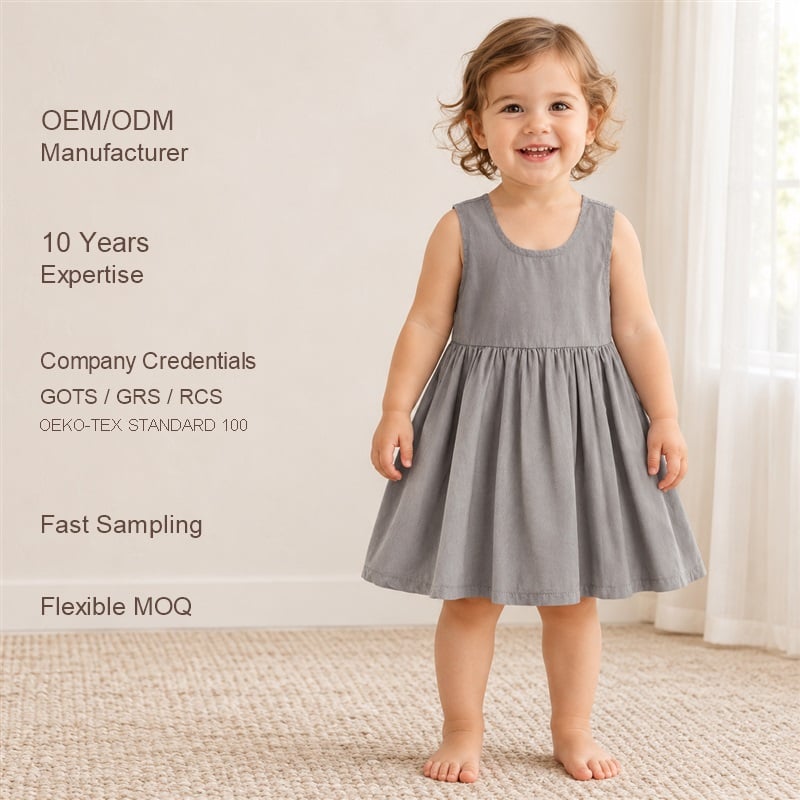
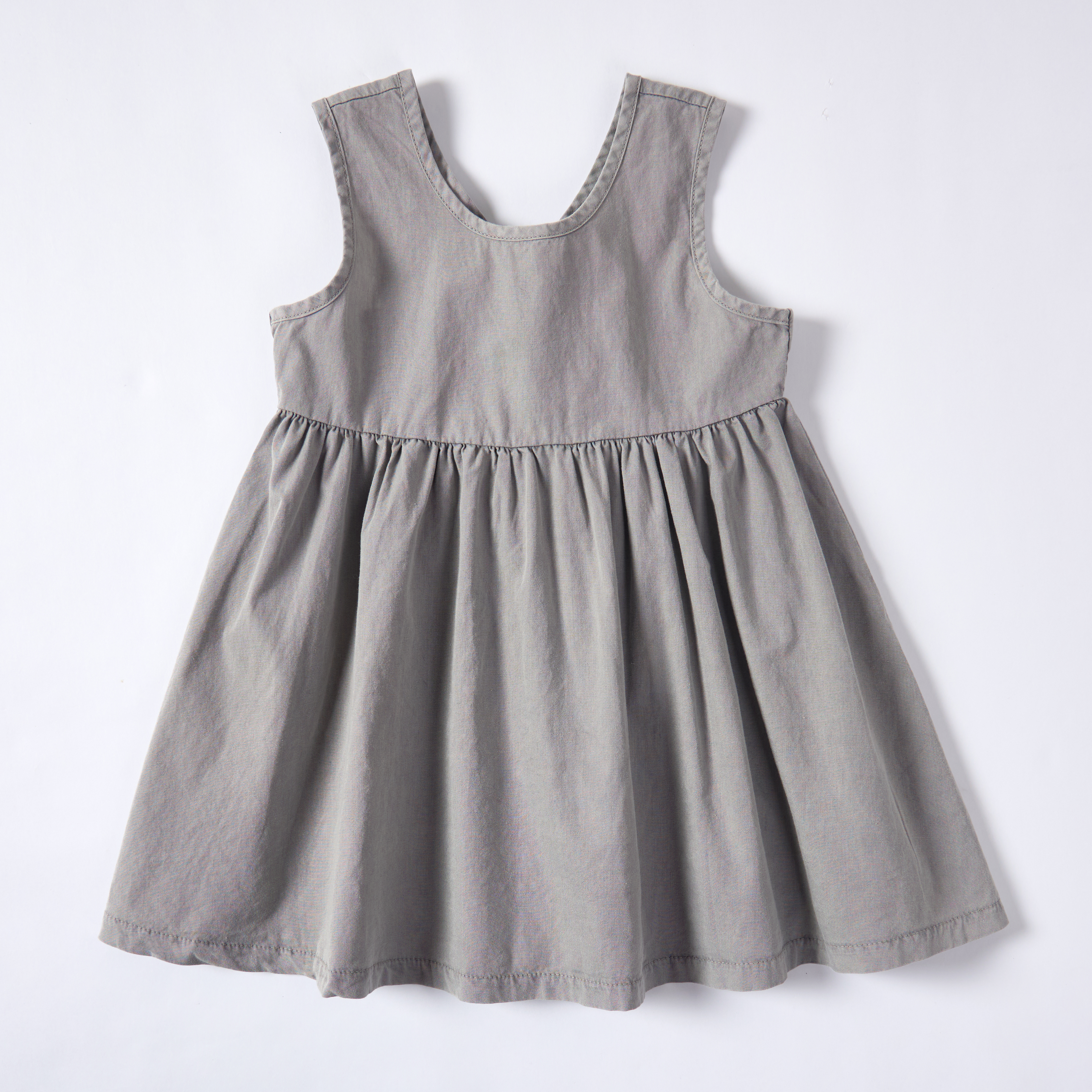
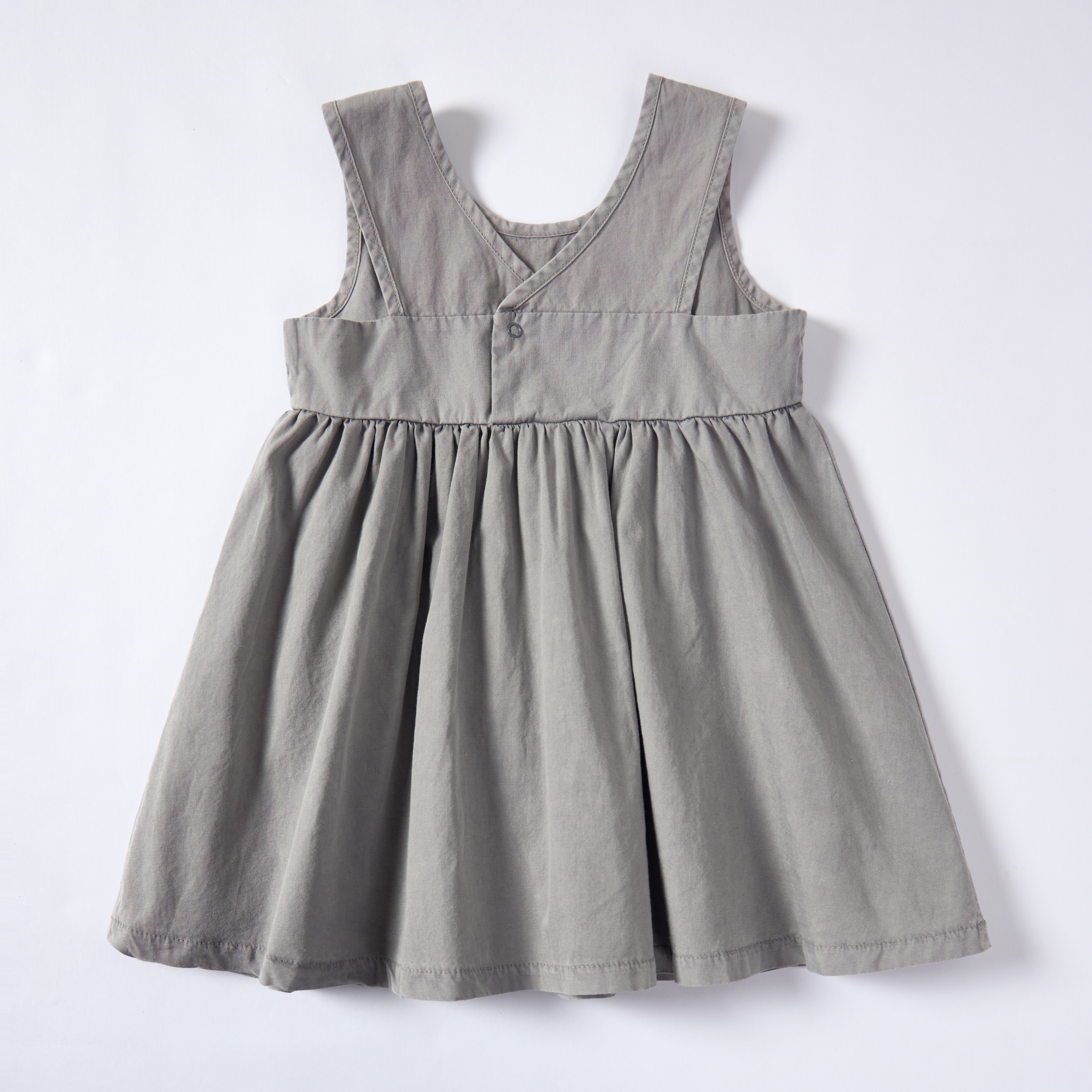
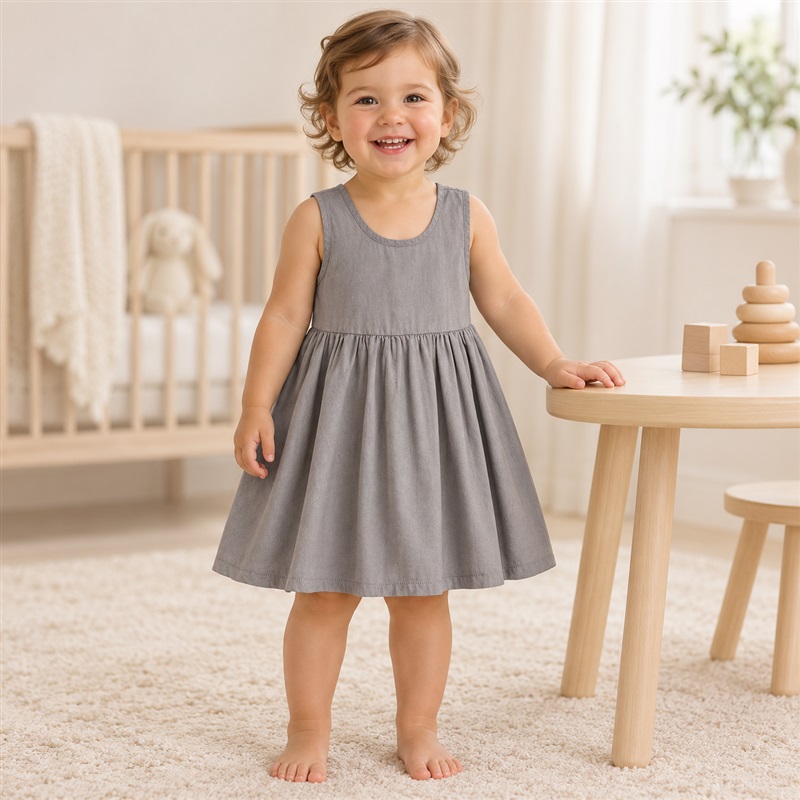
A sleeveless jumper dress in 125 gsm cotton poplin, dyed to a cool stone grey with gallnut (五倍子) and pomegranate rind (石榴皮): a scoop front neckline, self-fabric shoulder straps, a back that crosses and buttons at the centre, and a gathered A-line skirt from a waist seam.
Both materials named are tannins, and tannins on cotton give beige. The grey appears in a second bath, when the tannin meets iron — and iron is the one ingredient in this recipe that also acts on the cloth itself. On a flat mid-grey, two things then decide whether the dress looks right: how evenly the tannin went on, and whether the iron was kept below the point where it starts to weaken cotton.
At a glance
1. The cloth: a mid-grey on a single-layer bodice
- A mid-grey is the most exposing tone for levelness. The eye reads tonal difference on flat grey at arm's length, so a cloud from uneven tannin uptake shows here while it would pass on a cream or a charcoal.
- It is also the most forgiving tone for coverage. A seam allowance or a button back that would read through a pale cream stays invisible in stone grey, so the single-layer bodice works without a lining.
- What grey does show is structure. A bulky gathered seam, a stretched armhole binding or a pressed-in fold all read as shape, because there is no colour variation to distract from them.
- At 125 gsm the bodice holds its line without help. Poplin has no pile and no twill line, so the neckline and armhole sit as drawn lines; the skirt is light enough for the gathers to fall instead of standing out.
- Press shine is the one surface fault that shows in this tone, appearing as a lighter patch where a hot iron touched the face, so pressing is done on the reverse with a cloth.
2. Two tannins, and the iron that makes the grey
- Gallnut is bought by assay. Oak galls run roughly 50-70% tannin depending on lot and origin, so each lot is tested and the bath is set to the percentage it actually carries.
- Pomegranate rind builds the rest of the load and warms the shade. Its ellagitannins react more slowly than gallnut, and without them the iron-grey reads dead blue; with them it stays close to stone.
- The order is two baths, and it is fixed. Tannin first, until the fibre is saturated; iron second, reacting with what is already in the cloth. Iron applied first leaves the cloth with nothing to complex with, so the grey never develops.
- Depth is set by tannin load, hue by the gallnut-to-rind ratio. More tannin gives a deeper grey at the same iron dose; more rind warms it; more gallnut cools it.
- The reference is a sealed dyed sample, not a recipe card, because the two lots that make up a bath vary independently and the ratio has to be re-set when either changes.
3. Iron: what it does to the cloth
- The complex that gives the colour also catalyses oxidation in cellulose. In excess, iron tenders cotton, and the damage appears first where the cloth is folded, stacked or pulled — a hem edge, a button tab, the gathered seam at the waist.
- So the iron bath has its own record. Concentration, pH, temperature and dwell are specified and logged per batch, and the cloth is rinsed until unreacted iron is out of the fibre; the rinse is checked rather than judged by eye.
- Strength is a release item, not an assumption. Tensile and tear strength to ISO 13934-1 and ISO 13937-2 run against undyed cloth from the same lot, with the gathered waist seam and the button tab included in the checked areas.
- The salt is specified too. Ferrous sulfate carries copper, chromium, nickel and manganese as impurities, which both shift the shade and sit on the Class I limit list, so it is bought to an assay with limits stated.
- Colour and strength pull against each other. More iron deepens the grey toward charcoal and moves the cloth closer to its strength limit, so the target is the lightest grey that still reads grey on the approved sample.
4. Levelness: the real difficulty in a grey
- Cellulose takes tannin unevenly if it is not fully wet out. A dry spot, a folded selvedge or a trapped air pocket becomes a lighter patch that only appears after the iron bath, when it is too late to correct in the same piece.
- So wet-out is a step of its own: the cloth is wetted and relaxed before it enters the tannin bath, and pieces go in open rather than folded.
- Liquor circulation and batch size are set against each other. A bath loaded close to its limit circulates poorly, and the middle of the load takes less tannin than the edges; batch weight per bath is therefore fixed by the vessel.
- Water is part of the recipe. Hardness, iron content and residual alkali all shift a tannin-iron grey, so the dyeworks works to a set water specification and records it with the batch.
- Shade is checked on flat panels under D65 against the sealed sample, and on the finished dress at the bodice and skirt, since gathers read a shade deeper than a flat panel of the same cloth.
- Fastness is tested where the recipe is weakest: washing to ISO 105-C06 with a repeated-wash shade check, rubbing to ISO 105-X12, and light to ISO 105-B02 — an iron-tannin grey tends to age with a warm cast rather than by fading.
5. Class I: what the article has to prove
- Class I is the class for articles under 36 months. 6-9M, 9-12M, 12-18M and 24M sit inside it by age; 36M is assessed as Class I because the article can be worn by a child under that age.
- The base fabric holds an OEKO-TEX Standard 100 certificate, and the Class I scope for this poplin, colourway and trim is confirmed against it at quotation, before any claim is published.
- Plant origin is not an exemption. The assessment is of the garment, and a tannin-iron recipe is documented to the same limits as any other dye.
- The mordant is the item to document most carefully. Iron sits outside the restricted list, but its salt carries the metals that do not, so the assay and the impurity limits travel with the batch record.
- Fastness is judged as an infant article: washing, rubbing, perspiration, saliva and light, to ISO 105-C06, X12, E04 and B02, plus the saliva method the destination market applies.
- Article items are checked on the finished dress: pH, formaldehyde and extractable heavy metals, with a nickel-release check where metal-touch trim is used.
6. Fit and make: straps, crossover, waist seam
- The straps are the fit. With no sleeves, the strap has to sit on the shoulder blade and inboard of the armhole, wide enough that it does not roll when a child is lifted.
- The back opening is sized on head girth. A crossover back with one button passes over the head, so the opening is checked against head girth plus a working allowance on every size, and that allowance places the button.
- The crossover is a fixed overlap, not a tie. Two panels cross and button once; there are no free ends and no cord, so the style stays outside the cord and drawstring limits of EN 14682.
- The waist is a seam. Fit comes from the block rather than from elastic, and the skirt is gathered onto the seam with the allowance pressed down and topstitched — at 125 gsm an unsecured gathered seam ridges through the bodice after washing.
- One button, tested as a small part at 70 N retention, with button, thread and buttonhole assessed as one unit and checked against 16 CFR 1501 for the US market. On stone grey, trim is a matte tone approved against the dyed cloth rather than a shade card.
- Seams run at 12-14 stitches per inch; neckline and armholes are finished with self-fabric binding, which is what keeps a sleeveless edge from stretching on a hanger.
- AQL 2.5 for major defects, 1.0 for critical. Needle control: 100% detection on finished pieces; needles exchanged one-for-one at every break with the machine stopped; work in progress within 2.5 m re-screened twice; needle-free area enclosed, at least 2 m deep, single entry.
7. Sizes, customization, sampling and quoting
- Five sizes, graded from measurements. 6-9M, 9-12M, 12-18M, 24M and 36M move on body measurements rather than a percentage step, because head and chest grow on a different curve from the waist at this age.
- The back opening and strap position are re-set per size, since the head-girth allowance decides whether the dress goes on without a fight.
- Customization. Scoop, round or square neckline; crossover back or a centre-back placket with two buttons; self-fabric or contrast binding; gathered, pleated or plain A-line skirt; patch pocket; lined bodice; and a grey that runs warmer or colder by moving the gallnut-to-rind ratio.
- Shade. Stone grey as shown; a deeper charcoal with more iron; a warmer grey with more rind. Each is sampled and strength-tested at its own depth.
- Sampling: 3-7 days from a confirmed tech pack, including a dyed strike-off on flat panels, the strength retention check, a repeated-wash shade check, and a button pull test.
- Bulk: 30-60 days from approval, planned per dyebath; a split delivery is quoted as two batches because the bath is the unit of shade control.
- MOQ: 300 pcs for a custom development — cloth, shade, trim or fit; 50 pcs for a decorative process on a stock body; 100 pcs for stock cloth with your own logo and label. Mixed colour and size orders are quoted per order, and terms are confirmed against the current quotation.
Production runs with our production partner, Suzhou Shelmin Trade Co., Ltd.: founded 2017, 7,200 m² workshop, 8 lines, 200 staff, 6,000 pieces per day. Design confidentiality is held under NDA; buyer patterns, shades and prints are not re-used.
To quote, we need: target market and the Class I tests it requires; the tannin load and the gallnut-to-rind ratio; the iron salt and its assay; the rinsing stage and how it is checked; the water specification; button material and position; packaging; and whether certification runs in your brand name.