EN

OEM/ODM Vintage 100% Cotton Smocked Baby Romper | Eco-Friendly Plant-Dyed Infant Jumpsuit | Custom Sustainable Ruffle Collar Newborn Bubble Bodysuit | Hand-Smocked Boutique Toddler Apparel Wholesale


- Overview
- OEM/ODM Smocked Plant-Dyed Cotton Baby Romper
- Recommended Products
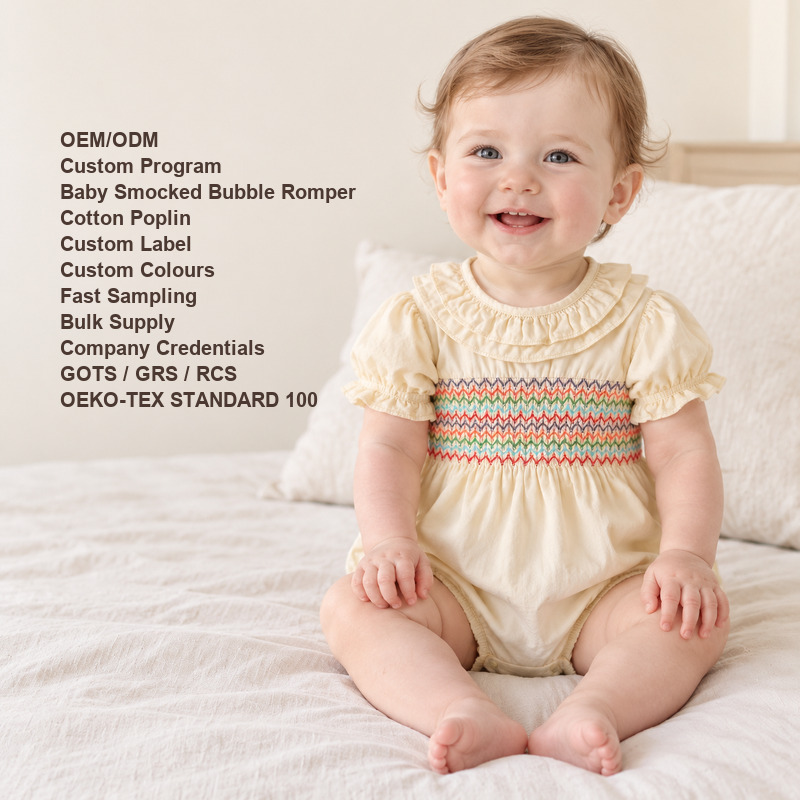
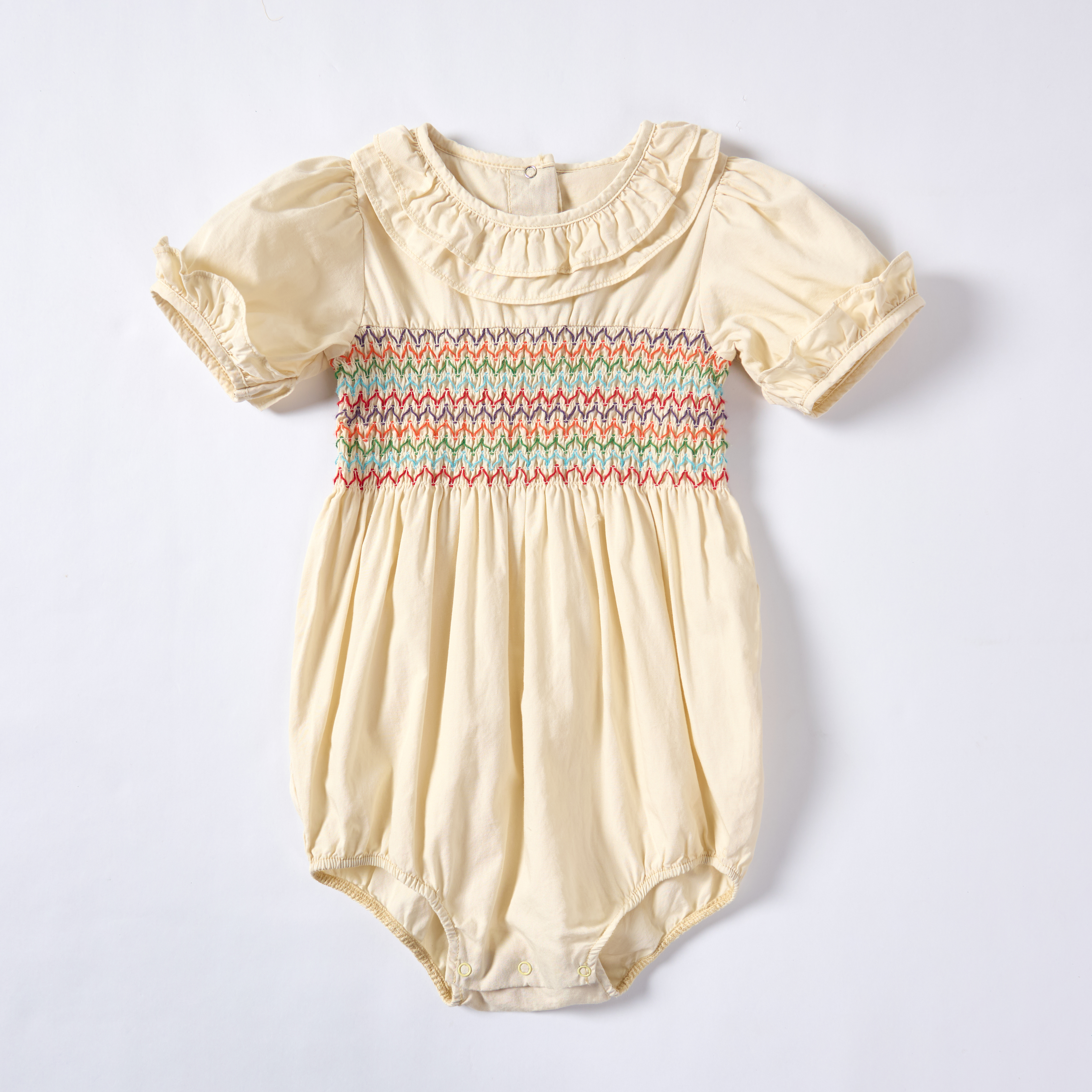
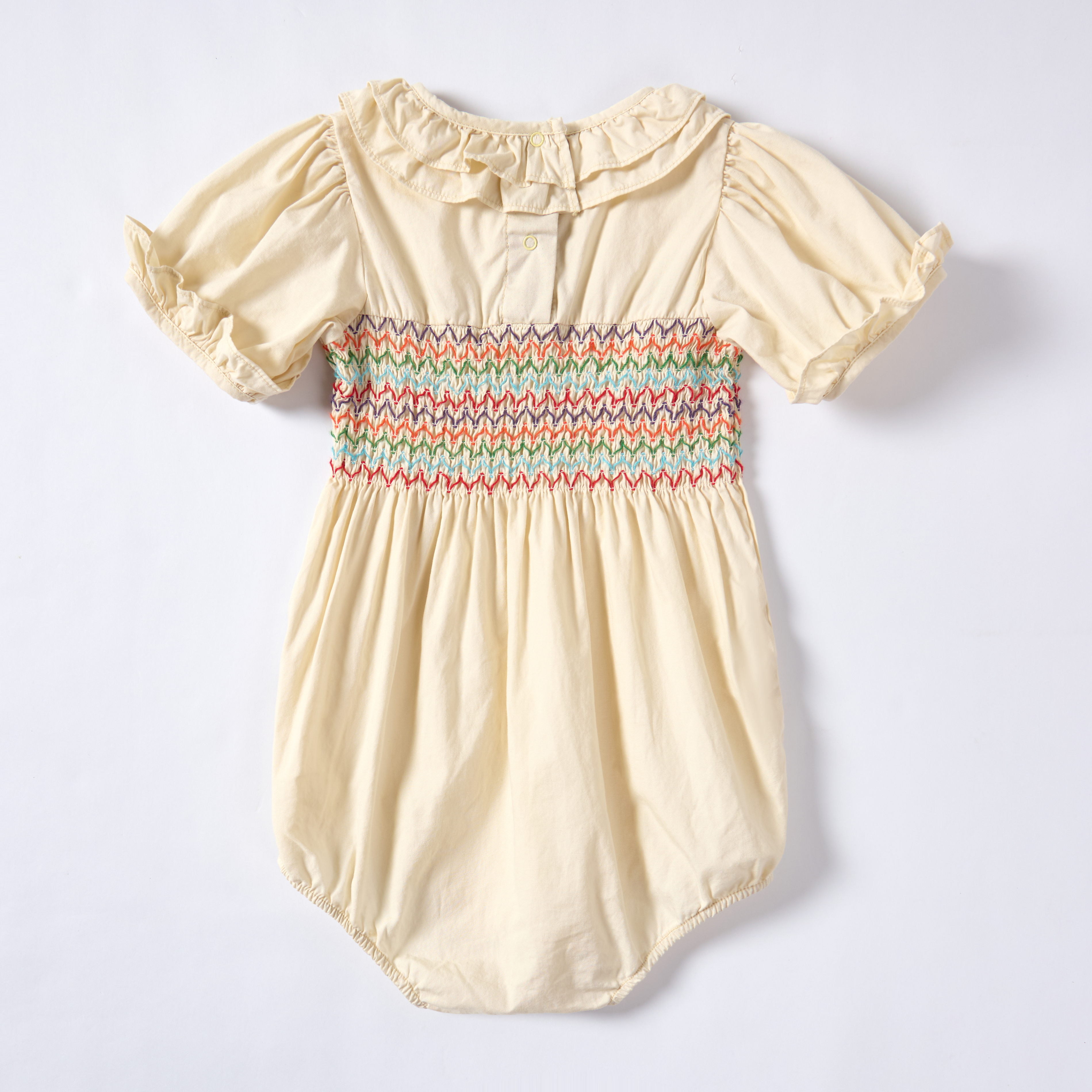
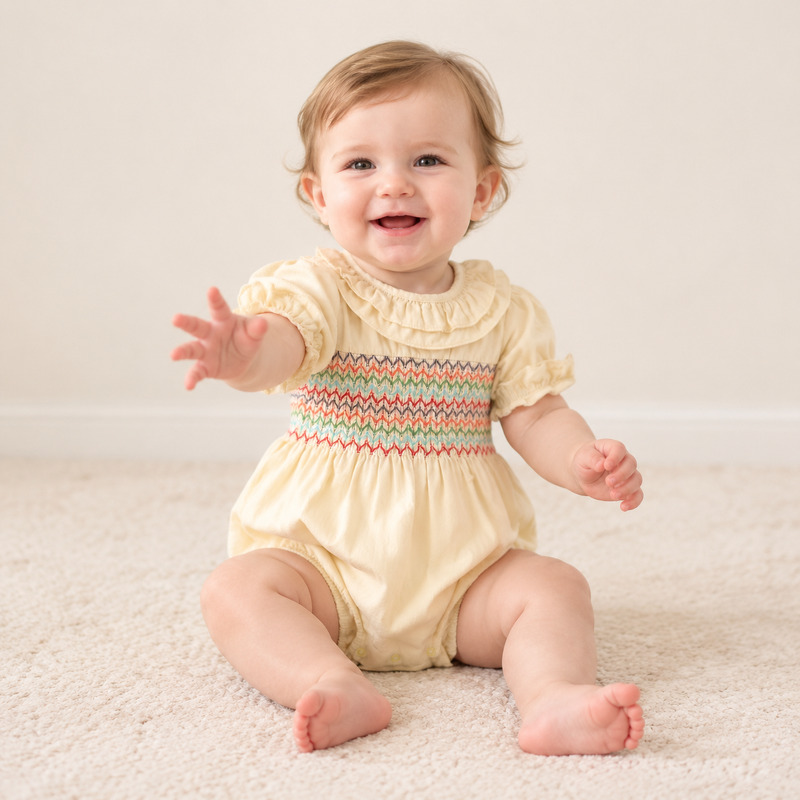
A short-sleeve bubble romper in 125 gsm cotton poplin, plant dyed to a cream ivory with sappanwood (苏木), madder (茜草) and pomegranate rind (石榴皮): a ruffle collar, puff sleeves gathered into a ruffle cuff, a smocked bodice worked in rows of wave stitch, a short back placket with one button, and a gathered bubble body closed at the crotch with snaps above elasticated leg openings.
Cream is the shade that a romper tests hardest, for a reason that has nothing to do with dyeing: a romper is washed every few days, not every few weeks. A garment that meets a hundred wash cycles is judged on where it ends up, not on how it leaves the workshop, and on a plant-dyed cream there are two things waiting in the wash — detergent residue, and the optical brightener most household detergents carry.
At a glance
1. This garment is judged over a hundred washes
- A dress is worn for occasions; a romper is worn on rotation. Nappy leaks, spills and the general arithmetic of a first year mean the same garment goes through the machine several times a week, so the relevant question is not whether the colour passes one wash test but what it looks like after fifty.
- So wash testing is run to a cycle count, with readings taken at intervals. Colour change and strength are recorded at named points in the sequence rather than collapsed into a single pass or fail, because a shade that holds at ten cycles and drifts by forty is a different product from one that holds throughout.
- The endpoint is defined rather than discovered. On a plant-dyed cream the realistic endpoint is a softer, slightly warmer cream, and that is written into the standard and the care wording so a customer sees a described behaviour rather than a surprise.
- Strength matters as much as colour here, because a romper is pulled at the crotch and stretched at the leg on every change; the wash sequence tests both, on the same specimens.
- Rub testing runs on the finished garment at the same intervals, since the placket and leg channel are where a garment this pale loses its evenness first.
2. Optical brightener is the variable nobody writes into the spec
- Most household detergents contain optical brighteners, which are designed to fluoresce on white and are not selective about what they land on. On a plant-dyed cream they lift the ground toward a cooler, paler tone, and the effect accumulates because the brightener is deposited, not rinsed away.
- So the specification includes a wash with a brightener-containing detergent, deliberately. The result is recorded as direction and magnitude, and the shade is approved knowing that a customer using a standard detergent will move it that way.
- Care wording follows the test, not the other way round. Where the market allows it, the label asks for a detergent without optical brightener; where it does not, the standard is set with the drift already accounted for.
- Residue is the second half of the same problem. Detergent left in a thick seam or a doubled placket reads as a pale line on cream, and on a bubble the seams are numerous; rinsing is specified rather than assumed, and a rinse check is part of the wash protocol.
- Softener is treated as a third variable. Most softeners carry a faint tint and a waxy deposit, both of which show on cream and neither of which is removed by the next wash; the label wording and the test protocol are decided together.
3. Three plants at the shallow end
- The rind sets the depth; the two reds set the temperature. At cream the rind carries almost all of the visible colour, madder supplies the warmth and sappanwood keeps the ground from going flat or greenish — dosed in small fractions, because at this depth an overshoot is obvious immediately.
- A shallow bath has little buffering. Less tannin on the fibre means less cushion against pH drift across a lot, so pH is logged per bath rather than per order, and a mid-lot correction re-reads the bath before more cloth enters.
- Evenness fails visibly at this depth, not at depth in general. A variation that would pass on a mid-tan shows on cream as a faint cloud, so bath circulation, liquor ratio and roll turning are specified, and mottling is judged on a dried panel.
- Iron is excluded from this route deliberately. A rust trace or a condensate drip lands as a grey-blue spot that no re-rinse removes, and on cream it is unmissable; pale shades run on an iron-free route with dedicated vessels and the cloth is inspected against a light under D65.
- The rinse endpoint is judged on a dried swatch, because residual tannin or soap reads as a yellow shift after a few weeks in a bag, and wet cloth always looks darker than it will dry.
4. Cream at the seat is the coverage question in its hardest form
- A closed bubble in a pale shade is the combination where a single layer has the least margin. Dry, 125 gsm poplin covers; wet, a plain weave of this weight loses opacity, and cream is the ground that shows what is behind it first.
- So coverage is checked as a property, dry and wet, against a standard insert under D65, and the result is recorded per shade rather than argued from the cloth's weight.
- Depth and coverage pull against each other, which is why this colourway sits at warm cream rather than at the palest point the bath would allow; going lighter is a construction change, not a dyeing one.
- The structural answers are a seat lining or a slightly heavier poplin, quoted as a variant with its own sampling, so a buyer asking for "the same thing but lighter" gets a garment that still covers.
- The front panel is checked in the same pass, because a bubble is worn without a vest as often as with one.
5. Hardware on a pale ground
- Snaps are the part of this garment that is used most and seen most. They sit at the crotch, they are worked by hand several times a day, and on cream a mark around the stud reads as a grey ring that a customer notices before anything else.
- So plating is specified and tested in both directions: corrosion of the part, and staining of the cloth around it, with a ring counted as a fault even where the snap is intact.
- Retention and pull are measured on the finished garment before and after wash cycles, because setting and plating both change with the first washes.
- Nickel release is confirmed for the EU market from the snap supplier's own report, and the declaration travels with the lot rather than being filed once at development.
- The placket is a stack — two plies, snap flange and leg elastic at one corner — so it is graded and pressed for a flat sit and reinforced with stay tape, since a pucker there is both visible and abrasive on cream.
6. The band carries the volume, and the fit sits above it
- The band holds a closed body here, so the panel-to-body join is the load path for the whole garment; it is reinforced and checked for puckering on every piece, and on cream a pucker reads as a shadow.
- Because the crotch opens, the band only has to pass a head at dressing, so the gathering ratio is set for a snug fit: two and a half to three times finished width, per size against head circumference plus clearance, with recovery checked on the sample and after five washes.
- Band and body read as one colour or not at all. Pleats hold shadow, so the band reads deeper than the flat body; colour is approved with the two side by side, and at this depth the step is more visible than on a mid-tone.
- The band's upper edge sits at a fixed distance below the armhole per size, a dimension that does not scale by percentage; the plain bodice above it is where a fit error shows first, and the two-tier collar ruffle is stabilised at the neckline with the upper tier cut narrower.
- Leg elastic is encased with no free ends and specified as relaxed and stretched circumferences per size, with clearance checked on 24M and 36M first; the back button is tested at 70 N retention with a check against 16 CFR 1501.
7. Tests, sizes, sampling and quoting
- Wash sequence testing at a defined cycle count, with colour change, strength and surface read at named intervals; rubbing to ISO 105-X12 on the crotch placket and leg channel at the same points, and a brightener-detergent wash recorded as direction and magnitude.
- Fabric tests at the shipped depth: light to ISO 105-B02, wash to ISO 105-C06 with the smocked panel in the load, perspiration and saliva to ISO 105-E04 plus the destination market's saliva method.
- Coverage at seat and front, dry and wet, against a standard insert under D65 and recorded per shade.
- Trim tests: snap retention and pull before and after wash cycles, corrosion and contact staining around the stud, leg elastic recovery after repeated washing, button retention at the back neck.
- pH is measured on the garment and held between 4.0 and 7.5; phenol yellowing is checked to ISO 105-X18 on a specimen carrying the actual packing fold, with packaging specified free of BHT.
- Five sizes on a measurement chart: 6-9M, 9-12M, 12-18M, 24M and 36M move on chest, body length, crotch depth, leg circumference and head clearance; the panel is re-set per size because stretch does not grade like a seam.
- Sampling: 3-7 days from a confirmed tech pack, covering a dyed strike-off against the sealed standard, one smocked panel with its body beside it, a fit check on the smallest and largest size with a nappy in place, a wet and dry coverage check, snap and elastic checks before and after five washes, a ten-cycle wash reading as the first data point in the sequence, and a bubble-shape check after washing.
- Bulk: 30-60 days from approval, planned per dyebath, per thread lot and per snap lot, with cloth released only after pH, fastness, mottling and coverage results are in hand.
- MOQ: 300 pcs for a custom development covering cloth, shade, smocking, trim or fit; 50 pcs for a decorative process on a stock body; 100 pcs for stock cloth with your own logo and label. Mixed colour and size orders are quoted per order, and terms are confirmed against the current quotation.
Production runs with our production partner, Suzhou Shelmin Trade Co., Ltd.: founded 2017, 7,200 m² workshop, 8 lines, 200 staff, 6,000 pieces per day. Design confidentiality is held under NDA; buyer patterns, shades and prints are not re-used.
To quote, we need: target market and the Class I tests it requires, including the nickel-release requirement if the snaps are to be sold in the EU; the cycle count you want the wash sequence run to; whether a brightener-containing detergent is part of your test protocol; the snap type and plating; leg elastic type and the relaxed and stretched circumferences you want; whether a seat lining is acceptable if a paler shade is required; the thread palette; smocking row count and stitch; lot certificates for the three plants and for the thread; the pH target and the dyehouse water specification; packing method; and whether certification is to run in your brand name.