EN

OEM/ODM Vintage 100% Cotton Smocked Baby Romper | Eco-Friendly Plant-Dyed Infant Jumpsuit | Custom Sustainable Ruffle Collar Newborn Bubble Bodysuit | Hand-Smocked Boutique Toddler Apparel Wholesale


- Overview
- OEM/ODM Smocked Plant-Dyed Cotton Baby Romper
- Recommended Products
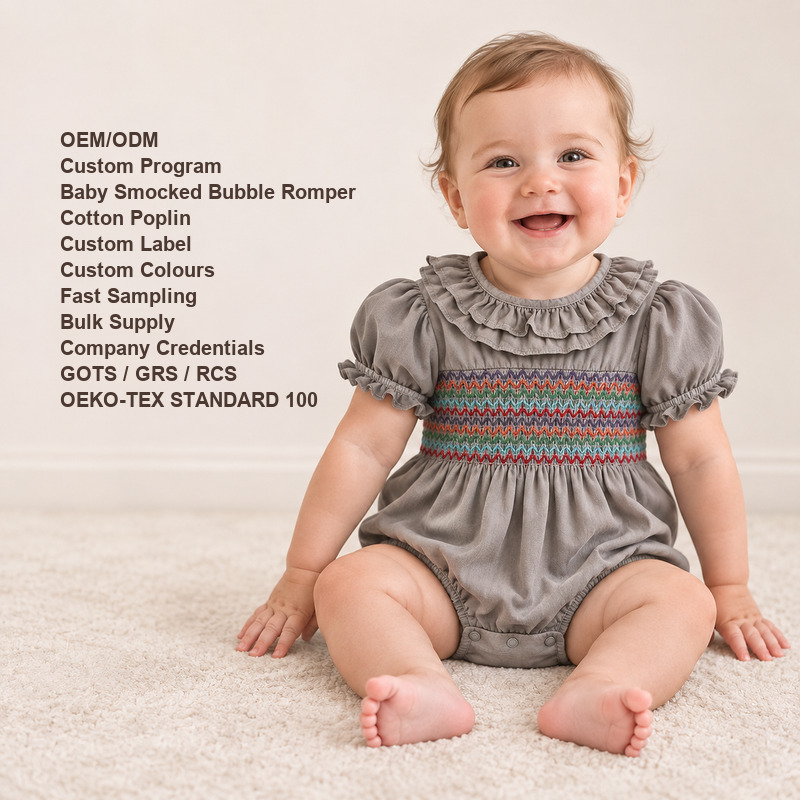
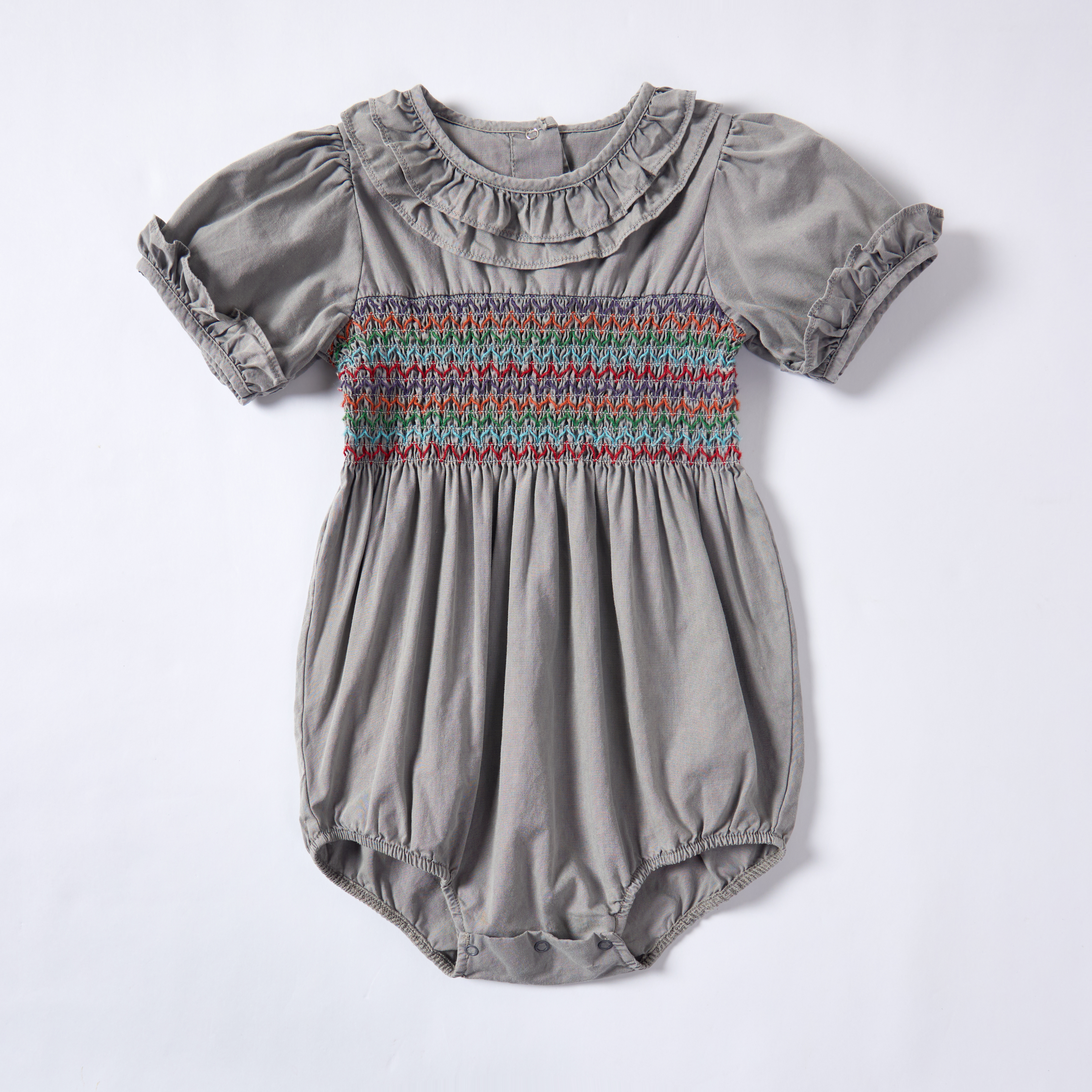
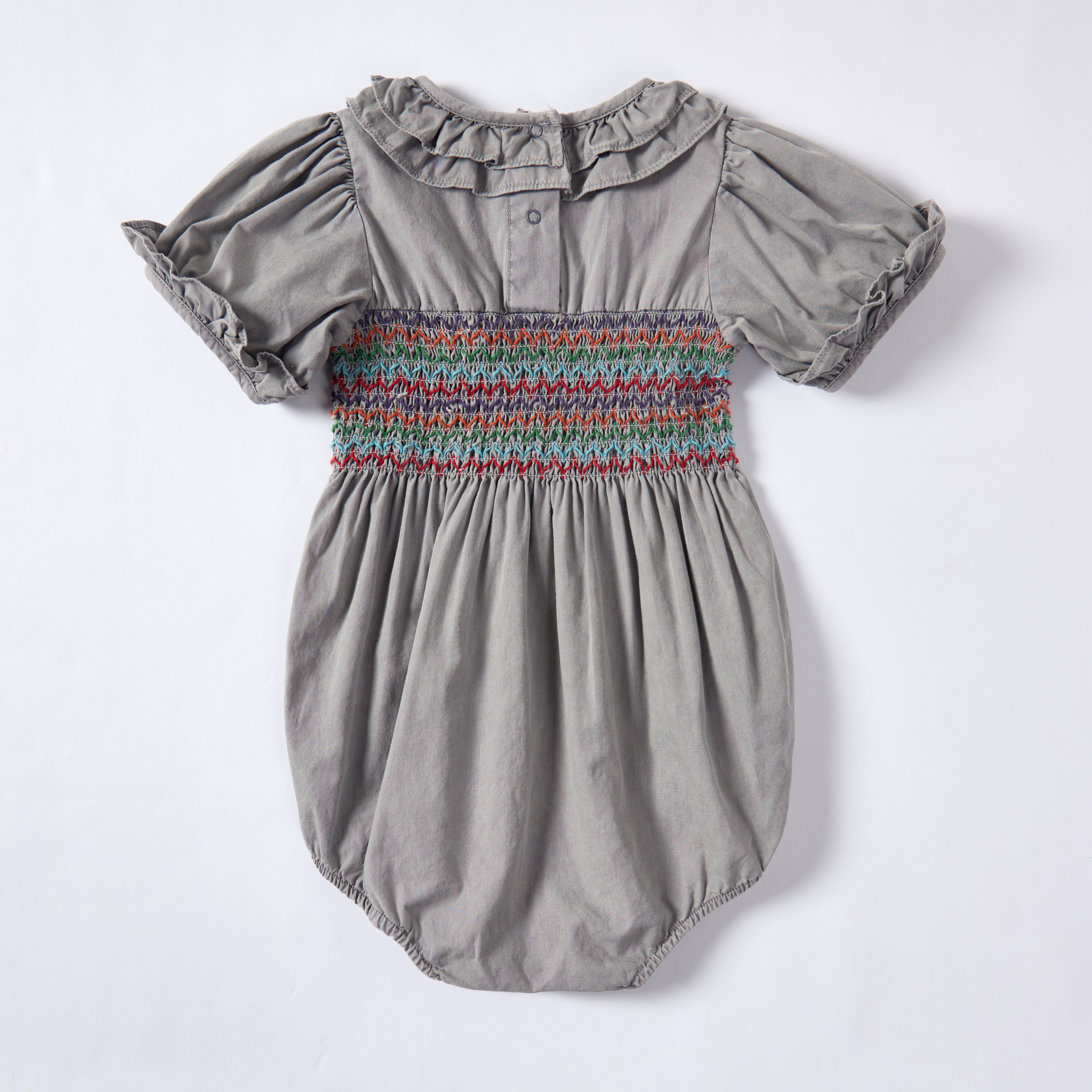
A short-sleeve bubble romper in 125 gsm cotton poplin, dyed to a light mist grey with gallnut (五倍子) and pomegranate rind (石榴皮), finished with a short back placket, a snap crotch and elasticated leg openings.
This is the colourway in the range that uses a metal on purpose, and it puts two metals in the same garment: the iron that develops the grey inside the fibre, and the plated snaps that open and close all day at the crotch. They do different things and they fail differently, and neither can be assessed by looking at the other. Because the shell is grey, a third thing changes too — what the eye notices. Grey covers better than a pale tone when wet, and shows every mark that a pale tone forgives.
At a glance

1. Two metals, two different problems
- The iron in the bath is chemistry; the plating on the snaps is hardware. The first forms a tannin-iron complex inside the fibre and is what makes the cloth grey at all. The second has to survive being opened, closed, wetted and washed without corroding or marking the cloth.
- They are not the same risk and cannot share a test. A grey that is evenly developed can still fail around the stud, and a snap that passes a corrosion test says nothing about whether the cloth was rinsed free of unreacted iron.
- So the specification runs on two tracks. Cloth: iron dose, rinse endpoint, rest period, strength. Hardware: plating, retention, corrosion and contact staining — with a separate result for each, recorded against the lot.
- What connects them is the rinse. Unreacted iron left in the cloth keeps working after packing, and it is also what attacks a plated part from the inside of the garment; the rinse endpoint is therefore verified before the snaps are set, not after.
- Neither metal is declared as a finish. The grey is described as a plant dye with a ferrous second bath, because that is what it is; the closure is described as a plated snap with its material stated.
2. The grey keeps moving after the snaps are set
- A tannin-iron grey deepens and settles for days after drying. Colour is therefore approved after a defined rest period, and every later lot is read at the same point in its own rest.
- Sampling has to include the hardware. A grey judged against bright new plating reads differently from the same grey with the snaps in place, and the crotch is where the buyer looks: the sample is presented as a finished romper, not as cloth with a swatch of snaps beside it.
- A short rest reads paler, and the difference survives washing. Two lots that look close on the line diverge within a week, and the mismatch appears in the same order — which is why the sealed standard is a physical piece of rested cloth, matched under D65.
- Storage belongs to the colour. Heat and humidity accelerate the shift, so the rest period and the storage of the standard are specified together, and the packed romper is checked against the standard rather than against the piece that was photographed.
- Re-orders are matched to the standard, not to the last shipment, otherwise a shade drifts one acceptable step at a time until the third order is a different colour.
3. Grey hides coverage and exposes marks
- On a single-layer bubble, this is the trade the colour makes. A light grey covers at the wet seat better than a pale coral does, so coverage stops being the question a buyer raises.
- What replaces it is marking. A damp patch, a water spot, a drip from a wet sleeve, or a scuff against a metal buckle all read as dirt on grey, because there is no hue to distract the eye — and on the seat of a romper, a visible mark is a return.
- Water spotting is the specific failure to test. Plant-dyed greys can show a ring where the cloth is re-wetted and dried unevenly, so the sample is spotted deliberately, dried, and read under D65 against an untreated area before the shade is approved.
- Metal contact is the second. A plated snap, a zip on an outer jacket, a pram buckle: the cloth is rubbed against each and checked for a grey or dark transfer, which on this ground reads as a shadow rather than as a stain and is harder to explain to a customer.
- Because marks matter more than depth here, the shade is built to sit mid-light. A very light grey exposes every mark; a darker one hides them at the cost of looking flat in photographs, and this colourway is set between those two points deliberately.
4. Where the iron's strength bill lands
- Excess ferrous iron catalyses oxidation in cellulose, and oxidised cotton loses strength before it looks different. The dose is capped against the tannin load, which is why gallnut is bought on analysed tannin content rather than by weight.
- The first signs are physical: at folds, at hems, and where cloth is repeatedly flexed. In this garment that means the crotch placket, the leg channel and the hem of the sleeve ruffle — not the flat panels a swatch test would choose.
- So strength is measured where the garment bends. Strip tensile to ISO 13934-1 and tear to ISO 13937-2 run on the dyed lot against undyed cloth from the same greige lot, and the placket and leg-channel areas are included rather than averaged into a panel result.
- Rinsing runs to a verified endpoint. Cloth is rinsed until no unreacted iron remains available in the fibre, and the final rinse is checked before drying; residual iron keeps working in the bag.
- Heavy-metal extraction is tested on the finished romper, on the article rather than the cloth, because the crotch of a garment is what a child's hands and mouth reach.
5. The closure and the leg channel take the load
- Nappy changes go through the crotch, so the snaps are opened and closed more often than anything else on the garment; retention and pull are measured on the finished romper before and after wash cycles.
- The placket is a stack — two plies, snap flange and leg elastic at one corner — so it is graded and pressed for a flat sit and reinforced with a stay tape that spreads the opening load, rather than a second row of stitching.
- Plating is specified, and contact staining is a fault on its own. A plated part that corrodes is one failure; a ring on the grey around the stud is a second, and it is counted even where the snap is intact.
- Nickel release is confirmed for the EU market from the snap supplier's own report, and the declaration travels with the lot instead of being filed once at development.
- Leg elastic is encased in a closed channel with no free ends and specified as two circumferences, relaxed and stretched, with the shirring ratio between them; clearance is checked on 24M and 36M first, since the thigh grows faster than the waist.
6. The band carries the body, and the fit sits above it
- The band holds a closed volume here, not a skirt, so the panel-to-body join is the load path for the whole garment and is reinforced and checked for puckering on every piece.
- Because the crotch opens, the band only has to pass a head at dressing, which is why the gathering ratio can be set for a snug fit: two and a half to three times finished width, set per size against head circumference plus clearance, checked for recovery on the sample and after five washes.
- Band and body read as one colour or not at all. Pleats hold shadow, so the band reads deeper than the flat body; colour is approved with the two side by side, and on a mid-light grey that step is easy to see.
- The band's upper edge sits at a fixed distance below the armhole per size, a dimension that does not scale by percentage; the plain bodice above it is where a fit error shows first, and the two-tier collar ruffle is stabilised at the neckline with the upper tier cut narrower.
- Sleeve head gather is distributed in two passes against the armhole, cuff band width including whether it carries elastic is fixed in the tech pack, and the single back button is tested at 70 N retention with a check against 16 CFR 1501.
7. Tests, sizes, sampling and quoting
- Cloth tests at the shipped depth: light to ISO 105-B02, wash to ISO 105-C06 with the smocked panel in the load, rubbing to ISO 105-X12 across the smocked area, the crotch placket and the leg channel, perspiration and saliva to ISO 105-E04 plus the destination market's saliva method.
- Iron-related tests: strength to ISO 13934-1 and ISO 13937-2 against same-lot undyed cloth including the placket and leg channel, rinse verification before drying, and heavy-metal extraction on the finished romper.
- Marking tests: deliberate water spotting read under D65 against untreated area, and metal-contact transfer against a plated part, both recorded per lot.
- Trim tests: snap retention and pull before and after wash cycles, corrosion and contact staining around the stud, leg elastic recovery after repeated washing, button retention at the back neck.
- pH is measured on the garment and held between 4.0 and 7.5; phenol yellowing is checked to ISO 105-X18 on a specimen carrying the actual packing fold, with packaging specified free of BHT.
- Five sizes on a measurement chart: 6-9M, 9-12M, 12-18M, 24M and 36M move on chest, body length, crotch depth, leg circumference and head clearance; the panel is re-set per size because stretch does not grade like a seam.
- Sampling: 3-7 days from a confirmed tech pack, covering a dyed strike-off read after its rest period, one smocked panel with its body beside it, a fit check on the smallest and largest size with a nappy in place, snap, corrosion, staining and elastic checks before and after five washes, water spotting and metal contact, strength on the placket and leg channel, and a bubble-shape check after washing.
- Bulk: 30-60 days from approval, planned per dyebath, per thread lot and per snap lot, with cloth released only after rest, strength, pH and fastness results are in hand.
- MOQ: 300 pcs for a custom development covering cloth, shade, smocking, trim or fit; 50 pcs for a decorative process on a stock body; 100 pcs for stock cloth with your own logo and label. Mixed colour and size orders are quoted per order, and terms are confirmed against the current quotation.
Production runs with our production partner, Suzhou Shelmin Trade Co., Ltd.: founded 2017, 7,200 m² workshop, 8 lines, 200 staff, 6,000 pieces per day. Design confidentiality is held under NDA; buyer patterns, shades and prints are not re-used.
To quote, we need: target market and the Class I tests it requires, including the nickel-release requirement if the snaps are to be sold in the EU; the snap type and plating, or a sample of the part you intend to use; the depth target against the sealed standard and the rest period used for it; leg elastic type and the relaxed and stretched circumferences you want; lot certificates for gallnut, rind and thread with analysed tannin content; the iron dose and rinse verification method; the pH target and the dyehouse water specification; packing method; and whether certification is to run in your brand name.