EN

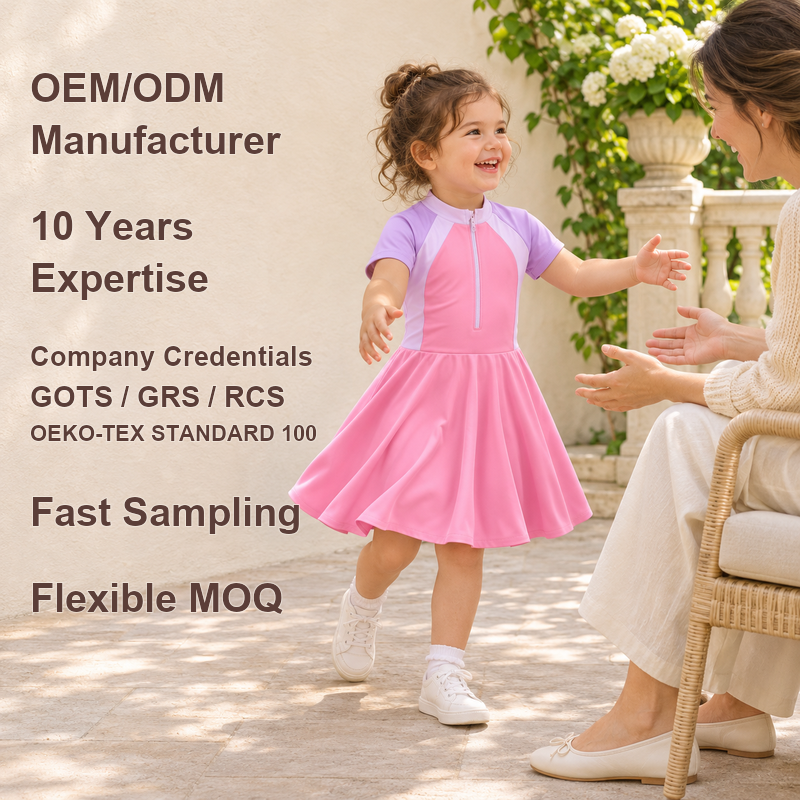
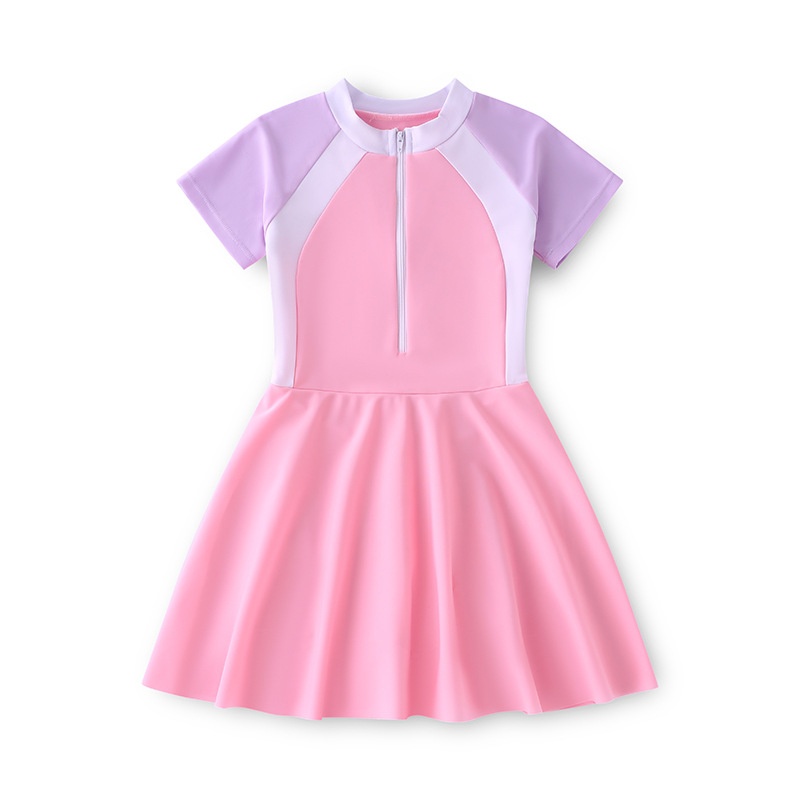
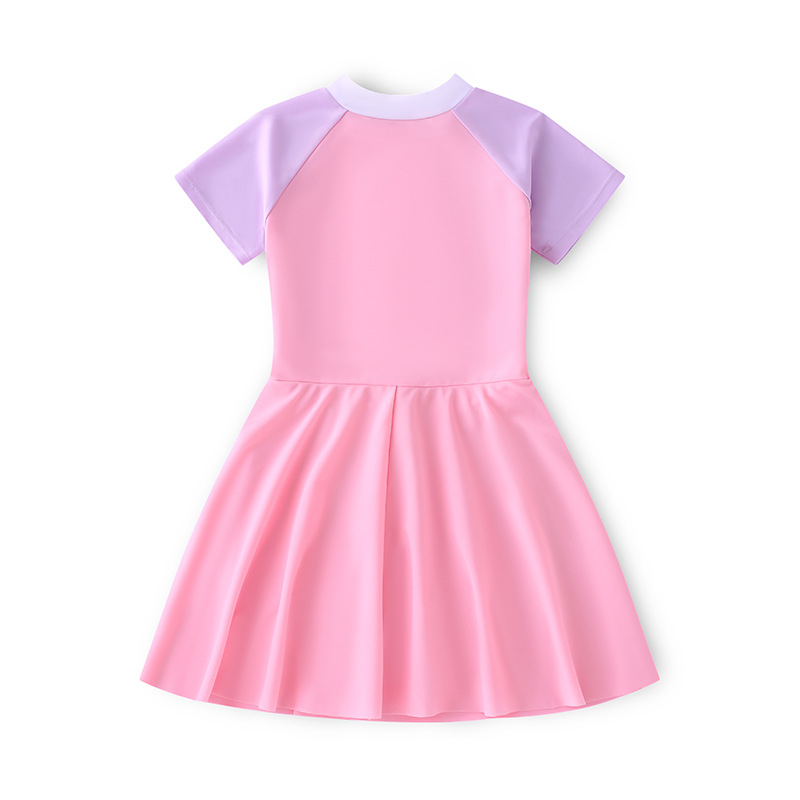
Girls' Recycled Polyester Skater Dress with Color Block Design | Short Sleeve Pink Flared Dress with Front Half-Zip | Custom Kidswear OEM ODM Manufacturer


- Overview
- Girls' Recycled Polyester Color Block Dress
- Recommended Products
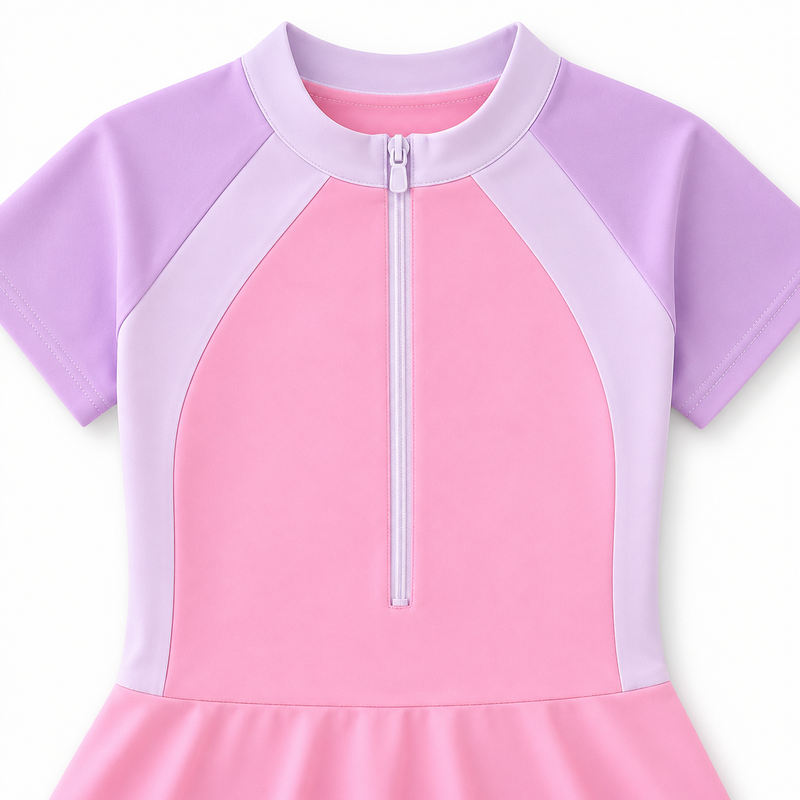
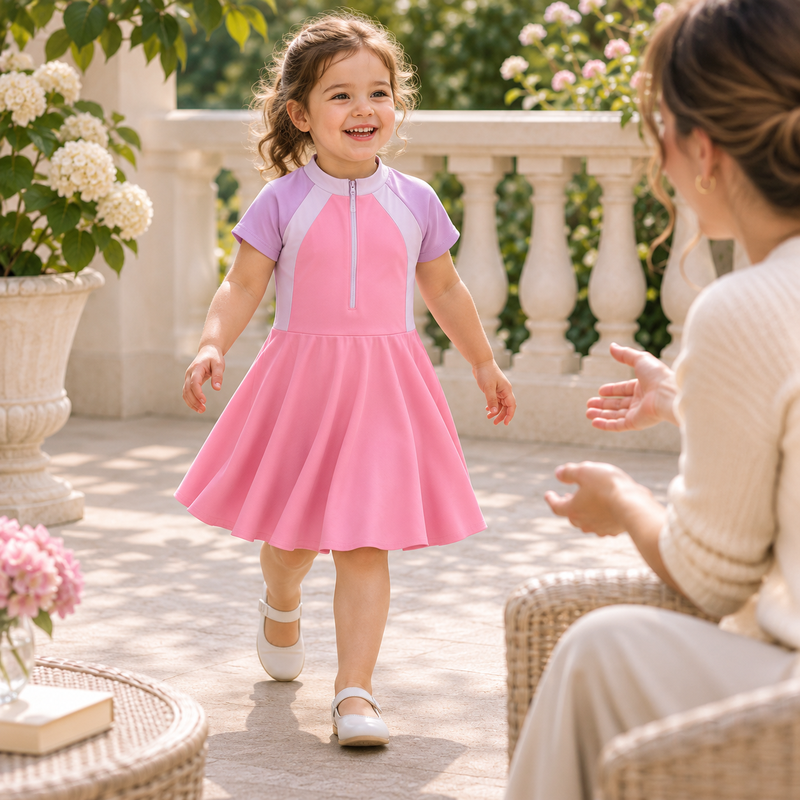
A swim dress in a 100% recycled polyester shell: raglan short sleeves, a half zip at the centre front with a chin guard, a lined bodice and a gathered skirt falling from the waist. Pink body, lilac sleeves, white raglan panels.
Swimwear is the one children's category where the garment is judged wet. Every question a buyer asks about it — will the colour hold, will it go see-through, will the skirt stay down, will the zip survive — is a question about what happens in chlorinated water, not on a hanger. Those four are addressed in order below, because each one is solved by a different part of the specification.
At a glance
1. Fibre: why polyester, and what "recycled" commits you to
- Polyester is the chlorine-tolerant option in swimwear. Chlorine attacks nylon and it attacks elastane far harder than it attacks polyester, so a polyester shell is the choice where a garment has to survive a season of pool water rather than a holiday.
- The stretch yarn is the weak point, not the shell. Recovery, sagging at the seat and the leg opening, and the softening that ends a swimsuit's life all come from the stretch component, so where a stretch yarn is specified its chlorine resistance is a separate decision from the shell's.
- rPET is the same polymer from a different feedstock. Dyeing, hand, drying and drape behave as polyester; nothing about the recycled route asks the sewing floor to work differently.
- The percentage is a chain-of-custody claim. GRS covers recycled content with processing controls and chemical limits, RCS covers the recycled content alone, and both run on transaction certificates — so the claim holds only while the certificate names the seller, the article and the percentage.
- Recycled feedstock does not change colour fastness or UV behaviour. Both are set by dye selection, knit tightness and finishing. A recycled shell and a virgin shell of the same knit test alike; the difference sits upstream, in the certificate file.
2. Fastness: four things try to strip this garment
- Chlorinated water is the first. Colour fastness to chlorinated water is tested as its own property, on the assembled garment rather than on the panels, because a colour-block style fails at the boundary — pink bleeding into the white raglan panel is the failure a parent sees, and it does not show up when each colour is tested alone.
- Sea water is the second. Salt water fastness is a separate test from chlorine; a shade that passes one does not automatically pass the other.
- Light is the third. Pale pink and lilac are the shades that shift first, and a swim dress spends its life in direct sun, so dye is chosen for light fastness over brilliance.
- Sunscreen and perspiration are the fourth. Residues on the cloth during wear are a fastness test in their own right, and pale grounds show a mark where a darker ground hides it.
- Testing runs on the finished garment, in the colour combination sold. Blocked styles are where the panel-to-panel problems live, and a per-panel test file answers the wrong question.
3. Opacity: the wet test
- Wet cloth is more transparent than dry cloth, at the same weight. This is the failure a buyer only discovers after the first swim, so opacity is specified as a wet condition, not a dry one: the bodice is lined at the front, and the lining is chosen so the garment still reads solid when soaked.
- Pale pink over white is the worst combination for it. A white panel behind a pale pink one, or the reverse, is where a swimsuit looks thin in water; the panel layout and the lining are set as a pair.
- The skirt is unlined by design, because a lined skirt holds water, drags and dries slowly; instead the skirt is cut from a weight that stays opaque on its own, and the bodice beneath it is the lined part.
- Seams and topstitching are opacity points. A seam that pulls open under stretch opens a line of light; flatlock seams are used so the join stretches with the cloth instead of gapping.
4. Coverage in water: the skirt lifts
- A gathered skirt is a silhouette, not a coverage device. In water it floats up and outward, so the coverage a parent is buying has to come from the bodice and the brief rather than from the skirt; the skirt is cut full enough to fall back into place on standing, which is what it is for.
- The bodice is where the fit is decided. It has to hold at the bust and the shoulder without riding up when the arms lift, so the block is fitted on the body rather than cut loose over it.
- The leg opening is the security point. Elastic at the leg is set to hold without marking, and its recovery is what keeps the garment from gaping in water; that is checked after repeated wet-and-dry cycles, not once on a dry sample.
- The raglan sleeve is set for reach, since a child's arms are up more than down in water; the armhole is cut so the sleeve does not pull the bodice up when the arm goes overhead.
- Entry is part of coverage. A wet swimsuit has to come off easily, so the half zip is the entry route and the neckline is sized to pass the head without stretching the collar out of shape.
5. Hardware and seams: what water does to them
- The zip is nylon coil with a plastic slider, not metal. Metal sliders pit and seize in chlorinated water; a plastic slider on a coil zip is the only combination that keeps working for the life of the garment.
- The chin guard is not cosmetic. The zip runs to the top of the collar, so the guard is what keeps the slider off the throat when the child is lying back in water.
- The puller is a small part and is tested as one, including its attachment after wet-dry cycling.
- No ties at the neck and no drawcord anywhere. Cord rules for children's clothing restrict neck cords, and on swimwear a neck tie is both a cord and an entanglement risk; this style is built without either.
- Flatlock throughout. An overlocked seam on swimwear is a ridge that chafes when wet and a row of loops that snags; flatlock lies flat, stretches with the knit and does not hold water in the seam channel.
- Needle control. 100% needle detection on finished pieces, one-for-one exchange at every break with the machine stopped, work within 2.5 m re-screened twice, needle-free area enclosed, 2 m deep, single entry.
6. Size: 2A–8A, and what the block has to allow for
- The range steps across two chemical classes. The 2A size is for a child under 36 months and is assessed as Class I; 4A and above is Class II, with the certificate set issued to cover both or the range split into two orders with two limit sets.
- Swimwear is sized on the body, not over clothes, which is the opposite of outerwear: there is no ease to hide a grading error, so chest, waist and torso length are graded together.
- Torso length is the dimension that fails first. A swimsuit that is correct at the chest but short in the torso pulls at the shoulders and rides at the leg; the sample is checked with the arms raised for that reason.
- The skirt length grades with the body, so the proportion of skirt to bodice stays the same from 2A to 8A rather than the skirt growing faster than the child.
- The neckline opening grades with the head, since it is the entry route: too small and the collar distorts with use, too large and the bodice slips off a narrow shoulder.
7. Customization, sampling and what we need to quote
- Sleeve. Raglan short sleeve as shown; a long sleeve rash-guard version; a flutter sleeve.
- Skirt. Gathered skirt as shown; a plain A-line; a skirted brief with a separate top.
- Closure. Half zip as shown; a scoop neck with no zip; a back zip for the older sizes.
- Colour blocking. Pink body, lilac sleeve, white raglan panel as shown; further combinations lab-dipped as a set.
- Lining. Front bodice lined as shown; a fully lined bodice; an added modesty panel in the skirt.
- Fastness route. Quoted with chlorinated water and sea water testing on the assembled garment, or with a reduced test scope where the market allows.
- Packing. Polybag with size sticker; hanger; woven or printed label, satin care label, hangtag with care symbols.
- Sampling. 3–7 days from a confirmed tech pack, with the block fitted and checked wet as well as dry; fastness testing is booked separately and its lead time is added to the schedule.
- Bulk lead time. 30–60 days from approval by quantity and dye lot schedule; rush production is quoted per order.
MOQ: 300 pcs for a custom development — custom fabric, colour, blocking or fit; 50 pcs for a decorative process added to a stock body; 100 pcs for stock fabric with your own logo and label. Mixed colour and size orders are quoted per order. These are standing programme terms, confirmed against the current quotation.
Production runs with our production partner, Suzhou Shelmin Trade Co., Ltd.: 7,200 m² workshop, 8 lines, 200 staff, 6,000 pieces per day. Design confidentiality is held under NDA; buyer patterns and colourways are not re-used.
To quote, we need: target market and the fastness tests it requires; whether a stretch yarn is in scope and at what percentage; shell weight and knit; the lining weight; whether the skirt is lined; zip type; the colour combination you want tested; packaging; and whether certification runs in your brand name.