EN

OEM/ODM 100% Cotton Double-Layer Crinkled Gauze Baby Romper | Eco-Friendly Plant-Dyed 135gsm Infant Jumpsuit | Custom Short Sleeve Button-Up Newborn Crepe Bodysuit Wholesale


- Overview
- OEM/ODM 100% Cotton Plant-Dyed Baby Romper 135gsm
- Recommended Products
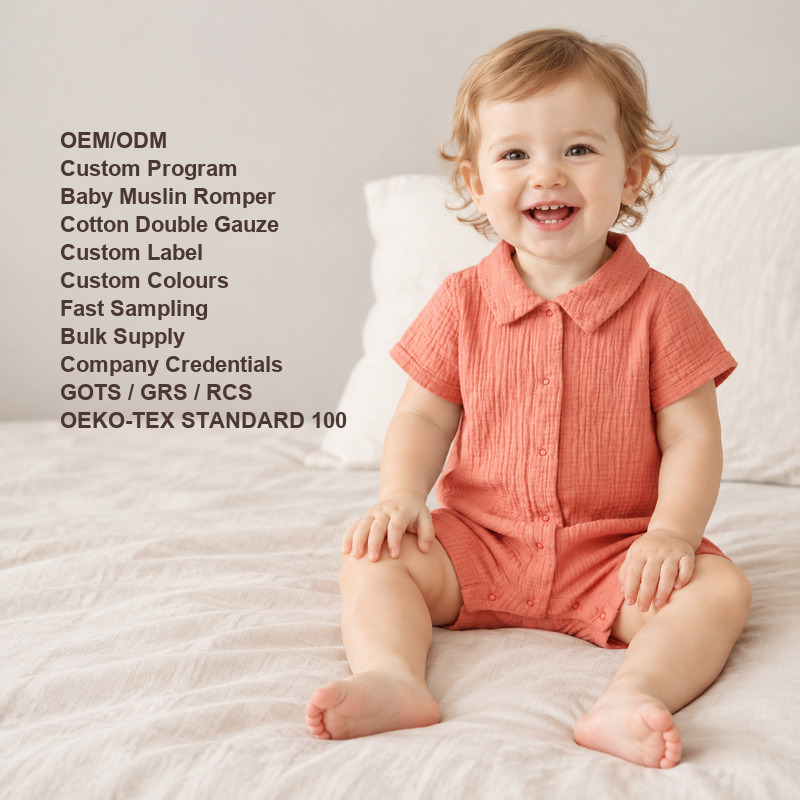
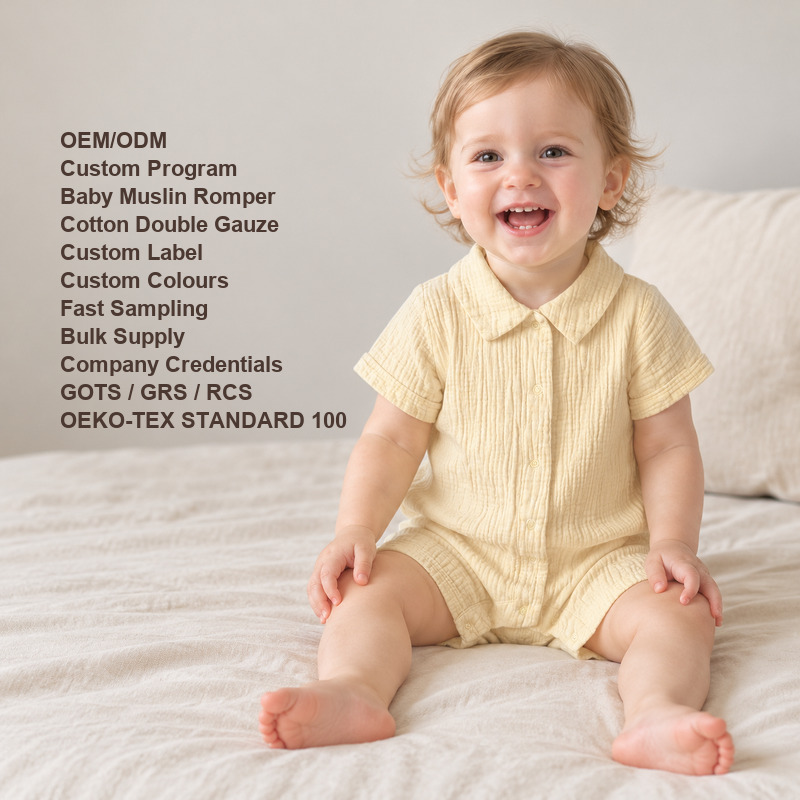
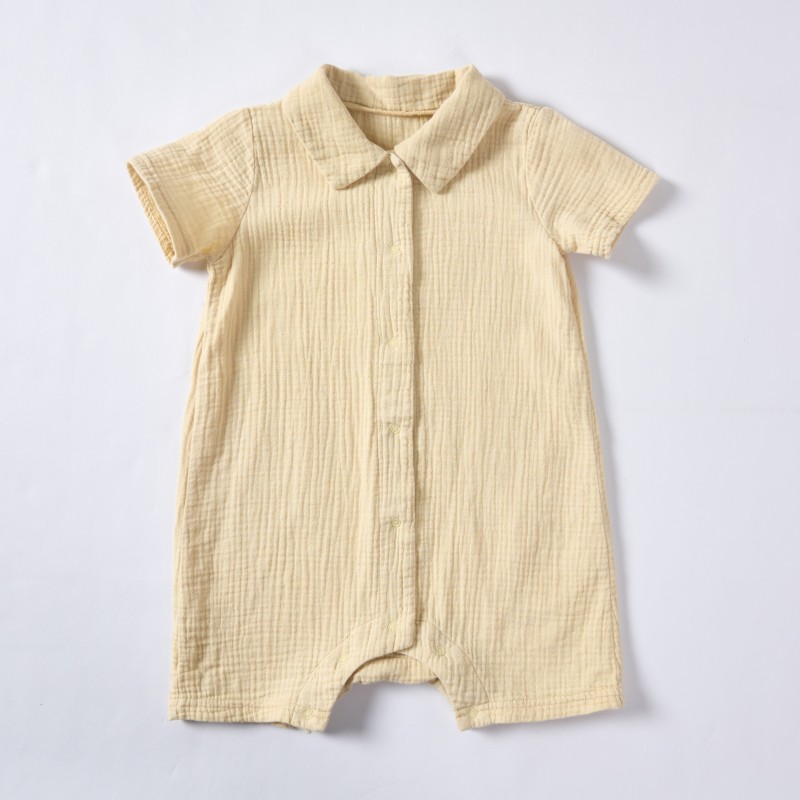
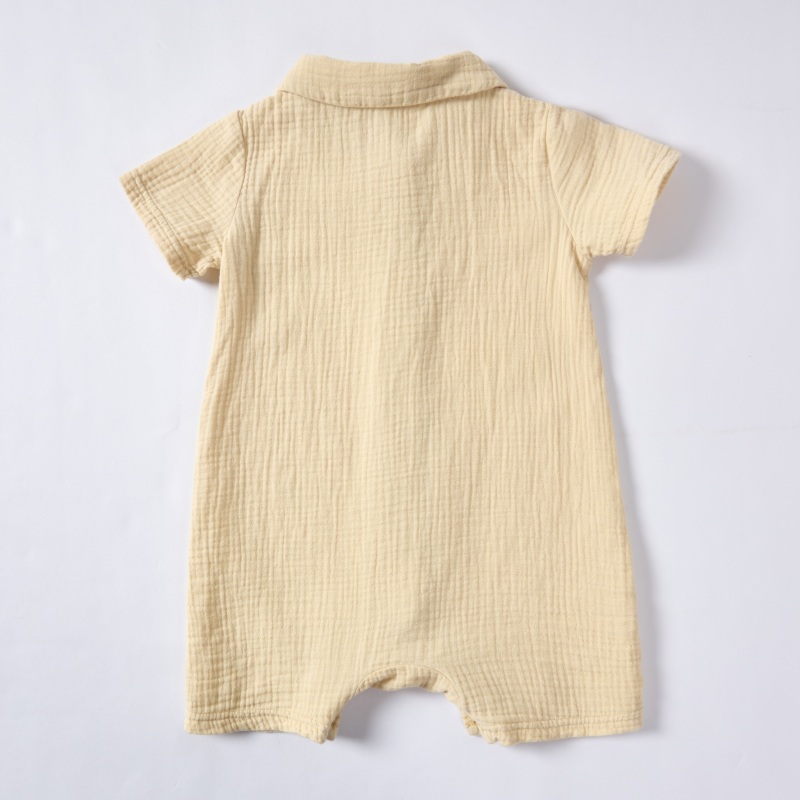
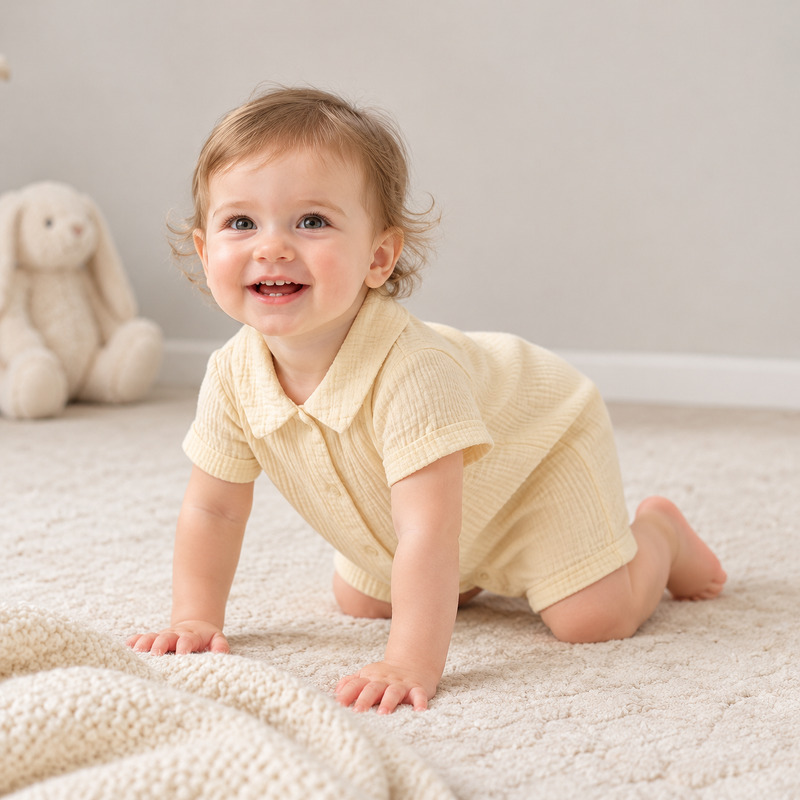
A short-sleeve shirt romper in a double-layer crinkled cotton, 135 gsm, dyed to a butter cream with sappanwood (苏木), madder (茜草) and pomegranate rind (石榴皮): a shirt collar, a full centre-front placket on snaps, short sleeves with a turned hem, straight short legs with a snapped crotch.
At this depth the garment stops hiding its own construction. A cream ground at 135 gsm shows what is behind it — the ring of each snap, the shadow of the fold inside the placket — and it records what lands on it, which on a baby is mostly at the upper placket. So this page is about two things a mid-depth version never has to discuss: what shows through, and what shows up.
At a glance
1. At cream depth the placket is semi-transparent
- A two-ply crinkle at 135 gsm is a light cloth, and at cream depth there is no colour to hide what sits behind it: the setting ring of each snap reads through as a faint circle, and the fold inside the placket reads as a soft vertical shadow.
- Neither is a fault in the make; both are a specification. What decides them is the number of layers behind the placket, the profile of the snap, and whether the placket is backed.
- So the placket is specified with the snap rather than after it: a low-profile snap, an extra layer behind the placket face where the ring sits, and the fold allowance turned so that its shadow falls inside the band rather than beside it.
- The check is a look from the front in daylight, on the finished garment, because the effect is invisible on a flat swatch and obvious on a made-up romper held up to a window.
- This is also why a cream version is not a colour change on the coral pattern. The construction behind the placket is different, and so is the price of the placket operation.
2. The upper placket is where everything lands
- Milk, food and hands arrive at the neck and the upper placket, and a cream ground records them where a coral absorbs them visually.
- So the placket is kept narrow and kept flat. A wide placket gives soil a bigger target, and a placket that has cockled in the wash holds what lands in its hollows rather than letting it wipe away.
- Flatness is a finishing decision made upstream: cloth fully relaxed before cutting, a placket cut on grain, and a press that sets the fold rather than stretching it.
- The care wording says what the garment does rather than what would be convenient: wash the whole garment cool rather than working on the placket, and dab a mark instead of scrubbing it, since scrubbing a cream ground takes the surface with the soil.
- This is written before sampling, not after the first complaint, because it is the one instruction that changes how the garment ages in the customer's hands.
3. Every press mark shows, and a press mark is a light band
- Pressing flattens the crinkle, and a flattened area reflects light where the texture scatters it, so on cream the placket reads as a slightly lighter band with a soft edge on each side.
- The band itself is wanted — it is the straight line the garment is judged by — but a second band beside it is not, and that is what a press plate wider than the placket leaves.
- So the plate width is set to the placket width, the press is made through a cloth rather than directly on the surface, and the same plate is used for every size rather than scaled with the garment.
- Press marks are also where handling shows first, since a hand that has touched a snap or a machine leaves a grey smudge that reads clearly on cream and not at all on coral.
- Both are checked on the finished garment in raking light, not on the cutting table, because the band and the smudge are both low-contrast marks that a front-on view hides.
4. A snap that has pulled shows as a light ring
- Edge distance decides whether a snap tears out, and spacing decides whether the placket gapes at the chest; both are set against this cloth rather than copied from a flat-poplin pattern.
- On cream a tear-out does not read as a hole first, it reads as a frayed lighter ring, because the fibres pulled to the surface scatter light differently from the dyed ground.
- That makes the pale version less forgiving of a marginal snap setting than any mid-depth colour in the range, even though the mechanic is identical.
- So retention is tested on the finished garment with the full placket stack in place, and the edge distance is measured on the garment rather than assumed from the pattern.
- The ring of flattened texture around each snap is expected, and it is graded for evenness instead of treated as a mark; on cream it is one of the reasons the placket is read from close up before approval.
5. Cream shows a seam under tension
- Where a seam is under tension it opens slightly, and at pale depth the gap reads as a light line — the effect the trade calls grinning, and it is most visible at the collar edge, the sleeve hem and the crotch corner where four edges meet.
- So stitch density and seam allowance are set together for this cloth, and the seams that sit on a curve are checked on the finished garment rather than on the flat piece, since a curve is where the pull concentrates.
- The collar edge is the first place to look, because it is also the edge the eye reaches first, and on cream a grinning collar is read as a cheap collar whatever the cloth cost.
- The crotch corner is the second, because four edges and a snap stack meet there and the bulk has to be trimmed in steps rather than sewn harder.
- Both are inspected in raking light on the made-up garment, in the same pass as the press-mark check, since they are the same kind of low-contrast defect.
6. Two plies, and the coverage question at the seat
- Every fold on this garment turns the cloth over, so a half step between the two plies becomes a visible edge at the placket turn, the collar roll and the sleeve hem turn; both faces are read side by side before and after washing.
- At cream depth there is a second question a coral does not raise: the crotch and seat are a single layer of a light two-ply cloth, and a pale ground is the one that shows a nappy through it when damp.
- So coverage is checked rather than assumed, dry and wet, against a standard insert under daylight, and the answer is a construction one if it fails — a seat lining or a slightly heavier cloth in the seat panel — quoted as a variant rather than promised as a colour change.
- The placket inside face is read as a face, since it is on show every time the garment is opened, and on cream a pale fringe at an overlocked edge is the first thing a reviewer sees.
7. Tests, sizes, sampling and quoting
- Fabric tests at the shipped depth: light to ISO 105-B02, wash to ISO 105-C06 with a whole garment in the load, rubbing to ISO 105-X12 on the outside face, on the inside face and through creases, perspiration and saliva to ISO 105-E04 plus the destination market's saliva method, with colour read on both plies.
- Depth-specific checks: show-through at the placket from the front in daylight, with the snaps set; press-band width against the placket width; handling smudges at the placket and snaps in raking light; seam grinning at the collar edge, sleeve hem and crotch corner; and wet and dry coverage at the seat against a standard insert.
- Construction checks: placket straightness under a rule at three points, placket width from neck to hem, snap spacing and edge distance on the garment, gaping after washing, snap retention at its Class I requirement with the full stack, collar point symmetry, and bulk control at the crotch corner.
- pH is measured on the garment and held between 4.0 and 7.5; extractable heavy metals are tested on the finished garment; phenol yellowing is checked to ISO 105-X18 on a specimen carrying the actual packing fold, with packaging specified free of BHT — the last of these matters most on a cream ground.
- Safety checks: snaps tested as small parts on the finished garment, neck opening measured on the closed garment on the smallest size, leg opening measured with a nappy in place, and confirmation that the garment carries no cords, ties or toggles.
- Five sizes on a measurement chart: 6-9M, 9-12M, 12-18M, 24M and 36M move on chest, body length, sleeve, leg opening and crotch depth, graded from measurements rather than by percentage.
- Sampling: 3-7 days from a confirmed tech pack, covering a dyed strike-off with its route and rinse stated, a made-up romper with the placket, collar, snaps and hems finished as production, a show-through view in daylight, a press-band and grinning inspection in raking light, a wash-and-remeasure with both faces re-read, a snap spacing and gaping check after washing, a snap retention pull, a coverage check at the seat dry and wet, and a fit check over a nappy.
- Bulk: 30-60 days from approval, planned per dyebath, with the placket layer, snap profile and press plate fixed for the style so the placket is made the same way in every batch.
- MOQ: 300 pcs for a custom development covering cloth, shade, crinkle level, trim or fit; 50 pcs for a decorative process on a stock body; 100 pcs for stock cloth with your own logo and label. Mixed colour and size orders are quoted per order, and terms are confirmed against the current quotation.
Production runs with our production partner, Suzhou Shelmin Trade Co., Ltd.: founded 2017, 7,200 m² workshop, 8 lines, 200 staff, 6,000 pieces per day. Design confidentiality is held under NDA; buyer patterns, shades and prints are not re-used.
To quote, we need: target market and the Class I tests it requires; whether a faint show-through of the snap rings is acceptable, or whether the placket is to be backed to remove it, since that is a construction and price decision; whether the care wording may name cool whole-garment washing and dabbing rather than spot work on the placket; snap type, spacing and edge distance; press-plate width, or agreement that it follows the placket; cuff or hem treatment and leg-opening dimension per size; the crinkle level you want, as crease count and depth per unit; whether a seat lining is needed for wet coverage; lot certificates for the three plants and for the thread; the pH target and the dyehouse water specification; packing method; and whether certification is to run in your brand name.