EN

Cotton Baby Girl Dress with Lace Collar & Ruffle Sleeves | Plant-Dyed OEM ODM Babywear Manufacturer


- Overview
- Eco-Dyed Baby Dress with Lace Collar and Ruffle Sleeves
- Recommended Products
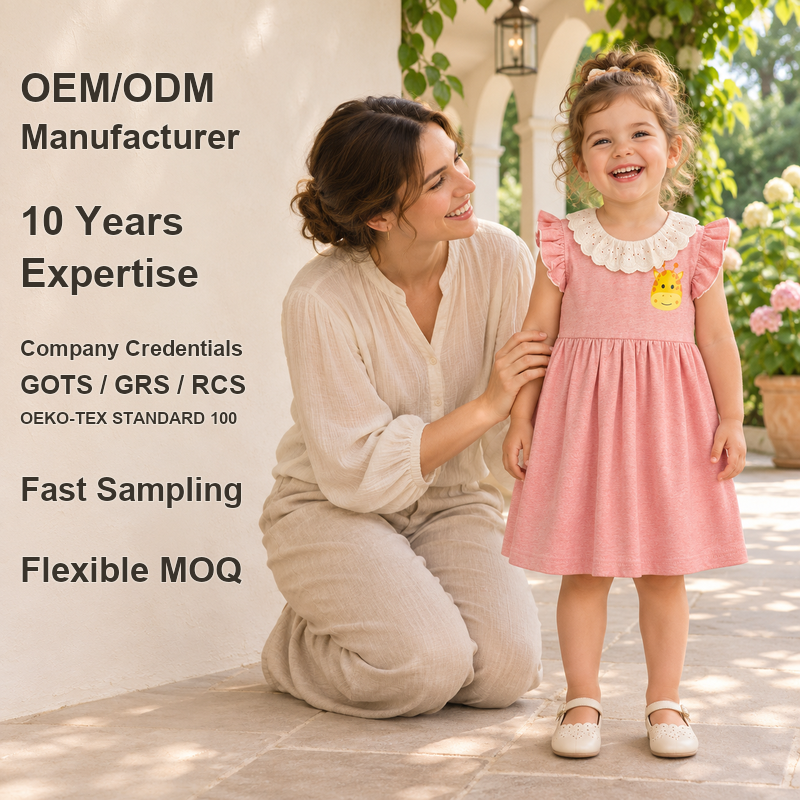
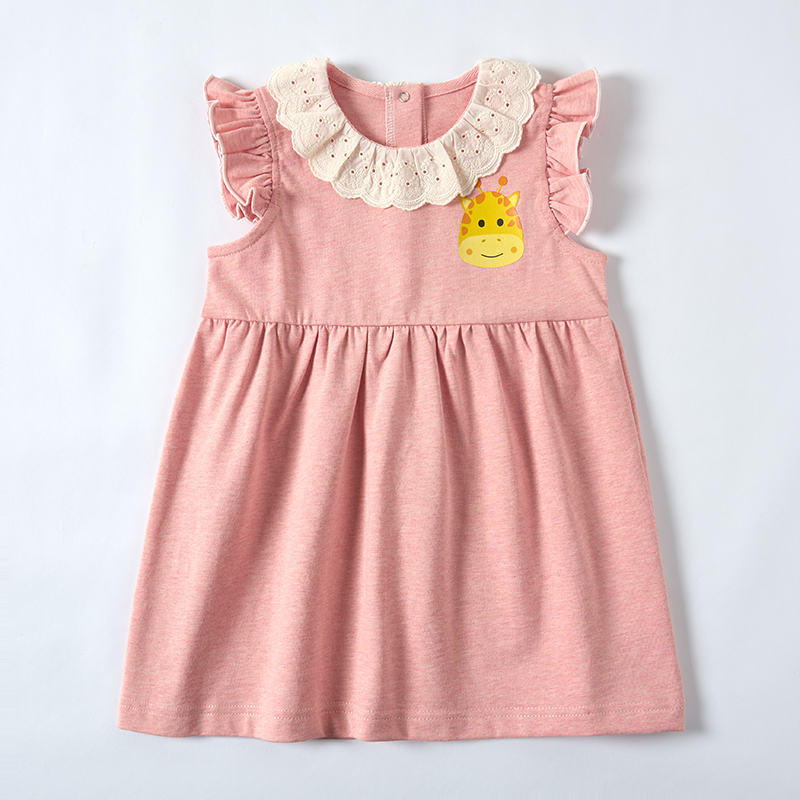
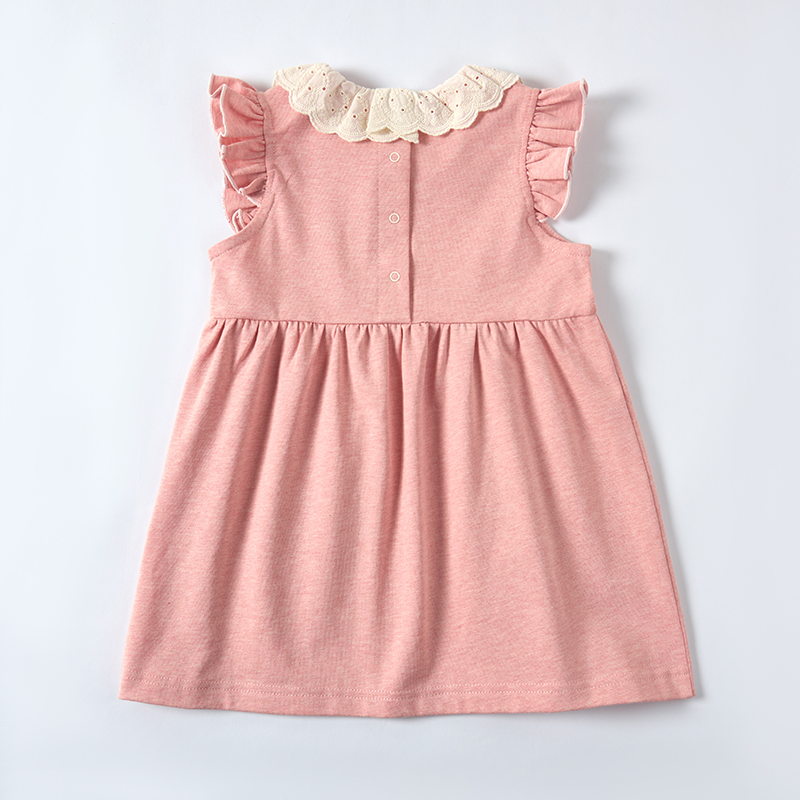
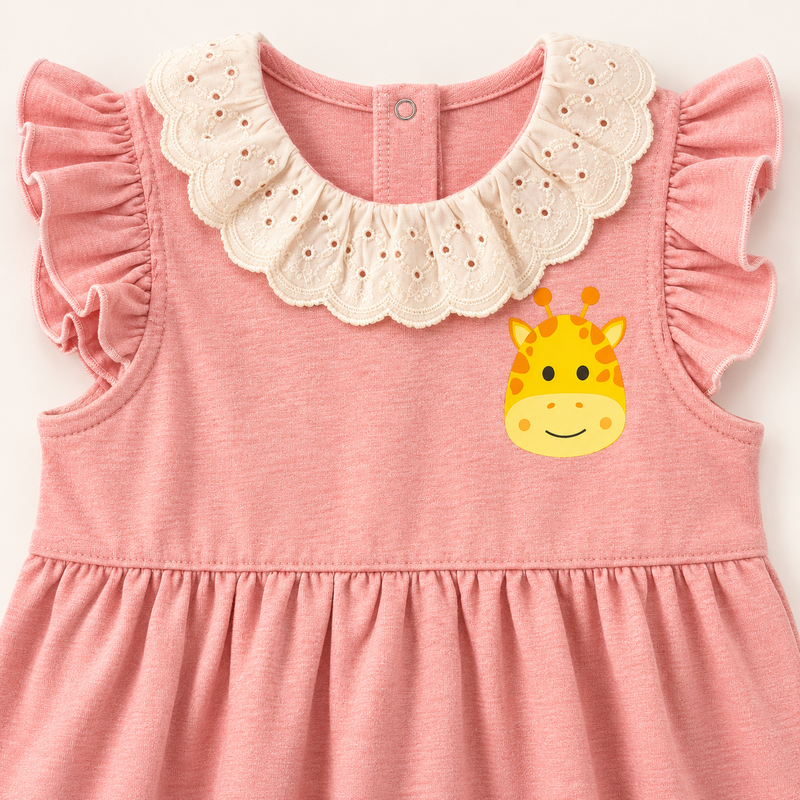
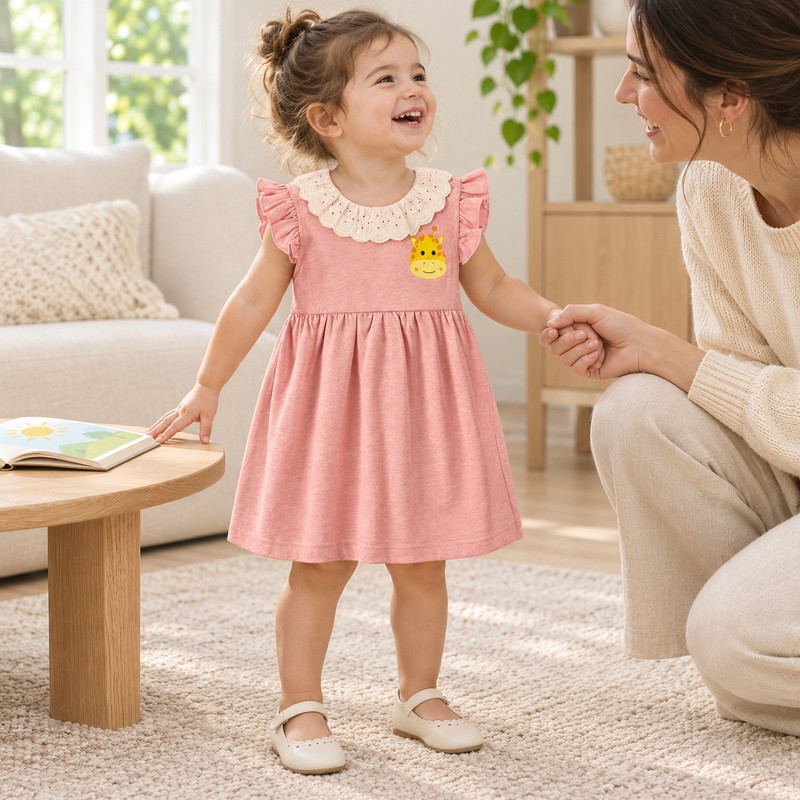
A dress in 230 gsm cotton jersey, plant dyed to a dusty rose with madder and logwood: a cream eyelet lace collar at the neck, flutter sleeves edged with a fine picot, one button at the back, a gathered skirt from a waist seam, and a single giraffe printed on the bodice below the collar.
Two things on this dress are not where they look. The flutter sleeve is not a sleeve — it is a frill hung at the armhole, and it takes away the armhole's ability to stretch. And the print is not a repeat but one placed motif, which means it has to be positioned again for every size rather than simply repeated.
At a glance
1. Cloth: two sets of gathers on one garment
- This dress gathers twice. The skirt is gathered onto the bodice at the waist seam, and each flutter is gathered into its armhole; a 230 gsm jersey is chosen because it gathers without stiffness at both places.
- Gathering is the only shaping in the garment. There are no darts and no panels, so the fit comes from the waist seam position and the armhole size, and both are set on the body rather than on the pattern.
- The heather in the yarn shows through a pale plant shade. Flecks read more strongly on this rose than they would on a solid ground, so the yarn is specified rather than accepted as it arrives.
- The bodice is a single layer and the skirt a single layer, which is what keeps the dress light; the neckline and armhole seams are the only places where the cloth is doubled.
- Cotton jersey has stretch from its loops but no elastane to recover it, so every opening on this dress is held by binding or by a seam rather than by the cloth springing back.
2. The flutter sleeve: a frill is not a sleeve
- A flutter covers nothing. It is a frill hung at the armhole, so it shades the shoulder and finishes the edge, and it gives no warmth and no protection — which is why the garment is sold as a dress and not as a sleeved one.
- It also takes the stretch out of the armhole. A jersey armhole stretches to pass an arm; a frill gathered into that seam does not stretch, so the opening has to be sized for the arm without relying on give.
- That changes the armhole seam from a finish to a structure. With a binding, the armhole is a folded edge; with a frill, it is a seam that both holds the garment and carries the frill, and it is the seam an adult's hands are closest to when lifting a baby under the arms.
- The frill is cut and gathered, so its edge length is fixed. A frill cut too full collapses into a ruffle; too skimpy and it stands out like a collar, and the fullness ratio is a number on the tech pack rather than a judgement at the machine.
- Its picot edge is a finished edge, not a raw one. A rolled or picot edge keeps the frill from fraying in the wash, and it is the edge that is inspected, because a frill is seen from underneath as much as from above.
3. Three layers at the shoulder
- Collar, frill and bodice all arrive at the same point. The lace collar sits at the neckline, the flutter is set into the armhole, and both are within a couple of centimetres of the shoulder seam, so the order in which they are sewn decides how the shoulder sits.
- The order is fixed on the tech pack. The collar goes in with the neckline seam enclosed, the frill is set after so its gathers are not crushed by the collar seam, and the shoulder is pressed flat between the two operations.
- The bulk is managed by trimming, not by pressing harder. Three layers plus seam allowances at one point will ridge on a baby's shoulder if the allowances are left full; they are graded and pressed away from the neck.
- The lace shrinks differently from the jersey, so it is washed and measured before the neckline is set; a lace that pulls in at the neck takes the shoulder with it.
- The shoulder is checked on the body, not on the hanger. A hanger hides exactly the sag that three layers at one point can produce.
4. The motif: one print, re-placed per size
- A placed motif is not a repeat. There is one giraffe, so it cannot simply run across the roll; it is positioned on each bodice panel, and the position is set per size rather than scaled from a single artwork file.
- A fixed motif grows relative to the garment. The same giraffe occupies far more of a 6M bodice than a 36M one, so either the motif is scaled with the size or it is held constant and repositioned — and the choice is made per order, because the two give a different look on a size run.
- It sits below the collar, so the collar is the reference. The motif is placed from the collar edge rather than from the shoulder seam, since the collar is what the eye measures against, and the gap is what makes it read as deliberate.
- It stays clear of the armhole and the waist seam. A motif that touches either seam distorts when the seam is sewn or the skirt is gathered, and on a knit the distortion is permanent.
- Print and cloth are approved together. A single motif on a heather rose is judged on the dyed cloth at the size where it is smallest, because that is where a loss of detail shows.
5. Yellow on rose: the ink is the specification
- The motif is the warmest thing on the garment. A yellow-orange giraffe on a cool dusty rose is the highest-contrast pair on the dress, which is why it reads at a glance — and why a slightly wrong yellow is obvious rather than subtle.
- Warm yellows and oranges are where restricted pigments sit. Cadmium and chrome yellows are the historic route to that brightness, so the ink set is named by number rather than matched to the artwork, and the printed panel is tested as part of the article.
- On a Class I article the printed area is assessed like the dyed cloth for azo colourants, heavy metals and formaldehyde, plus the plasticiser limits that apply to prints; a pigment film is not exempt for being thin.
- Adhesion is tested on this knit, not on a flat one. Jersey stretches under the print, so the ink has to extend with it; cracking appears at the chest first because that is where the cloth moves most when a baby is picked up.
- The print sits under the chin when the baby is carried, so the area is treated as a contact surface and its fastness is checked with that in mind.
6. Size: 6M–36M, and what the block has to hold
- The range sits inside Class I, with 6M, 12M and 24M clearly under 36 months and 36M assessed as Class I because the article can be worn by a child under that age.
- The armhole is graded with the flutter, not with the arm alone. Because the frill removes the armhole's give, the opening is set from the arm measurement plus clearance at each size rather than by scaling one armhole.
- The waist seam sits high on the smallest sizes, above the nappy line at 6M and 12M, and drops toward the natural waist as the child grows.
- The back button is the entry. One button at the centre back opens the neck enough to pass a head, and it is checked with the button done up, since that closed measurement is what the pattern is set to.
- The sample is checked sitting and being lifted, because the shoulder — where collar, frill and bodice meet — is where this dress shows a fit fault first.
7. Customization, sampling and what we need to quote
- Sleeve. Flutter with picot edge as shown; a plain sleeveless armhole with binding; a short set-in sleeve.
- Collar. Cream eyelet lace as shown; a self-colour ruffle; a plain neckband.
- Print. One chest motif as shown; a motif scaled per size; a repeat instead of a single placement; no print.
- Skirt. Gathered as shown; a circle skirt; a tiered skirt.
- Shade. Dusty rose as shown; a warmer rose with more madder; a deeper mauve with more logwood, quoted with a light fastness note.
- Packing. Polybag with size sticker; hanger; woven or printed label, satin care label, hangtag.
- Sampling. 3–7 days from a confirmed tech pack, with a dyed strike-off, a wash trial on the lace and on the frill edge, a pull check at the shoulder and a print placement check at the smallest size.
- Bulk lead time. 30–60 days from approval by quantity and dyebath schedule; the bath is planned per batch, so a split delivery is quoted as two batches.
MOQ: 300 pcs for a custom development — custom cloth, shade, trim or fit; 50 pcs for a decorative process added to a stock body; 100 pcs for stock cloth with your own logo and label. Mixed colour and size orders are quoted per order. These are standing programme terms, confirmed against the current quotation.
Production runs with our production partner, Suzhou Shelmin Trade Co., Ltd.: 7,200 m² workshop, 8 lines, 200 staff, 6,000 pieces per day. Design confidentiality is held under NDA; buyer patterns, shades and prints are not re-used.
To quote, we need: target market and the Class I tests it requires; the ink set for the yellow-orange, named by number; whether the motif is scaled per size or held constant; the frill fullness ratio; the lace quality and whether it is pre-shrunk; the mordant route and the ratio of madder to logwood; packaging; and whether certification runs in your brand name.