EN

Custom Plant Dyed Cotton Baby Suspender Dress Soft Toddler Pinafore Skirt OEM ODM Infant Clothing Manufacturing for Boutique Kidswear Brands


- Overview
- Plant Dyed Cotton Baby Pinafore Dress OEM ODM
- Recommended Products
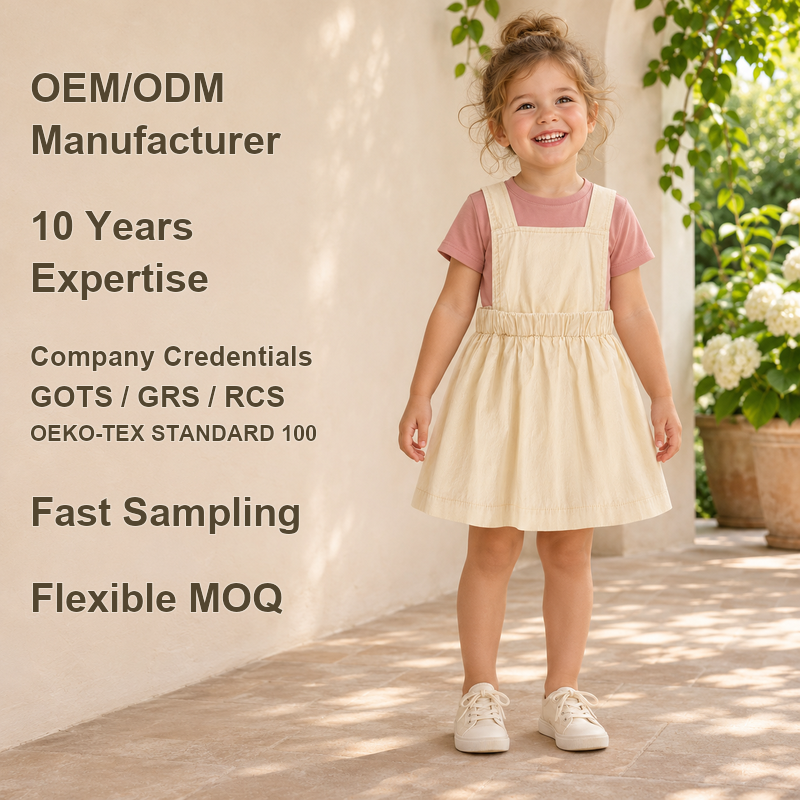
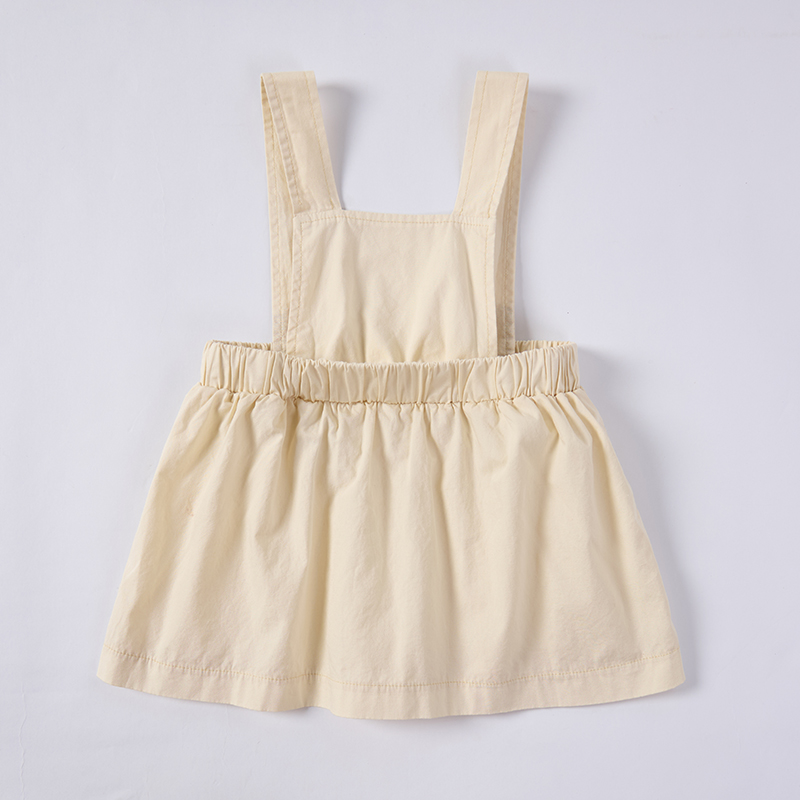
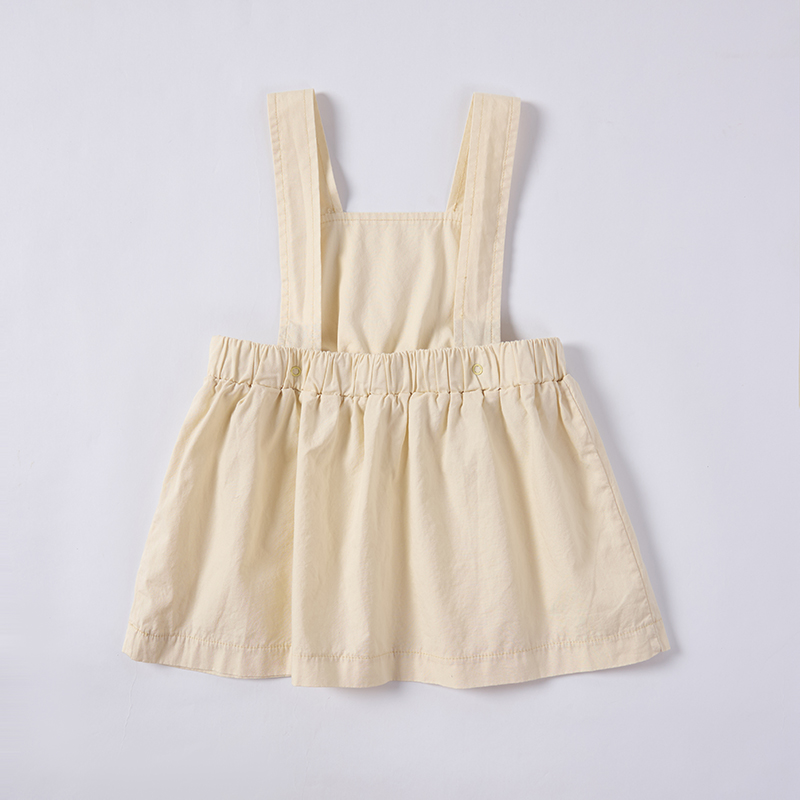
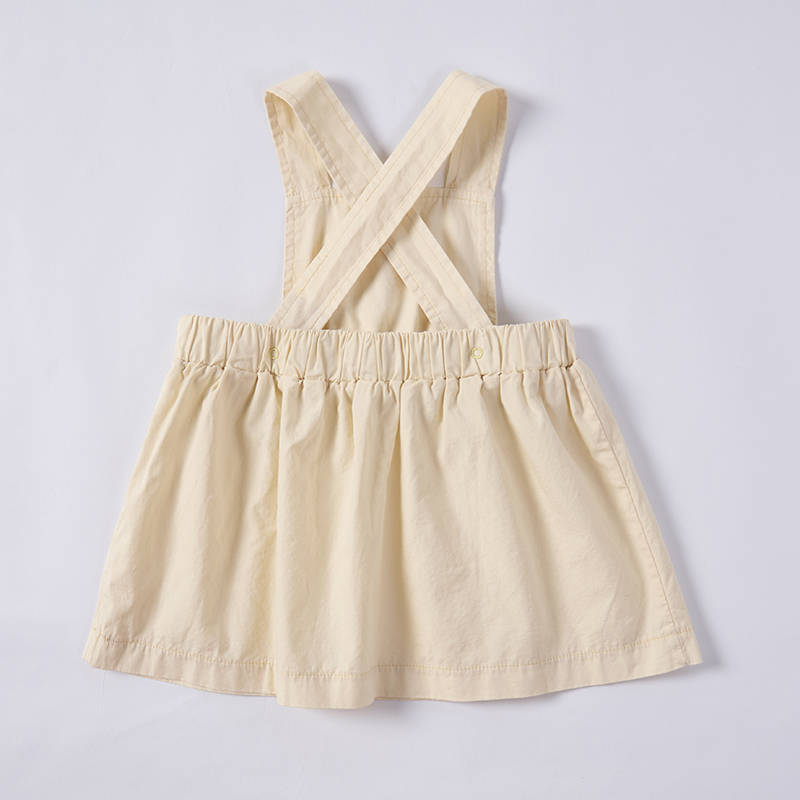
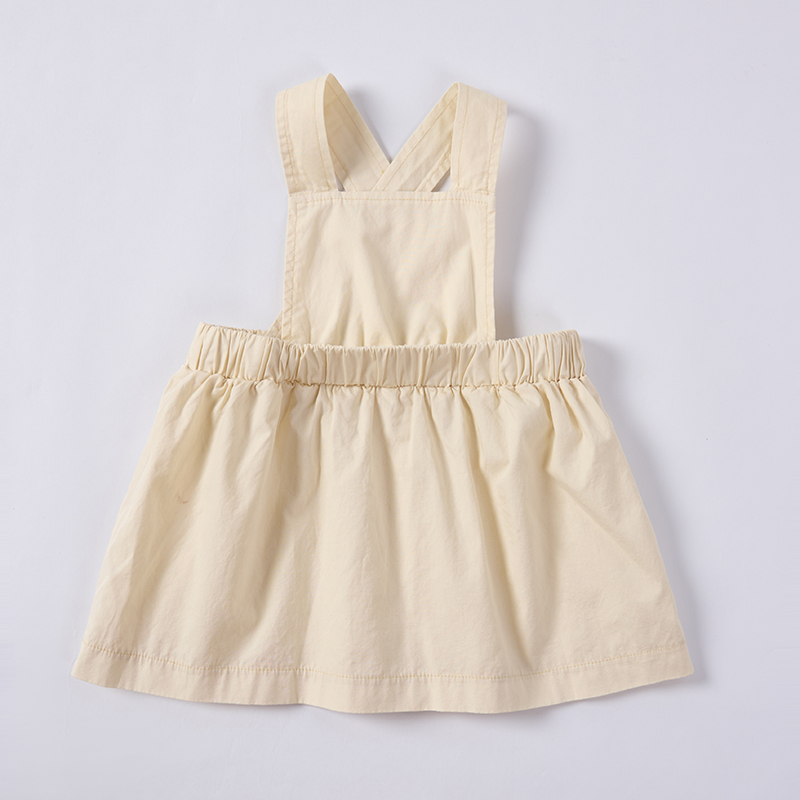
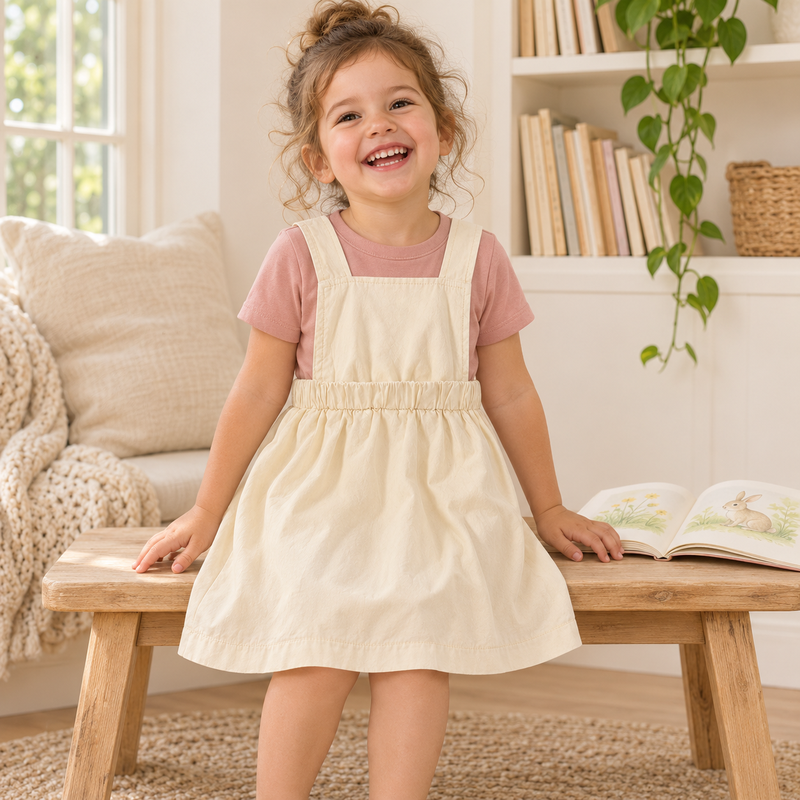
A pinafore dress in 125 gsm cotton poplin, dyed to a warm ivory with sappanwood (苏木), madder (茜草) and pomegranate rind (石榴皮): a square bib panel, two wide straps buttoned at the back waist, an elasticated and gathered waist, and an A-line skirt.
This recipe carries no metal mordant. On cotton that changes the order of operations: the rind goes on first and lays down a tannin, the two red-bearing plants follow in a second bath, and what holds the colour afterwards is that tannin layer rather than a metal lake. The hue is then steered by pH and by water, which are process decisions rather than ingredients — and on a pale shade they are where the colour is won or lost.
At a glance
1. The cloth: 125 gsm poplin in a pale shade
- A tight plain weave keeps a pale shade even. Poplin has no pile and no twill line to catch light at an angle, so ivory reads as one surface from bib to hem. On a pale colour, a single shade streak shows as a shadow line across the breadth.
- 125 gsm is the weight where two jobs both work. There is enough body to hold the bib panel square without interfacing, and little enough weight that the gathered skirt falls rather than standing away from the body.
- The weave has almost no give, so the dress is entered through the elasticated waist and the buttoned straps. Pattern, strap length and waist opening are set around that route rather than corrected at fitting.
- On ivory, the floor shows before the dye kitchen does. Rust from a machine bed, oil from a bare hand and a water mark all read at once on undyed-looking cloth, so covers, clean handling and edge-carrying are part of holding this colour, not housekeeping around it.
- Ivory sits close to the natural colour of cotton, so drift arrives as a cast — pink from too much sappanwood, yellow from madder in an acid bath — rather than as a different colour. That is why the shade is matched to a sealed sample instead of described in words.
2. Three plants, three jobs
- Sappanwood brings the red. The heartwood carries brazilin, which oxidises to brasilein and gives the pink-red this recipe needs; on cotton alone it sits near the surface and rinses away.
- Madder root builds the warm base. Its alizarin and purpurin give the brick-orange groundwork under the pink, and madder alone on cellulose also struggles to fix.
- Pomegranate rind is not a colour here. Its ellagitannins are the layer the other two hold on to — a tannin pre-treatment, which is the classical route to dyeing cellulose with madder-type colours.
- Two baths, in a fixed order. Rind first, until the cloth has taken the tannin; then sappanwood and madder together, extracted and cooled, in one colour bath. Reversing the order leaves the colour with nothing to sit on.
- The two reds are weighed as a pair. Sappanwood pulls the shade pink, madder pulls it brick; at ivory depth both sit at low load, so the ratio is fixed on a strike-off rather than copied from a formula.
3. No metal mordant: what carries the colour
- Cellulose has no ionic site for a dye like alizarin, which is why madder on cotton normally leans on a metal salt to form a lake. With no metal in the bath, that bridge has to come from somewhere else.
- The tannin layer is that bridge. Phenolic groups on the rind tannin hydrogen-bond to the cellulose and hold the dye complex at the fibre, so the mordant is a plant material applied in a separate step.
- A tannin bridge is weaker than a metal lake, so fastness is tested rather than assumed. Wash fastness to ISO 105-C06 and rubbing fastness to ISO 105-X12 run on the finished cloth at the depth actually supplied, not at a standard depth.
- No metal salt also removes a known failure route. A ferrous or copper bath brings oxidative tendering with it; here the strength question comes from hot tannin baths and repeated rinsing instead, and tensile and tear strength to ISO 13934-1 and ISO 13937-2 are tested against undyed cloth from the same lot.
- It removes a declaration line as well. There are no mordant metal impurities to report, which shortens the Class I file; in exchange, the plant material itself becomes the variable that has to be screened.
- The colour is a tannin-dye complex and is described as plant dyed. Calling it a mordant dye would misname both the chemistry and what the buyer is getting.
4. pH and water: how the ivory is held
- Without a metal, pH is the hue control. Sappanwood develops its red in a neutral-to-alkaline bath and turns yellow as the bath acidifies; madder deepens in alkali and shifts toward blue-red where calcium is high.
- So pH is set and logged per batch, and the water specification is part of the recipe: hardness, iron content and residual alkali all move a pale shade before they move a deep one.
- The finished cloth has to come back into the infant pH window of 4.0 to 7.5. A bath run alkaline for hue is neutralised and rinsed back into that window before the cloth is called finished — the point where dye chemistry meets the Class I file.
- Light is where the two reds part company. Sappanwood ages faster than madder, so light fastness to ISO 105-B02 is tested on the finished cloth at the supplied depth, because ivory and a full depth do not age the same way.
- The reference is a sealed dyed sample kept out of light, and shading is done against it rather than against a screen or a shade card, since a cast of this size is invisible on a monitor.
5. Class I: what a plant-dyed pale has to prove
- Class I is the class for articles under 36 months. 6-9M, 9-12M, 12-18M and 24M sit inside it by age; 36M is assessed as Class I because the article can be worn by a child under that age.
- The base fabric holds an OEKO-TEX Standard 100 certificate, and the Class I scope for this poplin, this colourway and its trim is confirmed against that certificate at quotation, before any claim is published.
- The plant material is the variable on this recipe. Rind and roots are agricultural, so heavy metals, pesticide residues and microbial load are screened at intake with a certificate of analysis per lot — the tannin step adds a material, and that material has to be documented.
- Fastness is judged as an infant article: washing, rubbing, perspiration, saliva and light, to ISO 105-C06, X12, E04 and B02, plus the saliva method the destination market applies.
- Article items are checked alongside the shade: pH of the finished cloth, formaldehyde and extractable heavy metals, with the dye recipe recorded in the same file so a buyer can see how the colour was built.
- Plant origin is not an exemption. The assessment is of the finished garment, and a mordant-free recipe is documented to the same limits as any other dye.
6. Bib, straps, buttons, waist and seams
- The bib hangs from the straps, so the straps carry the fit. Strap length and button position are set from the child's shoulder-to-waist measurement, and the waistband follows from them rather than the other way round.
- Straps are sewn to a finished length and buttoned. Two button positions are the growth allowance, and the strap end is reinforced where it meets the button, because two points carry the whole dress when a baby is lifted under the arms.
- Cord and drawstring rules are designed out. EN 14682 sets limits on cords and drawstrings on children's clothing; a fixed-length sewn strap and an elastic enclosed in a casing keep this style outside that category of risk.
- The waist gathers onto elastic inside a casing, with casing depth, elastic width and gather distribution specified together, since the casing is what stops the elastic rolling and holds the gathers where the pattern put them.
- Buttons are tested as small parts at 70 N retention, with button, thread and tab assessed as one unit, and checked against the small-parts requirements of 16 CFR 1501 for the US market. On ivory the trim is undyed corozo or a matched cream, approved against the dyed cloth rather than from a card.
- Seams run at 12-14 stitches per inch, and gathers are distributed from marked quarters so the volume does not land on one hip.
- Pressing is on the reverse with a press cloth: ivory shows a press shine less than a dark shade, and shows oil and rust at once, so machine beds are covered and pieces are handled by the edge.
- AQL 2.5 for major defects, 1.0 for critical. Needle control: 100% detection on finished pieces; needles exchanged one-for-one at every break with the machine stopped; work in progress within 2.5 m re-screened twice; needle-free area enclosed, at least 2 m deep, single entry.
7. Sizes, customization, sampling and quoting
- Five sizes, and at this age the steps are real. 6-9M, 9-12M, 12-18M, 24M and 36M are graded from body measurements rather than by a percentage step, because a nappy changes the waist far more than a size chart suggests.
- The waistband is re-set for each size: elastic length, casing height and button positions each come from the child's waist, and bib width follows the chest.
- Customization. Square or curved bib; buttoned, fixed or cross-over straps; elasticated waist or a flat waistband with a side opening; gathered, pleated or tiered skirt; a lined bib for a firmer front panel.
- Shade. Warm ivory as shown; a sand tone with more madder; a pinker cast with more sappanwood. Each is sampled before it is quoted, and each is tested at its own depth.
- Sampling: 3-7 days from a confirmed tech pack, including a dyed strike-off, a wash trial on the shade, light and wash fastness at the supplied depth, and a button pull test on the tab.
- Bulk: 30-60 days from approval, planned per dyebath; a split delivery is quoted as two batches because the bath is the unit of shade control.
- MOQ: 300 pcs for a custom development — cloth, shade, trim or fit; 50 pcs for a decorative process on a stock body; 100 pcs for stock cloth with your own logo and label. Mixed colour and size orders are quoted per order, and terms are confirmed against the current quotation.
Production runs with our production partner, Suzhou Shelmin Trade Co., Ltd.: founded 2017, 7,200 m² workshop, 8 lines, 200 staff, 6,000 pieces per day. Design confidentiality is held under NDA; buyer patterns, shades and prints are not re-used.
To quote, we need: target market and the Class I tests it requires; lot certificates for the sappanwood, madder and rind; the tannin load; the pH targets for both baths; the water specification; the depth you want the ivory at; button material; packaging; and whether certification runs in your brand name.