EN

OEM/ODM 100% Cotton Baby Girls Polo Shirts Natural Plant Botanical Dyed Tie Dye Infant Toddler Peter Pan Collar Puff Sleeve Blouse Tops Custom Wholesale Private Label


- Overview
- OEM Custom 100% Cotton Plant Dyed Baby Peter Pan Polo Tee
- Recommended Products
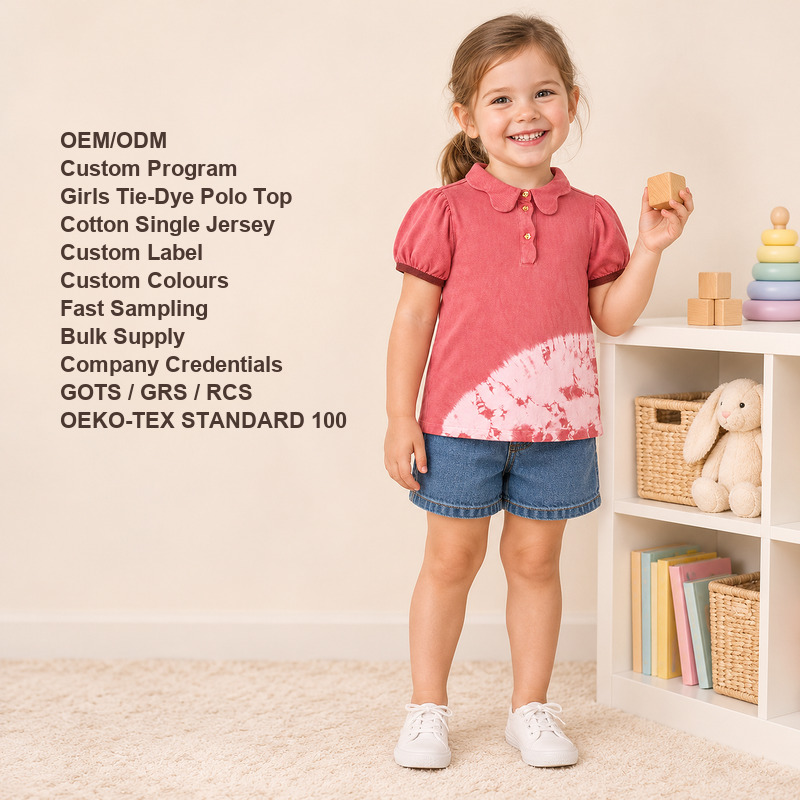
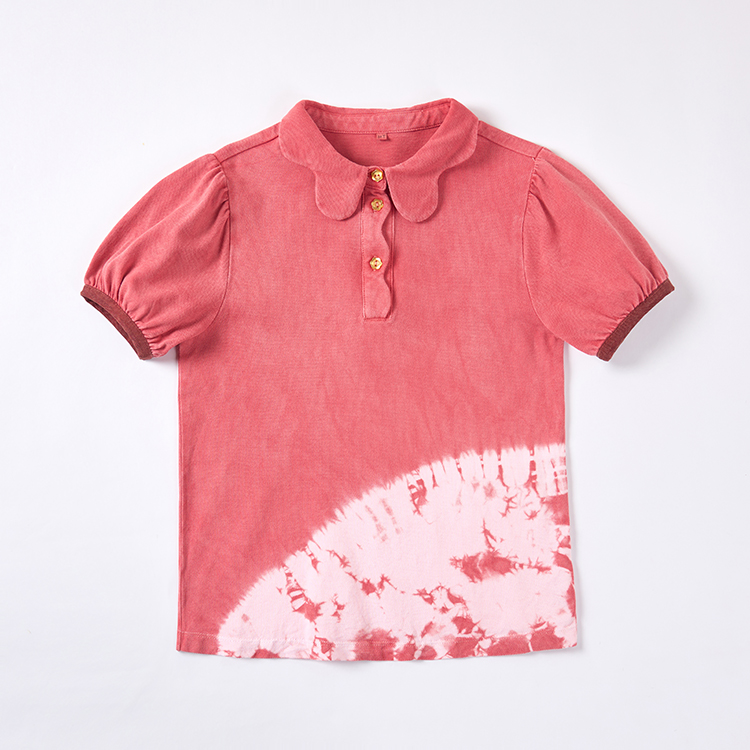
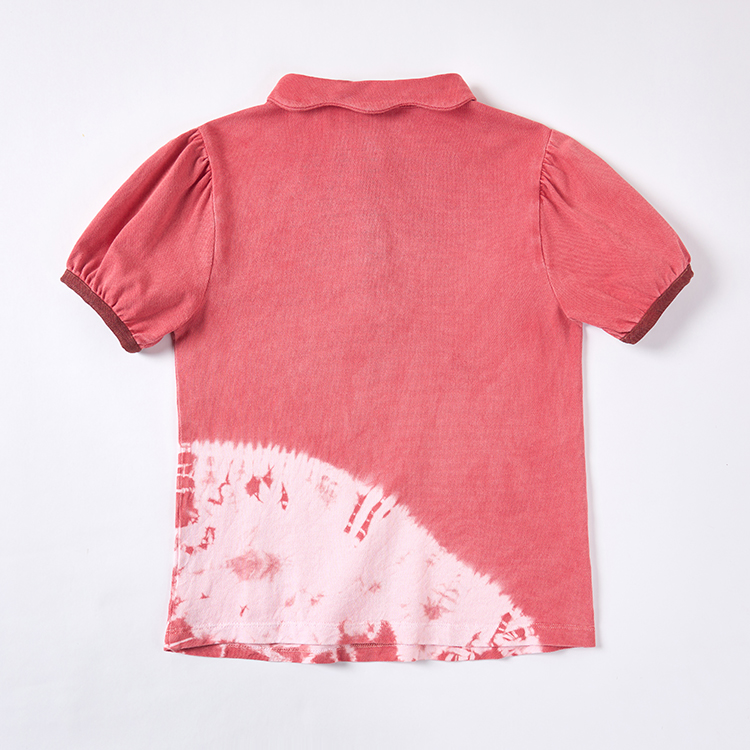
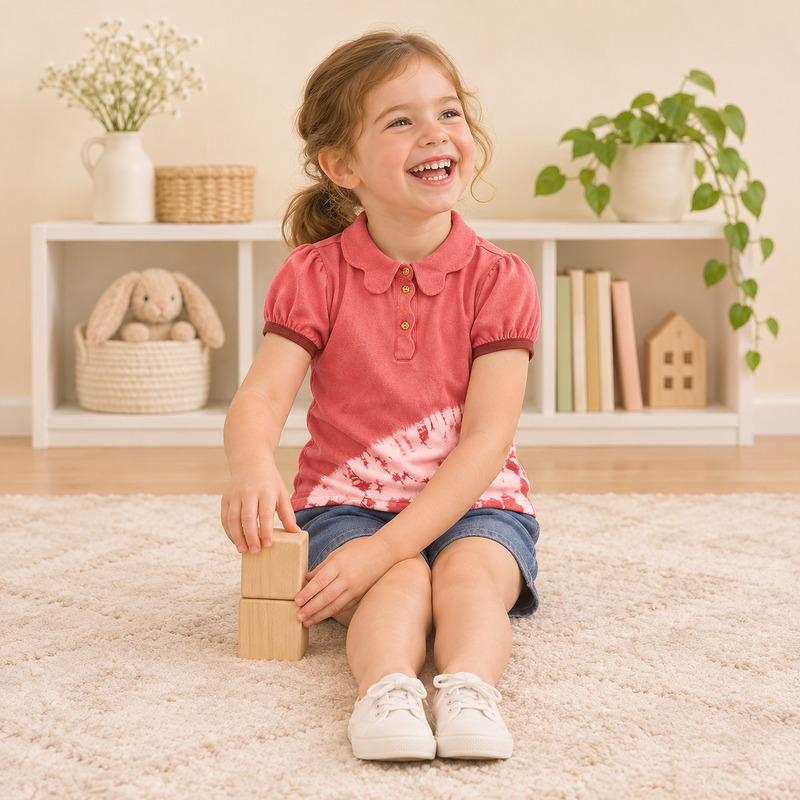
A polo shirt in a light cotton twill with a visible diagonal grain, plant dyed to a coral with sappanwood (苏木) and madder (茜草), no added mordant: a Peter Pan collar with a scalloped edge, a three-button placket, short puff sleeves gathered into a narrow contrast cuff, a narrow hem, and one bound diagonal across the lower body that opens into a pale field of fold marks.
The shirt carries variation at two scales, and they are not the same problem. The bath leaves a soft unevenness over the whole garment; the bound diagonal puts one hard edge across the body and a pale field under it. A single fibre makes that separation clean — nothing here is a difference in take-up between two materials, so every value on the shirt belongs to one dye behaviour.
At a glance
1. Two scales of variation on one shirt
- The bath leaves a soft unevenness everywhere, visible as a fine speckle across the solid coral. It is not a fault and it is not a print; it is what a plant bath does on a single-fibre cloth.
- The diagonal is a different order of event: one line, one side deep and one side pale, at a fixed angle. It is judged as a placed feature, not as part of the mottle.
- So the acceptance sheet has two sections. Evenness is read across a panel against a range; the diagonal is read as an angle, a crossing height and an edge quality.
- A single fibre keeps the two apart. With cotton throughout, a pale value is a pale value — there is no second fibre to explain a difference, which is why a patch that reads wrong here is a placement question rather than a chemistry one.
- Colour is read on the dried garment under D65, with the deep side and the pale field in the same light, because a warm lamp flatters the boundary and hides exactly the contrast being judged.
2. The boundary is a tie, and its edge carries the evidence
- The line is where the cloth was bound before it went into the bath, and the pale field under it is the fold structure opened out: fine streaks running across the pale area are the pleats the binding held.
- That is what separates a tied dip from a dipped garment. A dip leaves a soft gradient with no structure; a tie leaves an edge with fold marks running out of it, and the marks are the proof the process was used.
- So the combed edge is the accepted edge, not a defect to be smoothed. The brief describes it as a brushed boundary with fold streaks, and the sample is approved with that edge intact.
- What is rejected is a boundary that tears or steps. A gap in the line, or a step where the binding slipped, breaks a single continuous gesture and reads as damage rather than as a tie.
- The boundary is also the shallowest dye on the shirt, so it is the first place light and washing show; crock is run across the line itself and light is read on both sides rather than on the deep side alone.
- Its angle is fixed on the pattern. The boundary is a straight line at a set angle to the hem, so any curve in it comes from the body it is wrapped around, not from the way it was tied.
3. The line is placed where it crosses the seams, and it does not scale
- The diagonal is measured where it crosses the two side seams, as a height from the hem, because that is the only point on a curved body where a diagonal has a single value.
- Front and back are separate panels, so the boundary is planned on both: the left seam and the right seam carry the same height, and the back is cut so the line lands where the design wants it rather than where the pattern left room.
- The angle does not travel with the size. The same angle over a longer body covers a larger share of it, so the crossing height is graded per size and the angle adjusted with it — otherwise the pale field swallows the hem on 8Y.
- The pale field is bounded by the hem, and on the smallest size it comes close to it; the gap between the pale field and the hem is written as a minimum so that a 3Y does not lose the coral band under the dip.
- Panels for one shirt are cut from one length, so the crossing heights agree left and right rather than being matched at the seam afterwards.
4. The collar is fused, and fusing changes the take-up
- A Peter Pan collar is a doubled piece with an interlining, and an interlining fused before dyeing changes how much liquor the collar takes: it comes out a shade paler than the body it sits on.
- So fusing happens after dyeing, or the collar is cut from the same lot and fused by the same method, and the choice is written down rather than discovered at the sample.
- The scalloped edge is where the collar is judged. The curve is tight, the allowance is clipped and graded, and the turn shows the reverse of the cloth at every scallop tip — on a dyed ground that reads as a paler edge, which is expected and is not a sanding fault.
- The leaf shape is checked for symmetry against the centre front, because a collar cut from a cloth with a diagonal grain pulls unevenly when the two leaves are cut in opposite directions.
- The collar sits against the neck and is the first thing a parent touches, so its edge is finished clean with no exposed interlining, and the neckline seam under it is enclosed between the collar and the facing rather than left raw.
5. The neck is the tested area, and two of its parts are not plant dyed
- Three buttons and a placket sit on the most-handled part of a child's shirt. The buttons are flower-shaped in a honey tone and are not plant dyed, so they are declared as a separate component and tested as small parts, with attachment at 70 N and a check against the small-parts cylinder.
- Their colour is approved against the dyed ground, not against a card, because the ground varies across the shirt and a button that matches at the chest can read wrong at the placket.
- The placket is fused self-fabric, so it takes the same instruction as the collar: fused after dyeing, or the placket reads a strip lighter than the body it sits in.
- The placket is checked for straightness at three points and for gaping after washing, since a buttoned placket that opens between buttons is the first thing that looks tired.
- Class II applies: 3Y, 5Y and 8Y are for children over 36 months, the Class II scope for this cloth, both colourways and the buttons is confirmed against the certificate at quotation, and pH is measured on the garment and held between 4.0 and 7.5.
6. The puff sleeve and the contrast cuff
- The sleeve is gathered twice, at the cap and at the cuff, and the two ratios are set separately: the cap carries the puff and the cuff carries the close. A single ratio gives a sleeve that balloons at the wrist or collapses at the shoulder.
- Fullness at the cap is set per size against the armhole, not scaled from the sleeve length, because a child's shoulder grows differently from the arm.
- The cuff is a narrow band in a deeper tone, which makes it a second colour: it is dyed separately from the body, approved separately against it, and brings its own fastness result rather than inheriting the body's.
- A deeper band on a coral body is a hard match, because the eye compares them directly at the wrist; the two are approved together on the made-up sleeve rather than on two swatches side by side.
- The band is set narrow and any elastic in it is captive and sized per wrist, so that the cuff closes on the arm without gripping it.
7. Sizes, sampling and quoting
- Three sizes graded on measurements: 3Y, 5Y and 8Y move on chest, body length, shoulder, armhole, sleeve length and the diagonal's crossing height. The collar and placket are re-set per size rather than scaled, since a collar that grades by percentage loses its leaf shape.
- Customization. Collar shape, from the scalloped Peter Pan as sampled to a plain round collar; placket length and button count; button shape and colour; plain or contrast cuff; sleeve length; and the diagonal's angle and crossing height per size, each sealed on its own reference pair.
- Sampling: 3-7 days from a confirmed tech pack, covering a bound strike-off with its reference pair and the boundary marked at the intended crossing height, a made-up shirt with collar, placket, buttons and cuffs finished as production, a wash-and-remeasure with placket straightness and gaping checked, crock across the boundary and at the cuff, light on the deep side and the pale field, a button pull and a small-parts check after washing.
- Bulk: 30-60 days from approval, planned per bound batch and per dyebath, with the cutting layout made per size so the boundary crosses at the quoted height; AQL 2.5 major and 1.0 critical.
- MOQ: 300 pcs for a custom development covering cloth, shade, tie, trim or fit; 50 pcs for a decorative process on a stock body; 100 pcs for stock cloth with your own logo and label. Mixed colour and size orders are quoted per order.
Production runs with our production partner, Suzhou Shelmin Trade Co., Ltd.: founded 2017, 7,200 m² workshop, 8 lines, 200 staff, 6,000 pieces per day. Design confidentiality is held under NDA; buyer patterns, shades and prints are not re-used.
To quote, we need: target market and the Class II tests it requires; whether the ground is this light twill or a piqué, since the collar interlining and the sleeve gather are set differently on each; the diagonal's angle and its crossing height at 3Y and at 8Y; the deepest and palest values you will accept either side of the boundary; collar shape and interlining method; button specification, or your own buttons to be tested; the cuff band colour and whether it comes from the same bath; lot certificates for both plants, the buttons and the cuff cloth; the pH target and the dyehouse water specification; packing method; and whether certification is to run in your brand name.