EN

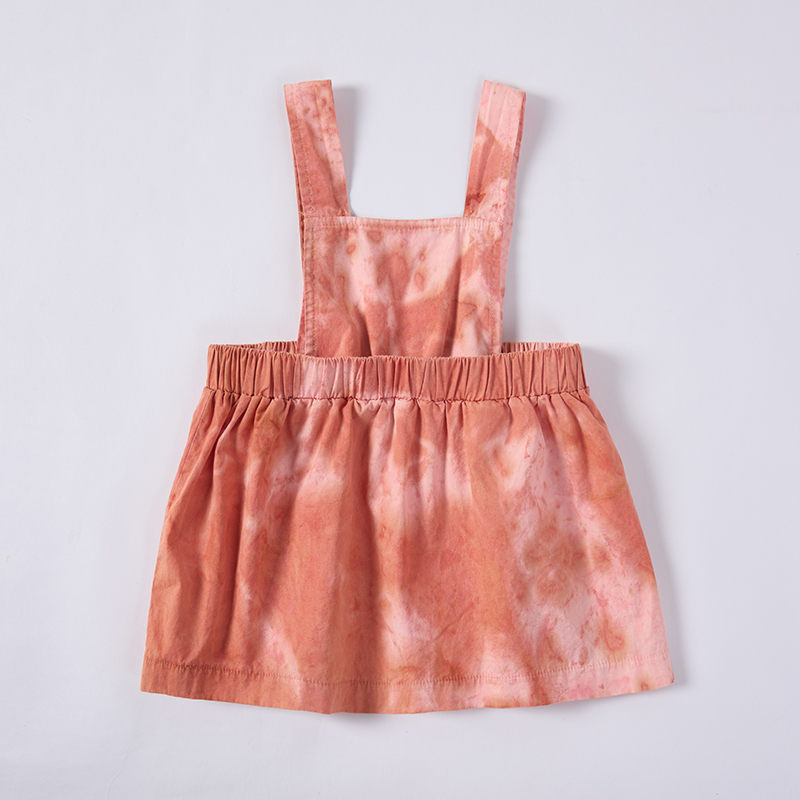
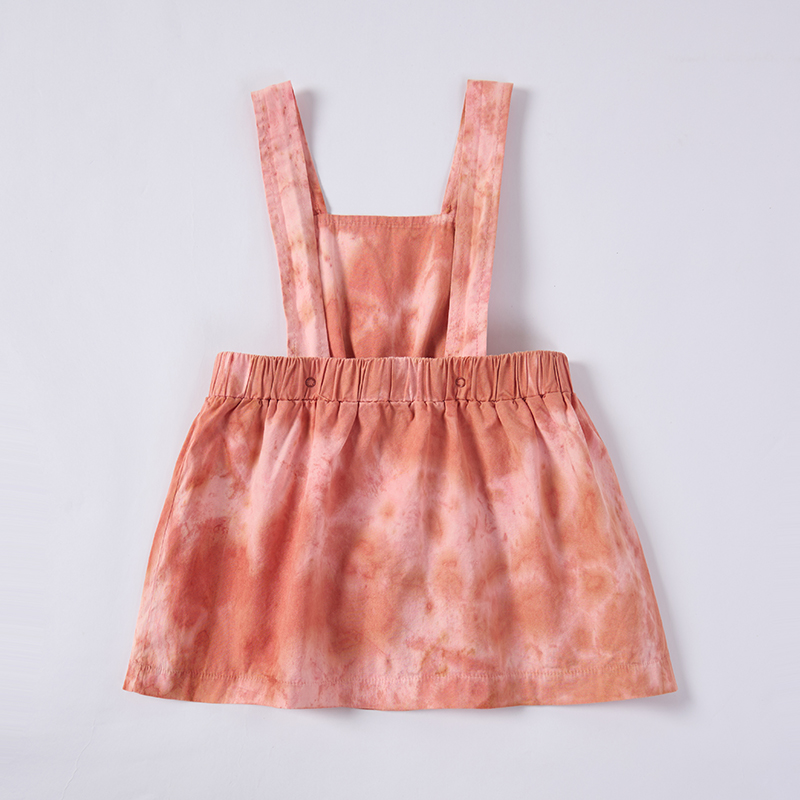
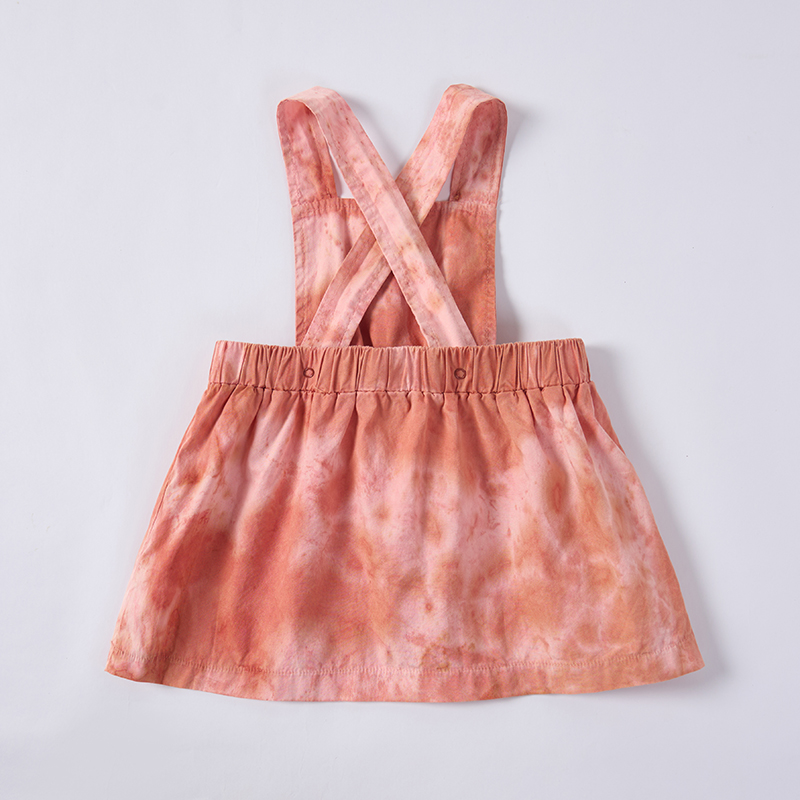
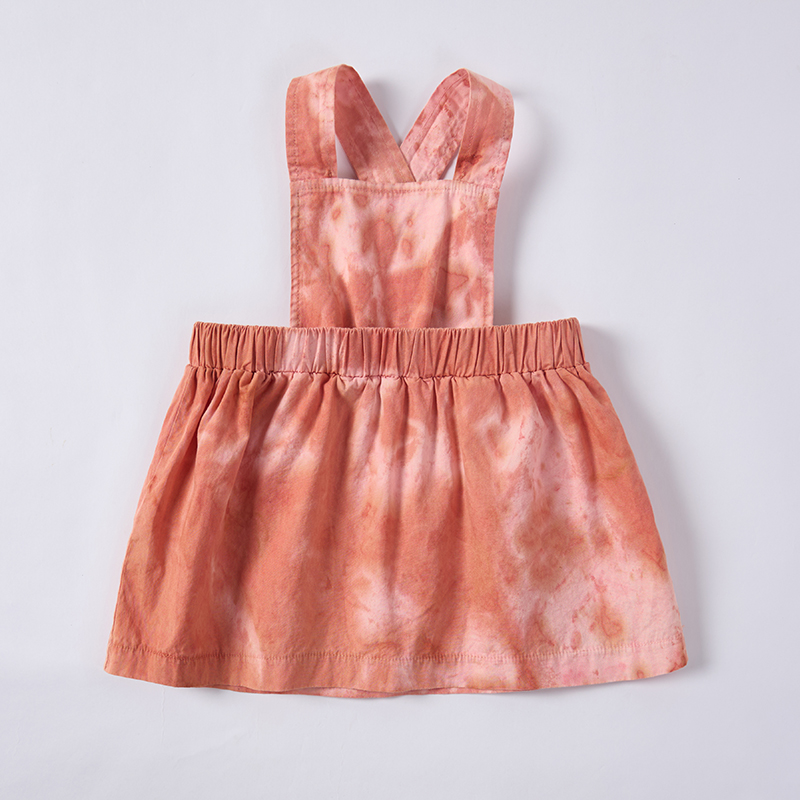
Cotton Plant-Dyed Baby Pinafore Dress Custom OEM ODM Toddler Suspender Skirt


- Overview
- Custom OEM ODM Toddler Suspender Skirt
- Recommended Products
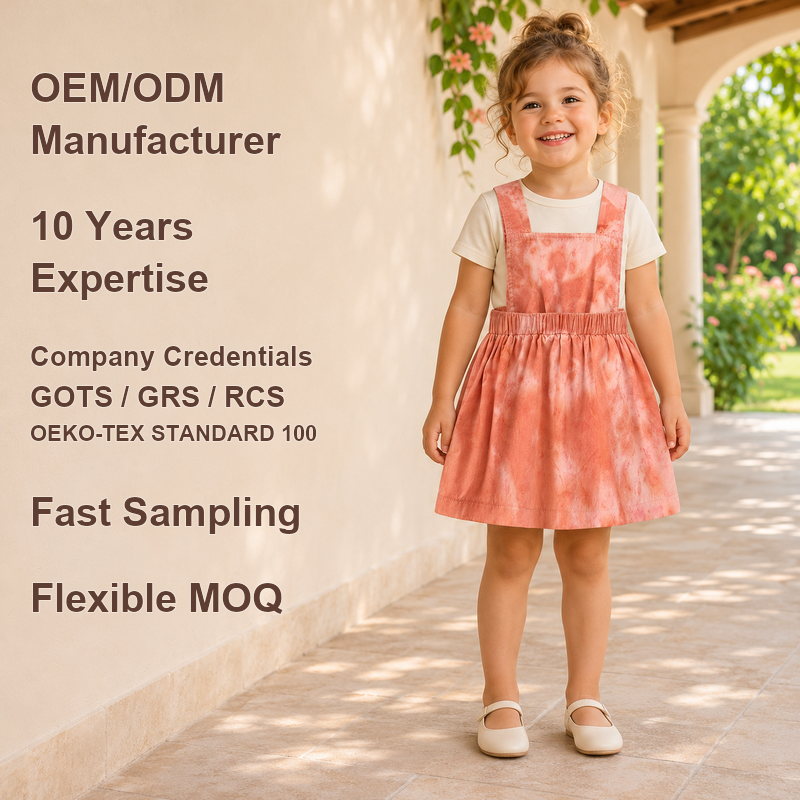
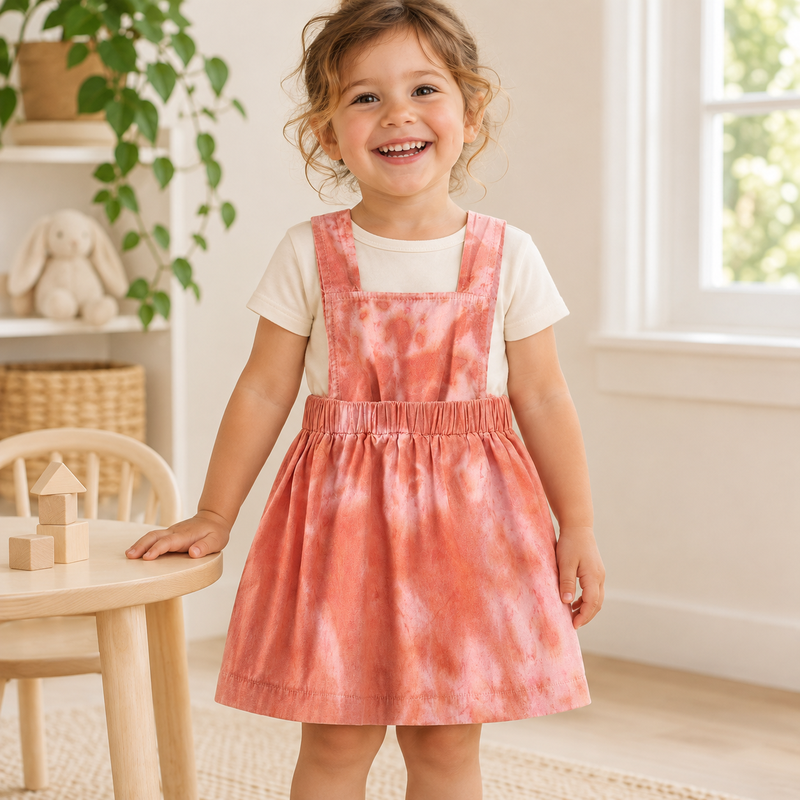
A pinafore dress in 125 gsm cotton poplin, plant dyed to a mottled salmon and apricot with logwood, madder and pomegranate rind: a square bib panel, two wide straps, an elasticated waist and a gathered A-line skirt, with the straps buttoned at the back waist.
Three plants went into this colour and only two of them are colours. The third, pomegranate rind, is the reason the other two stay in the cloth at all — and that changes what the garment can be washed like, how it feels in the hand, and why a button on this dress cannot simply be sewn where it looks right.
At a glance
1. The cloth: 125 gsm poplin has no give
- Poplin is a tight, fine plain weave. Fine yarns at high sett give it the crisp face poplin is bought for, and they also make it the least forgiving cloth in this range: it does not stretch, it does not drape heavily, and it holds a crease.
- A woven pinafore on a baby has to be entered, not pulled on. With no stretch anywhere in the cloth, the openings do the work — the elasticated waist and the buttoned straps are the entry, and they are sized for that rather than adjusted afterwards.
- Gathering is the only shaping. The skirt is gathered onto a narrow elasticated band, so the volume comes from the gather and the fit comes from the elastic, which is why the waistband is the most engineered part of the dress rather than a finishing detail.
- A tight weave resists penetration. The same tightness that gives poplin its crisp face slows the dyebath, so a plant colour on poplin sits nearer the surface than it would on a looser cotton; that is the reason crocking and wash fastness are the tests that matter here.
- Poplin shows every needle mark. A coarse needle leaves a permanent hole line along a seam, visible on 125 gsm without backlighting.
2. Three plants, two colours
- Logwood and madder are the colours. Logwood gives a violet that leans blue-black when built, madder gives a warm red, and the two together give the salmon this dress carries.
- Pomegranate rind is tannin, and tannin is the bridge. Cotton has little natural affinity for most plant colourants; a tannin-rich material gives the fibre something for the colourant to hold onto, which is why tannin is used as a base in cotton dyeing rather than as a colour in its own right.
- So the third material is doing structural work. Whether it is used as a pre-treatment or in the same bath changes how much of the other two stay after washing, which is why the recipe is written as a sequence with three named materials rather than as one blend.
- Tannin also shifts the shade, deepening and dulling what is applied over it, so the same proportions give a different salmon depending on how much rind is in the sequence.
- None of the three is a standardised colorant. Rind, root and heartwood vary by season and supplier, so the recipe is expressed against a reference batch and the batch record is the document that travels with the order.
3. The mottle, and what tannin does to the hand
This is not a flat shade and it is not meant to be read as one. The blotching across the bib and the skirt is either a technique written into the recipe or the result of an uncontrolled bath, and the two are not managed the same way.
On a tight poplin, uneven pick-up is the default. The weave that gives poplin its crisp face resists the bath, so where wetting is uneven the colour sits unevenly — the same mechanism that keeps plant colour near the surface, seen at a larger scale.
Where the mottle is planned, the method is named. A fold, a bind or a scrunch produces the pattern, and it is only repeatable if the fold direction, the number of ties and the time in the bath are written down; that record is what makes the next batch a relative of this one.
A planned mottle is approved as character, not as shade. Two pieces made by the same method are similar and never identical, so approval fixes the scale of the blotch — how large, how frequent — and the contrast between the pale and the deep areas, rather than a single reference swatch.
Unplanned patchiness is a defect, and it looks different. A run in which some pieces are almost flat and others heavily blotched is uneven wetting or a bath that changed through the lot; it is caught by laying several pieces side by side, never by judging one.
The gathers compress the pattern. Gathering shortens the cloth below the waistband, so the skirt reads denser there than at the hem, and the pattern is judged on the gathered panel for that reason.
Tannin firms the cloth. A tannin-rich dyeing leaves cotton crisper than an untreated one, and on 125 gsm poplin that reads as papery rather than soft, which matters on a dress worn over bare legs in summer.
So a hand modifier is a specification, not a preference, decided with the buyer because it affects both the feel and the way the cloth takes a crease.
Anything added to soften can work against the dye, carrying colour with it or dulling the shade, so the finish is chosen against the dye rather than added at the end of the line.
The hand is judged on the skirt panel and after a wash, since that is the part that touches the legs and tannin-rich cloth softens progressively over the first washes.
4. Straps, bib and a button that cannot sit on an elastic band
The straps button to the back waist, and the waist is elasticated. A button sewn into a gathered elastic band has nothing stable under it: the band moves as it stretches, the button travels with it, and the buttonhole distorts a little more with every wear.
So the button needs a stable tab. A small interfaced tab, or a flat section let into the band, gives the button a fixed point while the rest of the waist still stretches.
The button is a small part and is tested as one at the retention force the market requires — 70 N is the figure we work to for buttons and snaps — with the button, its thread and the tab assessed together.
The strap has to be able to take the load. A pinafore hangs from two straps; on a baby that is picked up under the arms, the straps and their buttons carry the whole garment, so the strap is reinforced where it meets the button.
Two positions are the growth allowance. Where a second button position is offered, the difference between them is what buys the extra months of wear, and both positions are checked with the strap buttoned.
The bib is a flat panel on a garment that gathers. All the volume sits below the waistband, so the bib has to lie flat without a dart, which is why the straps are set wide — a narrow pair pulls the bib into a V.
Strap width is set from the shoulder, not from the sample, because a narrow strap cuts into a shoulder that is being carried, and the straps are topstitched on both edges so they stay flat through washing.
The bib is lined or faced, since the back of a poplin panel shows every allowance and the wrong side of the dye; strap length is checked with the child sitting, where a pinafore that is right standing can lift at the bib.
5. Size: five sizes, and three months is a size at this age
- The range runs 6-9M, 9-12M, 12-18M, 24M and 36M. The first three steps are three and six months apart, and at this age a three-month step is a real size: a baby's rise and torso change more in three months than a school-age child's change in a year.
- So the two smallest sizes are not one pattern scaled. They differ in rise, in bib depth and in strap length, and they are graded from the child's measurements rather than from a percentage step.
- Class I applies across the range, with 6-9M, 9-12M, 12-18M and 24M clearly under 36 months and 36M assessed as Class I because the article can be worn by a child under that age.
- The waistband elastic is specified by width and recovery, and its recovery is checked after washing, because a relaxed band drops the skirt and exposes the nappy.
- The sample is fitted sitting and standing, with the bib, the strap length and the waistband checked together rather than one at a time.
6. Customization, sampling and what we need to quote
- Bib. Square bib as shown; a curved bib; a crossed back.
- Straps. Buttoned at the back waist as shown; fixed straps with a side opening; a tie-free wrapover.
- Waist. Elasticated as shown; a flat waistband with a side zip.
- Skirt. Gathered A-line as shown; a pleated skirt; a tiered skirt.
- Shade. Salmon pink as shown; a deeper shade with more logwood; a redder shade with more madder.
- Finish. A softener as quoted; an unsoftened hand where the buyer prefers the crisp face.
- Packing. Polybag with size sticker; hanger; woven or printed label, satin care label, hangtag.
- Sampling. 3–7 days from a confirmed tech pack, with a dyed strike-off, a wash trial on the shade and on the hand, a crocking check, and a button pull test on the tab.
- Bulk lead time. 30–60 days from approval by quantity and dyebath schedule; the bath is planned per batch, so a split delivery is quoted as two batches.
MOQ: 300 pcs for a custom development — custom cloth, shade, trim or fit; 50 pcs for a decorative process added to a stock body; 100 pcs for stock cloth with your own logo and label. Mixed colour and size orders are quoted per order. These are standing programme terms, confirmed against the current quotation.
Production runs with our production partner, Suzhou Shelmin Trade Co., Ltd.: 7,200 m² workshop, 8 lines, 200 staff, 6,000 pieces per day. Design confidentiality is held under NDA; buyer patterns, shades and prints are not re-used.
To quote, we need: target market and the Class I tests it requires; how the pomegranate rind is used, as a pre-treatment or in the bath, and at what concentration; the mordant route for the logwood and madder; whether a softener is in scope; poplin weight and sett; the button material; packaging; and whether certification runs in your brand name.