EN

OEM/ODM 100% Cotton Tank Baby Girl Dress | Eco-Friendly Plant-Dyed Toddler Sun Dress | Custom Sustainable Botanical Warm Yellow Kids Apparel | Wholesale Premium Private Label Boutique Children Clothing


- Overview
- Plant-Dyed Cotton Poplin Baby Dress | OEM ODM
- Recommended Products
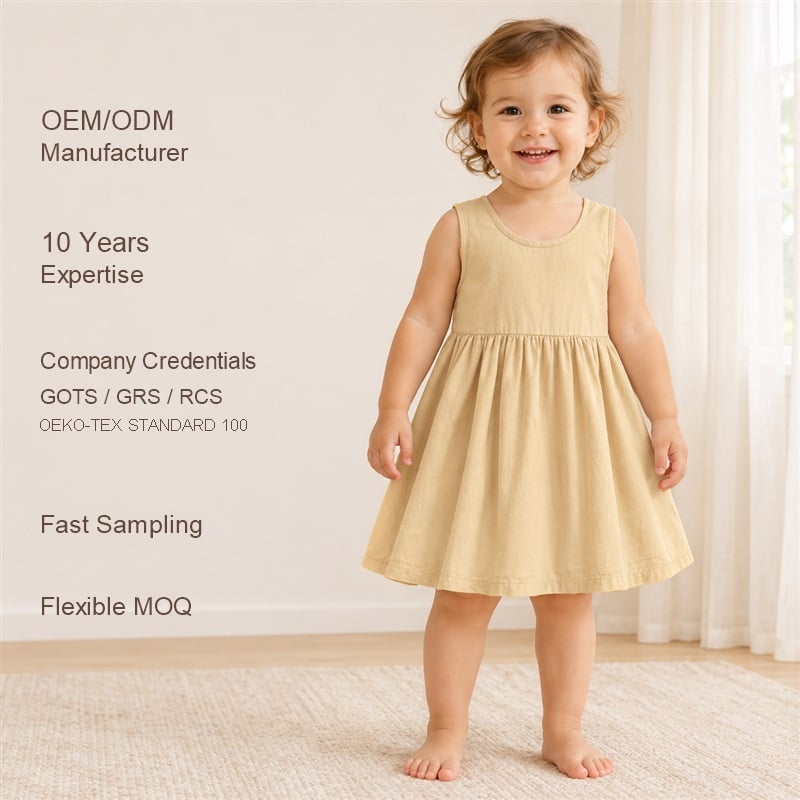
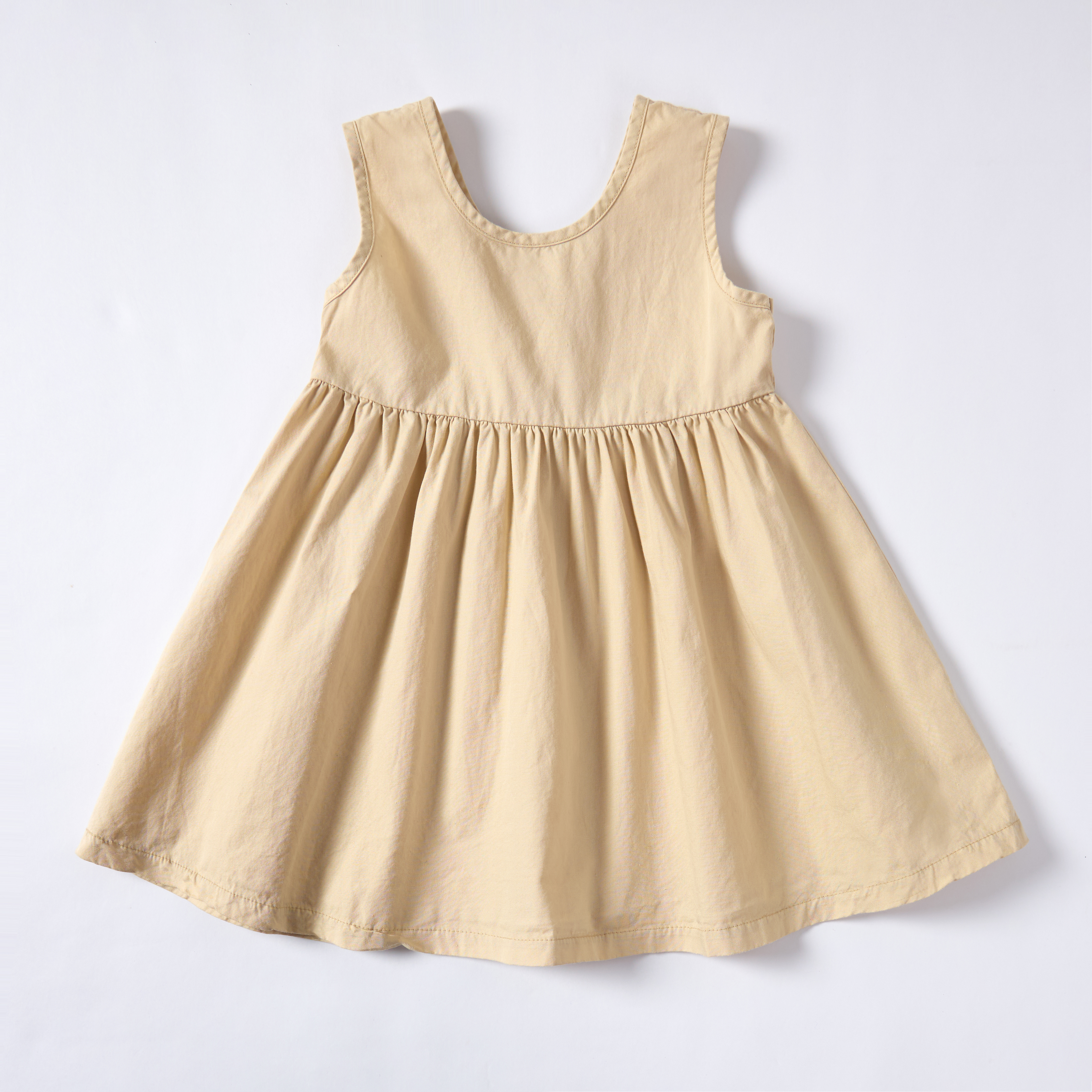
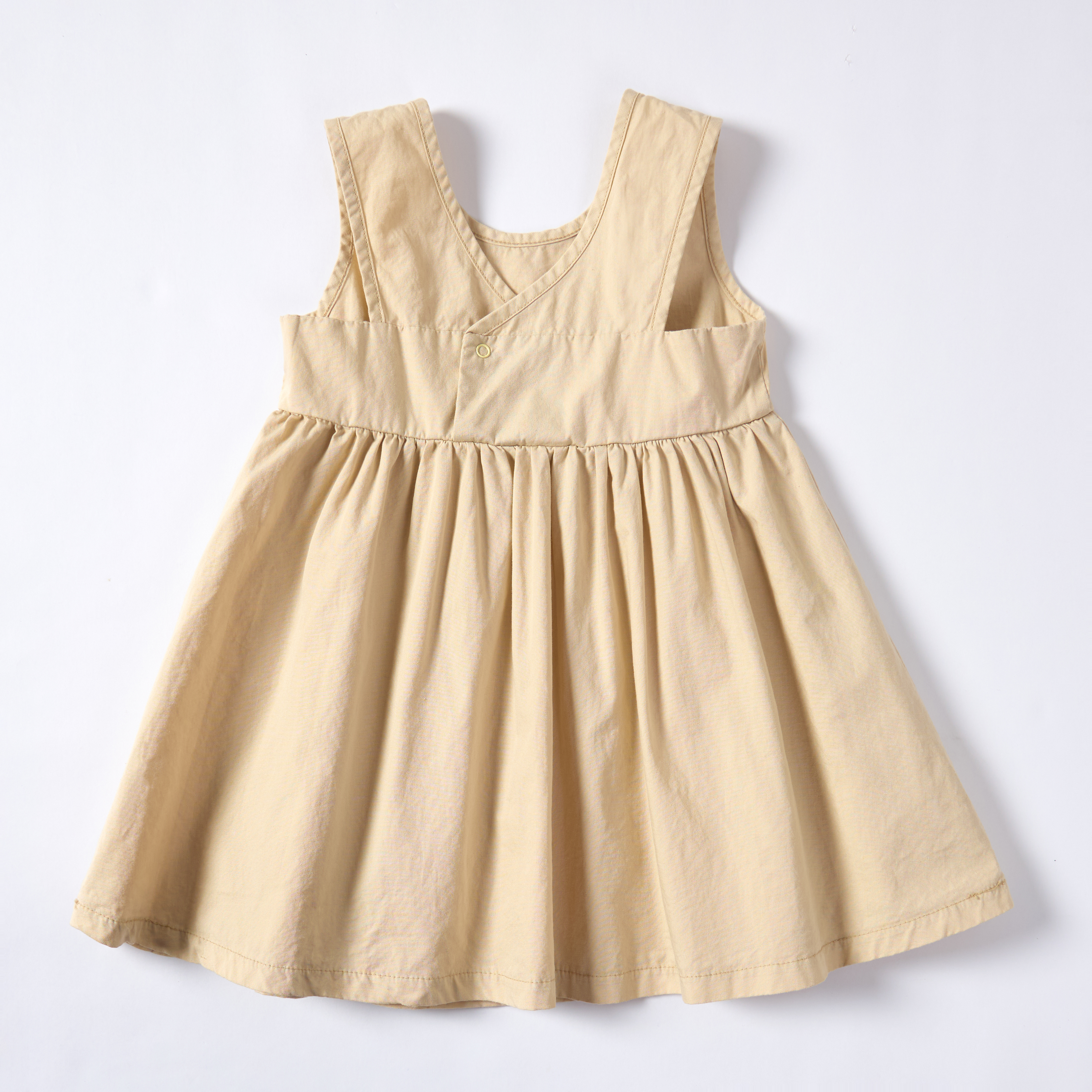
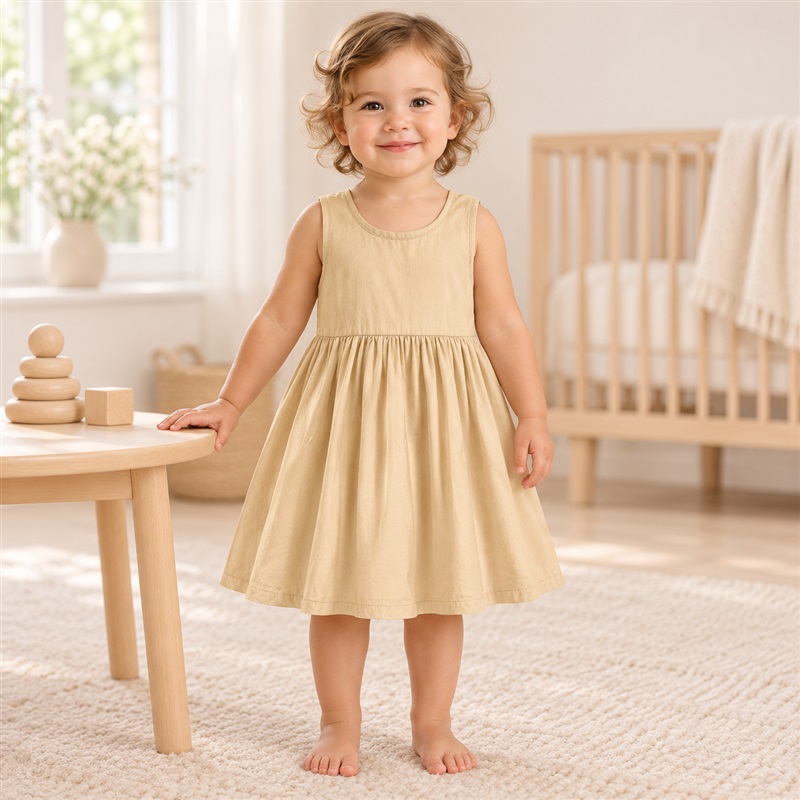
A sleeveless jumper dress in 125 gsm cotton poplin, dyed to a warm sand with sappanwood (苏木) and pomegranate rind (石榴皮): a scoop front neckline, self-fabric shoulder straps, a back that crosses over and buttons at the centre, and a gathered A-line skirt falling from a waist seam.
Two things decide whether this style works, and neither is decorative. The dress has no sleeves and no elastic, so it stays on the child by pattern alone — strap position, neckline depth and the size of the back opening. And the shade is built from one red plant over a tannin, with no metal mordant, so the sand is held by pH rather than by a metal lake.
At a glance
1. The cloth: poplin cut as a jumper dress
- A tight plain weave is what makes a sleeveless dress read as clean. Poplin has no pile and no twill line, so the neckline, armhole and waist seam sit as drawn lines on a flat surface, and the sand tone does not break up across the bodice.
- 125 gsm carries the two halves of this dress. The bodice needs enough body to stand away from the chest without a lining; the skirt needs to be light enough that a gathered seam falls into folds instead of collapsing into bulk.
- The weave has no give, so the fit is pattern work. With no sleeves and no elastic, the dress is held by shoulder straps and by the back opening; those three dimensions are set on the block and checked on a fitting, not adjusted on the finished garment.
- Sand is a mid-tone, and mid-tones show gathering as bands. Where the skirt gathers, the cloth turns away from the light and reads slightly deeper; uneven distribution shows as a tonal stripe over one hip before it shows as a shape problem.
- At this depth the cloth also shows a fold line that has been pressed in and not lifted out, so pressing and packing are set with the same care as the dye bath.
2. Two plants: a red over a tannin
- Sappanwood supplies the red. Brazilin in the heartwood oxidises to brasilein, and the colour it gives on cotton is a soft rose-red rather than a brick — close enough to the rind's own buff that the two read as one warm sand when they are layered.
- Pomegranate rind supplies the ground and the depth. Its ellagitannins give the beige that sits under the red, and they give the fibre something for the red to hold on to. The rind is the reason this recipe can run without a metal salt.
- The order is rind first, then colour. Tannin goes on until the cloth has taken it; the sappanwood bath follows. Put the red on first and most of it rinses away, because cellulose has nothing to hold it.
- Rind load is the depth control, sappanwood the hue. More rind gives a deeper, browner sand; more sappanwood pushes the same depth toward rose. The pair is weighed together and the ratio is fixed on a strike-off.
- Sand is a narrow window. A small shift in either direction reads as pink-beige or as khaki, which is why the reference is a sealed dyed sample kept out of light, not a colour name.
3. No metal mordant: where the colour is anchored
- Alizarin-type and brazilin-type dyes have little affinity for cellulose on their own. Normally a metal salt forms the lake that anchors them; here that job is done by the tannin layer laid down first.
- The bond is hydrogen bonding, not a metal complex. Phenolic groups on the rind tannin attach to the cellulose and hold the dye at the fibre, which is why the recipe is described as plant dyed rather than as a mordant dye.
- A tannin anchor is more sensitive to washing than a metal lake, so fastness is a test item at the depth actually shipped: washing to ISO 105-C06 and rubbing to ISO 105-X12 on the finished cloth.
- No metal salt means no metal impurities to declare from the mordant side, which shortens the Class I file. In exchange, the plant material becomes the variable, so rind and heartwood are screened per lot.
- Strength is still tested. There is no ferrous bath here, so the tendering route that iron brings is absent; the stress is hot tannin liquor and repeated rinsing, and tensile and tear strength to ISO 13934-1 and ISO 13937-2 run against undyed cloth from the same lot.
4. Holding a sand: pH, water and ageing
- With no metal, pH is the hue control. Sappanwood runs red in a neutral-to-alkaline bath and turns straw-yellow as it acidifies; the rind's own colour also darkens with alkali. The two move together, which is what makes a sand repeatable.
- pH is set and logged per bath, and water is specified. Hardness, iron content and residual alkali all shift a shade at this depth, and a well or mains change between lots is enough to move it.
- The finished cloth returns to the infant pH window of 4.0 to 7.5. A bath run alkaline for hue is neutralised and rinsed back into that window before the cloth is released — the point where the dye recipe and the Class I file become the same document.
- Ageing reads as fading, not as a hue change. Sappanwood is the faster of the two, and a sand fades toward pale straw, so light fastness to ISO 105-B02 is tested on the finished cloth at the supplied depth.
- Shade is matched under D65 against the sealed sample, and the tolerance is the one fixed in the approved sample rather than one agreed after the bulk arrives.
5. Class I: what the article has to prove
- Class I is the class for articles under 36 months. 6-9M, 9-12M, 12-18M and 24M sit inside it by age; 36M is assessed as Class I because the article can be worn by a child under that age.
- The base fabric holds an OEKO-TEX Standard 100 certificate, and the Class I scope for this poplin, colourway and trim is confirmed against it at quotation, before any claim is published.
- The plant material is the variable in a mordant-free recipe. Rind and heartwood are agricultural, so heavy metals, pesticide residues and microbial load are screened at intake, with a certificate of analysis per lot held with the batch record.
- Fastness is judged as an infant article: washing, rubbing, perspiration, saliva and light, to ISO 105-C06, X12, E04 and B02, plus the saliva method the destination market applies.
- Article items are checked on the finished dress: pH, formaldehyde and extractable heavy metals, alongside a nickel-release check where metal-touch trim is used.
- Plant origin is not an exemption. The assessment is of the garment, and a recipe with no added metal is documented to the same limits as any other dye.
6. Fit: straps, back opening, waist seam
- The straps hold the dress up, so their width and position are the fit. There are no sleeves to stop the shoulder slipping out; the strap is cut wide enough to sit on the shoulder blade and set inboard of the armhole so it does not slide when a child is carried.
- The back opening is sized on head girth, not on the waist. A crossover back with one button passes over the head, so the opening is checked against head girth plus a working allowance for each size — the same check that decides where the button sits.
- The crossover is a fixed overlap, not a tie. Two panels cross and button at the centre; there are no free ends and no cord, which keeps the style outside the cord and drawstring limits of EN 14682.
- The waist is a seam, not elastic. Fit comes from the block: the bodice is cut to the chest and the skirt is gathered onto it, so a size change moves the seam rather than the elastic.
- Gathers are distributed from marked quarters and stitched with the seam allowance pressed down and topstitched, because at 125 gsm an unsecured gathered seam ridges through the bodice after washing.
- One button, tested as a small part at 70 N retention, with button, thread and buttonhole assessed as one unit and checked against the small-parts requirements of 16 CFR 1501 for the US market. On sand, the trim is undyed corozo or a matched tone approved against the dyed cloth.
- Seams run at 12-14 stitches per inch; armholes and neckline are finished with self-fabric binding, which is also what keeps a sleeveless edge from stretching out of shape on a hanger.
- AQL 2.5 for major defects, 1.0 for critical. Needle control: 100% detection on finished pieces; needles exchanged one-for-one at every break with the machine stopped; work in progress within 2.5 m re-screened twice; needle-free area enclosed, at least 2 m deep, single entry.
7. Sizes, customization, sampling and quoting
- Five sizes, graded from measurements. 6-9M, 9-12M, 12-18M, 24M and 36M move on body measurements rather than a percentage step, because the head and chest grow on a different curve from the waist at this age.
- The back opening and the strap position are re-set per size, since the head-girth allowance is what decides whether a dress can be put on without a fight.
- Customization. Scoop, round or square neckline; crossover back or a centre-back placket with two buttons; self-fabric or contrast binding; gathered, pleated or plain A-line skirt; patch pocket; lined bodice.
- Shade. Warm sand as shown; a deeper camel with more rind; a rose-sand with more sappanwood. Each is sampled and tested at its own depth.
- Sampling: 3-7 days from a confirmed tech pack, including a dyed strike-off, a fit check on the smallest and largest size, a wash trial on the shade, light fastness at the supplied depth, and a button pull test.
- Bulk: 30-60 days from approval, planned per dyebath; a split delivery is quoted as two batches because the bath is the unit of shade control.
- MOQ: 300 pcs for a custom development — cloth, shade, trim or fit; 50 pcs for a decorative process on a stock body; 100 pcs for stock cloth with your own logo and label. Mixed colour and size orders are quoted per order, and terms are confirmed against the current quotation.
Production runs with our production partner, Suzhou Shelmin Trade Co., Ltd.: founded 2017, 7,200 m² workshop, 8 lines, 200 staff, 6,000 pieces per day. Design confidentiality is held under NDA; buyer patterns, shades and prints are not re-used.
To quote, we need: target market and the Class I tests it requires; lot certificates for the sappanwood and rind; the tannin load and the depth you want; the pH targets; the water specification; neckline and back construction; button material; packaging; and whether certification runs in your brand name.