EN

Custom Baby Girls Cotton Eyelet Dress Plant Dyed Tie Dye Sleeveless Dress OEM ODM Boutique Kids Clothing Manufacturer


- Overview
- Plant Dyed Eyelet Cotton Dress, Coral Scallop | OEM
- Recommended Products
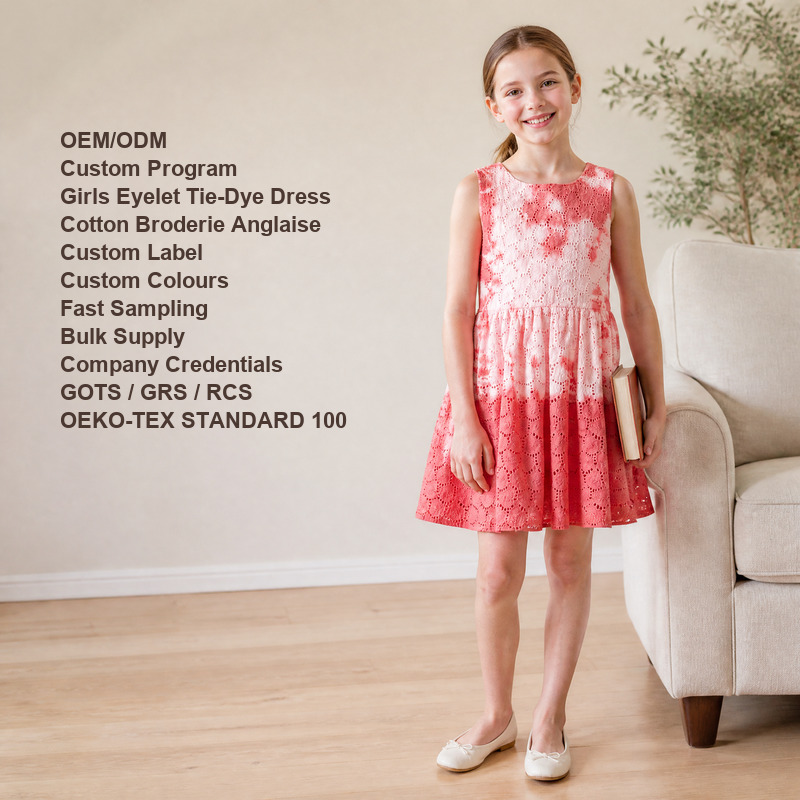
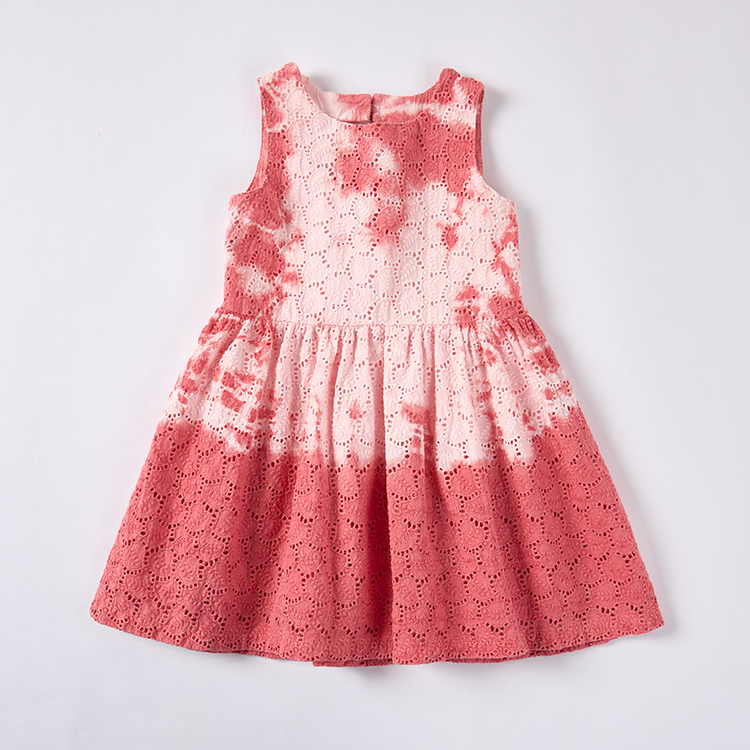
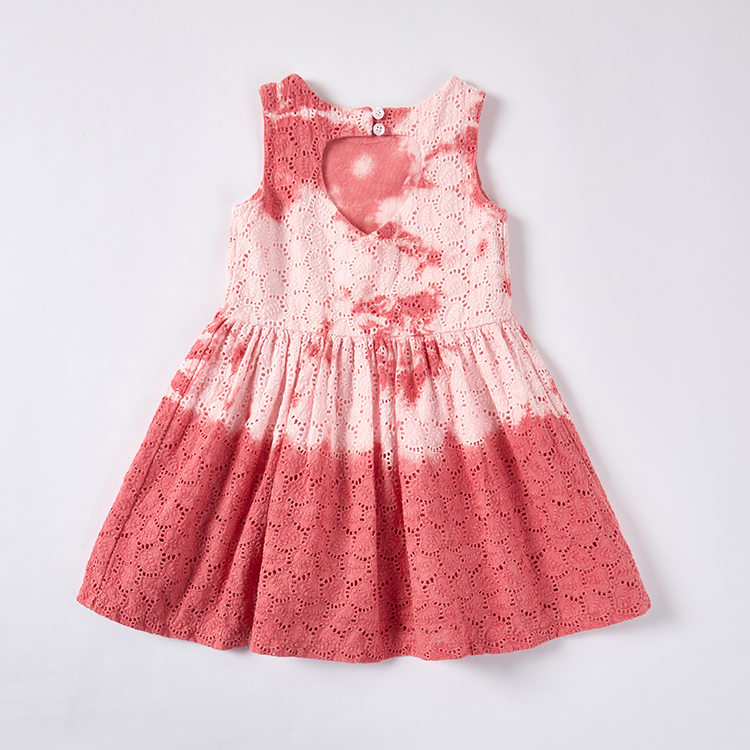
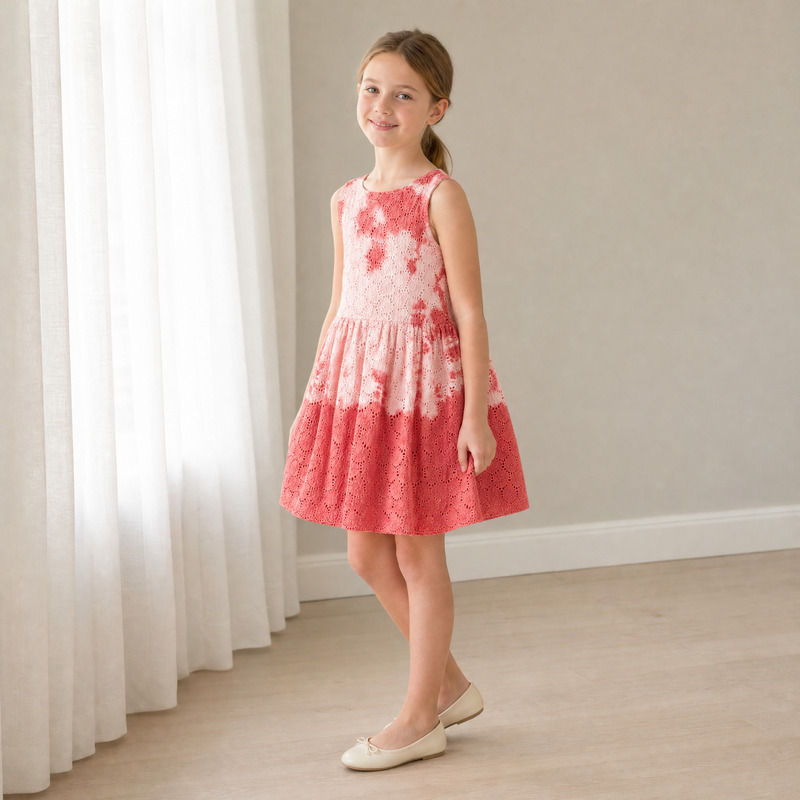
A sleeveless dress in a 100% cotton eyelet, dyed with sappanwood (苏木) and madder (茜草) to a coral that runs from a pale, blotched upper to a deep band across the lower skirt: a round neck cut on a scallop, with two small buttons at its centre and a rounded cut-out below them, a gathered waist seam, a single gathered skirt, and a hem that follows a scalloped curve rather than a straight line.
That curve is the subject here. The hem and the neck are both cut along a scallop through the embroidery, and the place where a scallop ends in a point is the weakest few millimetres on the whole garment: the fewest threads, the embroidery bridging them, and a cut edge that has to be finished without pulling the point out of shape.
At a glance
1. The scallop is cut, and the point is the weak place
- The hem is not a fold and not a straight cut: the cloth is cut along a wave that follows the embroidery, and the edge is finished narrow so the wave stays a wave.
- At the tip of each scallop there is the least cloth, sometimes two or three threads with embroidery across them, which is why the point is where a hem fails first.
- So the cut is placed relative to the last stitch rather than to a measurement, leaving enough cloth past the embroidery for the finish to hold, and no more than that.
- The finish has to be soft enough not to stiffen the point and firm enough to stop it fraying; a rolled edge and an overlock give different results at the tip, and the sample fixes which one this dress uses.
- Whether the scallop comes from a bordered cloth or from a wave cut through an allover pattern is settled with the mill before sampling, because the two behave differently: a bordered cloth gives a repeatable edge and quantises the length, while a cut wave needs the point finished by hand-eye judgement at every scallop.
- Points are counted and checked one by one, since a single flattened point is visible along an edge that is otherwise a rhythm.
- The rounded cut-out below the buttons is the sharpest test of the same skill, because it is a closed shape cut out of the embroidery: two corners and a wide curve, all of them finished without a fold, and the corners concentrate stress the way a scallop point never does.
2. Length follows the repeat, not the millimetre
- A scalloped hem has a pitch, the distance from one point to the next, and the hem can only end where a scallop ends.
- So the finished length moves in steps of that pitch, and the size chart carries a tolerance equal to roughly half a pitch rather than a single figure.
- The same applies to the neckline, which is a closed curve: it needs a whole number of scallops, so the neck circumference is adjusted to the scallop rather than the scallop squeezed to the neck.
- That adjustment is a design decision made once, on the pattern, and then held for every size; a neck that gains one scallop between sizes jumps by the whole pitch at the neck, which is visible as a change of character rather than of fit.
- The skirt is measured at the point of a scallop, the only repeatable place on that edge, and the method is written into the size chart so two factories measure the same thing.
3. A deep band on a gathered panel
- The deep coral covers the lower skirt, and its upper edge is a dye boundary rather than a seam, so it is soft and slightly uneven by nature.
- Gathering then bends it: each gathered panel carries the boundary at its own height, and the pleats make the line rise and fall by a few millimetres along the skirt.
- So the boundary is read per panel and as a range, not as a straight line to be matched to a drawing; what is checked is that it sits within the agreed band of heights and that it does not run diagonally.
- The boundary is most legible where it crosses a scallop row, because the embroidery's ring of holes stays pale inside the deep area and marks the line; that is where it is measured.
- The deep area also passes through the hem finish, so the very edge of the hem is the deepest part of the dress and the place where crock is read.
4. The holes hold no colour
- A pierced ring is a hole, not a pale stitch, so in the deep band the rings stay the colour of whatever is behind them while the cloth around them goes deep.
- At arm's length that reads as a slightly greyed band rather than a solid one, and the deeper the band, the more the pale rings tell.
- So the depth is taken a step past the swatch when the swatch is a plain cloth, and the comparison is made on the eyelet itself rather than on a flat sample of the same shade.
- The same effect helps the upper body, where the blotches read softer than they would on a plain ground because the holes break up the edge of every blotch.
- The rings are also where crock shows first, since the embroidery stands proud of the ground and takes the rub; the reading is taken on a ring inside the deep band.
5. What the eyelet does at the seams
- The waist seam gathers a pierced cloth, and the gathers fall in the intervals between the embroidery rather than evenly across it, so the pleats read as groups.
- That is the character of the cloth rather than a sewing fault, and it is judged for evenness of the groups rather than for a smooth gather.
- The seam allowance is trimmed and finished narrow, because a bulky allowance behind pierced cloth shows through the holes as a shadow.
- The shoulder and side seams are the two places where a shadow would show at the neck and under the arm, so both are checked with the dress held against a light.
- The cut-out is the only opening, and because the dress is unlined it is also a window onto the inside: what shows through is the reverse of the eyelet, which reads as a plain cloth with the embroidery's residue rather than as a perforated one.
- That puts the inside finish on show at the chest, so the edge of the cut-out is finished on both faces and the seam allowances below it are trimmed close; a raw allowance would be read as a shadow through the opening rather than behind it.
- Two buttons close it at the neck edge, declared as their own component, with the cut-out's corners checked for a point that has not been cut into and for a finish that does not pucker the embroidery around them.
6. What is fixed here, and what is confirmed at quotation
- Fixed by the brief and the sample: the composition as 100% cotton, the two dyestuffs, the construction, the edge finishes and the two buttons described on this page.
- Not asserted here: the mordant route, the certificate held for the cloth and its scope for this article and colourway, the chemical class that applies to the size range, and the test list. Each can be quoted by a buyer, so each is confirmed at quotation against documents rather than stated on a page.
- The mordant changes what can be claimed, not only what is seen: with no mordant the shade is built by repetition, with one the depth arrives faster at a different light fastness; the two are different products and are not interchangeable at the sample stage.
- The class that applies is read per size against the destination market, since this size range spans more than one band in the usual schemes, and the tests follow the market rather than the page.
- The buttons need their own declaration, as they are handled by a child and are not the shell cloth; their material is confirmed by the supplier's document rather than described here.
7. Sizes, sampling and quoting
- Three sizes graded on measurements: 3Y, 5Y and 8Y move on chest, bodice length to the waist seam, neck circumference and its scallop count, waist, skirt length to the point of a scallop, scallop pitch and hem sweep.
- Customization. Whether the scallop is a bordered edge or a cut wave; scallop pitch and its count at the neck; skirt length to the nearest point; the band's height range and its softness; depth taken one step past the swatch to answer the pale rings; edge finish at neck and hem; cut-out size and corner radius; button count and colour; the mordant route quoted as two products, each sealed on its own reference set.
- Sampling: 3-7 days from a confirmed tech pack, covering a resist strike-off with its reference pair, an eyelet panel showing the deep band with its boundary and a hand-finished scallop, a made-up dress with neck, keyhole, waist seam, gathers and hem finished as production, every scallop point checked along the hem and the neck, band height measured per panel, skirt length measured at a point, a wash-and-remeasure of the skirt and of the points, crock on a ring inside the deep band, and the seams read against a light.
- Bulk: 30-60 days from approval, planned per resist bundle and per bath, with the scallop pitch and the neck's scallop count written into the pattern so both survive the size run; AQL 2.5 major and 1.0 critical.
- MOQ: 300 pcs for a custom development covering cloth, shade, edge or fit; 50 pcs for a decorative process on a stock body; 100 pcs for stock cloth with your own logo and label. Mixed colour and size orders are quoted per order.
Production runs with our production partner, Suzhou Shelmin Trade Co., Ltd.: founded 2017, 7,200 m² workshop, 8 lines, 200 staff, 6,000 pieces per day. Design confidentiality is held under NDA; buyer patterns, shades and prints are not re-used.
To quote, we need: target market and the class and test list it requires per size; whether the scallop comes from a bordered cloth or a cut wave; scallop pitch and the neck's scallop count; skirt length to the nearest point; the band's height range; whether the mordant route is to be used, so both versions can be quoted; the button you want, or ours to be tested; the certificate held for the cloth and the scope you need; lot certificates for both dyestuffs; the pH target and the dyehouse water specification; packing method; and whether certification is to run in your brand name.