EN

Custom Girls Floral Embroidered Dress Organic Cotton Plant Dyed Sleeveless Kids Boutique Dress OEM ODM Manufacturer


- Overview
- Kids Cotton Embroidered Organza Dress
- Recommended Products
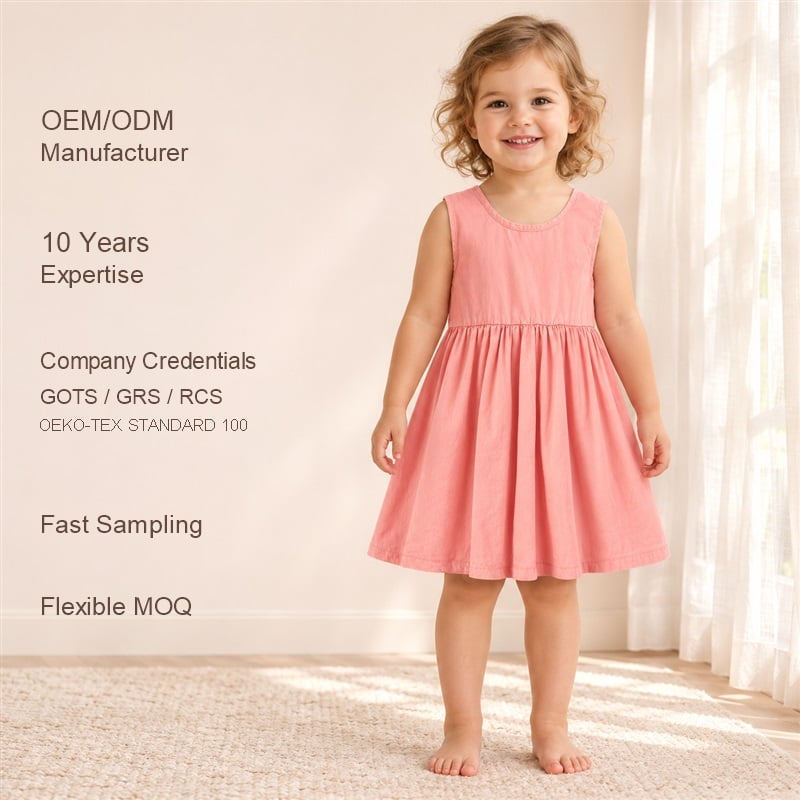
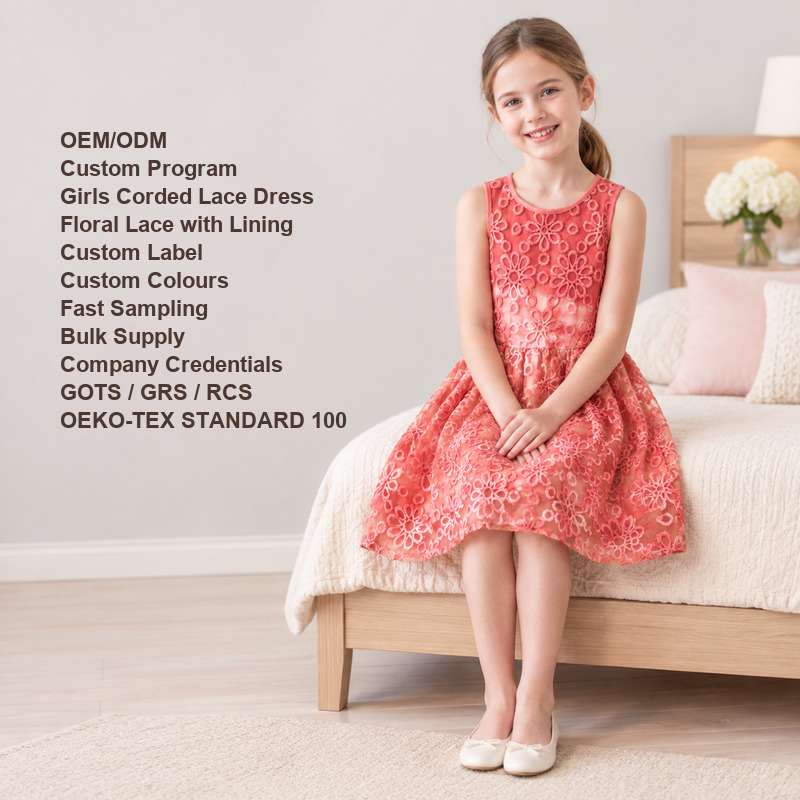
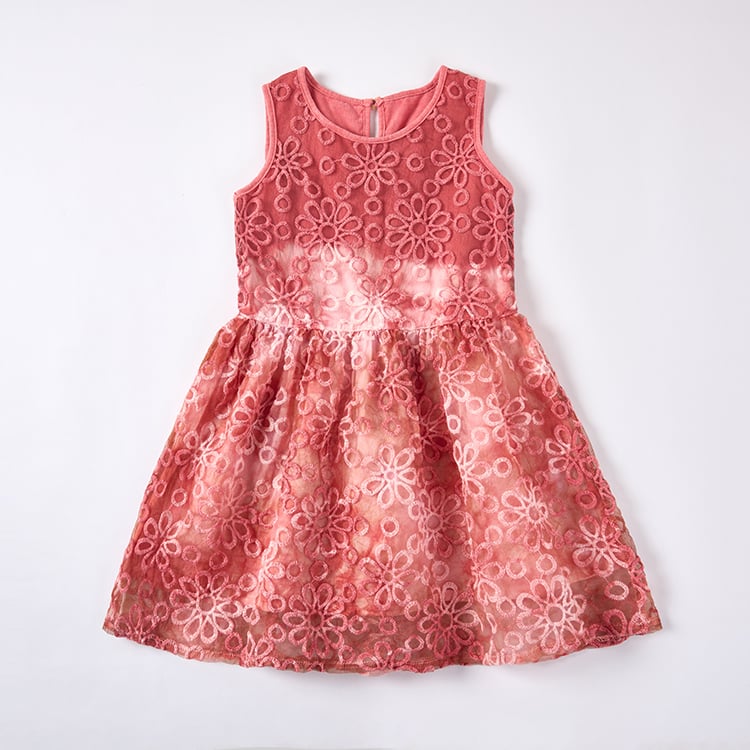
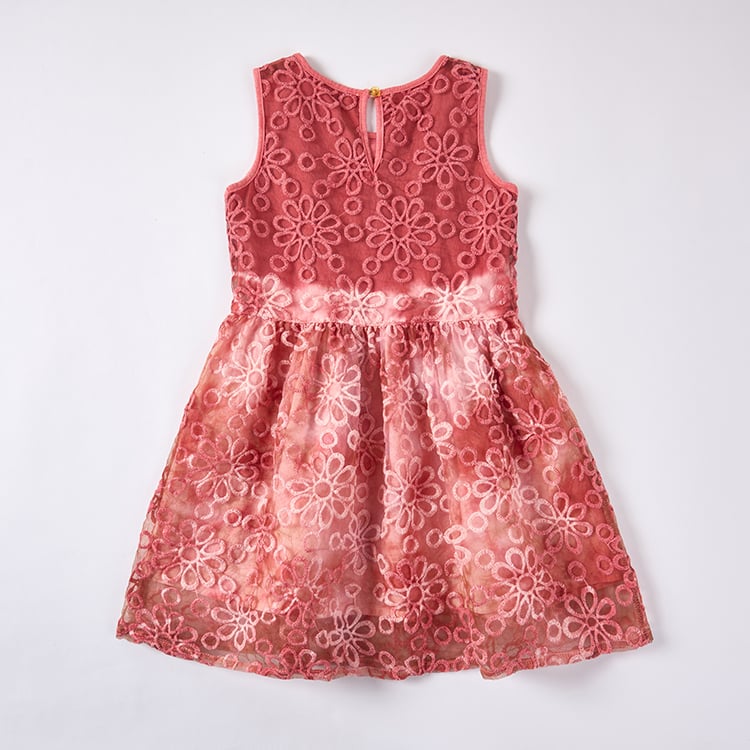
A sleeveless dress in a cotton loop embroidery on a sheer organza ground, plant dyed with sappanwood (苏木) and madder (茜草), no added mordant: a bound neckline and bound armholes, a bodice covered in corded daisy and ring motifs, a gathered waist through the embroidery, a centre back zip, and a lower edge that is the embroidery's own loops rather than a folded hem.
The dress is unlined, so the inside is legible from the outside, and that changes one ordinary decision into the central one: the zip. Its tape is the palest thing on the garment and the one part that keeps its own colour through a plant bath, and on a sheer body it is seen twice, once from the back and once through the cloth.
At a glance
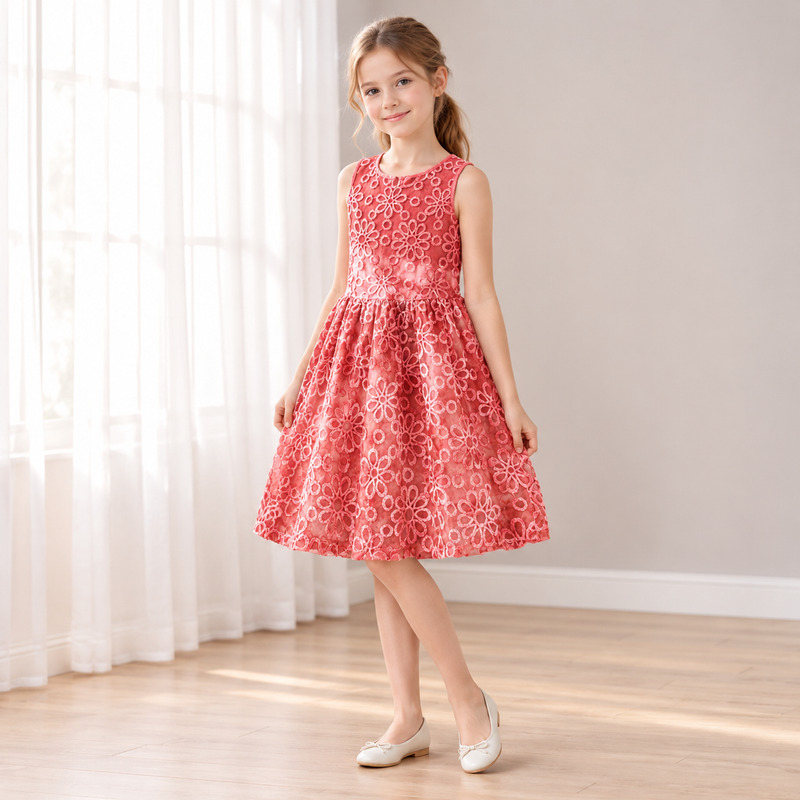
1. The zip is the palest thing on the dress
- A zip tape is a woven synthetic strip, and where it is synthetic it keeps its own colour through a plant bath while everything around it takes the dyestuff.
- On this dress that is visible at the neckline, where the tape sits between the two bound edges as a light strip in the middle of a coral bodice.
- So the tape is specified rather than inherited: its colour is chosen against the dyed cloth, and it is confirmed on the sample against the bodice, not against a colour card.
- A tape matched by dyeing is a different route, since the tape has to be able to take the dyestuff at all; where it can, it is dyed with the garment and the tape becomes part of the field rather than a strip in it.
- The alternative is a covered or concealed zip, which hides the tape behind a placket of the shell; that is a construction change with its own cost and its own thickness, and it is quoted separately.
- The slider is metal, and it is the one hard component on the dress: nickel release is tested on it, and it is declared with the zip as a unit rather than as an unspecified trim.
2. On a sheer dress the inside is read from the outside
- Nothing on this dress is hidden by a lining, so every structural answer at the back is also a front-facing decision.
- The zip's stabiliser is the clearest example: a strip of interfacing behind a mesh is a lighter, denser band, and it is seen through the cloth as a ghost strip beside the spine.
- So the stabiliser is chosen by how it reads through the cloth, not only by how well it holds the zip: a lighter weight that is barely visible may need a longer stitch and a slower run, and that is a production cost worth naming at the sample.
- The armhole and the neck are bound rather than faced for the same reason: a facing is a doubled layer and would read as a band through a sheer shoulder, while a narrow binding reads as an edge.
- A lining is a genuine option and a separate quotation, because it changes the garment rather than finishing it: it removes the see-through character, it hides the stabiliser, and it adds a second cloth with its own dye take-up and its own shrinkage.
- Seam allowances are part of the design here, since a plain seam allowance in a sheer cloth reads as a line through the panel; the seams are trimmed narrow and finished so the allowance is a line rather than a shadow.
3. A zip needs a clear channel in the embroidery
- The embroidery covers most of the bodice, and a zip cannot be sewn through it: the needle deflects off the corded loops, the tape is pushed out of line, and the stitch length stops being controllable.
- So a channel is left clear in the embroidery along the centre back, and its width is set in the embroidery layout rather than at the machine.
- That makes the channel a design element, visible as a smooth column through a patterned field; it is either accepted as part of the design or narrowed to the minimum the machine will run.
- Where the channel is trimmed after embroidery rather than left clear, the cut loops are visible at its edges: trimming corded loops leaves open thread ends, and on a sheer ground those ends read at the front.
- The channel runs the height of the zip only, and the embroidery resumes below it, so the change of pattern at the base of the channel is a horizontal break that is compared left and right.
- The channel is checked with the zip closed and open, because the bodice pulls differently in the two states and a channel cut to the closed state pinches when it is opened.
4. Gathering through embroidery works only in the clear ground
- A gathered waist needs the cloth to compress, and corded embroidery compresses far less than the ground it sits on.
- So the gathers form in the clear areas and resist where the motifs are, which makes the waist look unevenly gathered even when the sewing is even.
- The gather ratio is therefore limited by the embroidery, not by the skirt's fullness: past a certain point the motifs collide instead of compressing, and the waistline thickens into a ridge.
- The balance is set by counting motifs at the waist, not by measuring the skirt: a waist that carries a readable row of motifs below the seam is a waist that gathered cleanly.
- The waist seam allowance is pressed up into the bodice, where the embroidery hides it, because pressed down it shows through the skirt as a ridge on a sheer cloth.
- The waist is checked with the dress hanging, since the skirt's weight pulls the gathers down after a few minutes and what looked even on the bench settles into a pattern.
5. The edge is the motif, and that sets the length
- There is no folded hem: the lower edge follows the embroidery's own loops, so the hem is a thread path rather than a straight line.
- That makes the finished length a decision made at the cutting table, where a row of loops is chosen and the cloth is cut between motifs rather than through them.
- Cutting through a loop leaves an open thread on a sheer ground, and a cut thread at the hem reads from the front as a small pale hook; the cut is therefore made in the clear ground between motifs and finished narrow.
- The working tolerance on length is set by the motif spacing, since the nearest cut point to the intended length is one motif away; the tolerance is agreed on the sample and written into the size chart rather than left to the finishing room.
- The edge reads slightly deeper than the skirt above it, because the finish gathers a little cloth into the last row of loops; it is expected rather than corrected.
- Because the skirt is sheer, the hem is read against the leg and against the light, so it is checked hanging rather than flat.
6. Class II, and three things to declare
- Class II applies: 3Y, 5Y and 8Y are for children over 36 months and the scope for this cloth, colourway and zip is confirmed against the certificate at quotation; perspiration runs to ISO 105-E04, pH is measured on the garment and held between 4.0 and 7.5, and extractable heavy metals are tested on the finished garment.
- The zip is declared as a unit, tape and slider together, with nickel release tested on the slider to EN 1811 with the wear simulation of EN 12472.
- The stabiliser behind the zip is declared, since it is a separate material inside the garment and visible through it.
- The ground's fibre is declared, because it decides whether the organza takes the plant dye at all: on a synthetic organza the ground stays clear and the colour sits only in the cotton embroidery, while a cotton organdy takes the dyestuff and shows a mottled ground as this sample does.
- Crock is read on a loop and on the ground beside it, the two surfaces that take colour at different rates.
- There is no cord, no drawstring and no toggle on the dress; the only hardware is the zip slider.
7. Sizes, sampling and quoting
- Three sizes graded on measurements: 3Y, 5Y and 8Y move on chest, bodice length, waist, skirt length to the motif row, motif scale at the waist, armhole, neck opening and zip length.
- Customization. Zip tape chosen in its own colour, dyed with the garment where the tape allows it, or concealed behind a placket, each quoted separately; the width of the clear channel at centre back; motif scale and its density across the bodice; the motif row used for the hem and the resulting length tolerance; a lining as a separate quotation; binding width at neck and armhole; and the stabiliser weight, each sealed on its own reference set.
- Sampling: 3-7 days from a confirmed tech pack, covering a dye strike-off with its reference pair, a bodice with the channel cut and the zip set, read closed and open and from the inside, a zip tape compared against the bodice in daylight and in shop light, a gathered waist counted in motifs, a hem cut at an agreed motif row with its length measured, crock on a loop and on the ground beside it, nickel release on the slider, pH at the deepest point, and the sheer panels read against a light and against a leg.
- Bulk: 30-60 days from approval, planned per dye bath and per embroidery run, with the channel width and the hem motif row written into the embroidery programme so both are repeatable; AQL 2.5 major and 1.0 critical.
- MOQ: 300 pcs for a custom development covering cloth, shade, embroidery, zip or fit; 50 pcs for a decorative process on a stock body; 100 pcs for stock cloth with your own logo and label. Mixed colour and size orders are quoted per order.
Production runs with our production partner, Suzhou Shelmin Trade Co., Ltd.: founded 2017, 7,200 m² workshop, 8 lines, 200 staff, 6,000 pieces per day. Design confidentiality is held under NDA; buyer patterns, shades and prints are not re-used.
To quote, we need: target market and the Class II tests it requires; the organza ground's fibre; whether the zip tape is to be dyed, matched or concealed; the channel width at centre back; motif scale and density; the motif row for the hem and the length tolerance you will accept; whether a lining should be quoted; binding width; lot certificates for both plants; the pH target and the dyehouse water specification; packing method; and whether certification is to run in your brand name.