EN

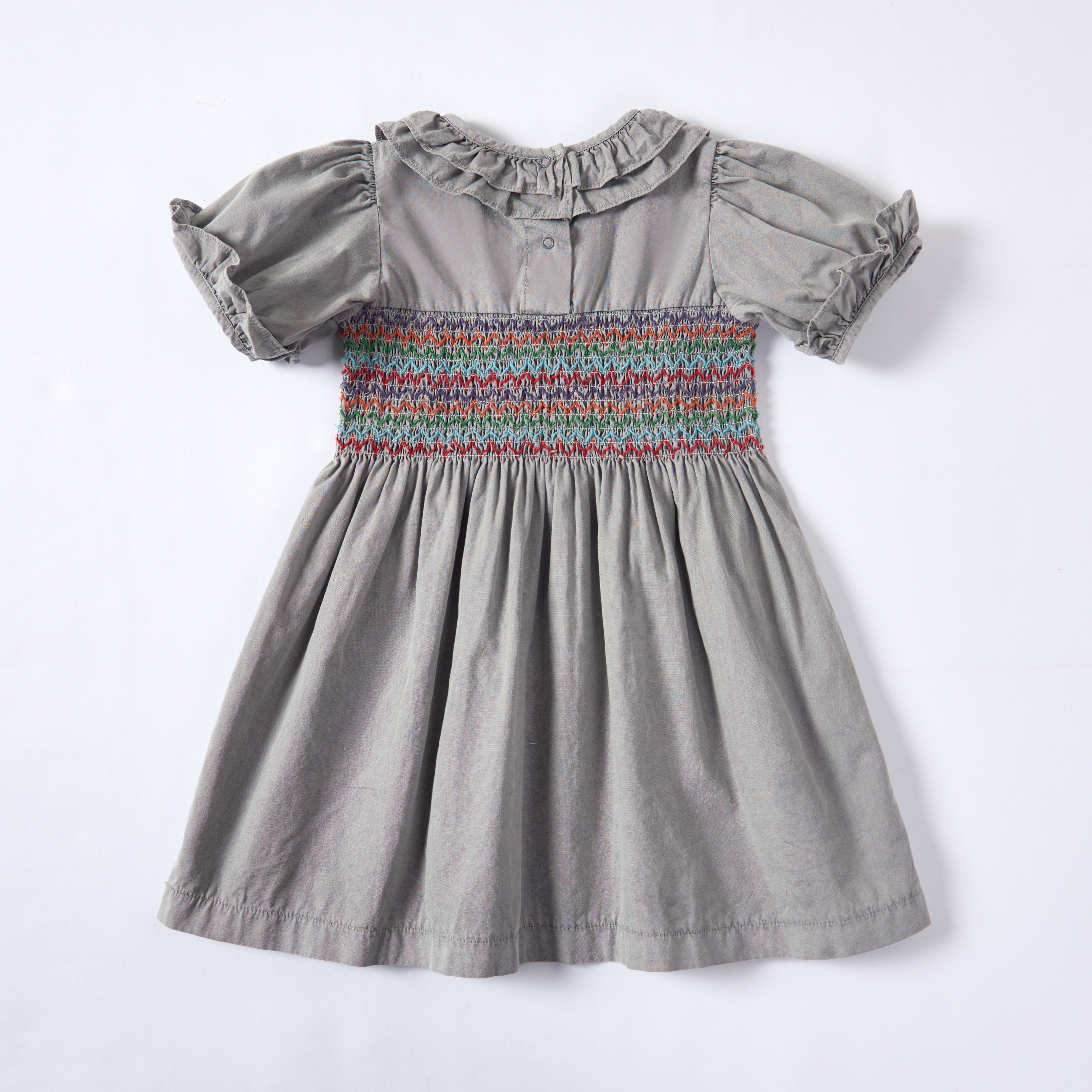
OEM/ODM Vintage 100% Cotton Smocked Baby Girl Dress | Eco-Friendly Plant-Dyed Toddler Dress | Custom Sustainable Botanical Ruffle Collar Kids A-Line Dress | Hand-Smocked Boutique Children Apparel Wholesale


- Overview
- OEM/ODM Smocked Plant-Dyed Cotton Girl Dress
- Recommended Products
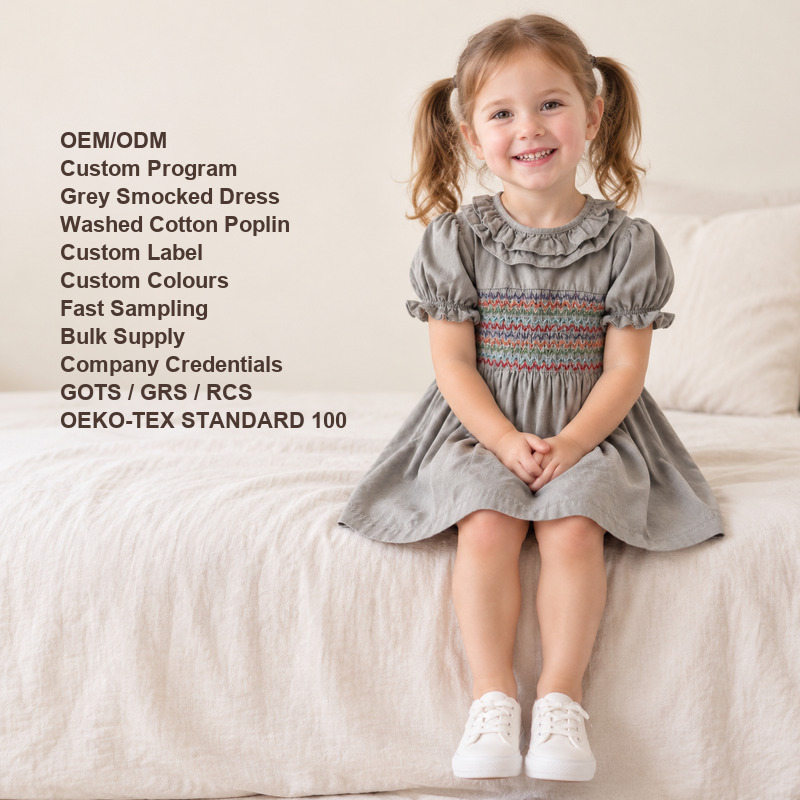
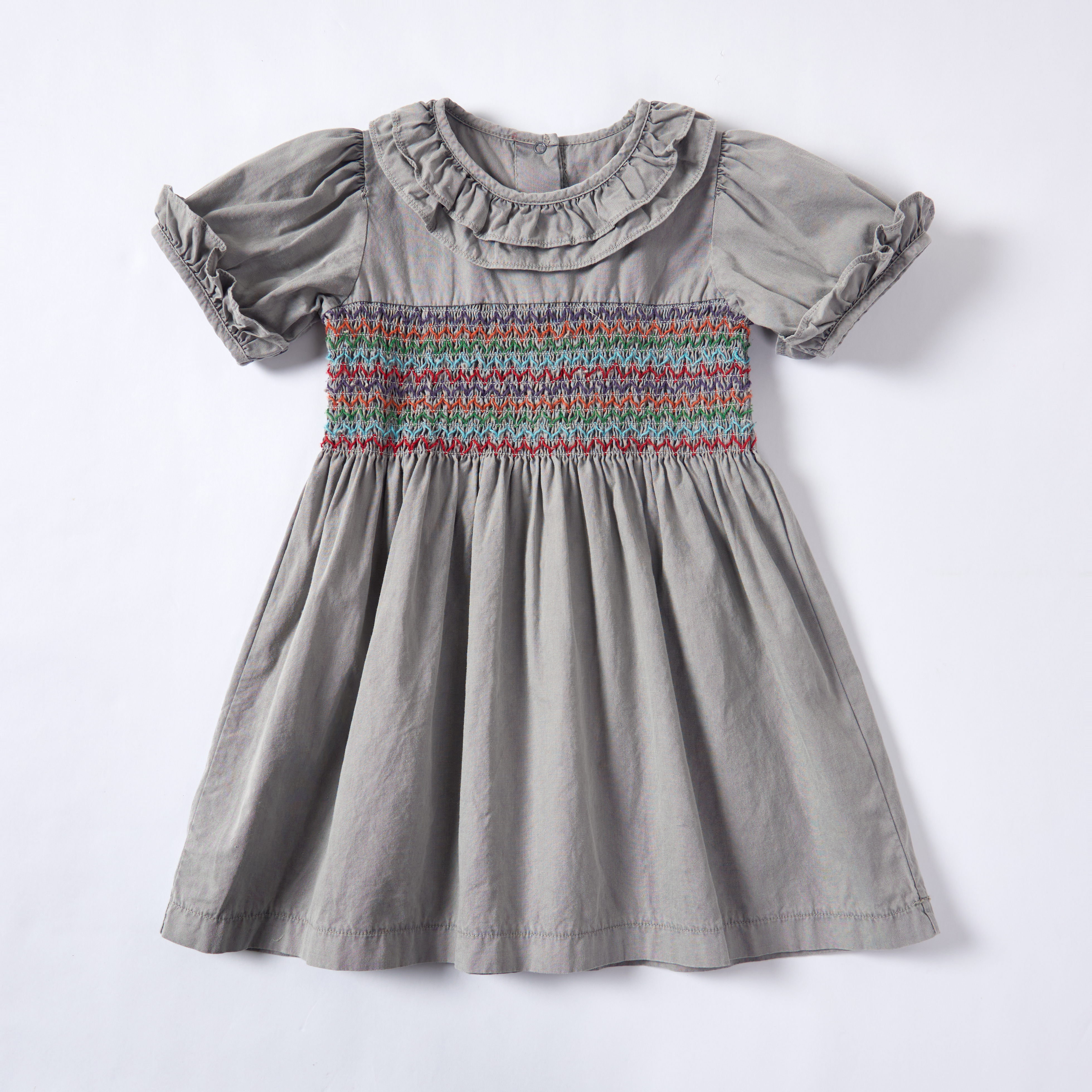
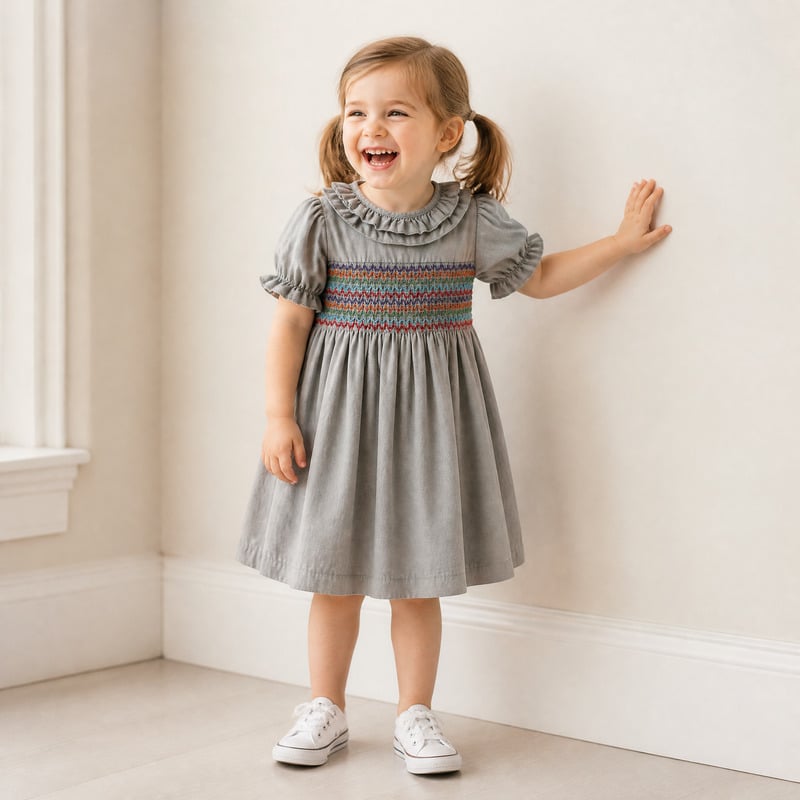
A short-sleeve smocked dress in 125 gsm cotton poplin, dyed to a warm dove grey with gallnut (五倍子) and pomegranate rind (石榴皮): a ruffle collar, puff sleeves gathered into a ruffle cuff, a smocked bodice worked in rows of wave stitch, a short back placket with one button, and a gathered skirt hung from the smocked panel.
This is the one colourway in the range where a metal is used deliberately. Neither gallnut nor rind gives grey on cotton — both are tannins, and on their own they give buff to light brown. The grey comes from a second bath of ferrous iron, which forms a dark complex with the tannin already in the fibre. That makes this a two-bath colour with a chemical step in it, and it makes the questions different: how much iron, how evenly, and what it does to the cloth over time.
At a glance
1. Grey is two baths, and the order is not negotiable
- The tannins load; the iron develops. Gallnut and rind are both applied first, together, and they have to be in the fibre and evenly distributed before any iron goes near the cloth. Iron first gives a surface colour that rubs off and mottles.
- Gallnut is the heavier tannin and does the loading. It is bought on tannin content and checked per lot, because the iron dose is set against the tannin actually on the cloth, not against the weight of the powder that went in.
- Rind is the softer tannin, and it is what keeps the grey from going blue. Its ellagitannins carry a warmer tone into the complex, which is why the result reads as a warm dove rather than a cold slate — the balance between the two is the colour.
- Iron is a development step and has to be even. The bath is run at a fixed concentration and temperature with the cloth moving throughout, because iron that sits still on cloth develops unevenly and leaves the grey patchy in a way that cannot be corrected afterwards.
- Nothing about this colourway is reversible. An over-ironed lot cannot be pulled back by rinsing, so the batch is weighed, dosed and logged before the cloth enters, and the iron bath is treated as a single-use operation.
2. The grey is not final when it leaves the bath
- The complex keeps developing. A tannin-iron grey continues to deepen and settle for days after drying, so a lot read on the day it comes off the line is not the colour the buyer will receive.
- So colour is approved after a defined resting period. The sealed standard is struck from cloth that has rested, not from the first dry piece, and every subsequent lot is read at the same point in its own rest.
- A shorter rest reads paler, and the difference survives washing. This is the quiet failure on iron greys: two lots that look close on the line diverge once both are a week old, and the mismatch appears in the same order.
- The standard is a physical sealed piece, not a number. Re-orders are matched against it under D65, which is the only way to hold a colour whose chemistry is still moving when it is packed.
- Storage conditions belong to the colour. Heat and humidity accelerate the shift, so the rest and the storage of the standard are specified together rather than left to the warehouse.
3. Iron dose, and the strength bill that comes with it
- Iron above what the tannin can take is not colour, it is damage. Excess ferrous iron catalyses oxidation in cellulose, and oxidised cotton loses strength before it looks any different.
- The dose is capped against the tannin load. That is why gallnut is bought on analysed tannin content: the cap is a ratio, and a weaker gallnut lot at the same weight would leave unreacted iron in the cloth.
- The first signs are physical, not visual. Embrittlement appears at fold lines, at the hem edge and along pleat ridges, which are the places that flex — on a garment, that means the smocked band and the hem before anywhere else.
- So strength is measured, not assumed. Strip tensile to ISO 13934-1 and tear to ISO 13937-2, run on the dyed lot against undyed cloth from the same greige lot, so the loss attributable to the iron is separated from the cloth's own variation.
- Rinsing runs to an endpoint and is checked. Cloth is rinsed until no unreacted iron remains available in the fibre, and the final rinse is verified before drying; residual iron keeps working after the garment is packed.
- Heavy-metal extraction is tested on this colourway specifically, on the finished dress rather than on the cloth, because that is the article a child puts in its mouth.
4. A compressed band is where grey shows its faults
- The band reads deeper than the skirt. Pleats hold shadow, so the same cloth reads a shade darker as a band; colour is approved with the band and the skirt side by side on one garment, and depth is chosen so the two read as one colour.
- Abrasion shows as pale fuzz before it shows as wear. On iron-mordanted cotton, needle and pleat-ridge abrasion raises a lighter haze, and on a mid-grey that haze is visible in a way it is not on cream.
- That is why the panel is the tightest inspection point. Every panel is screened for pale abrasion at the pleat ridges and at the seam ends, and needles are changed at a set interval and one-for-one at every break with the machine stopped.
- The band is the entry to the dress, not a decorative strip. It is gathered to roughly two and a half to three times its finished width, with the ratio set per size against head circumference plus clearance, and stress and recovery are checked on the smallest size first.
- The panel-to-skirt join carries the whole skirt and sits under continuous tension, so it is specified with a reinforcing stitch and checked for puckering, which on grey reads as a light line rather than a dark one.
5. Fit above and below the band
- The band's upper edge sits at a fixed distance below the armhole per size, so the smocking lands on the torso rather than riding up; this is one of the dimensions that does not scale by percentage.
- The plain bodice above the band is where a fit error shows first. Long by a centimetre and the collar bunches at the neck, short and the band sits too high to stretch comfortably.
- The collar ruffle adds weight to a narrow neckline, so the neckline is stabilised and the upper tier cut narrower; a two-tier collar that gapes at the centre front is a weight problem before it is a sewing problem.
- The sleeve is gathered at the head and finished with a narrow ruffle cuff. Head gather is distributed against the armhole in two passes so the cap stays flat, and cuff band width, including whether the band carries elastic, is fixed in the tech pack because it changes finished sleeve length.
- One button on a faced placket, tested as a small part at 70 N retention and checked against 16 CFR 1501 for the US market.
6. What the grey changes about the threads
- The ground is plant dyed with a ferrous second bath; the smocking is not. The five tones across the bodice are conventional dyed threads, and that is stated because a buyer reading "plant dyed" will otherwise assume the whole garment.
- Grey is a hard ground to approve threads against. A red that reads warm on cream reads cooler and slightly duller on grey, and a green can go muddy; the five-tone palette is therefore signed off on the worked grey panel, never on a card.
- Thread sits against skin across the whole bodice, so it is specified and tested as a component to the same restricted-substance limits as the cloth, with a supplier declaration held per lot.
- A fully plant-dyed version is possible and narrower: plant-dyed thread, separately tested, one or two muted tones, quoted as its own development.
- Labels and fusible are declared separately from the 100% cotton shell in the fibre content and on the care label, per the destination market's rule.
7. Tests, sizes, sampling and quoting
- Fastness is measured at the shipped depth: light to ISO 105-B02, wash to ISO 105-C06 with the smocked panel in the load, rubbing to ISO 105-X12 in both directions across the smocked area, perspiration and saliva to ISO 105-E04 plus the destination market's saliva method.
- Grey fades toward warm, not toward neutral. Light exposure lifts the blue component first, so the direction of the shift is recorded when the standard is struck, and the care label wording follows it.
- pH is measured on the garment and held in the 4.0-7.5 range; phenol yellowing is checked to ISO 105-X18 on a specimen carrying the actual packing fold, with packaging specified free of BHT.
- Five sizes graded on measurements. 6-9M, 9-12M, 12-18M, 24M and 36M move on chest, length, head size and the band's drop below the armhole; the panel is re-set per size because stretch does not grade like a seam.
- Customization. Single or double ruffle collar; plain neckline; smocking row count and stitch; thread palette from one to five tones; puff sleeve, plain short sleeve or sleeveless; one or two buttons; gathered, pleated or plain skirt; a deeper charcoal with a higher iron dose within the strength limit.
- Sampling: 3-7 days from a confirmed tech pack, covering a dyed strike-off read after its rest period, one smocked panel in the agreed palette with its skirt beside it, a stretch-and-recovery check before and after five washes, crock and bleed on the smocked area, a button pull test, and a fit check on the smallest and largest size.
- Bulk: 30-60 days from approval, planned per dyebath and per thread lot, with cloth released only after rest, strength, pH and fastness results are in hand.
- MOQ: 300 pcs for a custom development covering cloth, shade, smocking, trim or fit; 50 pcs for a decorative process on a stock body; 100 pcs for stock cloth with your own logo and label. Mixed colour and size orders are quoted per order, and terms are confirmed against the current quotation.
Production runs with our production partner, Suzhou Shelmin Trade Co., Ltd.: founded 2017, 7,200 m² workshop, 8 lines, 200 staff, 6,000 pieces per day. Design confidentiality is held under NDA; buyer patterns, shades and prints are not re-used.
To quote, we need: target market and the Class I tests it requires; the depth target against the sealed standard; the thread palette and count; smocking row count and stitch; lot certificates for gallnut, rind and thread with analysed tannin content; the iron dose and the rest period used for the standard; the rinse verification method; the pH and water specification; packing method; and whether certification is to run in your brand name.