EN

OEM/ODM 100% Cotton Double-Layer Wrinkled Gauze Baby Bubble Shorts | Eco-Friendly Plant-Dyed 135gsm Toddler Bloomers | Custom Sustainable Botanical Dye Infant Summer Shorts with Side Bows Wholesale


- Overview
- OEM/ODM 135gsm Plant-Dyed Cotton Baby Bubble Shorts
- Recommended Products
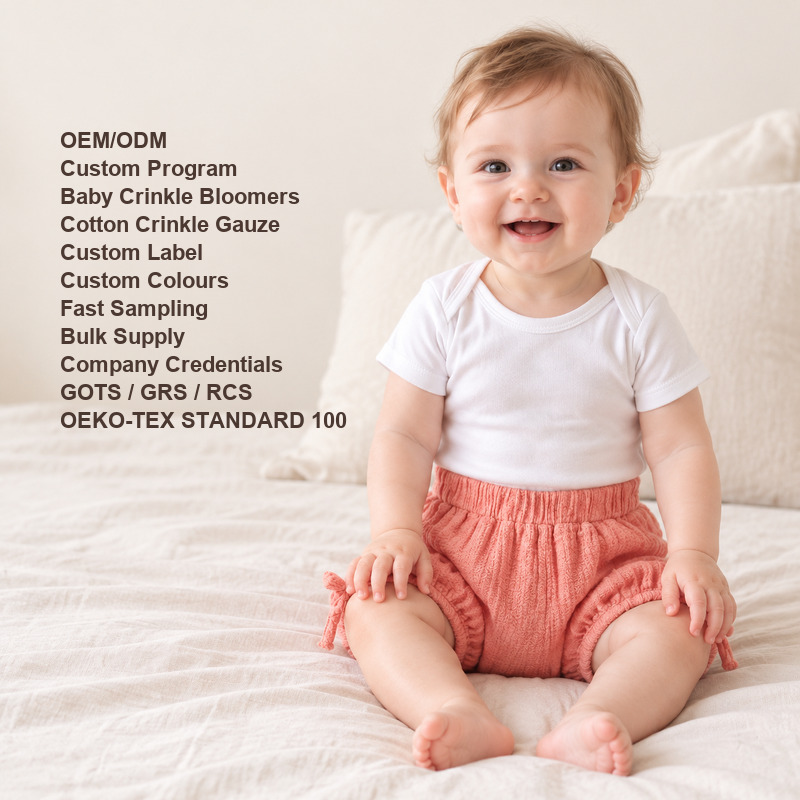
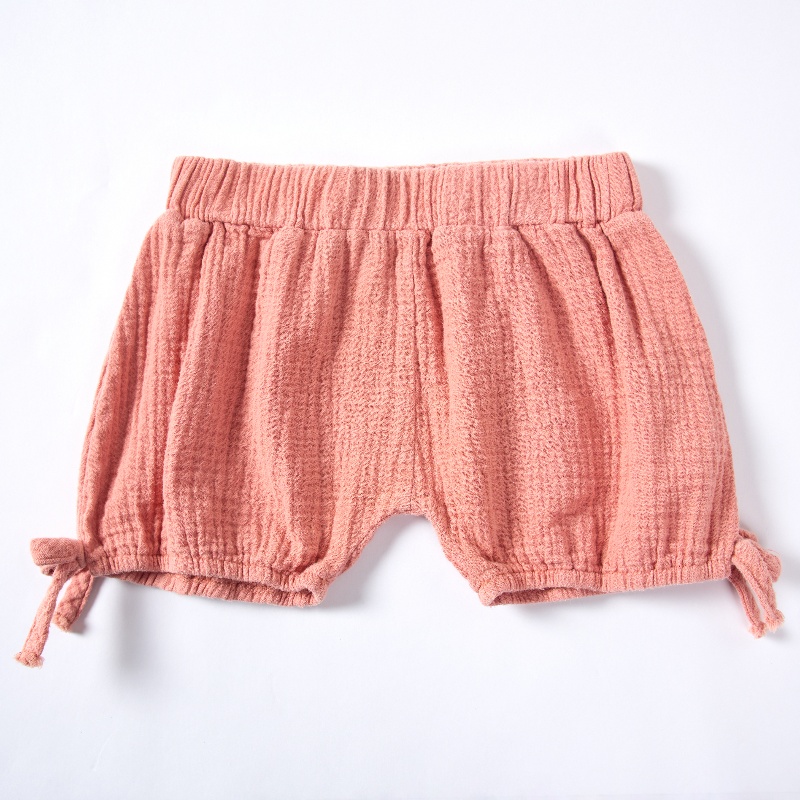
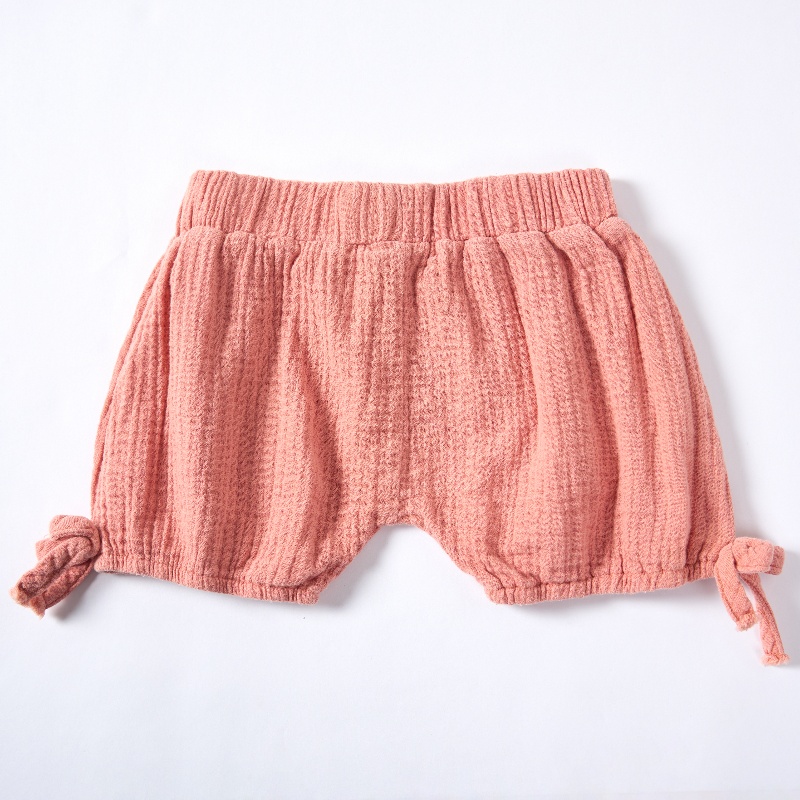
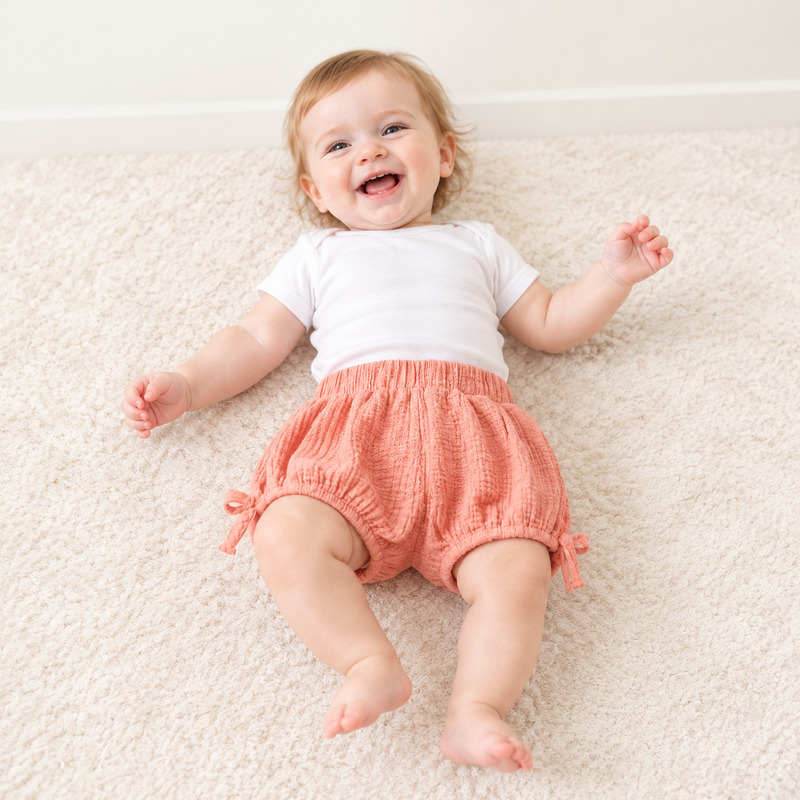
Baby bloomer shorts in a double-layer crinkled cotton, 135 gsm, plant dyed to a coral bloom with sappanwood (苏木), madder (茜草) and pomegranate rind (石榴皮): a gathered paperbag waist on elastic, a full leg that closes at the thigh on encased elastic, and short self-fabric ties at the side seams.
Every previous decision in a plain-weave garment has a counterpart here, and none of them behave the same way. A double layer takes liquor between its plies; a crinkle holds liquor in its creases; and a textured surface reads darker than the flat cloth it was dyed from. This page is about that: what changes when the cloth is two layers deep and permanently creased.
At a glance
1. Two layers, and the liquor has to go through both
- A double-layer cloth is two surfaces and the space between them. Dye liquor has to wet both plies evenly, and the crinkle makes that harder because the cloth does not lie open in a bath.
- Uneven wetting shows as a difference between the plies, not as a patch on one surface: an outer ply that takes more colour than the inner reads as a garment whose inside and outside are two shades, and the inside is the side a customer sees when the waistband folds over.
- So the bath is specified for penetration, not for speed. Wet-out before dyeing, longer immersion than a plain poplin at the same weight, and circulation that keeps the cloth opening and closing rather than compressed in a pack.
- Both plies are checked, not the face only. A shade card is read on the inner ply as well, because a two-layer garment that matches on the outside and misses inside will be found at the first turn of the waistband.
- Weight is 135 gsm for the pair, so each ply is light; the practical consequence is a short dyeing window and a fabric that marks if it is handled wet and hot, which is why handling at the dyebath is specified rather than left to the operator.
2. A crinkle reads deeper than the flat cloth it came from
- Texture darkens. Creases hold shadow, so a crinkled cloth reads deeper and warmer than the same cloth flat, and the tighter the crinkle the deeper it reads.
- That makes the flat swatch an unreliable standard. A shade approved on a flat piece will read too dark once the garment is made up, so the colour is approved on the crinkled cloth, on the garment, at the same light.
- Crinkle intensity becomes part of the colour specification. Two crinkle levels from one bath are two different colours on the body, so the crinkle is specified and checked as a parameter — crease count and depth per unit, not "about the same as the last lot".
- Comparison across lots is made on the same texture. A retained standard that has been washed and pressed flat no longer describes the shade; standards are kept crinkled and stored flat rather than pressed.
- The shift is in the same direction as depth, which is why the recipe is not pushed to a saturated coral: a deeper bath on a crease would read heavier than the target and lose the softness that the shade is for.
3. Crinkle relaxes in the wash, and that is a measurement
- A crinkle finish is held by the cloth's own memory, and washing lets some of it go: the cloth relaxes, the garment grows in length and the creases soften.
- So length is specified after washing, not before. Post-wash length and width are the dimensions a customer experiences, and a bloomer that grows becomes a different silhouette rather than a slightly bigger one.
- The waist is elastic so it does not fall down — it just sits lower, which is why the waistband depth and the rise are dimensioned against the relaxed state and checked after the wash sequence.
- Relaxation differs along and across the grain, so the pattern is cut with a stated allowance per direction and the cut is left to rest before sewing; a bloomer cut straight off the roll will not match a bloomer cut after resting.
- The self-fabric ties move with relaxation because they hang from the side seam; their finished length and the point at which they sit are checked after washing as well as before.
4. Rinse and dry are the bottlenecks, not the dyeing
- Creases hold liquor. A crinkled cloth carries more water out of the bath and gives it up more slowly, so rinsing takes longer than the weight suggests and residual tannin or soap sits in the folds.
- Residue in a crease shows as a tide mark once the garment dries, and on a coral it reads as a darker line that follows the crease rather than the seam.
- So the rinse is verified on a crease specimen, opened out and dried under D65, rather than on a flat offcut that was never inside a fold.
- Drying is specified flat and in shade, because a crinkle dried under tension loses depth in the creases and dries unevenly at the fold lines; the same instruction goes on the care label.
- Unfixed dye in a crease is a crock risk, not only a rinse risk, so rubbing is tested through the crease as well as on the flat areas between them.
5. The paperbag waist and the leg elastic are where the bulk sits
- The waist gathers a double-layer cloth onto elastic, which is four plies plus elastic at one seam. It is graded and pressed to sit flat, and the needle and feed are specified for the bulk, since a deflected needle marks a dyed crinkle visibly.
- Elastic is specified as relaxed and stretched circumference per size, at the waist and at both leg openings, with waist recovery checked after repeated washing because a gathered waist is under constant tension.
- Leg clearance is checked on the largest size first, since thigh growth outpaces the waist in this size range and a tight leg on a bloomer reads as a fit fault rather than a style.
- The side ties are a children's-wear item in their own right. They are short, they are attached at both ends, they cannot form a loop, and their finished length is held within the cord limit for the destination market, checked against the 13 cm figure used for this size range.
- The ties are cut from the same dyed lot as the body, because a self-fabric tie from a different bath is the most visible mismatch on the garment: it hangs free, in daylight, at the widest point.
6. What the plant dye has to carry on a textured ground
- Evenness is judged on the crinkled surface, not on a flattened specimen. A flattened patch is the one place where a texture-based colour and a flat-based colour can be compared, and they should not be mixed.
- The three plants divide the work here as elsewhere: the rind supplies the tannin carrier and the warmth, madder the red, sappanwood the correction that keeps the coral from going flat; at this depth the rind dose is the one that decides whether the coral reads soft or dusty.
- Because the inner ply is visible at the waist turn and the leg turn, the shade is accepted on both sides, and the seam that joins them is checked for a step where one ply turned under.
- There is no smocking and no hardware here, so the garment's risk sits in the cloth: wetting, rinsing, relaxation and texture. That is unusual in this range and it changes the sampling list rather than the standards.
- pH and fastness are unchanged: pH held between 4.0 and 7.5 on the garment, light, wash, rubbing, perspiration and saliva tested at the shipped depth, with the tests run on the crinkled cloth.
7. Tests, sizes, sampling and quoting
- Fabric tests at the shipped depth: light to ISO 105-B02, wash to ISO 105-C06 with a whole garment in the load, rubbing to ISO 105-X12 on flat areas and through creases, perspiration and saliva to ISO 105-E04 plus the destination market's saliva method, and colour read on both plies.
- Relaxation and dimension change after washing, recorded as length, width and rise before and after the wash sequence, with the waistband and ties dimensioned in the relaxed state.
- Trim and safety checks: waist and leg elastic relaxed and stretched circumferences, elastic recovery after repeated washing, tie length against the cord limit for the market, tie attachment strength at both ends, and a loop check on the finished garment.
- pH is measured on the garment and held between 4.0 and 7.5; phenol yellowing is checked to ISO 105-X18 on a specimen carrying the actual packing fold, with packaging specified free of BHT.
- Five sizes on a measurement chart: 6-9M, 9-12M, 12-18M, 24M and 36M move on waist, rise, leg opening and outseam, measured in the relaxed state and confirmed after washing.
- Sampling: 3-7 days from a confirmed tech pack, covering a dyed strike-off on the crinkled cloth with its crinkle level stated, a made-up bloomer washed once and re-measured, a fit check on the smallest and largest size with a nappy in place, an inner-ply colour check at the waist turn, elastic and tie checks, and a crease rinse check.
- Bulk: 30-60 days from approval, planned per dyebath and per elastic lot, with cloth released only after both-ply colour, rinse, pH and relaxation results are in hand.
- MOQ: 300 pcs for a custom development covering cloth, shade, crinkle level, trim or fit; 50 pcs for a decorative process on a stock body; 100 pcs for stock cloth with your own logo and label. Mixed colour and size orders are quoted per order, and terms are confirmed against the current quotation.
Production runs with our production partner, Suzhou Shelmin Trade Co., Ltd.: founded 2017, 7,200 m² workshop, 8 lines, 200 staff, 6,000 pieces per day. Design confidentiality is held under NDA; buyer patterns, shades and prints are not re-used.
To quote, we need: target market and the Class I tests it requires, including the cord and tie requirement that applies there; the crinkle level you want, described as crease count and depth per unit; whether the shade is to be approved on the crinkled cloth rather than a flat swatch; the acceptable post-wash length change; waist and leg elastic type with relaxed and stretched circumferences; tie finished length; lot certificates for the three plants and for the thread; the pH target and the dyehouse water specification; packing method; and whether certification is to run in your brand name.