EN


OEM/ODM 100% Cotton Embroidered Girls Smocked Dress Natural Plant Botanical Dyed Tie Dye Toddler Kids Flutter Sleeve Princess Dresses Custom Wholesale


- Overview
- OEM Custom 100% Cotton Plant Dyed Girls Smocked Dress
- Recommended Products
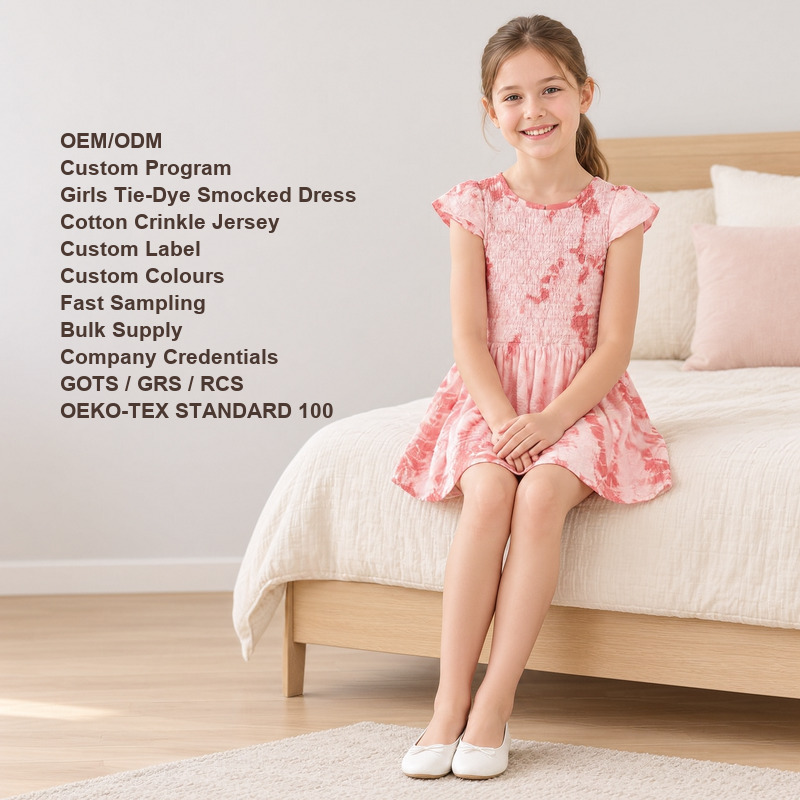
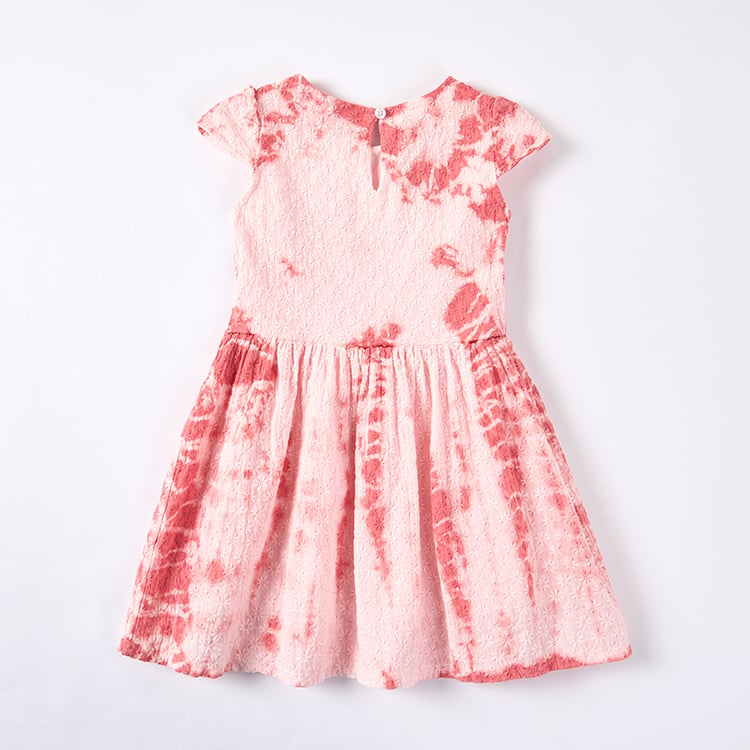
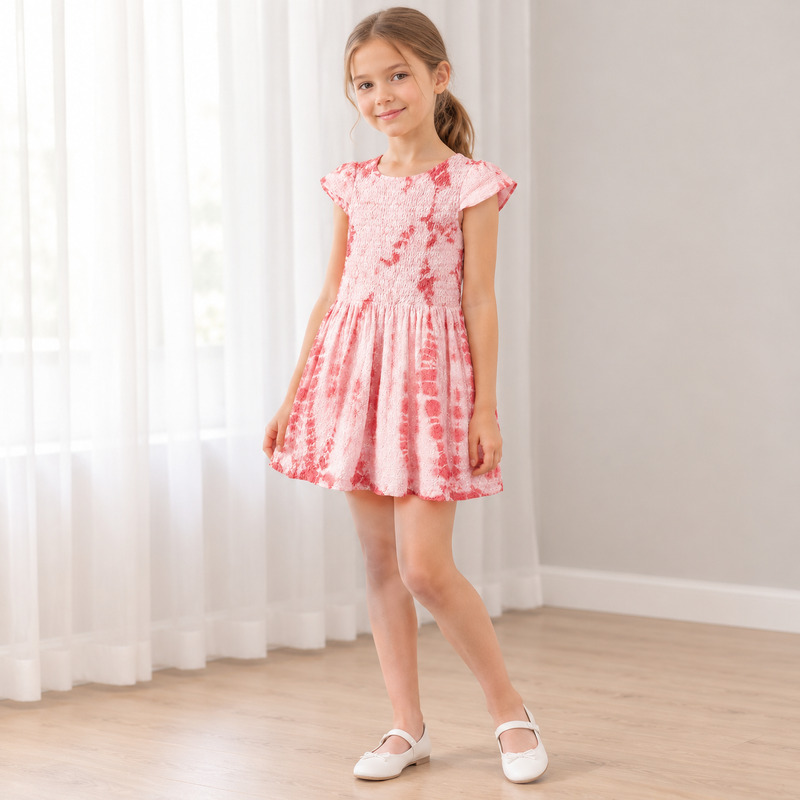
A dress in a cotton with a regular dot grid embossed into the cloth, plant dyed to a coral block pattern with sappanwood (苏木) and madder (茜草), no added mordant: a narrow bound neckline, a bodice shirred in fine rows with elastic thread, ruffle caps at the shoulder, a gathered skirt, and a keyhole at the centre back closed with a button and a thread loop.
Three things are stacked on this dress and they work at three different scales: the block marks at the scale of a hand, the shirring at the scale of a row of stitching, and the dot grid at the scale of the cloth itself. The most consequential of the three is the shirring, because it is both the fit and, on this sample, the reason the bodice is paler than the skirt.
At a glance
1. The bodice is a stretch structure, and it is the whole fit
- Shirring is rows of elastic thread sewn into the cloth, not a decorative stitch over a fitted panel: each row pulls the fabric into fine pleats, and the panel as a whole stretches and returns.
- Four numbers set it: row spacing, stitch length, elastic tension and row count. Spacing and count decide how far the bodice extends; tension decides how it returns; stitch length decides whether the pleats sit as fine lines or as coarse gathers.
- So the bodice is specified by extension and recovery rather than by a measurement. A shirred panel measured flat tells a buyer nothing; what is written down is the flat width, the extended width and the waist it is expected to hold.
- Recovery is what the dress lives or dies by. A bodice that stretches well and returns slowly sags at the waist after a month of wear, and the skirt hangs from that waist.
- The shirring stops below the neckline band, which is why the neck needs its own opening: the band does not stretch, so the keyhole at the back is what lets a head through.
2. A stretch bodice on a non-stretch skirt
- Two different systems meet at one seam. The bodice extends by several centimetres; the skirt does not extend at all; the waist seam has to be sewn so that the first can be pulled without the second giving way.
- That means a stitch with give in it, and a seam allowance that is finished so the allowance itself can open with the bodice rather than fighting it.
- The skirt gather is distributed against the bodice's flat width, not its extended width, or the seam is sewn while the bodice is stretched and the waist pulls in as soon as it relaxes.
- The seam is checked under extension, not flat: the sample is pulled to its working width with the skirt attached, and the seam is read for puckering, for a popped stitch and for the gather bunching at one point.
- Every one of those faults shows at the centre back first, because the keyhole split sits directly above the seam and the eye follows that line down.
3. The bodice went into the bath compressed, so it reads paler
- On this sample the bodice is several steps paler than the skirt, and the cause is structural: the shirred panel is folded onto itself in fine pleats, so the liquor reaches the ridges and only partly the valleys.
- The skirt was free in the same bath, so it took the colour fully and carries the block marks at full depth. The difference across the waist seam is the difference between compressed cloth and open cloth, not between two dyes.
- That is a design consequence to be agreed, not a fault to be corrected at the dyebath. Chasing it with a longer dip deepens the skirt as well and leaves the bodice behind again.
- The alternative is to dye the cloth before shirring. That gives a bodice as deep as the skirt, and it loses the alignment between the block marks and the shirring rows, because the marks then fall where the cloth was, not where the panel is.
- The row spacing is also a colour decision: rows set closer together compress more cloth, hold more liquor out, and read lighter than the same cloth shirred in wider rows.
4. The dot grid is the smallest scale, and it changes how the pale areas read
- The cloth carries a regular grid of embossed dots, so the surface is never flat: the dots sit proud of the ground and take the dye differently from the cloth between them.
- In the deep areas the grid disappears; in the pale areas it is the only thing giving the surface any figure, which is why a pale bodice reads as cloth rather than as blank.
- The grid also hides small faults and exposes big ones. A pale patch in the middle of a dot grid reads as a soft change; a pale patch with a hard edge cuts the grid and reads as a stain.
- Embossing and shirring compete for the same millimetres. A row of shirring laid across the grid presses the dots flat, so the row lines read as slightly smoother bands, which is expected at this row spacing.
- The grid is checked for crush after washing, since an embossed figure that flattens in the first wash changes the look of every pale area on the dress.
5. Two vertical systems meet at the waist
- The block marks run in columns and the skirt gathers run vertically too, so at the waist the two can either reinforce each other into a stripe or break into a column that stops and restarts.
- So the column spacing is planned with the gather distribution, not separately: the marks are placed so that the columns continue through the seam rather than colliding with the gather lines at an angle.
- The marks themselves come from clamping: the cloth is folded and held between boards before it goes into the bath, and the pattern is where the boards pressed. Nothing is printed.
- The board edge is soft, not sharp, because liquor creeps under every board; a hard-edged square is the signature of a print, and it is the mark that is rejected.
- On the sleeves the columns drift, since a ruffle cap is small and cut from a different part of the cloth; the drift is accepted at the sleeve because the piece is too small to carry a column, and it is specified so the sample is not read as a fault.
6. The keyhole is the only closure, and it carries the neck
- One button and a thread loop at the centre back. The loop is short, sized so it passes the button and no more, because a long loop on a child's garment becomes something to catch on.
- The button is a small part: attachment is checked at 70 N, the button goes through the small-parts cylinder, and the check is repeated after washing rather than only on the sample.
- The keyhole is bound or faced so its edges do not fray, since it is cut into a cloth that is under tension from the shirring below and a raw edge there opens with wear.
- The keyhole sits above the shirring, on the plain band, so the button is not strained by the bodice's stretch; a button on a stretching panel pulls through its hole in a few weeks.
- Class II applies: 3Y, 5Y and 8Y are for children over 36 months, the Class II scope for this cloth, colourway and button is confirmed against the certificate at quotation, and pH is measured on the garment and held between 4.0 and 7.5.
7. Sizes, sampling and quoting
- Three sizes graded on measurements: 3Y, 5Y and 8Y move on chest, bodice length, skirt length, sleeve and waist. The bodice is graded by row count and row spacing rather than by width alone, because extension is what the size actually needs.
- Customization. Row count and spacing; elastic tension; neckline shape and keyhole position; ruffle cap depth; block scale and column spacing; and the bodice-to-skirt depth relationship, either as sampled or dyed before shirring, each sealed on its own reference pair.
- Sampling: 3-7 days from a confirmed tech pack, covering a clamped strike-off with its reference pair, a made-up dress with the bodice shirred and the skirt attached, an extension and recovery check before and after five washes, a pull test on the waist seam with the skirt attached, a button pull and small-parts check after washing, crock in the deep and pale areas, and light on both.
- Bulk: 30-60 days from approval, planned per clamp batch and per dyebath, with the skirt cut per lot so the columns meet the gather distribution, and the bodices shirred to the recorded row count and tension; AQL 2.5 major and 1.0 critical.
- MOQ: 300 pcs for a custom development covering cloth, shade, resist, trim or fit; 50 pcs for a decorative process on a stock body; 100 pcs for stock cloth with your own logo and label. Mixed colour and size orders are quoted per order.
Production runs with our production partner, Suzhou Shelmin Trade Co., Ltd.: founded 2017, 7,200 m² workshop, 8 lines, 200 staff, 6,000 pieces per day. Design confidentiality is held under NDA; buyer patterns, shades and prints are not re-used.
To quote, we need: target market and the Class II tests it requires; whether the bodice is to stay paler than the skirt as sampled, or the cloth is to be dyed before shirring so the two match; row count, spacing and elastic tension, or the extension and recovery you want; the block scale and column spacing; the button specification, or your own button to be tested; whether the embossed dot grid is to be this cloth or a plain ground; lot certificates for both plants and for the elastic thread; the pH target and the dyehouse water specification; packing method; and whether certification is to run in your brand name.