EN

Custom Kids Cotton Hoodie & Jogger Set Manufacturer | Plant Dyed Toddler Tracksuit OEM ODM


- Overview
- OEM ODM Sustainable Kids' Giraffe Plant-Dyed Tracksuit
- Recommended Products
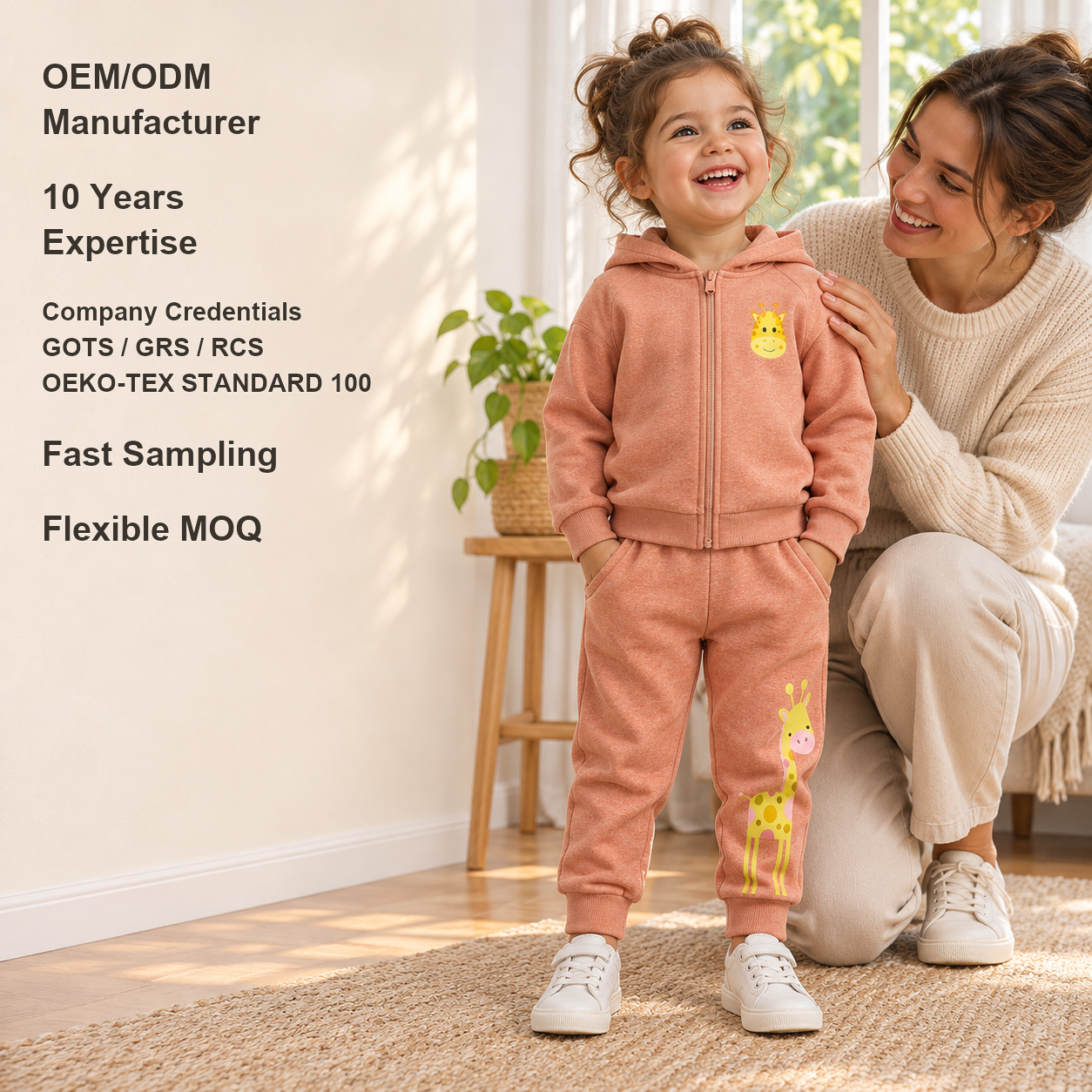
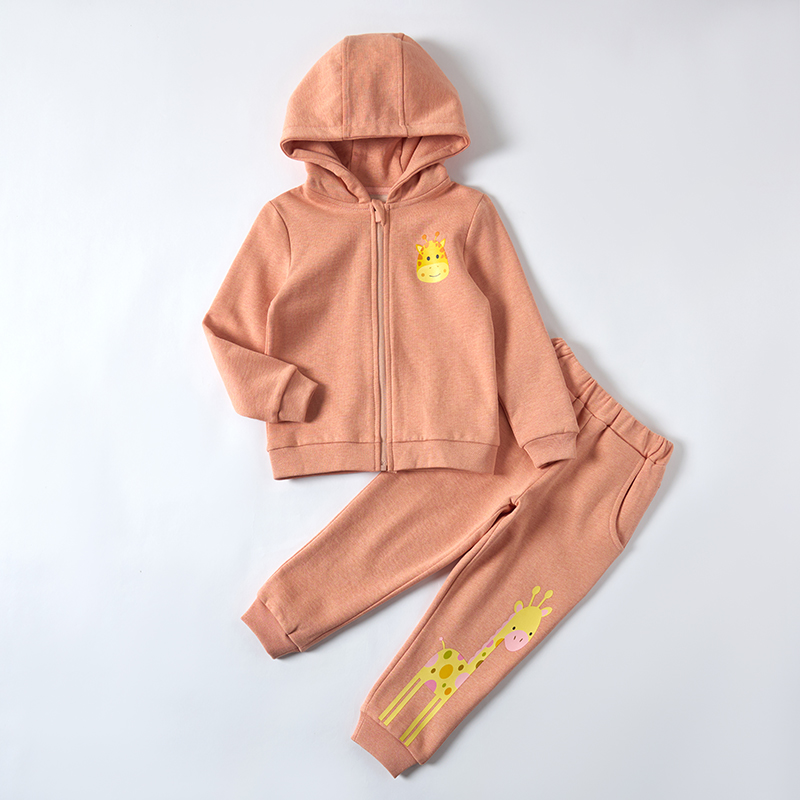
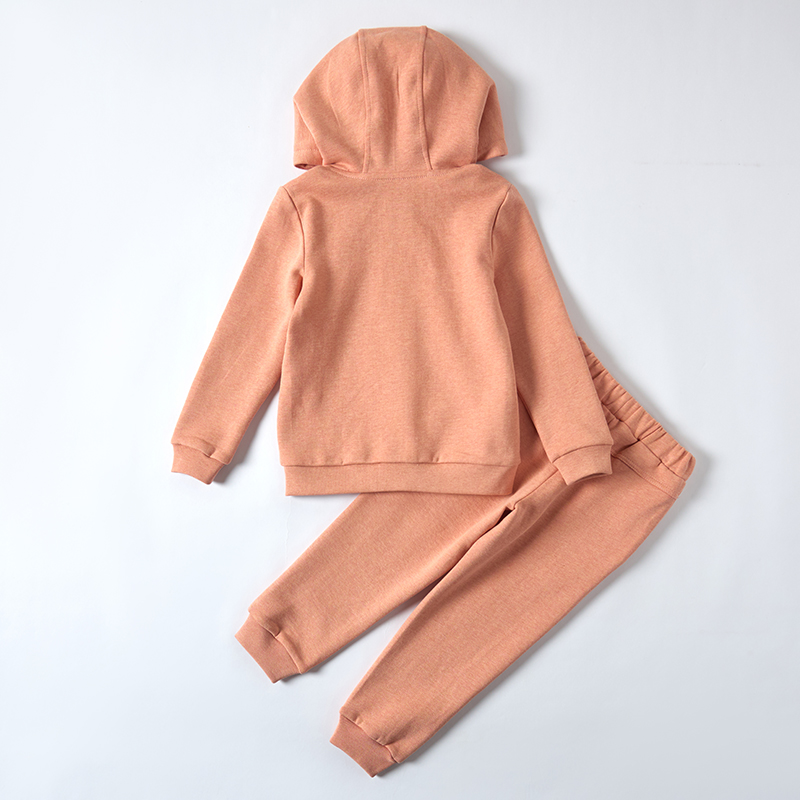
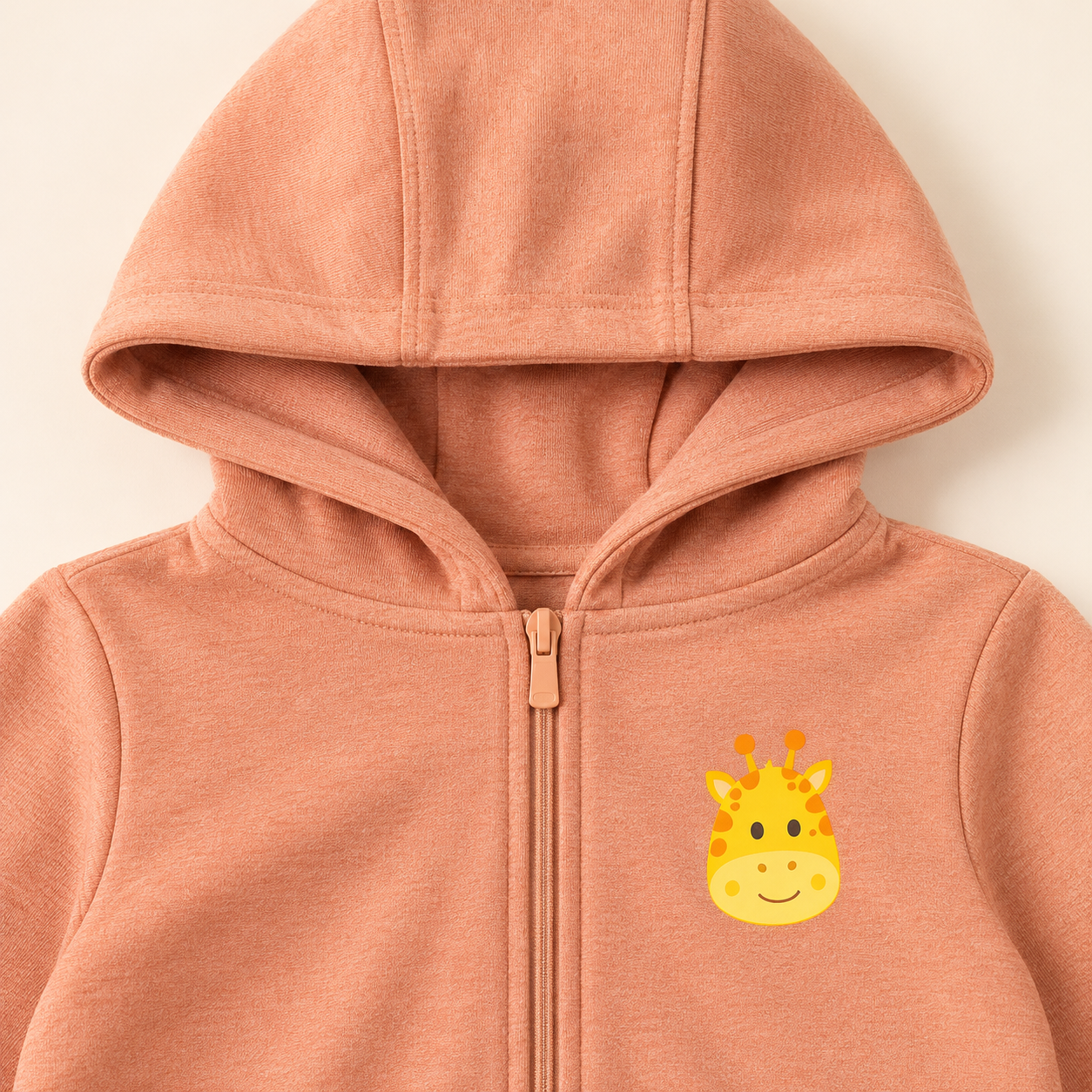
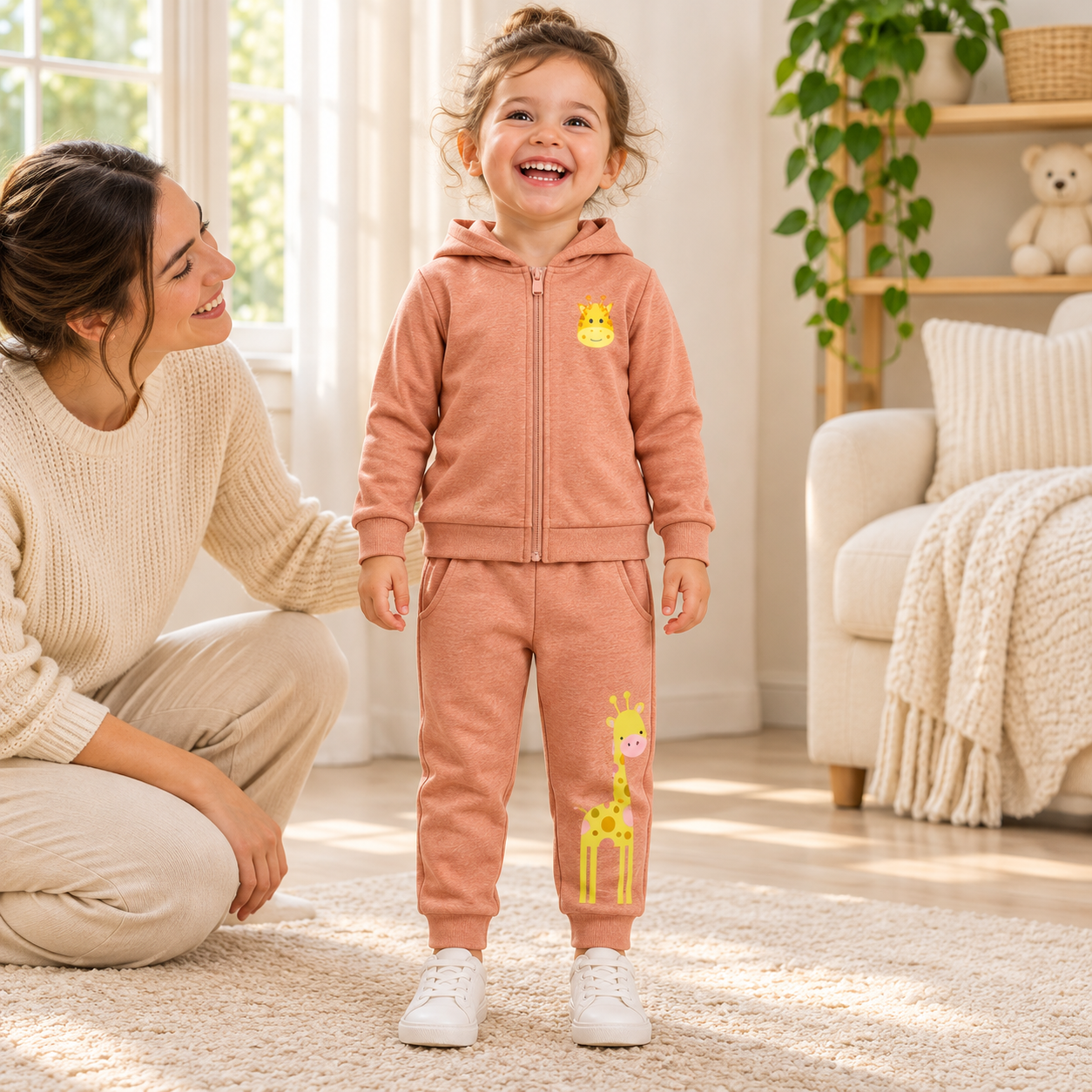
A zip-front hoodie and jogger set in 280 gsm brushed cotton flannelette, plant dyed to a soft peach with madder root and sophora buds, with a small printed badge at the chest and a print down one leg. Rib cuffs, rib hem, elasticated waist.
Two plants make this colour and neither of them is peach. Madder gives red and sophora gives yellow, and peach is what happens when the two are laid one over the other at the right proportion. Unlike a blue-yellow pair, both of these are mordant colours, which means the mordant decides the hue before the dyestuff does — and that is what makes peach a narrow window rather than a wide one.
At a glance
1. The cloth: a pale shade on a brushed face
- Brushing changes saturation, not just lightness. On a 280 gsm flannelette the raised fibre scatters light across the surface, so a pale plant colour reads dustier than the same shade on a flat cotton — a peach that looks juicy on a swatch looks chalky on the pile.
- So peach is chosen on the brushed cloth. The approval is taken on a dyed and brushed piece, because a decision made on flat cotton will come back one step pale and one step grey.
- The pale face is also the exposed face. The pile that gives the softness is the part in contact with light and air, and it is where a pale madder shade fades first.
- 280 gsm holds the hood without interfacing, which is why a zip-front at this weight can stand up at the neck rather than collapsing into the zip.
- The cloth is not flat, so a graphic is not flat either. A print placed on a brushed ground sits on the pile, and its edge is judged on the cloth rather than on paper.
2. Two mordant dyes: the mordant sets the hue
- Madder root works through alizarin, and alizarin needs a metal to become a colour. On its own it is a weak, dull stain; combined with a mordant it forms a lake inside the fibre, and which metal is used decides what that lake looks like — alum gives a warm red toward coral, iron pulls the same dye toward brick and brown.
- Sophora buds behave the same way. The yellow is a flavonoid that also fixes through a mordant, so the yellow shifts with the mordant as well.
- So the mordant is chosen before the dye ratio is. Two mills using the same two plants and different mordants will produce two different garments, and both will honestly call them madder and sophora.
- That is why the route is documented per order, with the mordant, its concentration and the soaping after-treatment recorded in the batch record alongside the two dyestuffs.
- Neither plant is a standardised colorant. Root and bud vary by season, so the recipe is expressed against a reference batch rather than as a fixed percentage of fibre weight.
3. Peach: the narrow window
- Peach is the overlap, and the overlap is small. Lean on madder and the set goes brick; lean on sophora and it goes apricot; peach sits between them and holds only while both are in proportion.
- The order of application still matters. Yellow under red and red under yellow do not give the same peach, even at the same ratio, because the second bath sits on a different ground than it would on greige.
- Shade is approved as a range, not a chip. The approved reference is a physical dyed piece, and the acceptable window is written into the approval so that inspection has a limit to work to rather than an opinion to offer.
- The set is dyed as one lot. Hoodie and jogger are cut from the same dyed batch, because peach is precisely the shade where a neighbouring batch reads as a different product rather than as a near miss.
- A yellow print on a peach ground has little separation. The giraffe reads through its outline and its darker spots, not through its hue, so the print is checked for contrast on the dyed cloth rather than on the artwork.
4. Light fastness: the pale shade is the one that moves
- Pale madder shifts toward beige, not toward white. As the alizarin lake breaks down under light, the red component leaves first and what remains is the yellow ground underneath, which is why a faded peach looks dusty rather than bleached.
- The brushed face has more surface for light to work on. A raised pile exposes more fibre ends than a flat cloth, so a brushed garment fades faster at the places that catch the sun: the shoulder, the crown of the hood and the outside of the knee.
- That is checked on the finished garment, not on a swatch, because the fade shows as a difference between the shoulder and the inside placket, and a swatch has no shoulder.
- Wash and light are separate failures. Washing removes unfixed dye and dulls the shade gradually; light breaks the lake and shifts the hue. Both are tested, and neither is read off the other.
- What can be documented is the recipe, the batch record and the finished-goods test results. That file is what a buyer audits on a plant-dyed claim.
5. The zip: the one part that cannot take the plant bath
- Zip tape is polyester and will not take a plant dye. The dyestuffs here fix to cotton through the fibre's chemistry; on polyester tape there is nothing for them to bond to, so the tape is dyed separately by a conventional route to match the cloth, or chosen as a deliberate contrast.
- Matching the tape to a plant-dyed cloth is a two-colour problem. A plant-dyed peach is never completely flat, so the tape is matched to the average of the approved range rather than to a single point, and the match is judged on the sewn jacket.
- A soft brushed cloth makes a zip wave. There is no body in the cloth to hold the zip straight, so the placket is stabilised with a fusible strip or a stable tape behind the zip; without it the zip line undulates after the first wash and never recovers.
- The zip is set after dyeing and washing, because the bath would attack the tape and the slider, and because the cloth has to be at its finished shrinkage before the zip is measured in.
- The chin guard and the puller are part of the safety file. The zip runs to the collar top, so the guard keeps the slider off the throat, and the puller is treated as a small part and tested as one.
- Thread is dyed separately too. On a peach ground a tonal thread is matched to the cloth rather than to a card, since a thread that matches flat peach reads light against pile.
6. Size: 2Y–8Y, and what the block has to hold
- Sizes run by age, 2Y, 4Y, 6Y and 8Y, so the block is graded on the standard child measurement for each year and the finished measurements are published rather than implied.
- Every size here is above 36 months, so the set is assessed as Class II under OEKO-TEX Standard 100, with the certificate covering the dyed cloth, the rib, the zip tape and the print.
- A zip-front is sized on the chest and the shoulder, because the zip has to lie flat when the jacket is closed over a layer; a chest that is right but a shoulder that is narrow pulls the placket open at the top.
- Sleeve length is judged with the arm raised, since the cuff has to stay at the wrist at full reach, and the rib hem is checked sitting so it does not ride above the waistband.
- The set is fitted as a pair, with the hoodie hem and the jogger rise checked together rather than each on its own.
7. Customization, sampling and what we need to quote
- Set. Zip hoodie and jogger as shown; a pullover hoodie; a shorts version of the jogger.
- Shade. Soft peach as shown; a deeper coral with more madder; a yellow-only version with no madder.
- Mordant. Alum route as approved; an iron route for a duller brick, quoted separately since it changes both hue and fastness.
- Zip. Nylon zip as shown; a tonal tape; a contrast tape; a press-stud placket for the smallest size.
- Print. Badge and leg print as shown; a chest print only; a woven badge instead of a print.
- Packing. Polybag with size sticker; hanger; woven or printed label, satin care label, hangtag.
- Sampling. 3–7 days from a confirmed tech pack, with a dyed and brushed strike-off, a light fastness trial on the finished garment and a wash trial on the printed area; testing is booked separately and added to the schedule.
- Bulk lead time. 30–60 days from approval by quantity and dyebath schedule; the bath is planned per batch, so a split delivery is quoted as two batches.
MOQ: 300 pcs for a custom development — custom cloth, shade, print or fit; 50 pcs for a decorative process added to a stock body; 100 pcs for stock cloth with your own logo and label. Mixed colour and size orders are quoted per order. These are standing programme terms, confirmed against the current quotation.
Production runs with our production partner, Suzhou Shelmin Trade Co., Ltd.: 7,200 m² workshop, 8 lines, 200 staff, 6,000 pieces per day. Design confidentiality is held under NDA; buyer patterns, shades and prints are not re-used.
To quote, we need: target market and the fastness tests it requires; the mordant route and its concentration for both dyes; the ratio of madder to sophora and the order of application; whether the zip tape is matched or contrast; cloth weight and whether it is brushed before or after dyeing; packaging; and whether certification runs in your brand name.