EN

Custom Kids Graphic Hoodie & Jogger Set Manufacturer | 100% Cotton Plant Dyed Children Tracksuit OEM ODM


- Overview
- OEM ODM Plant-Dyed Kids' Tracksuit
- Recommended Products
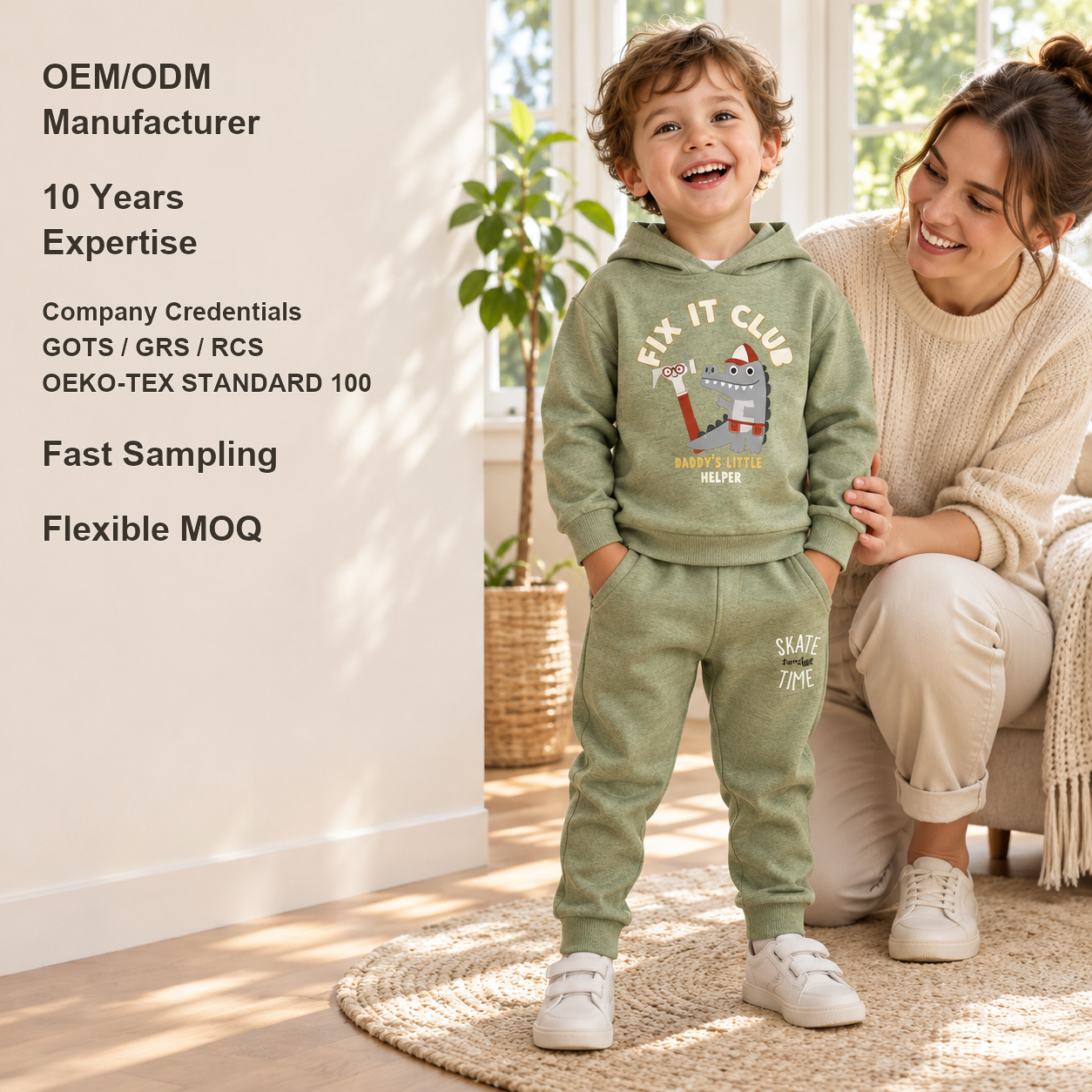
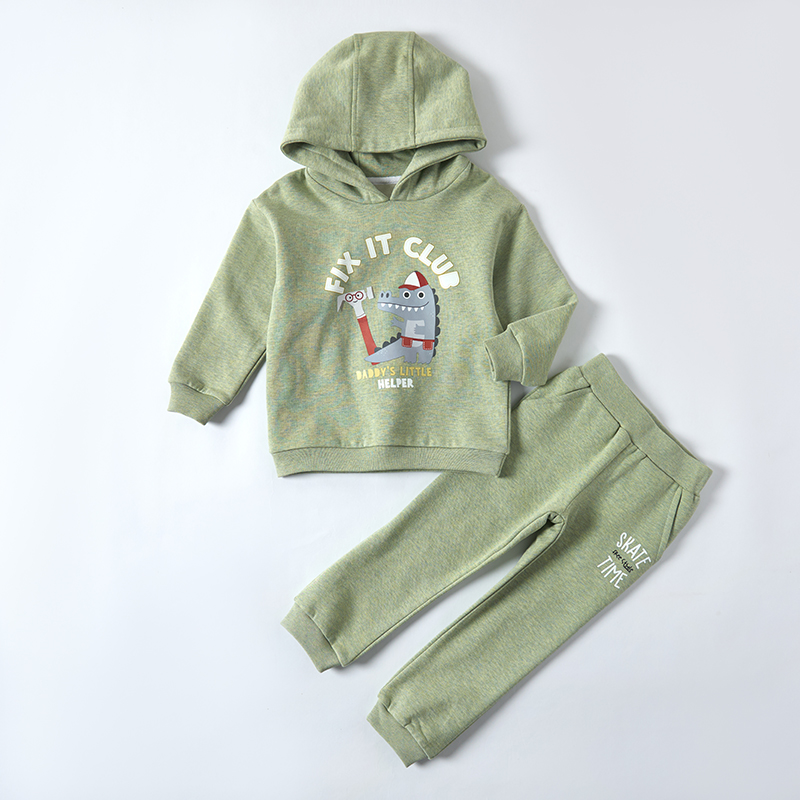
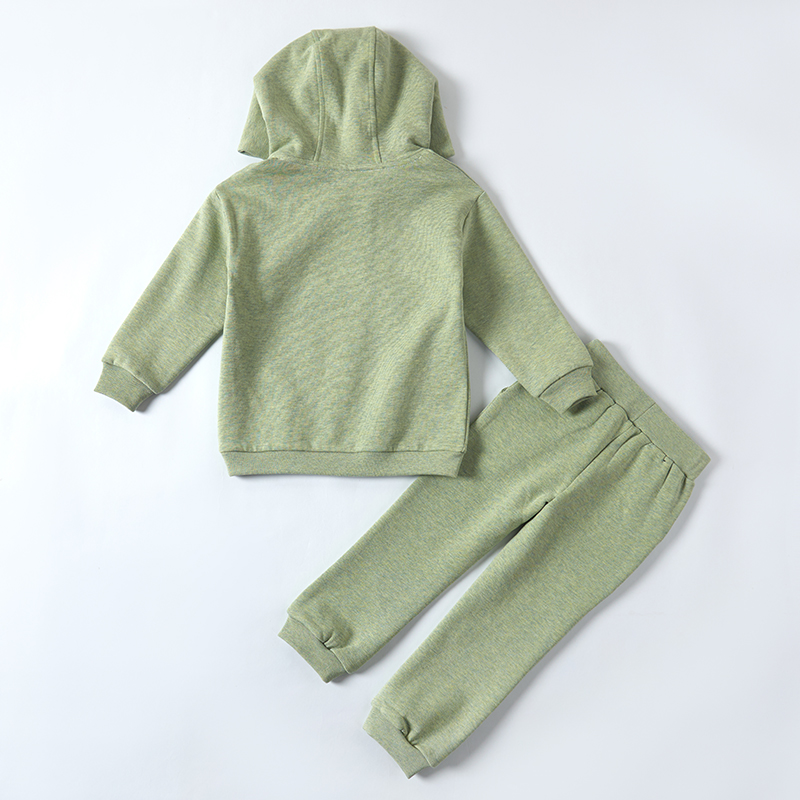
A hoodie and jogger set in 280 gsm brushed cotton flannelette, plant dyed to a soft sage green with sophora buds and Isatis indigo, and printed at the chest and on one leg. Rib cuffs, rib hem, elasticated waist with a rib tunnel.
Green from these two plants is not a colour that exists in either of them. Yellow comes from one and blue from the other, and the green is built by putting one over the other. That single fact decides how the shade is controlled, why the two garments must be dyed in one batch, and why the brushed surface changes what the colour looks like before the print ever goes on.
At a glance

1. The cloth: what 280 gsm brushed cotton does
- Brushing raises the fibre, and that is the whole point of flannelette. The surface is abraded so the fibres stand up, which traps air and gives the warmth a 280 gsm cloth would not otherwise have; it also softens the hand, which is why the set feels like a blanket rather than a sweatshirt.
- The raised face reads lighter than the back. Standing fibres scatter light, so the same dye looks paler on the brushed side; where a garment turns its face — at a cuff, a hem, a pocket edge — the two surfaces meet and the difference is visible if the dye has not gone through.
- A brushed surface is more absorbent and less level. It takes the dye up quickly at the pile and holds the bath unevenly, so a plant dye that is level on a flat cotton will show a soft mottle here. That mottle is the character of the method, not a fault, and it is approved as a range.
- Heavy and brushed means slow penetration. At 280 gsm with a raised face, the bath has to be given time to reach the core; a cloth that is dyed only at the surface looks right on the outside and shows a pale core the first time a seam is opened.
- 270–280 gsm is where a set starts to hold its own shape, which is why the hood stands and the jogger falls straight rather than clinging.
2. Two dyes, two chemistries, one colour
- Sophora buds give yellow by a different route from indigo. The bud dye is a plant colourant that has to be fixed onto cotton — its fastness depends heavily on the mordant route used — while Isatis indigo is a vat dye that is insoluble until it is reduced in an alkaline bath, applied in its soluble form, and then oxidised back to blue in the air.
- So they cannot be mixed in one bath. Yellow and blue are applied in sequence, and the green is the result of the sequence: yellow first, then a number of indigo dips, or the reverse. The order and the dip count are what make this green rather than another green.
- Indigo sits on the fibre rather than inside it. It builds in rings near the surface, which is why indigo shades rub and fade where they are worn hardest — at the cuff, the seat and the knee — and why a plant-dyed indigo garment lightens rather than dulls.
- The yellow is the part that decides fastness. An indigo blue will hold reasonably well on its own; a bud yellow without a proper fixation route washes out and shifts toward beige. The mordant route, its concentration and the soaping after-treatment are set per order and recorded in the batch record.
- Neither dye is a standardised product. Plant material varies by season and supplier, so the recipe is expressed against a reference batch rather than as a fixed percentage.
3. Shade control: the batch, not the piece
- The unit of approval is the batch. Because the green is built by dips, a batch is dyed as a batch: the same liquor, the same dip count, the same cloth. A garment dyed in a second batch will be a near neighbour of the first, not a match.
- So the hoodie and the jogger are dyed together. A set is one colour across two garments, and the two are cut from the same dyed lot; dyeing them separately is the single most common way a set arrives looking like two products.
- Shade is approved as a range, not as a chip. Every batch is matched against the approved reference under two light sources, and the acceptable window is stated in the approval rather than left to the eye at inspection.
- Colour builds darker with each indigo dip and it is not linear. Two dips are not twice as deep as one; the first dip does most of the work, so the dip count is fixed and the bath strength is adjusted around it, not the other way round.
- Plant dye has no colour-fastness certificate to point at. What can be documented is the dyestuff, the recipe, the batch record and the finished-goods test results; that file, not a logo, is what a buyer audits.
4. Penetration on a heavy brushed cloth
- The core check is the test. A seam is cut open and the cross-section inspected: a plant-dyed 280 gsm flannelette that is dyed through shows colour at the core, and one that is not shows a pale line that no surface inspection would find.
- Cuffs, hems and the waist tunnel show it first. These are the places where the cloth is turned back on itself, so the undyed side becomes the visible side; they are checked on the finished garment, not on a flat swatch.
- The bath has to be worked through the pile. Brushing closes the surface against quick wetting, so the cloth is wetted out before it enters the dyebath; skipping that step is what produces a ring-dyed effect on a cloth that was meant to be solid.
- The cloth loses weight and length in the bath. Cotton relaxes and shrinks in hot wet processing, so the pattern is cut for the finished measurement rather than the greige, and the shrinkage is confirmed on the dyed cloth rather than assumed from the greige.
- Brushing after dyeing changes the shade again. If the cloth is brushed after it is dyed, the raised fibre is paler; the order of brushing and dyeing is a decision that changes the final colour, so it is fixed per order.
5. The prints over a plant-dyed ground
- White ink over a mottled ground is not white. The print is semi-opaque, so the soft variation of the plant dye shows through the lighter areas; on an uneven ground this reads as a patchy edge rather than as a clean graphic, and the artwork is judged on the dyed cloth, not on a white sheet.
- A pale cream or silver print sits better than a pure white on this shade. The right choice is made on a strike-off over the actual green, because the same ink that looks clean on a flat ground looks chalky on a soft one.
- Brushed pile is a weaker key for the ink. A raised surface gives the print less mechanical grip than a flat one, so adhesion and cracking are tested on the brushed side after washing, especially at the cuff and hem where the fabric flexes.
- Print placement has to clear the seams and the rib. A graphic that runs into a rib cuff or a side seam cracks along that line first; the placement is set with the seam positions drawn on it.
- The print is applied after dyeing, never before. A dye bath under a cured print would attack it, so the sequence is dye, wash, dry, print, cure.
6. Size: 2Y–8Y, and what the block has to hold
- Sizes are by age here, not by height band, so the block is graded on the standard child measurement for each year and the finished measurements are published rather than implied.
- A set is bought as one size for two garments. The hoodie and the jogger are graded as a pair, so the jogger length and the hoodie body length stay in proportion instead of each following its own chart.
- Class II applies across this range. Every size in 2Y–8Y is above 36 months, so the set is assessed as Class II under OEKO-TEX Standard 100, with the certificate covering the dyed cloth, the rib and the print.
- The hoodie is sized with room for a layer, because it is worn as an outer layer indoors; the jogger is sized on the seat and the rise, since the elasticated waist covers the variation a fixed waist cannot.
- The sample is fitted as a set, with the cuffs at the wrist and the ankle, and the jogger hem checked sitting and standing.
7. Customization, sampling and what we need to quote
- Set. Hoodie and jogger as shown; a sweatshirt instead of a hoodie; a shorts version of the jogger.
- Shade. Sage green as shown; a deeper green with more indigo dips; a yellow-only version with no indigo.
- Print. Chest and leg as shown; a chest print only; a woven label instead of a print.
- Trim. Rib cuffs and hem as shown; a self-fabric cuff; a drawcord-free elastic waist as standard.
- Weight. 280 gsm as shown; a lighter 240 gsm for a summer weight.
- Packing. Polybag with size sticker; hanger; woven or printed label, satin care label, hangtag.
- Sampling. 3–7 days from a confirmed tech pack, with a dyed strike-off, a core check on the seam and a wash trial on the printed area; fastness and migration testing is booked separately and added to the schedule.
- Bulk lead time. 30–60 days from approval by quantity and dyebath schedule; the dyebath is planned per batch, so a split delivery is quoted as two batches.
MOQ: 300 pcs for a custom development — custom cloth, shade, print or fit; 50 pcs for a decorative process added to a stock body; 100 pcs for stock cloth with your own logo and label. Mixed colour and size orders are quoted per order. These are standing programme terms, confirmed against the current quotation.
Production runs with our production partner, Suzhou Shelmin Trade Co., Ltd.: 7,200 m² workshop, 8 lines, 200 staff, 6,000 pieces per day. Design confidentiality is held under NDA; buyer patterns, shades and prints are not re-used.
To quote, we need: target market and the fastness tests it requires; the mordant route for the bud yellow and whether a soaping after-treatment is in scope; the dip count for the indigo; cloth weight and whether it is brushed before or after dyeing; the print method and ink; whether both garments are dyed in one batch; packaging; and whether certification runs in your brand name.