EN

Custom Organic Cotton Baby Suspender Dress Plant Dyed Toddler Pinafore Skirt OEM ODM Kidswear Manufacturing for Boutique Baby Clothing Brands


- Overview
- Plant-Dyed Cotton Baby Pinafore Skirt OEM ODM
- Recommended Products
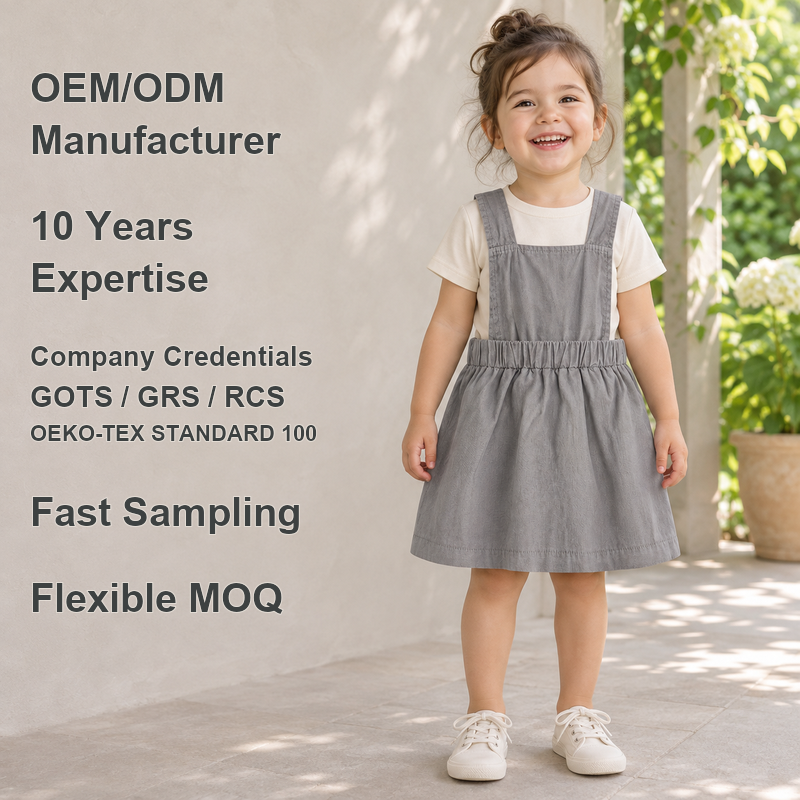
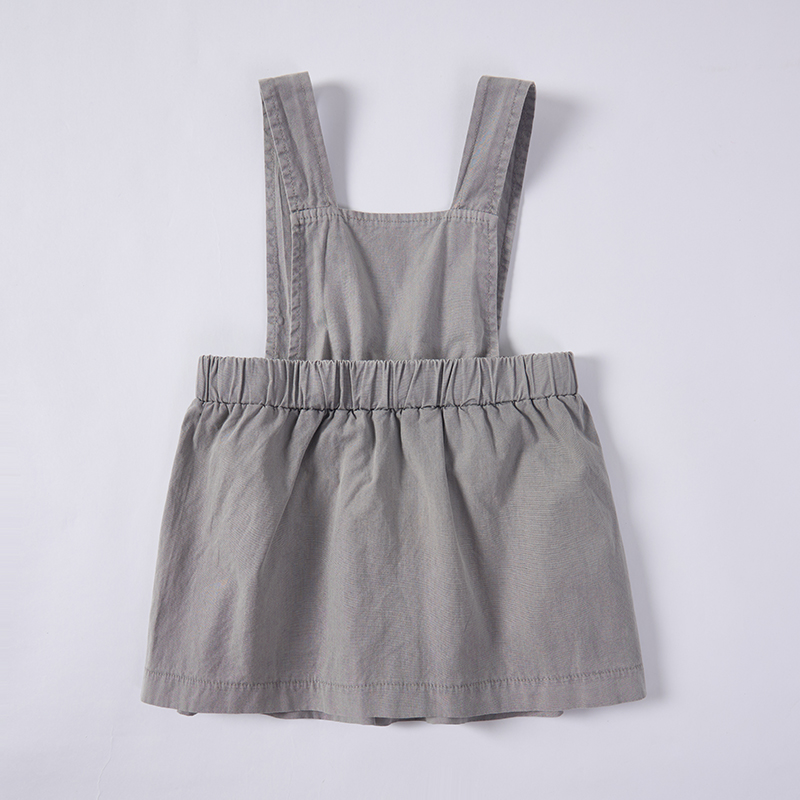
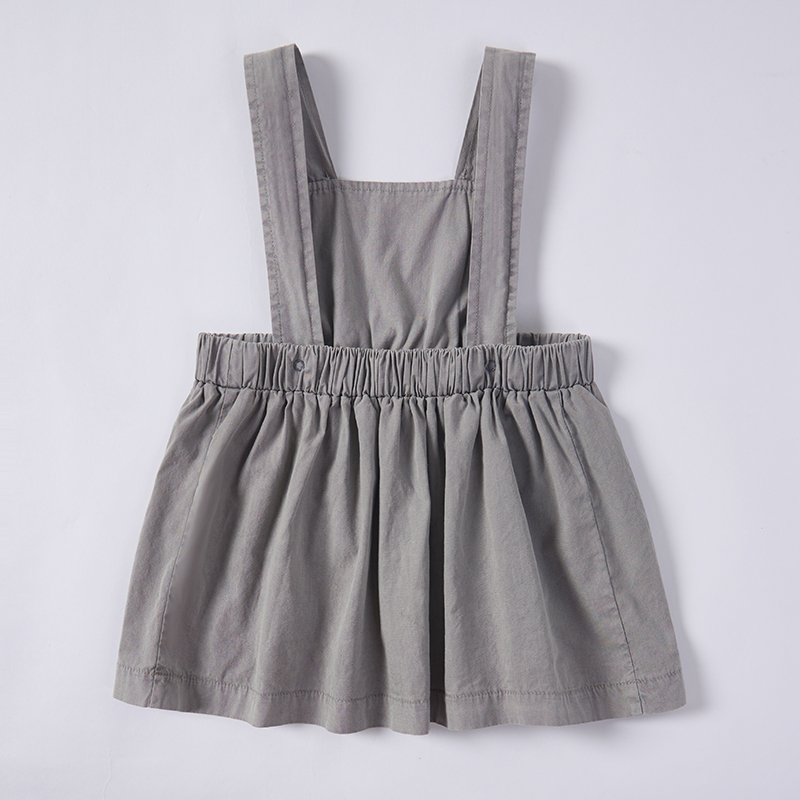
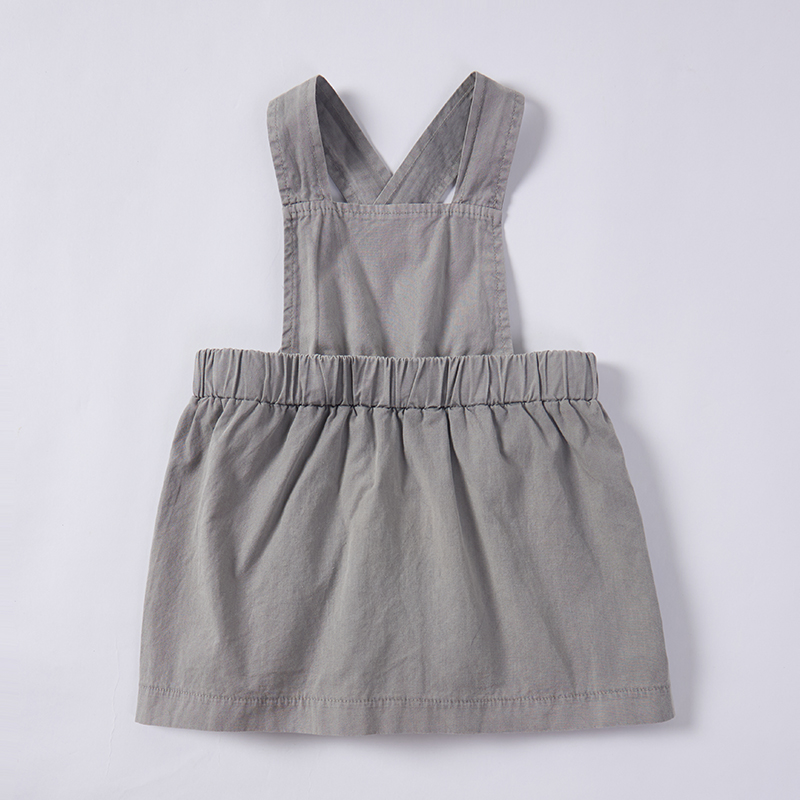
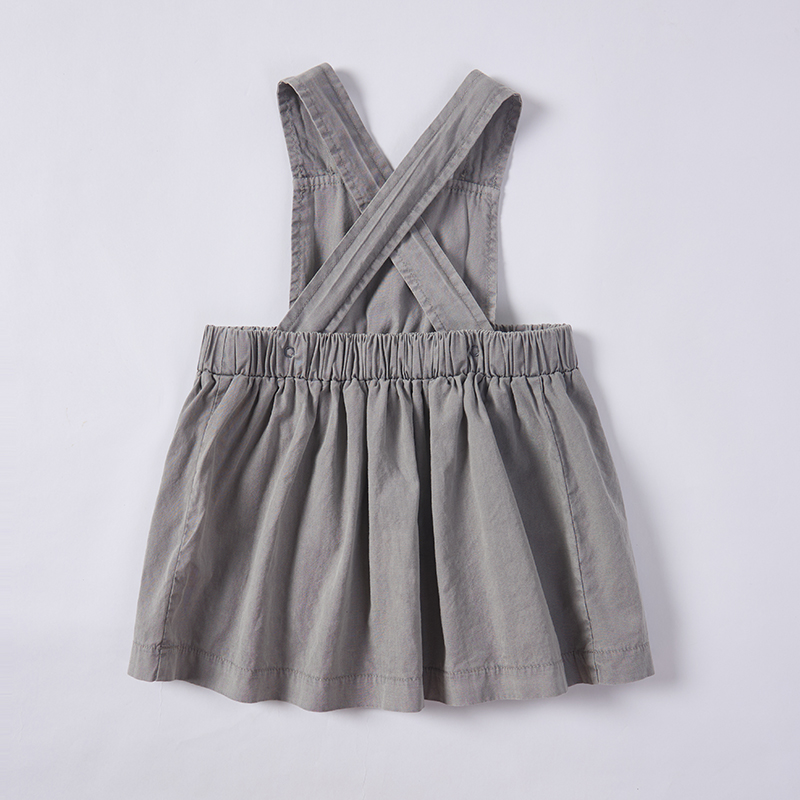
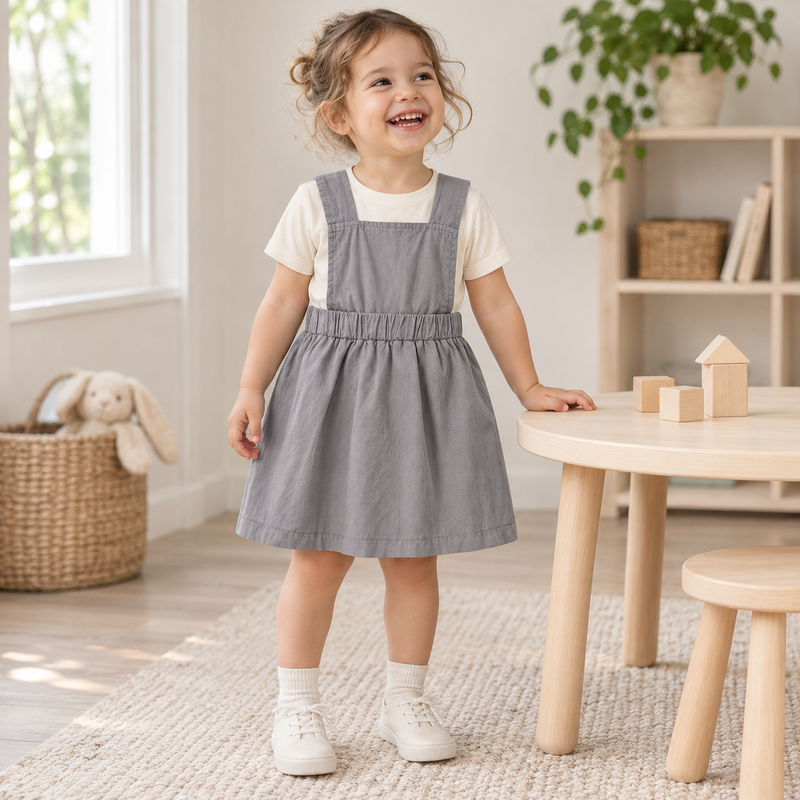
A pinafore dress in 125 gsm cotton poplin, dyed to a cool grey with gallnut (五倍子) and pomegranate rind (石榴皮): a square bib panel, two wide straps buttoned at the back waist, an elasticated and gathered waist, and an A-line skirt.
Neither material on the dyestuff list is a colour plant. Both are tannins, and tannins on cotton give beige, buff or khaki. The grey appears when the tannin meets iron. That one step decides the shade, the strength of the cloth and what has to be documented on a Class I article, which is why the sections below are ordered around it.
At a glance
1. The cloth: why 125 gsm poplin carries a gathered pinafore
- A tight plain weave keeps the grey even. Poplin has no pile and no twill line to catch light at an angle, so the shade reads as one surface from bib to hem. On a flat colour, that evenness is the whole appearance.
- 125 gsm is the weight where two opposite jobs both work. There is enough body to hold the bib panel square without interfacing, and little enough weight that the gathered skirt falls instead of standing away from the body.
- The weave has almost no give, so the dress is entered through the elasticated waist and the buttoned straps. Pattern, strap length and waist opening are set around that route rather than corrected at fitting.
- Gathering behaves at this weight. A heavier poplin bunches at the waistband seam; a lighter one grins open along the gather line after washing. 125 gsm presses flat and stays flat.
- A smooth surface records everything. Stitch line, needle mark, press shine and any dry patch in the dye bath all show. Tension and pressing are fixed on the sample, not adjusted on finished garments.
2. Two tannins, and no colour plant
- Gallnut is bought by assay, not by name. Oak galls carry roughly 50-70% tannin, and the figure varies with lot and origin, so each lot is tested and the bath is set to the percentage it actually holds.
- Pomegranate rind brings a second, softer tannin. Its ellagitannins react more slowly than gallnut, and in this recipe they warm the grey so it does not read flat blue after the iron.
- On cotton, tannin alone gives beige. Buff, khaki, the colour of tea and old paper: useful shades, but not this one. The grey is a reaction product rather than a dye colour.
- The sequence is two baths, and the order is fixed. Tannin first, until the fibre is saturated; iron second, reacting with what is already in the cloth. Reversing the order gives a patchy and weakened result, and the grey does not form.
- The ratio is weighed as a pair. Shade moves green or blue with the rind share, so gallnut and rind are batched together and the reference is a sealed dyed sample rather than a recipe card.
3. Iron: it makes the colour and it costs the cloth
- Tannin plus ferrous iron gives the blue-grey of iron-gall ink. There is no other route to this shade from these two materials, so the iron belongs in the specification even where a dyestuff list names only the plants.
- Iron catalyses oxidation in cellulose. In excess it tenders cotton, and the damage appears first as a tear at a fold, a hem edge or a buttoned strap end — the points where a child pulls.
- So concentration is specified and dwell is logged. The iron bath runs as its own vessel with its own record: concentration, pH, temperature, time. The cloth is then rinsed until unreacted iron is out of the fibre, and the rinse is checked rather than judged by eye.
- Strength is measured, not assumed. Tensile and tear strength are tested on the finished poplin against an undyed control from the same lot, to ISO 13934-1 and ISO 13937-2, and the result is a release item.
- Colour and strength pull against each other. More iron deepens the grey toward charcoal and moves the cloth closer to its strength limit, so the target is the lightest grey that still reads grey on the approved sample.
- Water is part of the recipe. Hardness and residual alkali shift a tannin-iron grey, so the dyehouse works to a set water specification and records it with the batch.
4. Class I: what the certificate covers
- Class I is the class for articles under 36 months. 6-9M, 9-12M, 12-18M and 24M sit inside it by age; 36M is assessed as Class I because the article can be worn by a child under that age.
- OEKO-TEX Standard 100 certificate 23.HCN.45112 is held at Class I for this fabric. It sits with our production partner and its supply chain, and the article-specific scope — this poplin, this shade, the threads, elastic and buttons — is confirmed against it before a claim is listed.
- Class I is stricter where a pinafore meets a baby. Lower limit values than Class II, plus colour fastness to saliva and to acid perspiration, which matters on a bib panel that goes into the mouth.
- The mordant is the item to document most carefully. Iron itself sits outside the restricted list, but the salt it is bought as can carry copper, chromium or nickel as impurities, so it is bought to an assay with impurity limits stated.
- Plant origin changes nothing in the assessment. The test is of the finished article, not of the plant, and a tannin-iron recipe is documented to the same limits as any other dye.
- Verification is straightforward: certificate number, issuing institute, validity date, and the article and colourway named in its scope. A test report on the finished garment is supplied with the bulk documents where the buyer's market requires one.
5. Bib, straps, buttons and the elasticated waist
- The bib hangs from the straps, so the straps carry the fit. Strap length and button position are set from the child's shoulder-to-waist measurement, and the waistband follows from them rather than the other way round.
- Straps are sewn to a finished length and buttoned. Two button positions are the growth allowance, and the strap end is reinforced where it meets the button, because two points carry the whole dress when a baby is lifted under the arms.
- Cord and drawstring rules are designed out. EN 14682 sets limits on cords and drawstrings on children's clothing; a fixed-length sewn strap with a button, and an elastic enclosed in a casing, keep this style outside that category of risk.
- The waist gathers onto elastic inside a casing. Casing depth, elastic width and gather distribution are specified together, because the casing is what stops the elastic rolling and what holds the gathers where the pattern put them.
- Buttons are tested as small parts. 70 N retention is the figure we work to for buttons and snaps, with button, thread and tab assessed as one unit; for the US market the same parts are checked against the small-parts requirements of 16 CFR 1501.
- Trim is approved against dyed cloth. A warm cream button reads yellow next to a cool grey, so buttons and thread are matched on the dyed poplin rather than chosen from a shade card.
6. Sewing, pressing and inspection
- Seams run at 12-14 stitches per inch on this woven. Tighter than a knit, and the setting is what keeps a gathered seam closed at the waistband after washing.
- Gathers are distributed from marked quarters. The skirt is wide against the waistband, and an uneven distribution puts the volume on one hip, where a plain grey shows it at once.
- Pressing is on the reverse, with a press cloth. Iron-tannin grey takes a shine from a hot iron on the face, and the shine reads as a light patch that washing will not lift.
- The hem is a turned band with a visible topstitch. Depth and stitch length are set so the hem edge lies flat rather than cupping, which at 125 gsm is a tension question as much as a finish.
- Inspection covers what grey reveals: shade against the sealed reference under D65, oil and needle marks under inspection light, press shine, button retention on the tab, waistband recovery, and Class I labelling.
- AQL 2.5 for major defects, 1.0 for critical. Needle control: 100% detection on finished pieces; needles exchanged one-for-one at every break with the machine stopped; work in progress within 2.5 m re-screened twice; needle-free area enclosed, at least 2 m deep, single entry.
7. Sizes, customization, sampling and quoting
- Five sizes, and at this age the steps are real. 6-9M, 9-12M, 12-18M, 24M and 36M are graded from body measurements rather than by a percentage step, because a nappy changes the waist far more than a size chart suggests.
- The waistband is re-set for each size: elastic length, casing height and button positions each come from the child's waist, and bib width follows the chest.
- Customization. Square or curved bib; buttoned, fixed or cross-over straps; elasticated waist or a flat waistband with a side opening; gathered, pleated or tiered skirt; a lined bib for a firmer front panel.
- Shade. Cool grey as shown; a deeper charcoal with more iron; a greener grey with a higher rind share. Each is sampled before it is quoted.
- Sampling: 3-7 days from a confirmed tech pack, including a dyed strike-off, the strength retention check, a wash trial on the shade, and a button pull test on the tab.
- Bulk: 30-60 days from approval, planned per dyebath; a split delivery is quoted as two batches because the bath is the unit of shade control.
- MOQ: 300 pcs for a custom development — cloth, shade, trim or fit; 50 pcs for a decorative process on a stock body; 100 pcs for stock cloth with your own logo and label. Mixed colour and size orders are quoted per order, and terms are confirmed against the current quotation.
Production runs with our production partner, Suzhou Shelmin Trade Co., Ltd.: founded 2017, 7,200 m² workshop, 8 lines, 200 staff, 6,000 pieces per day. Design confidentiality is held under NDA; buyer patterns, shades and prints are not re-used.
To quote, we need: target market and the Class I tests it requires; the tannin load and the gallnut-to-rind ratio; the iron salt and its assay; the rinsing stage; whether a softener is in scope; poplin weight and sett; button material and second position; packaging; and whether certification runs in your brand name.