EN

Custom Plant Dyed Cotton Baby Outfit Set | OEM ODM Bunny Toddler Clothing


- Overview
- 100% Cotton Plant Dyed Bunny Baby Outfit Set for OEM & ODM
- Recommended Products
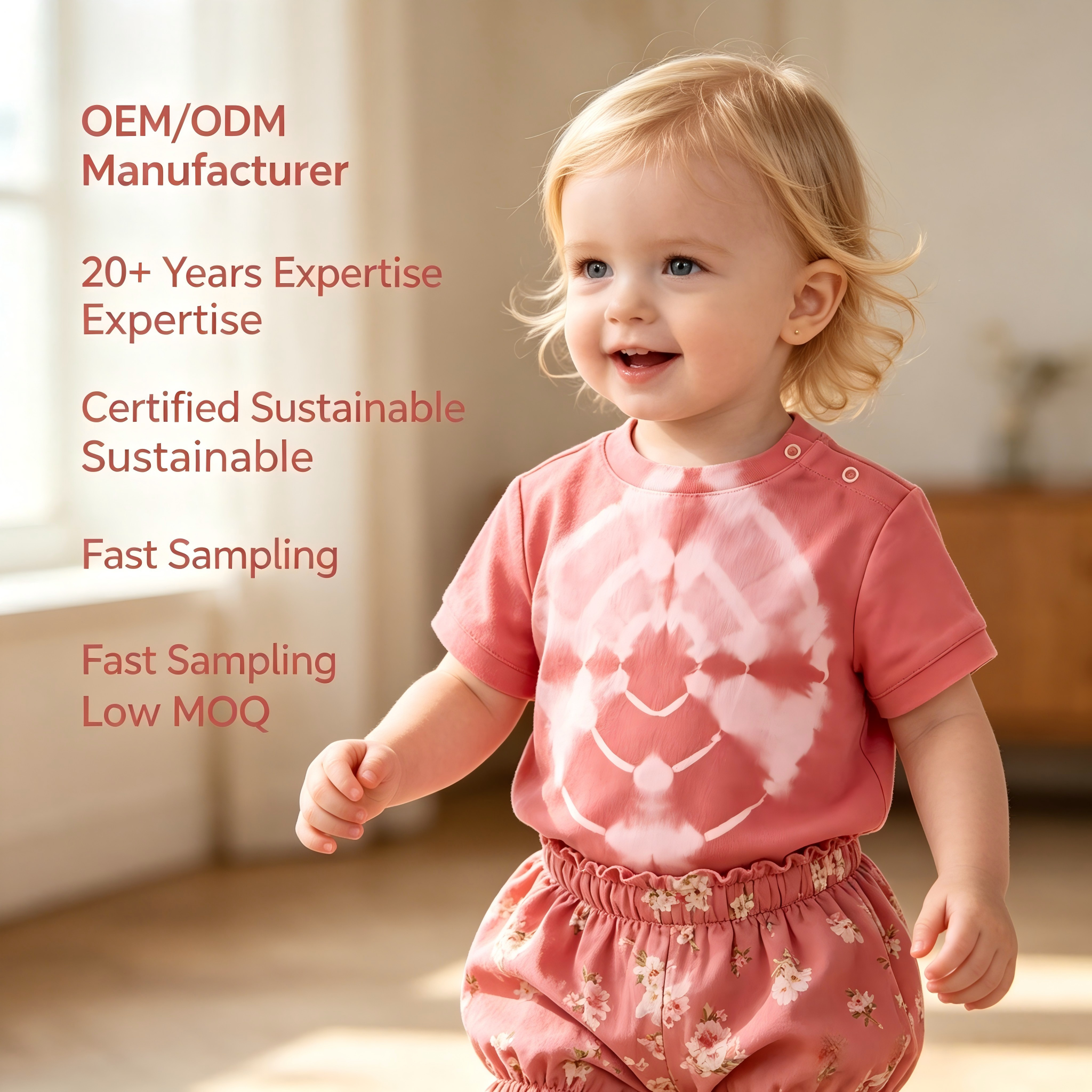
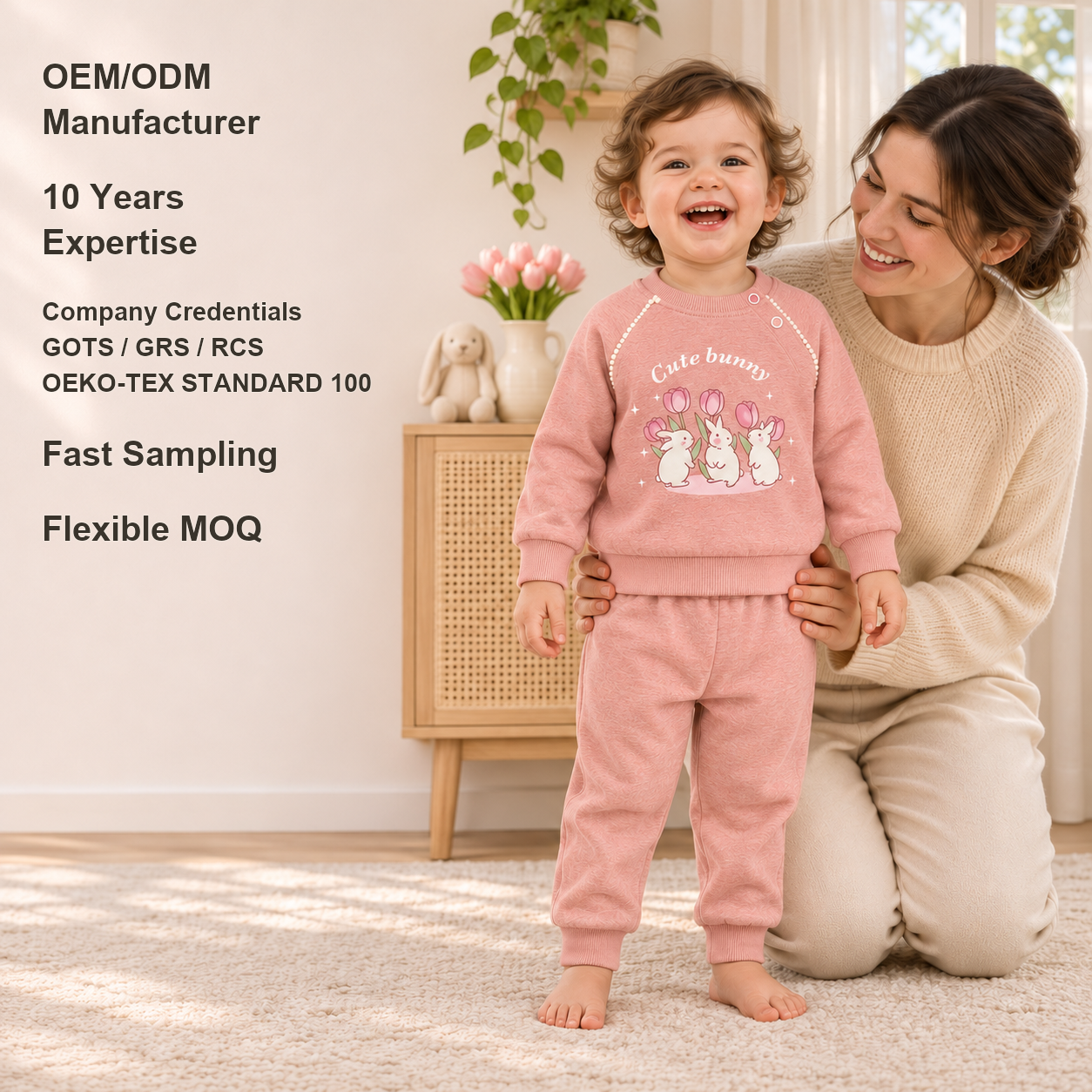
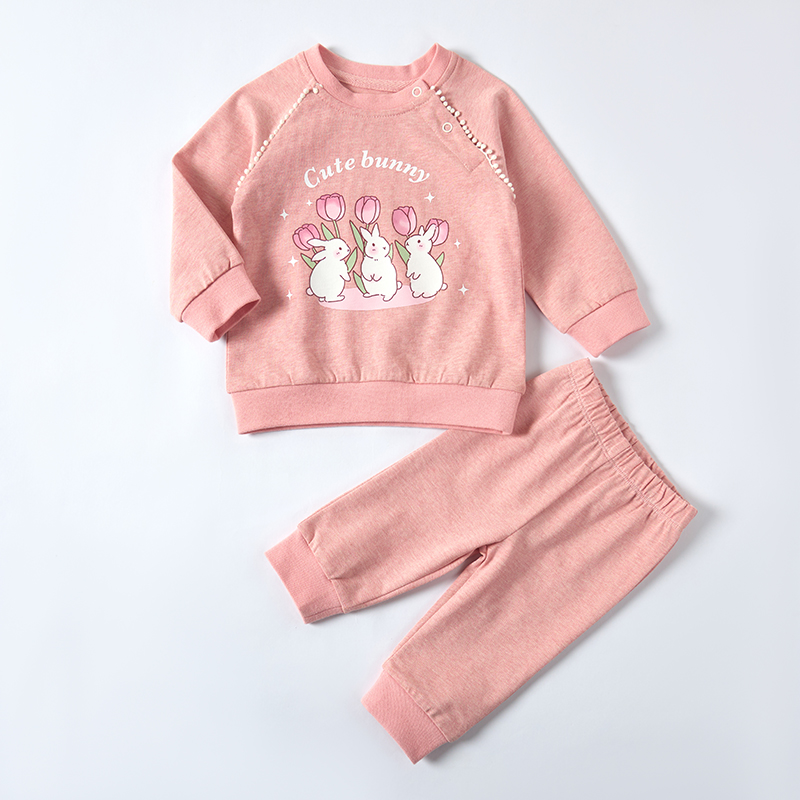
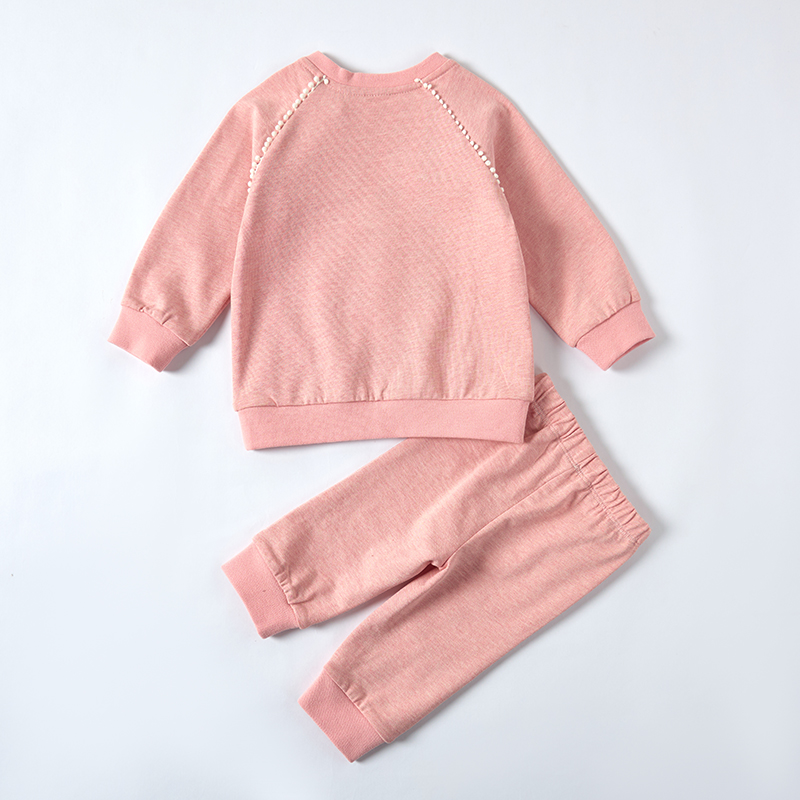
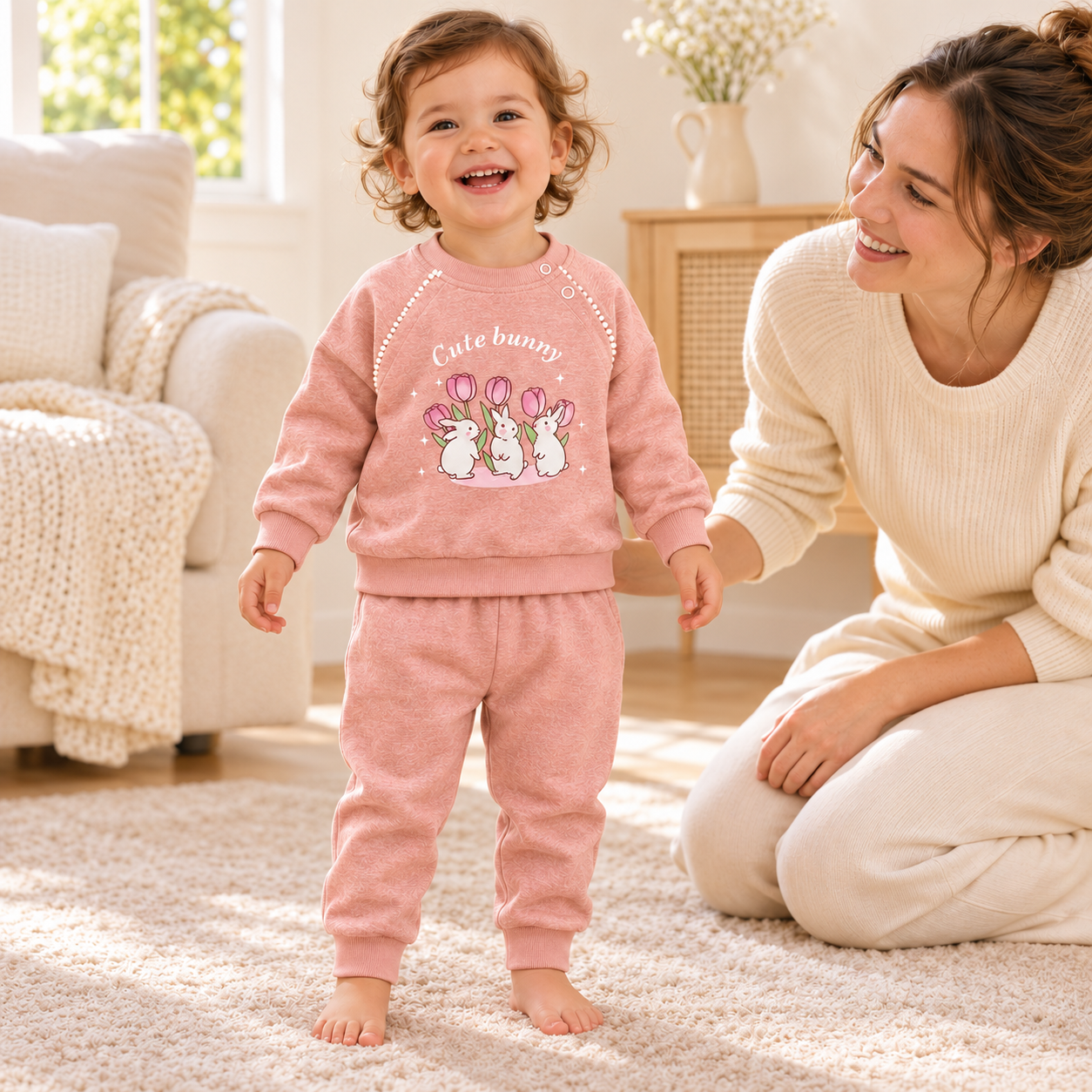
A sweatshirt and jogger set in 230 gsm cotton jersey, plant dyed to a dusty rose with madder and logwood, with a printed bunny at the chest, rib cuffs and hem, a shoulder placket closed with snaps, and a picot trim running along both raglan seams.
This is the infant range, and that changes the question. On a garment for 6 to 36 months the colour is not only a design decision: it sits inside Class I, the strictest limit set in the standard, and Class I limits are mostly limits on metals. A plant dye that is fixed with a metal mordant is therefore exactly where the compliance work happens, and logwood — one half of this shade — is also the least light-fast of the traditional dyes.
At a glance
1. The cloth: 230 gsm jersey and the rib that controls it
- Jersey is a single knit, so it stretches in one direction more than the other. That is what makes a 230 gsm sweatshirt comfortable on a baby and it is also why the neckline, cuffs and hem are ribbed: the rib is the part that returns to shape after the garment is pulled over a head.
- Cut edges curl. A single jersey curls to the face at a cut edge, which is why the neck is finished with a rib band rather than a turned hem, and why every other edge is either ribbed or coverstitched.
- 230 gsm is a light sweatshirt weight, not a fleece. It layers under outerwear without bulk and dries quickly, and it also means the cloth is thin enough that a print sits visibly on it.
- A pale print on a pale ground relies on tone, not hue. The bunnies read because they are lighter than the body and outlined, so the print is judged on the dyed cloth where that separation is smallest.
- Two panels of the same dye lot can still differ in a knit, because jersey relaxes differently across the width; the body and the sleeves are cut so the grain runs the same way, not merely from the same roll.
2. Madder and logwood: red plus violet
- This pink is not madder alone. Madder gives a warm red, logwood gives a violet that leans blue-black when it is built up, and the two together give a pink with a grey-violet undertone — which is why this rose reads dusty rather than sweet.
- Logwood is the fugitive half. Of the traditional dyes it is among the least light-fast: hematoxylin fades visibly under daylight, and it fades toward grey-brown rather than toward white, so a logwood shade does not lighten so much as lose its colour.
- That makes the ratio a durability decision, not only a shade decision. More logwood deepens and cools the rose and shortens its life in sun; more madder warms it and holds better.
- Both dyes are mordant colours, and the mordant changes the hue. Madder with alum goes toward coral, madder with iron toward brick; logwood with alum goes violet, logwood with iron goes near black. The mordant is chosen before the ratio is set.
- Neither plant is a standardised colorant, so the recipe is expressed against a reference batch, and the batch record is the document a buyer audits.
3. Class I: where the mordant becomes a compliance question
- Class I is the limit set for articles for babies and children up to 36 months, and its limits are stricter than Class II on exactly the substances a plant dye can introduce: heavy metals, formaldehyde, azo colourants and the arylamines they can release.
- A mordant is a metal salt. Alum is aluminium, iron is iron; both are metals, and both are on the list that Class I limits. So the mordant is not only an aesthetic choice — its type and its residual concentration are part of the compliance file.
- The after-treatment decides the residue. Mordant that is not exhausted or rinsed out sits in the cloth; the soaping and rinsing stages are specified per order for that reason, and the finished cloth is the article that is tested, not the dyestuff.
- Plant dye has no exemption for being natural. The dyestuff source, the mordant and the auxiliaries are all assessed against the same limit values, and some plant materials are themselves on restricted lists; the material is checked against the standard before the shade is approved.
- Class I is also a physical standard, not only a chemical one: it carries colour fastness requirements suited to a baby, which is the subject of the next section.
4. Saliva and perspiration: the tests that matter at this age
- Babies mouth what they wear. Collars, cuffs and the shoulder placket go into the mouth, so colour fastness to saliva is a relevant test on this garment in a way it is not on a school-age set.
- Saliva fastness is tested on the assembled garment, including the rib and the print, because a baby's mouth reaches the neckline seam and the printed area when the garment is held up.
- Perspiration fastness covers the neck and the cuffs, which is where a dye that is not properly fixed shows as a ring or a stain on the skin side.
- A plant-dyed pale shade is where this shows first. An unfixed madder or logwood fraction migrates easily, and on a pale rose the migration reads as a dull patch rather than as obvious bleeding.
- Soaping after dyeing is what makes these tests pass. It removes the unfixed fraction before the garment is cut, and it is specified per order rather than left to the dyehouse's habit.
5. The shoulder: placket, seam and a trim that carries load
- The placket exists because a baby's head does not fit a crew neck. Two or three snaps on one shoulder open the neckline enough to pass the head without stretching the rib out of shape, which is why the garment is built this way rather than with a wider neck.
- Snaps are small parts and are tested as small parts. Retention is checked at the force the market requires — 70 N is the figure we work to for buttons and snaps — on the finished placket, not on a component sample. Metal snaps bring nickel release into the file; plastic snaps avoid it but have their own retention behaviour.
- The raglan seam is the highest-load seam on a knit, and here it also carries a trim. A picot edge run along that seam has to stretch with it: a rigid tape would take the elongation out of the seam and it would crack at the shoulder, so the trim is specified as an elastic picot or a knit trim.
- The trim is a different substrate and does not take the plant bath as cotton does. On a hidden tape a mismatch would not matter; on a decorative line it does, so the trim is either dyed separately to the average of the approved range or chosen as a deliberate contrast.
- The trim sits where a cheek rests. It is checked by hand for scratch as well as by eye for evenness, and the scallop pitch is compared across both shoulders, because the two are always seen together.
- Hardware and trim together add bulk next to the neck, so the allowance is pressed flat and the snaps are set so nothing stands proud; the placket is checked with the snaps closed and open.
- The placket is placed on one shoulder only, and the trim runs on both, so the asymmetry is deliberate rather than accidental.
6. Size: 6M–36M, and what the block has to hold
- The range sits inside Class I, with 6M, 12M and 24M clearly under 36 months and 36M assessed as Class I because the article can be worn by a child under that age.
- The rise is cut for a nappy. At 6M and 12M the jogger carries extra rise so it sits over a nappy without pulling at the crotch, and the rise steps down as the size grows.
- Sleeve and leg length are checked with the limbs extended, because a baby's arms and legs spend more time outstretched than hanging, and a cuff that only reaches the wrist at rest leaves a gap.
- The neck opening is measured on a head form with the placket closed, since the placket is the entry route and the closed measurement is the one that decides whether the garment can be worn at all.
- The set is fitted as a pair, with the sweatshirt hem and the jogger waist checked together so the two do not fight each other at the waist.
7. Customization, sampling and what we need to quote
- Set. Sweatshirt and jogger as shown; a bodysuit instead of the sweatshirt; a footed version of the jogger.
- Shade. Dusty rose as shown; a warmer rose with more madder; a deeper mauve with more logwood, quoted with a note on light fastness.
- Mordant. Alum route as approved; an iron route for a deeper, duller shade, quoted separately since it changes hue as well as fastness.
- Placket. Three snaps as shown; two snaps; a wrap-over shoulder with no hardware.
- Print. Chest print as shown; a printed back; a woven badge instead of a print.
- Packing. Polybag with size sticker; hanger; woven or printed label, satin care label, hangtag.
- Sampling. 3–7 days from a confirmed tech pack, with a dyed strike-off, a light fastness trial on the finished garment and a saliva fastness test on the neckline and the print; testing is booked separately and added to the schedule.
- Bulk lead time. 30–60 days from approval by quantity and dyebath schedule; the bath is planned per batch, so a split delivery is quoted as two batches.
MOQ: 300 pcs for a custom development — custom cloth, shade, print or fit; 50 pcs for a decorative process added to a stock body; 100 pcs for stock cloth with your own logo and label. Mixed colour and size orders are quoted per order. These are standing programme terms, confirmed against the current quotation.
Production runs with our production partner, Suzhou Shelmin Trade Co., Ltd.: 7,200 m² workshop, 8 lines, 200 staff, 6,000 pieces per day. Design confidentiality is held under NDA; buyer patterns, shades and prints are not re-used.
To quote, we need: target market and the tests it requires for Class I; the mordant route and its residual limits; the ratio of madder to logwood and the acceptable light fastness; whether the snaps are metal or plastic; whether the picot trim is elastic or rigid and whether it is dyed to match; the print method and ink; whether the 36M size is sold as Class I or split out; packaging; and whether certification runs in your brand name.