EN

OEM/ODM 100% Cotton Organza Girls Lace Dress Natural Plant Botanical Dyed Tie Dye Kids Summer Flutter Sleeve Princess Dresses Custom Wholesale Private Label


- Overview
- OEM Custom Cotton Organza Plant Dyed Girls Lace Dress
- Recommended Products
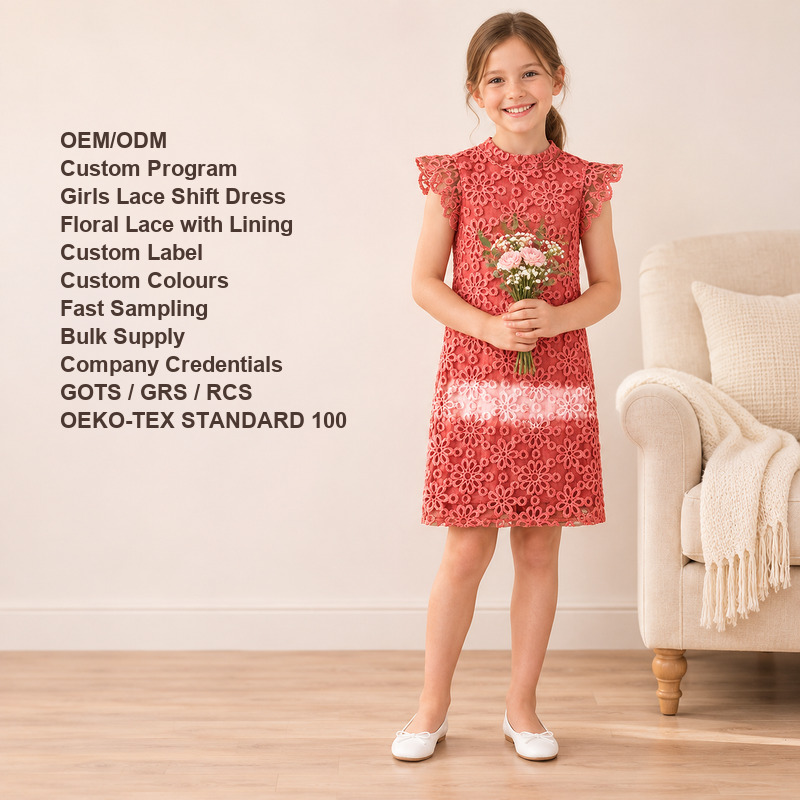
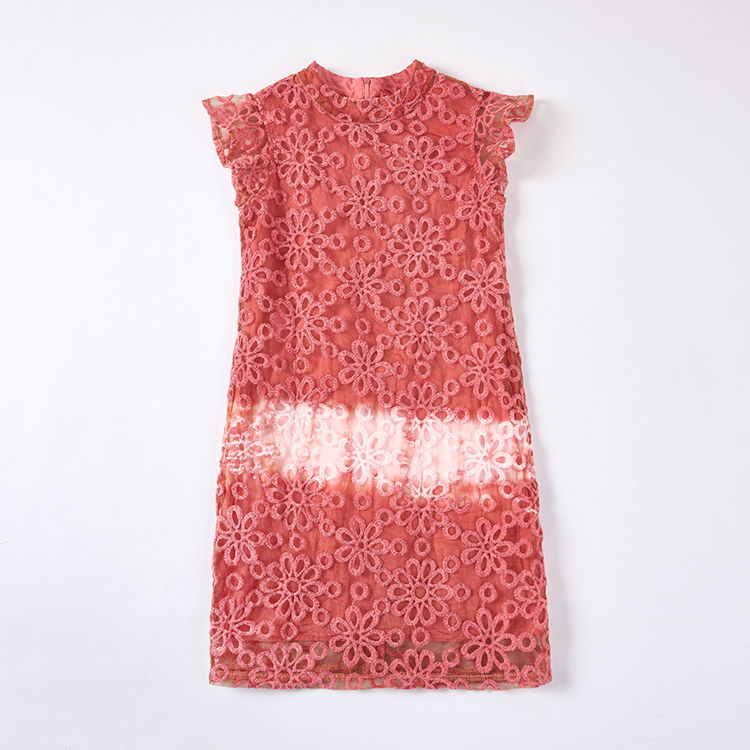
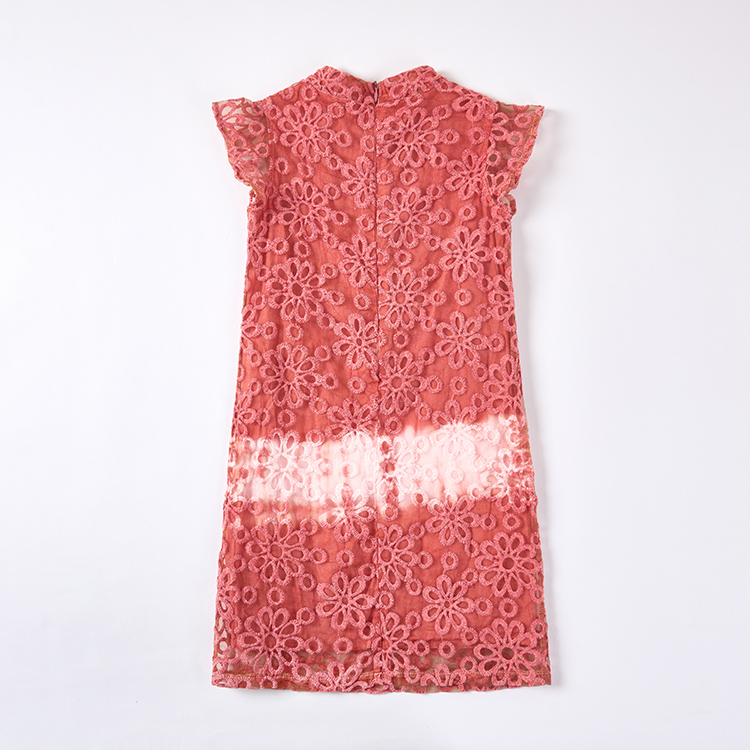
A shift dress in cotton floral embroidery on an organza ground, plant dyed to a rosewood with sappanwood (苏木) and madder (茜草), no added mordant: a bound round neckline with a short notch at the centre front, a lace ruffle gathered onto each shoulder, a straight body with no waist seam, a centre-back zip, and a wide pale band bound into the cloth and landing on the lower skirt.
Two things decide whether this dress works. The first is that a straight shift hangs from the armhole, so the shoulder line and the armhole carry a fit that a gathered waist would otherwise absorb, and a stiff lace gives none of it back. The second is the band: it is a horizontal line in the cloth, so it has to arrive level across three seams and at the same height on three sizes — which is a cutting and grading question before it is a dyeing one.
At a glance
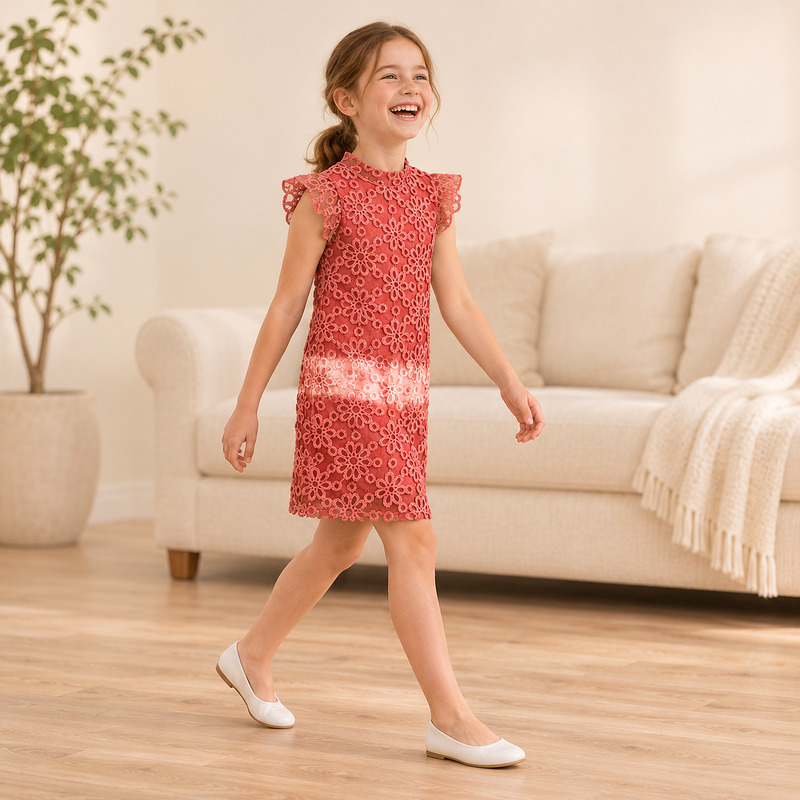
1. A shift hangs from the armhole, and the lace gives nothing back
- There is no waist seam and no gathering, so the fit is carried by the shoulder line, the armhole and the neckline, and there is no seam below them to take up an error.
- Darts would read as shadow lines through a sheer ground, so the shape comes from the side seam alone. That makes the side seam a fit seam rather than a joining seam, and its curve is a graded dimension on the pattern.
- The armhole is the whole fit. A shift that gapes there shows a strap line through the lace, and on a stiff ground the gap does not settle with wear; it is measured on the arm per size rather than scaled from the chest.
- A shoulder that is out by five millimetres is a hem that is out by five millimetres, because a straight tube has nowhere to absorb a tilt. Shoulder level is checked on the hanger and on the body.
- The length is set from the shoulder, not from a waist, so the sample is measured hanging rather than flat, since the lace falls under its own weight once it is on.
2. The band is in the cloth, so the cut becomes a matching job
- The band is made before the dress is cut: a length is folded and bound across its width, and the fold that holds the liquor out leaves a band with soft edges and a depth that varies along the band. Nothing is printed and nothing is sprayed.
- A horizontal line is the hardest thing to carry across panels. It has to arrive level at two side seams and at the centre-back seam, or it steps by a few millimetres at each join — and a step in a straight line is the first thing an eye finds.
- So the band positions are marked on every panel at cutting, as a print would be marked, and the panels for one dress are cut from one length so the band sits at the same distance from the hem all the way round.
- The band's edges are the acceptance edge, not its depth. A soft transition is the process working; a hard edge where the fold pressed is a band that was bound too tight.
- Its depth varies along the band on purpose. The palest point is specified, and the variation along the band is what separates a bound band from a printed stripe.
3. The band cannot scale with the size, and that is a decision
- On the cloth, the band sits at a fixed distance from the selvedge. On a garment, that becomes a fixed distance from one edge — so the same length gives the band at one height only.
- Cut 3Y short and 8Y long from the same banded length and the band rises on the bigger size, because the dress grew around a band that did not move.
- Cut each size from its own band position and the band keeps the same proportion, which costs a longer dyed length per garment and a separate layout for each size.
- Both are legitimate; the choice belongs in the quotation. What is not legitimate is a band that is placed by proportion on the sample and by distance on bulk, because the two runs then disagree at 8Y.
- The band's height is written as a measurement per size, shoulder to band, plus band width, and it is graded like a seam rather than eyeballed on the sample.
4. Inside the band, the flower changes how it reads
- In the band the ground goes pale and the embroidery goes nearly white, so the motif drops out of contrast and reads by texture — the satin stitch casting a shadow on the net rather than a colour against a colour.
- That sets a floor on how pale the band can go. Push it further and the flower disappears into plain net for a hand's width of the dress, which is the one place a buyer will always look.
- So the band is specified as a range with a minimum contrast, held against the deep field on the same garment rather than judged on its own.
- The embroidery reads lighter than the ground at every value, which is the two-fibre take-up working in the same direction in both zones; the band does not invert the motif, it flattens it.
- Approval is the made-up dress at 3Y and 8Y, because the band covers a different share of the silhouette at each end of the run.
5. Two finished edges carry the whole dress
- The neckline is bound in solid cotton poplin, with a short notch at the centre front. The notch is what lets a head through a bound neck on a cloth with no stretch, and it is set deep enough to work and shallow enough to stay closed when worn.
- The lace ruffle is gathered onto the shoulder seam and hangs over the armhole join, so the armhole is covered rather than bound; the ruffle's own scallop is its edge and is not hemmed.
- The ruffle hides the seam, it does not fix the armhole. A gape under a ruffle still shows as a gap between cloth and arm, so the armhole is fitted before the ruffle goes on and checked again with it in place.
- The armhole seam sits against skin, so it is finished narrow and flat, with the allowance graded at the shoulder where two seams meet.
- The hem is the lace's scallop, stitched in a dense satin edge with no allowance to turn; length is changed in whole motif repeats, since cutting between them leaves a scallop that no longer closes.
6. Class II, and three values to test on one garment
- 3Y, 5Y and 8Y sit in Class II, not Class I, because the article is for children over 36 months; the Class II scope for this cloth, colourway and trim is confirmed against the certificate at quotation.
- Three zones are read separately: the deep field, the band, and the embroidery inside the band, since each holds a different amount of the same dyestuff. A single figure would be wrong in all three.
- The band is the detector. It is the lightest area on the garment, so any colour that moves in washing or in storage lands there first, and it is read against its own unwashed counterpart rather than against a card.
- Light changes the band's contrast before it changes the field, and because the field and the band move at different rates the gap can widen; the pair is re-read together after exposure.
- Phenol yellowing to ISO 105-X18 runs on a specimen carrying the packing fold with packaging free of BHT, and pH is measured on the garment and held between 4.0 and 7.5, with perspiration to ISO 105-E04 on the same lot.
7. Sizes, sampling and quoting
- Three sizes graded on measurements: 3Y, 5Y and 8Y move on chest, shoulder width, armhole, body length and band height. The band height is graded explicitly, because it is the dimension that a fixed cloth position resists.
- Customization. Band height and width, or a plain skirt; sleeve option, from the ruffle as sampled to a plain armhole; neckline with or without the notch; motif scale; and the depth of the rose, each sealed on its own reference pair.
- Sampling: 3-7 days from a confirmed tech pack, covering a banded strike-off with its reference pair and the band marked at the intended distance from the hem, a made-up dress with bound neck, ruffle, zip and scalloped hem finished as production, a hanging measurement at 3Y and 8Y, a wash-and-remeasure with the band re-read, crock on the field and in the band, light on both zones, and a head-entry check through the notch.
- Bulk: 30-60 days from approval, planned per banded length and per dyebath, with the cutting layout made per size so the band arrives at the quoted height; AQL 2.5 major and 1.0 critical.
- MOQ: 300 pcs for a custom development covering cloth, shade, band, trim or fit; 50 pcs for a decorative process on a stock body; 100 pcs for stock cloth with your own logo and label. Mixed colour and size orders are quoted per order.
Production runs with our production partner, Suzhou Shelmin Trade Co., Ltd.: founded 2017, 7,200 m² workshop, 8 lines, 200 staff, 6,000 pieces per day. Design confidentiality is held under NDA; buyer patterns, shades and prints are not re-used.
To quote, we need: target market and the Class II tests it requires; the fibre of the organza ground, since a protein ground takes the plant dyes and a synthetic one does not; whether the band is to hold the same distance from the hem on every size or the same proportion, with the band height you want at 3Y and at 8Y; the palest value you will accept inside the band; ruffle depth and armhole finish; the fibre content that goes on the label, since the ground and the embroidery differ; lot certificates for both plants and for the embroidery; the pH target and the dyehouse water specification; packing method; and whether certification is to run in your brand name.