EN

Cotton Baby Girl Bubble Romper Dress with Peter Pan Collar | OEM ODM Baby Clothing Manufacturer


- Overview
- OEM ODM Sustainable Infant Romper Dress
- Recommended Products
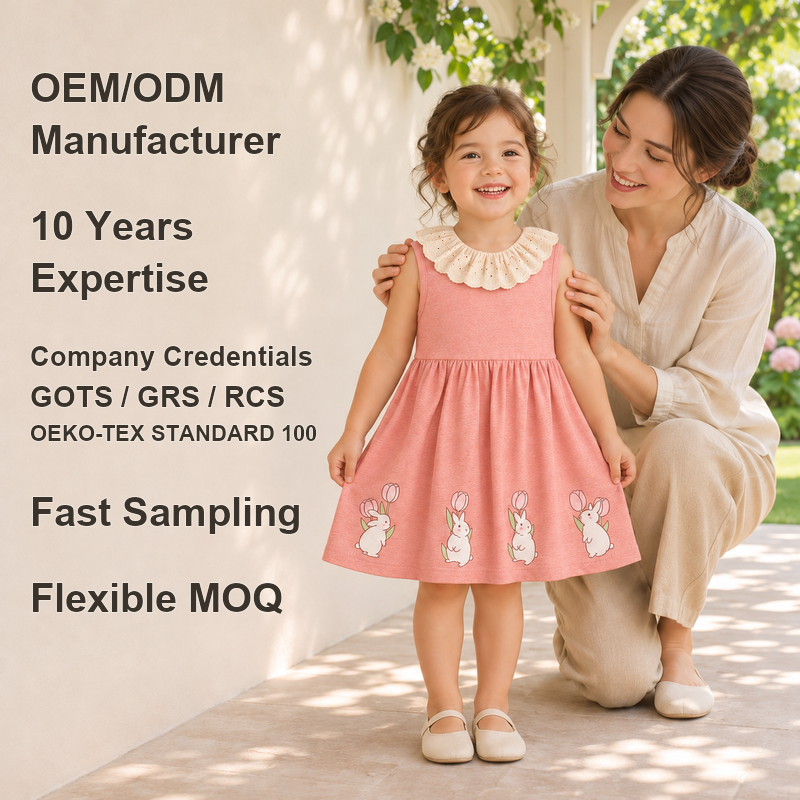
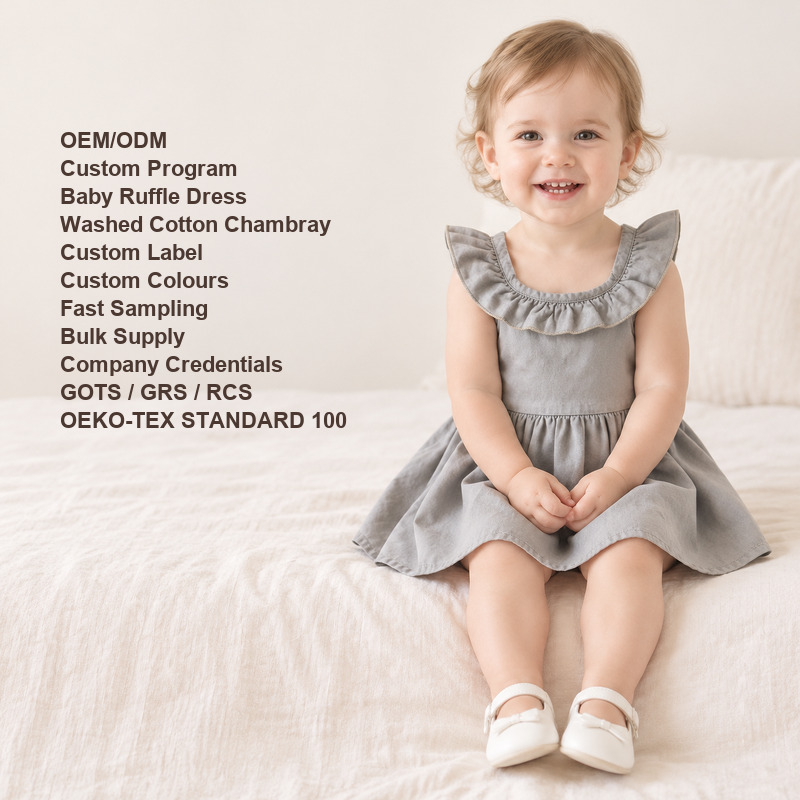
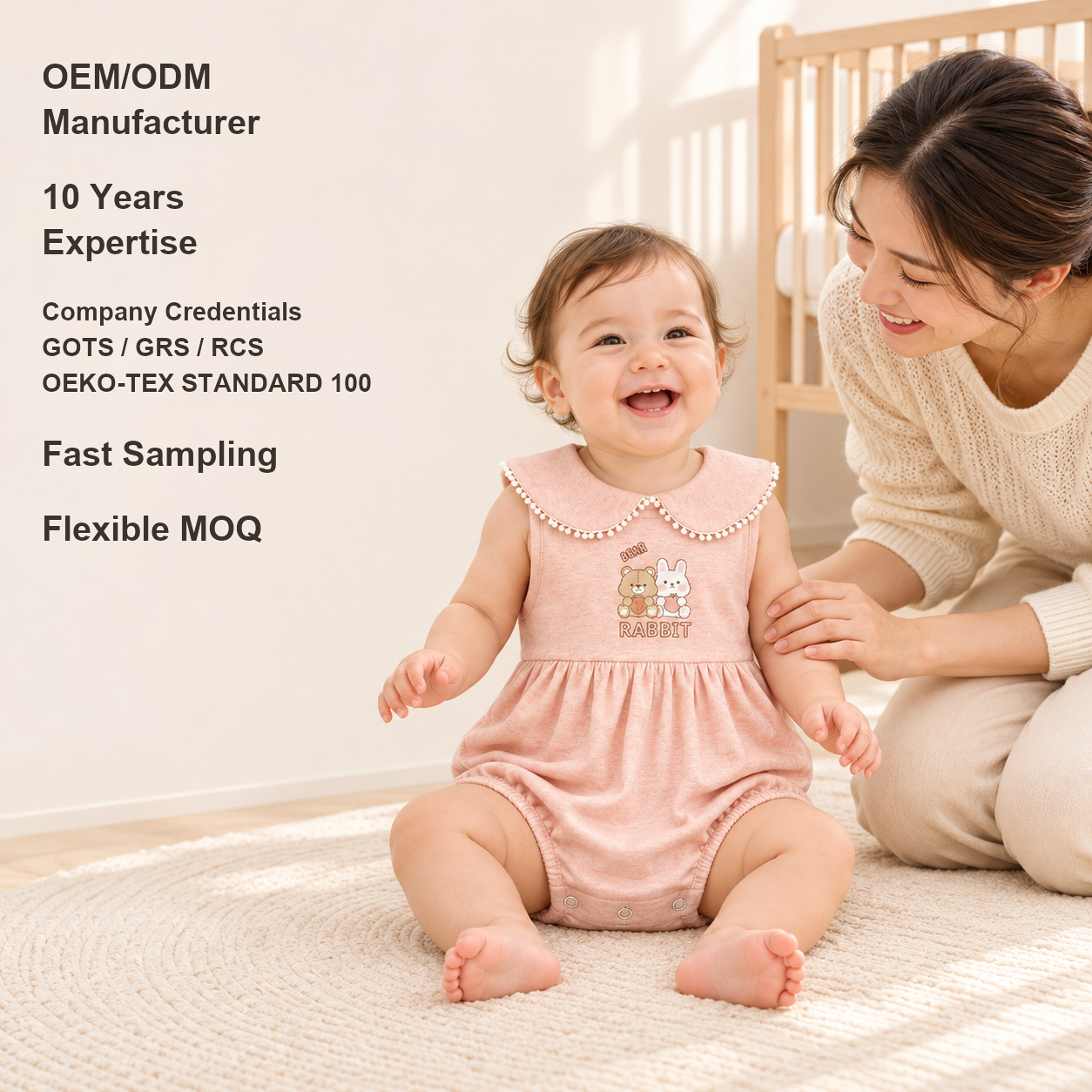
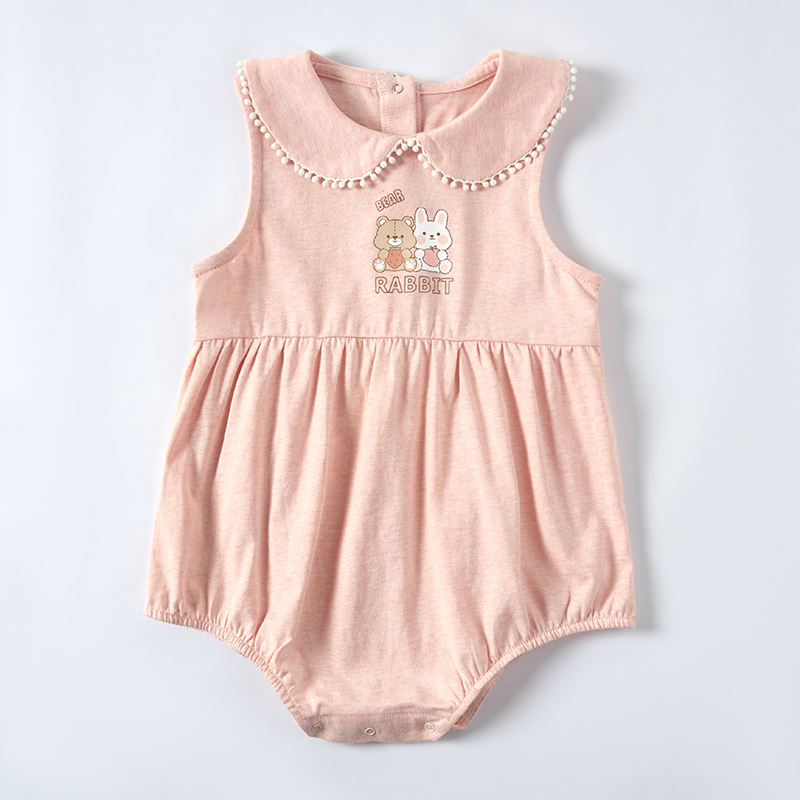
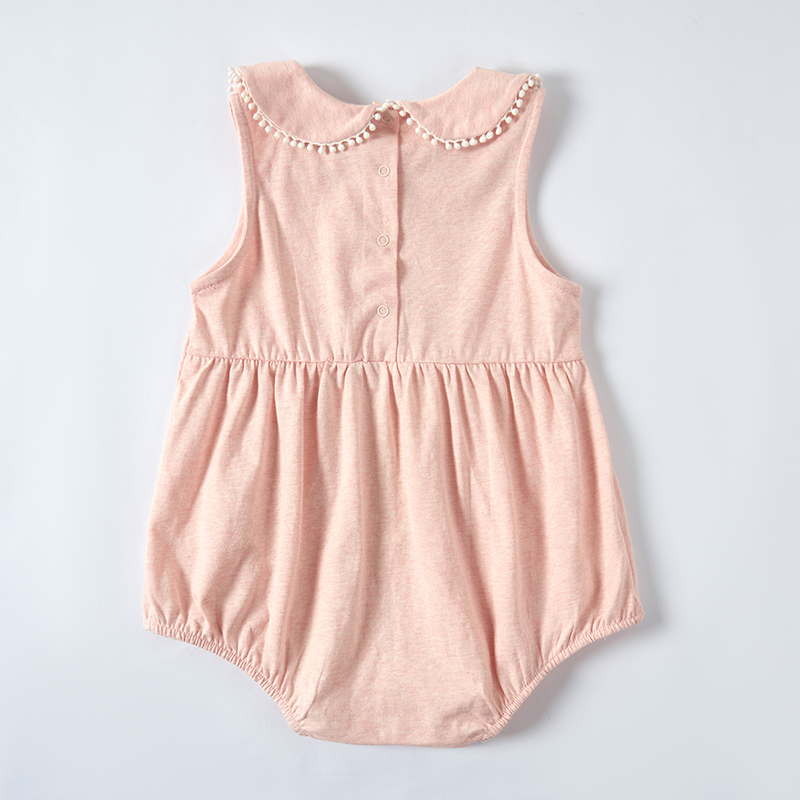
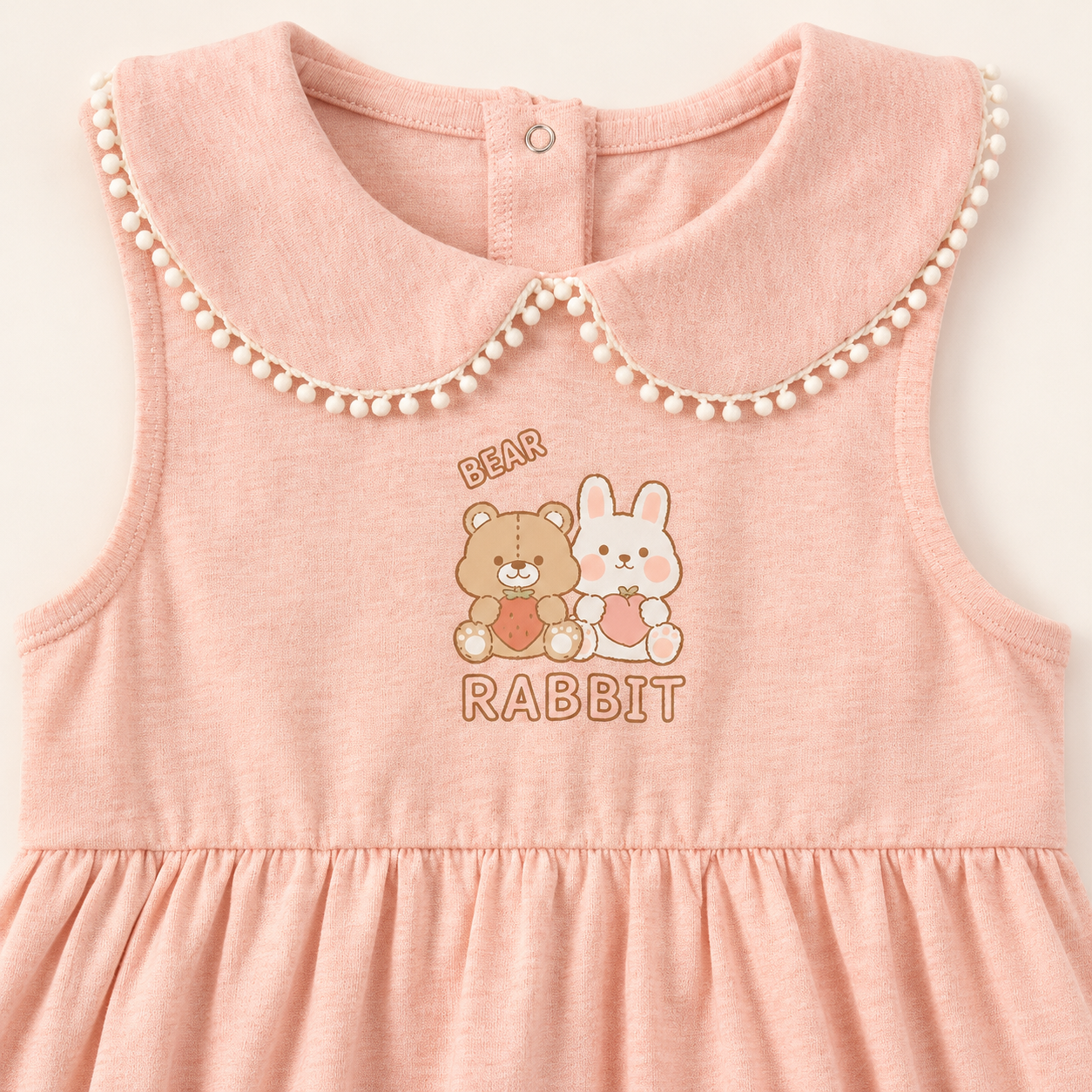
A bubble romper in 230 gsm cotton jersey, plant dyed to a dusty rose with madder and logwood: a Peter Pan collar edged with small beads, a button at the back neck, a gathered skirt over a bubble body, snap crotch and elasticated leg openings.
Three points set the production brief on this garment, and the colour is not one of them. The bead trim is built entirely of small parts, and it sits next to a baby's mouth. The crotch snap is the closure the garment exists for. And because a romper is washed more often than anything else a baby wears, the dye meets water far more often than it would on a sweatshirt.
At a glance

1. Cloth and shape: why a bubble is jersey
- The bubble is held by the cloth, not by wadding. A 230 gsm jersey gathers into volume at the leg and the waist because the knit has enough body to stand away from the body without padding it, which is why a bubble romper is soft rather than structured.
- Jersey stretches to pass a nappy, which a woven of the same weight would not; that stretch is what makes the leg opening work and why the leg elastic can be modest.
- Gathering is the construction. The skirt is gathered onto the bodice at a waist seam and the body is gathered at the leg, and those seams are where the romper is picked up by an adult — one hand under the seat, one at the chest — so they carry more load than any seam on a top.
- At 230 gsm the cloth is thin enough to read wet. A pale rose that looks opaque dry goes slightly translucent when soaked, which is why the bodice is a double layer to the waist and the bubble is lined or self-faced at the seat.
- Two panels of one dye lot still differ in a knit, so the bodice and the gathered skirt are cut from the same grain direction, not merely the same roll.
2. The bead trim: every bead is a small part
- A bead trim on an infant collar is a row of small parts. Under the small-parts requirements that apply to articles for children under 36 months, a component that fits the test cylinder and can be pulled off is a hazard; a collar edge sits exactly where a baby's hands and mouth are.
- So attachment is the specification, not the decoration. Each bead is tested at the pull force the destination sets for attached components, on the finished collar, and the bead, the thread and the stitch that holds it are assessed as one unit.
- The thread is the weak link, not the bead. A bead held by a single pass of thread passes a bench test and fails in a wash; the trim is therefore run on a double thread with a locked stitch through each bead, and the finished collar is checked after a wash cycle.
- Where the force cannot be met, the trim changes rather than the test. A stitched picot edge, a corded edge or an embroidered scallop gives the same visual line with no small part to detach, and on the smallest sizes that is the more defensible choice.
- The trim also changes the hand at the neck. A bead row is a hard edge against the throat when a baby lies back, so the collar is checked with the beads on the inside of the fold, away from the skin.
3. The two closures the garment exists for
- The crotch snaps are the product. It is opened and closed many times a day, so the snap count and spacing are set so the crotch opens one-handed with the baby lying down, and the placket is cut so the two flaps do not need to be lined up visually.
- Snaps are tested as small parts, at the retention force the market requires — 70 N is the figure we work to for buttons and snaps — on the finished garment rather than a component sample. Metal snaps bring nickel release into the file; plastic snaps avoid it but behave differently in wash and dry cycles.
- The snap placket must not twist. It sits inside the leg where it is least visible and most handled, so the placket is interfaced at the ends and the snaps are set after the leg elastic is in, not before.
- The back neck button is the entry. One button at the nape opens the collar enough to pass a head through a neckline that is otherwise closed, and it is the part that is checked with the collar buttoned, because that closed measurement is what the pattern is set to and what the finished garment is measured against.
- Both closures are chrome-free where metal is used, and the button is tested with the thread that holds it, since a shank that is sound on the bench can pull out of a knitted buttonhole.
4. Collar and leg opening: the two places it has to fit
- The collar is a flat collar on a stretch knit. It is interfaced to lie flat and edge-stitched so it does not roll, because a Peter Pan collar on un-interfaced jersey curls up at the point within a wash.
- The collar makes a ring at the neck. Collar, trim and neckline seam sit within a few millimetres, so the neckline seam is pressed away from the skin and the collar is kept shallow so the ring does not thicken where a baby's chin rests.
- The leg opening is measured over a nappy, not over a leg. That is the measurement that decides whether the bubble sits where it should; a leg elastic set to a bare leg marks the thigh and still leaks.
- The leg elastic is specified by width and recovery, and its recovery is checked after repeated washing, because an elastic that relaxes turns a bubble into a bag.
- The rise is cut for a nappy at 6M and 12M and steps down as the size grows, so the crotch snaps sit where they can be reached rather than where the garment has ridden to.
5. Wash frequency: the hardest test on this dye
- A romper is washed more often than anything else a baby wears. Leaks, spills and dribble mean a romper goes through the machine several times a week, so wash fastness — not light fastness — is the property that decides this garment's life.
- Logwood is weak in both. Hematoxylin is not a strongly substantive dye; without a thorough mordant and a soaping stage it rinses out gradually, and a romper gives it far more chances to do so than a sweatshirt does.
- So the ratio leans on madder here more than on a top. Madder holds better through washing, and on a garment with this wash cycle the shade is built with the durability of each component in mind rather than only the look of the blend.
- Shade drift is measured across washes, not once. The approved reference is compared with the garment after repeated home washing, and the acceptable drift is written into the approval so that a buyer and a factory are judging the same thing.
- Soaping after dyeing is what makes the difference. It removes the unfixed fraction before the garment is cut; without it, the first three washes do the job in the customer's machine instead of in the dyehouse.
6. Size: 6M–36M, and what the block has to hold
- The range sits inside Class I, with 6M, 12M and 24M clearly under 36 months and 36M assessed as Class I because the article can be worn by a child under that age.
- A romper is sized on torso length, not on age. The torso has to clear a nappy and still let the leg opening sit at the thigh, so the length and the rise are graded together rather than independently.
- The leg opening grades with the rise, so the bubble does not become a straight leg at the largest size.
- The neckline is measured on a head form with the collar buttoned, because the collar is part of the opening, not decoration laid over it.
- The sample is checked lying down and being lifted, since the waist seam and the seat are where a romper is handled and where a fit fault shows first.
7. Customization, sampling and what we need to quote
- Collar trim. Bead edge as shown; a stitched picot edge; a corded edge; a plain collar.
- Collar. Peter Pan as shown; a rounded club collar; a ruffle.
- Bottom. Bubble with elastic leg as shown; a straight leg; a shorts-length romper.
- Closure. Snap crotch as shown; a full popper placket; a tie-free wrapover.
- Shade. Dusty rose as shown; a warmer rose with more madder; a deeper mauve with more logwood, quoted with a light fastness note.
- Print. Chest print as shown; no print; a woven label instead.
- Packing. Polybag with size sticker; hanger; woven or printed label, satin care label, hangtag.
- Sampling. 3–7 days from a confirmed tech pack, with a dyed strike-off, a bead pull test on the finished collar, a wash trial on the trim and on the shade, and a saliva fastness check at the neckline.
- Bulk lead time. 30–60 days from approval by quantity and dyebath schedule; the bath is planned per batch, so a split delivery is quoted as two batches.
MOQ: 300 pcs for a custom development — custom cloth, shade, print or fit; 50 pcs for a decorative process added to a stock body; 100 pcs for stock cloth with your own logo and label. Mixed colour and size orders are quoted per order. These are standing programme terms, confirmed against the current quotation.
Production runs with our production partner, Suzhou Shelmin Trade Co., Ltd.: 7,200 m² workshop, 8 lines, 200 staff, 6,000 pieces per day. Design confidentiality is held under NDA; buyer patterns, shades and prints are not re-used.
To quote, we need: target market and the small-parts requirement it applies; whether the trim is bead, picot or corded; the mordant route and its residual limits; the ratio of madder to logwood and the acceptable drift after washing; whether the snaps are metal or plastic; shell weight; packaging; and whether certification runs in your brand name.