EN

OEM/ODM Infant Shoulder-Snap T-shirt | 100% Organic Cotton Plant-Dyed Baby Tee | Eco-Friendly Non-Toxic Botanical Dye Short Sleeve Top for Private Label | Sustainable Breathable Newborn Apparel | Wholesale Manufacturer


- Overview
- Plant Dyed Baby Rosette Tee | OEM
- Recommended Products
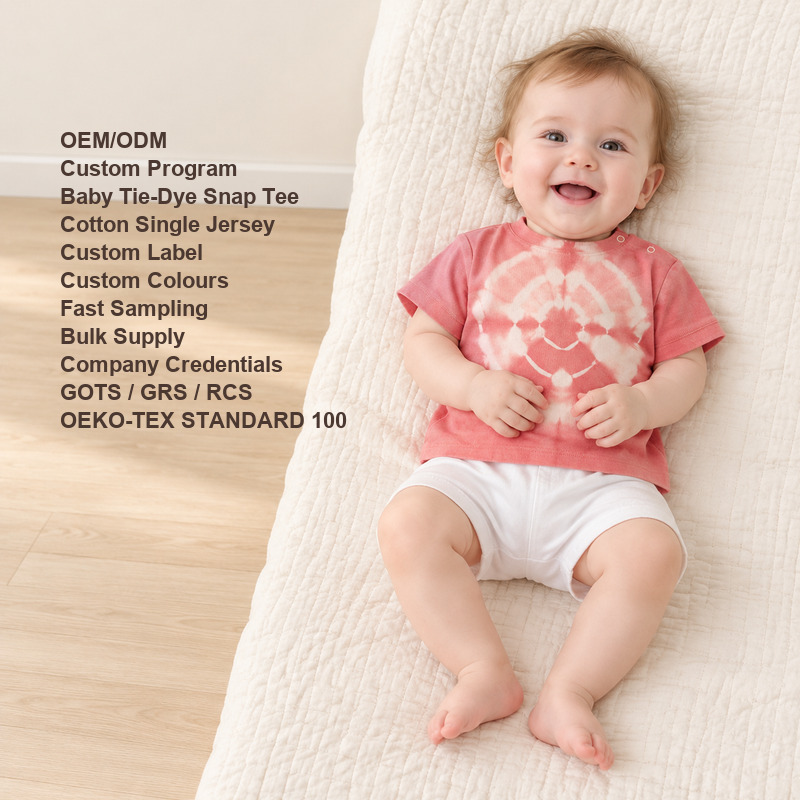
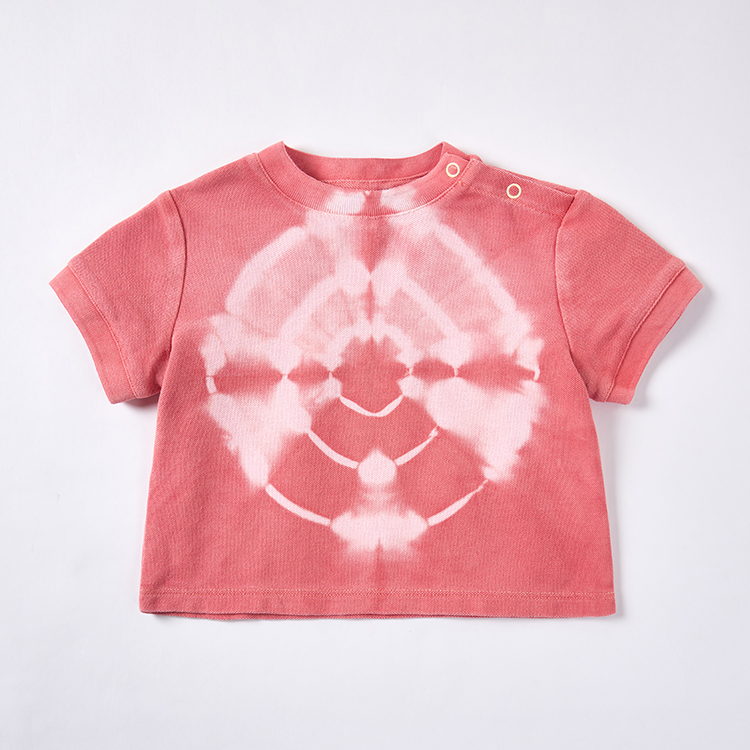
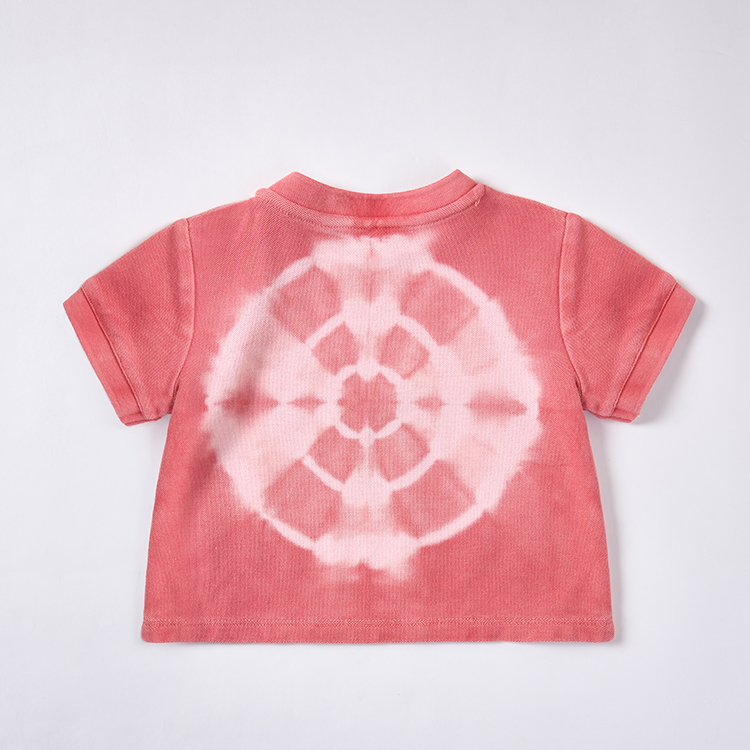
A baby tee in a 100% cotton knit with a visible vertical grain, dyed with sappanwood (苏木) and madder (茜草): a banded round neck, short sleeves with turned hems, a shoulder placket closed with two metal snaps, and on the body a radial rosette — broad and cropped by the neckline at the front, complete and centred at the back.
The rosette is not a print and it is not a dip. It is a fold: the cloth is folded onto itself again and again, bound at a point, and only then entered in the liquor, so the pattern comes out of the fold and the tie. That makes it the one pattern on which every parameter is a count — how many times the cloth was folded, how exactly the folds were halved, and where the centre of the fold was placed on the panel.
At a glance
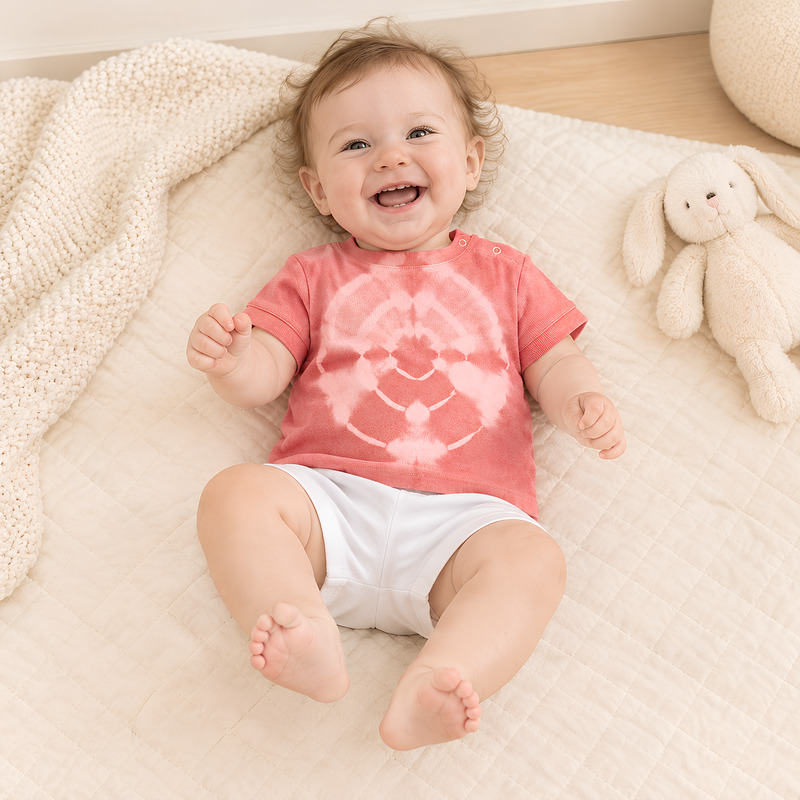
1. The rosette is placed, not dipped
- A radial pattern comes from a fold and a bind, so the whole design exists before the panel is cut: the cloth is folded onto itself, tied at one point, and the liquor works into the exposed faces.
- That gives the pattern a centre, and the centre is a position on the flat cloth rather than a height in a bath.
- So the rosette is specified by where its centre sits, measured from the neckline and from the centre of the panel, and not by an outline; move the centre five centimetres and the whole rosette moves with it.
- The centre also carries the mark of the tie, a small ring where the binding held the cloth, which no later process removes and which is part of the pattern rather than a fault.
- Because the pattern is made flat and cut after, it is repeatable in a way a dip is not: two panels folded the same way give the same rosette, which is why this pattern can be approved on a flat panel rather than only on a garment.
2. Petal count is fold count
- The number of petals is the number of layers the cloth was folded into, so eight petals means the cloth was folded into eight before it was bound.
- That makes the petal count a production parameter, not a drawing: it is set by how many times the panel is halved, and it is checked by counting petals on the sample.
- The petals are also the check on the fold itself, since a fold that is not exactly halved leaves one petal wider than the rest, and a single wide petal reads at once across a ring that is otherwise even.
- The petals have soft, feathered edges rather than crisp ones, because the liquor creeps a little way into each fold; that softness is the character of the method rather than a loss of definition.
- So the pattern is judged on two things only, the equality of the petals and the evenness of the feathered edge, and both are read on the made garment as well as on the flat panel.
3. The neckline is the crop
- The rosette is made before the neck is cut, so the neck opening lands on the pattern and crops it wherever the centre was placed.
- On this tee the front rosette loses its upper petals to the neck, while the back rosette is complete; that difference is a matter of position rather than of two different patterns.
- The shoulder placket is the second crop, since it is a straight edge across one shoulder and it will cut whatever the rosette puts there.
- So the centre is placed with both crops in mind, and the placement is checked on the made garment at the neck edge and under the placket rather than on the flat panel alone.
- The crop is a design decision with a limit: raise the centre to show more of the rosette and the neck eats into the petals; lower it and the rosette runs into the hem.
4. Two centres, and they are not twins
- Front and back carry a rosette each, so there are two centres to agree, one on each panel.
- They are not identical on this tee: the back rosette is larger and complete, the front one broader and cropped, which is what two separately folded panels look like rather than one pattern seen from two sides.
- That is worth stating because a buyer comparing the two sides will read the difference as an error unless the specification declares it: either the two panels are folded to the same count and the same diameter, or the difference is written down as intended.
- The two centres are also at different heights relative to the shoulder, since the front panel is cropped by the neck and the back is not, so the centre is measured on each panel rather than carried across.
- Both centres are marked before folding, because a rosette that is folded to the wrong point cannot be corrected afterwards; the mark is the only control on placement.
5. On a knit, a circle is a fit question
- A rosette is circular on the flat panel, and the cloth here is a knit with a visible vertical grain, which gives more in one direction than in the other.
- So whether the rosette stays circular in wear is a fit question rather than a dyeing one, and it is checked on the fit sample: a cloth that gives across the body pulls the rosette wider than it is tall.
- That check is done at the smallest and the largest size, because the amount of give in the panel is a proportion of its width and the distortion grows with the size.
- The pale ground is the detector for anything that moves in the wash, and the rosette's outer edge is where a shift would show first, since it is the longest soft boundary on the garment.
- Nothing on the rosette is reinforced, so the pattern relaxes with the cloth; that is expected and it is why the fit sample is measured calm rather than stretched.
6. The placket, the snaps, and what is confirmed at quotation
- The shoulder placket is functional, not decorative: the neck opening is small enough to hold its shape, so the tee goes on over the head through that shoulder, and without it the garment does not go on a baby.
- Two metal ring snaps close it, and they are the only hardware on the tee and the only opening anywhere on it.
- They are declared as components and tested as small parts, including attachment, and the metal is the reason a nickel-release test belongs on this garment's list rather than being assumed away.
- The placket is the second straight edge on the garment after the hem, so it is read for a fold that lies flat and for a snap that has not pulled the knit out of line.
- Fixed by the brief and the sample: the composition as 100% cotton, the two dyestuffs, the construction and the two snaps. Not asserted here: the mordant route, the certificate held for the cloth and its scope for this article and colourway, the chemical class applying to these sizes, and the test list, each confirmed at quotation against documents rather than stated on a page.
7. Sizes, sampling and quoting
- Seven sizes graded on measurements: 3M, 6M, 9M, 12M, 18M, 2Y and 3Y move on chest, body length, sleeve, neck opening, placket length, the position of the rosette's centre on each panel, and its diameter.
- Customization. Petal count, which is the fold count; the diameter of the rosette on each panel; the placement of each centre and therefore how the neck and the placket crop the pattern; whether the two sides are matched or deliberately different; the depth of the tie mark at the centre; the neck band width; and the mordant route quoted as two products, each sealed on its own reference set.
- Sampling: 3-7 days from a confirmed tech pack, covering a fold-and-bind strike-off with its reference pair, a flat panel with the petals counted and the feathered edge read, a made-up tee with neck, placket, snaps and hems finished as production, the rosette's centre measured on each panel and the crop checked at the neck and under the placket, the fit sample read calm and worn for the roundness of the rosette at 3M and at 3Y, a wash-and-remeasure of the outer edge, crock on the solid ground and on a petal edge, and the snaps pulled and checked for a knit pulled out of line.
- Bulk: 30-60 days from approval, planned per fold set and per bath, with the fold count and the marked centre written into the method so a second lot starts from a number and a mark rather than from a photograph; AQL 2.5 major and 1.0 critical.
- MOQ: 300 pcs for a custom development covering cloth, shade, fold or fit; 50 pcs for a decorative process on a stock body; 100 pcs for stock cloth with your own logo and label. Mixed colour and size orders are quoted per order.
Production runs with our production partner, Suzhou Shelmin Trade Co., Ltd.: founded 2017, 7,200 m² workshop, 8 lines, 200 staff, 6,000 pieces per day. Design confidentiality is held under NDA; buyer patterns, shades and prints are not re-used.
To quote, we need: target market and the class and test list it requires per size; petal count and the diameter wanted on each panel; where each centre should sit and how the neck and placket may crop the rosette; whether the two sides are matched or deliberately different; neck band width; whether the mordant route is to be used, so both versions can be quoted; the snaps you want, or ours to be tested; the certificate held for the cloth and the scope you need; lot certificates for both dyestuffs; the pH target and the dyehouse water specification; packing method; and whether certification is to run in your brand name.