EN

OEM/ODM Premium Baby Burp Cloth | 100% Organic Cotton Plant-Dyed Muslin Washcloth | Eco-Friendly Non-Toxic Botanical Dye Brush Stroke Print Infant Spit-Up Rag for Private Label | Sustainable Absorbent Nursing Essential


- Overview
- Plant Dyed Cotton Burp Cloth, Brushed Olive | OEM
- Recommended Products
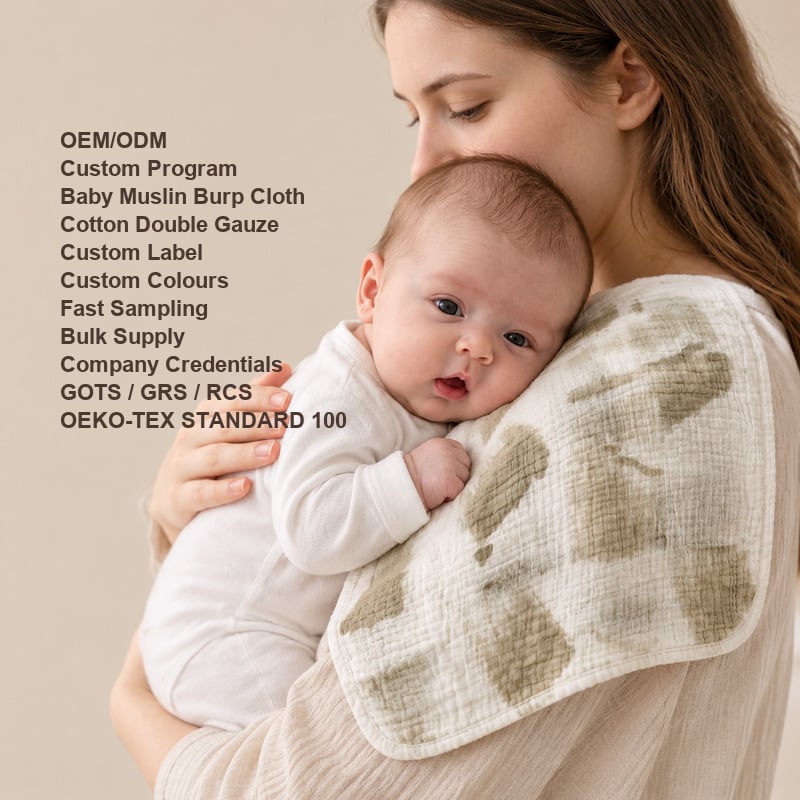
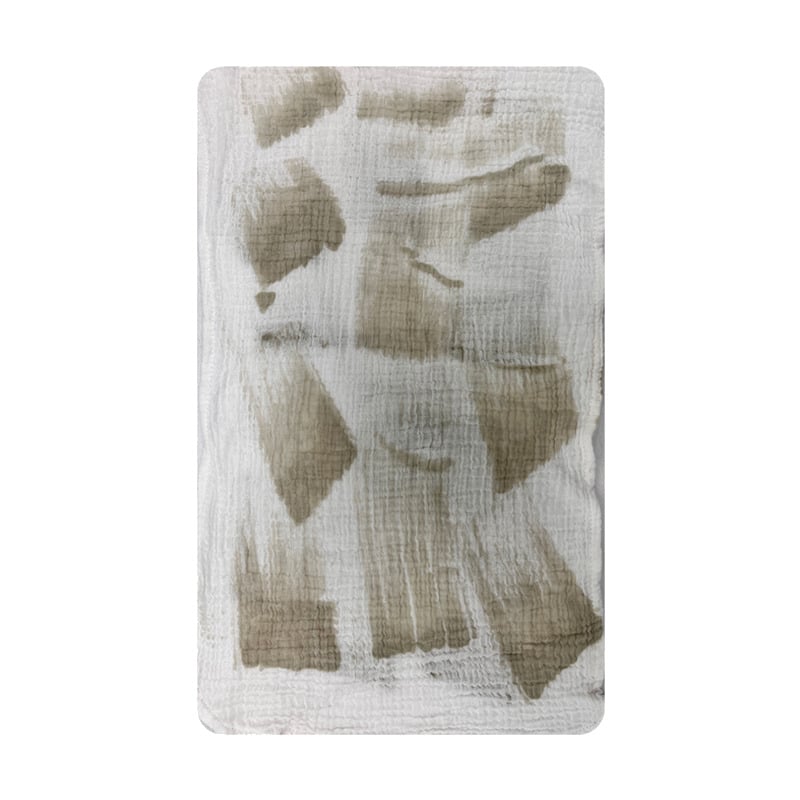
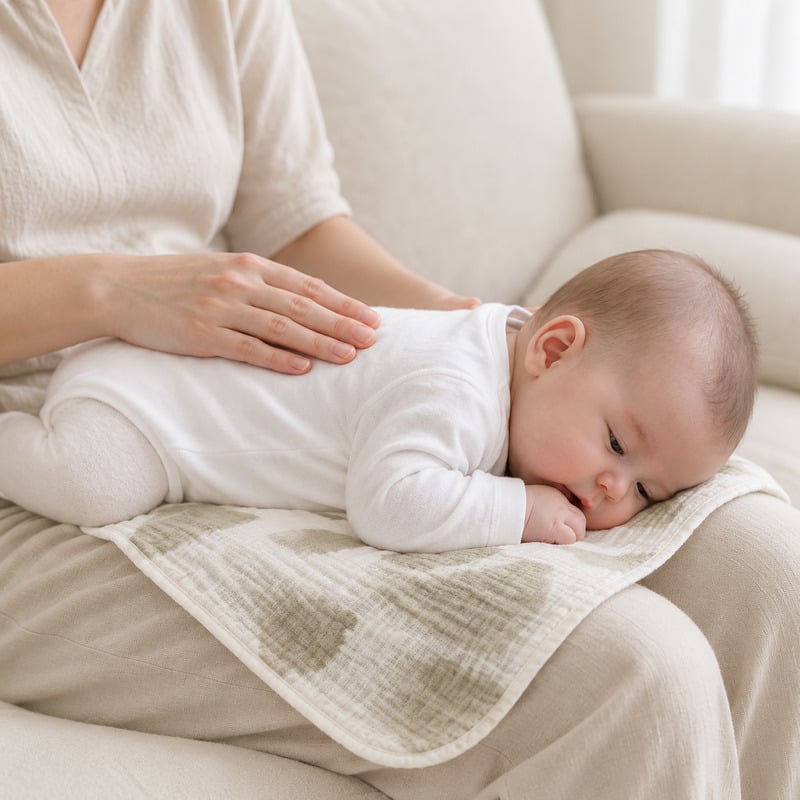
A burp cloth in a 100% cotton double-layer crinkle gauze at 135 g/m², cut to a rectangle with rounded corners and a narrow edge finish, on a warm cream ground carrying olive-khaki patches brushed on by hand: a yellow from sophora buds first, then indigo from Isatis over it.
This cloth is not a flat surface, and that single fact governs the whole pattern. The two gauze layers are joined at regular intervals, which puffs the cloth into a grid of small cells; a brush loaded with paste lands on the crest of each cell and skips the valley between them. So the colour does not arrive as a wash. It arrives as a grid, its edges advance one cell at a time, and the same cloth read flat on a table and pulled over a shoulder shows two slightly different patterns.
At a glance
1. The edge advances one cell at a time
- A patch on this cloth has no drawn boundary, because the surface it is laid on is a field of small domes: the brush reaches the crest of a cell and the paste stops at the valley beside it.
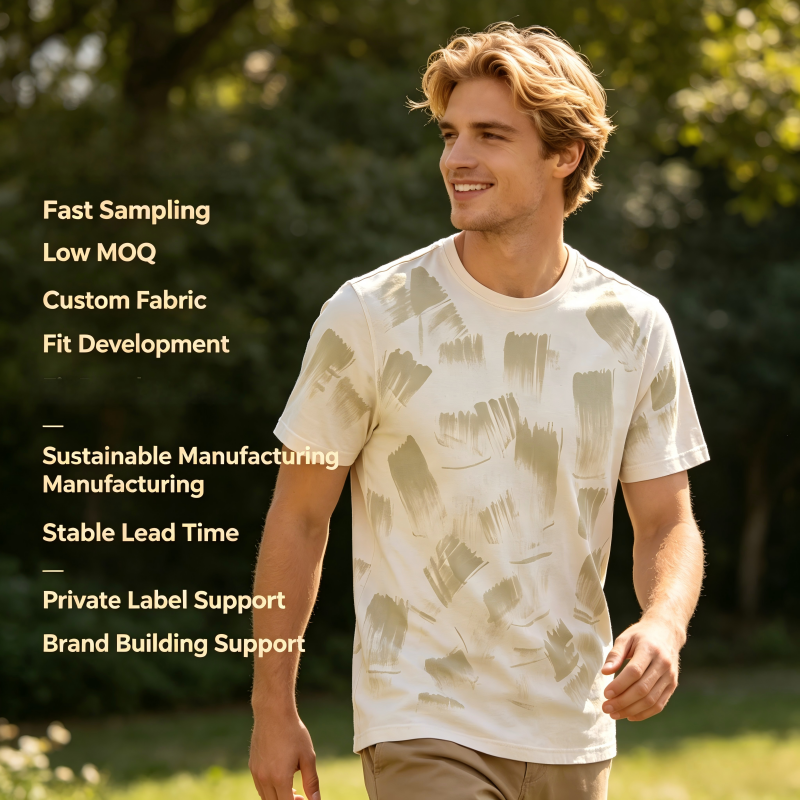
- So the edge is a fringe rather than a line. It steps in and out by roughly a cell, and it leaves single half-filled cells and small detached droplets beyond the main body of the patch, which is what the sample shows below its larger shapes.
- That is the difference between brushing a flat jersey and brushing a gauze. On a flat knit the paste wicks outward and the edge ends in a soft gradient; here the cloth's own relief interrupts it first, so the edge is ragged at the scale of the pucker rather than soft at the scale of a centimetre.
- The fringe is a quality signal rather than a defect, and it is also the reason a burp cloth cannot be ordered to a drawn layout: what can be ordered is the number of patches, their approximate size and the coverage between them.
2. The colour carries the cloth's relief
- Inside a patch the grid is still visible, because the crest of each cell holds more pigment than the valley around it; so a filled area reads as dark cells on a paler grid rather than as a solid block.
- The gauze adds a second texture over it. The base cloth has fine vertical streaks in it, and the colour follows those too, which is why the patches in the sample show vertical striations running through the grid.
- Two structures, therefore, in one patch: a grid from the pucker and a grain from the yarn, both of them belonging to the cloth rather than to the brush.
- It also means the pattern cannot be corrected afterwards. A patch that has filled the crests but not the valleys cannot be evened out by brushing again, because a second pass fills the same crests; evening it out is a change to how much paste the brush carries and how hard it is pressed.
- The honest way to approve it is on cloth in hand, held to the light and then laid flat, rather than against a photograph, because a photograph flattens exactly the relief that makes the pattern.
3. Stretched and relaxed are two different patterns
- The cloth is used pulled: over a shoulder, gripped at one corner, hanging under its own weight against a back. Every one of those states stretches the grid open and brings the valleys up toward the surface.
- When that happens the pale valleys widen and the pattern lightens, then it darkens again as the cloth relaxes. So the same cloth shows a paler, more open pattern in use than it does folded on a shelf.
- That argues for approving the pattern in the state it will be seen in. A flat reference is the right place to judge coverage; a stretched reference is the right place to judge whether the pattern still reads as a pattern at all.
- It is also why the coverage ratio matters more than the patch shape here. On a surface that changes with every pull, coverage is the number that survives; a shape is a detail of one particular state.
4. The two layers meet at the grid, and that decides the reverse
- The two gauze layers are joined at the pucker points, not left free, so the cloth behaves as one object with two faces and a set of pins between them.
- Brushing works one face. The paste sits on the outer layer's crests; at the points where the layers are joined the colour can pass, but between those points the inner layer is a separate surface.
- For a burp cloth that matters more than it would on a garment, because both faces get used: one against the shoulder, the other against a chin a minute later. If the reverse stays on the ground, the cloth reads as two different products depending on which way up it is.
- So the reverse is a decision to take deliberately — brush both faces, accept a pale reverse, or brush one face and finish the reverse as a clean ground — and each of the three is a different amount of work.
- The join points are where the difference shows first, because they are the only places the two faces are in contact; that is where a pale reverse will look least like a plain ground.
5. A wavy edge cannot be pressed flat
- The edge of this cloth runs in waves, because the pucker continues right to the selvedge and no amount of pressing removes it for long.
- A narrow finish has to follow those waves. Pressed flat, it fights the cloth and the seam ripples back within a wash; followed, it sits down and stays.
- The rounded corners are part of the same problem, since a corner is where a wavy edge has to turn: the radius has to be large enough for the finish to travel around it without gathering.
- None of this shows on a photograph of the face, which is why the edge is checked as a separate item: laid flat, then lifted by one corner, then washed.
- On a burp cloth the edge is also a wear point, since it is what gets gripped and wrung, so the finish is judged for how it survives handling rather than for how it looks on a table.
6. Why the patches read olive rather than green
- The green on this cloth is a layering, not a dyestuff. A yellow from sophora buds goes on first, indigo goes over it, and what the eye reads is the two together; at the depths used here the result is olive-khaki, closer to a dried herb than to a leaf.
- Two dials move it. A stronger yellow pulls the colour toward brass and mustard; more indigo passes pull it toward grey-green and then toward blue. Neither dial changes the other, which is why they are quoted separately.
- The cream ground is itself a dye result rather than an undyed cloth, at a low strength of the same yellow, so the ground and the patches are related and shift together when the strength changes.
- The two halves of the pattern also age differently: the yellow half is the one that moves in light, while the indigo half is the one that gives up surface pigment in the first washes. A pale olive is therefore a pattern that will drift rather than a pattern that will fade evenly.
- Which is a reason to keep the reference as cloth. A photograph of the sample will be wrong before the cloth is, and it will be wrong in the direction of looking cleaner than the cloth does.
7. Sizes, sampling and quoting
- One size, with the dimensions fixed per order: length, width, corner radius, finish width and the coverage of the brushed field.
- Customization. Number of patches and their approximate size; coverage ratio; edge softness as far as the pucker allows; the strength of the yellow and the number of indigo passes; whether both faces are brushed; which face carries the pattern if only one does; the corner radius; the finish width; the dimensions; and whether the cloth is supplied flat or pre-washed.
- Sampling: 3-7 days from a confirmed tech pack, covering a brushed set of two or three pieces approved on the oxidised, dried and washed result; the pattern judged flat, held to the light, and pulled diagonally as it would be in use; both faces compared; the edge laid flat, lifted by one corner and washed once; and the coverage re-measured after washing, because the pucker tightens and the pattern with it.
- Bulk: 30-60 days from approval, brushed in batches by trained hands with pass count and coverage recorded per batch against a retained cloth reference; AQL 2.5 major and 1.0 critical.
- MOQ: 300 pcs for a custom development covering cloth, shade, brush pattern or dimensions; 50 pcs for a decorative process on a stock cloth; 100 pcs for stock cloth with your own logo and label. Mixed orders are quoted per order.
- For a baby product the test list is not a formality. The faces of this cloth meet a chin and a shoulder, so the tests that matter are the ones for what a mouth leaves behind, and the artificial saliva test (ISO 105-E04) is the standard one for that; which tests apply, at what limits, and whether they run in your brand name are set by the destination market and confirmed at quotation.
Production runs with our production partner, Suzhou Shelmin Trade Co., Ltd.: founded 2017, 7,200 m² workshop, 8 lines, 200 staff, 6,000 pieces per day. Design confidentiality is held under NDA; buyer patterns, shades and brush layouts are not re-used.
To quote, we need: destination market and the age group it will be sold for; the Class I scope you need and the test list that comes with it; the dyehouse documentation for both dyestuffs and the mordant; the coverage ratio, number of patches and largest patch you will accept, with two reference pieces if you have them; the strength of the yellow and the number of indigo passes; whether both faces are brushed; length, width and corner radius; finish width; whether the cloth is supplied flat or pre-washed; the certificate held for the cloth and the scope you need; lot certificates for both dyestuffs; the pH target and the dyehouse water specification; packing method; and whether certification is to run in your brand name.