EN

OEM/ODM 100% Cotton Double-Layer Wrinkled Gauze Baby Bubble Shorts | Eco-Friendly Plant-Dyed 135gsm Toddler Bloomers | Custom Sustainable Botanical Dye Infant Summer Shorts with Side Bows Wholesale


- Overview
- OEM/ODM 135gsm Plant-Dyed Cotton Baby Bubble Shorts
- Recommended Products
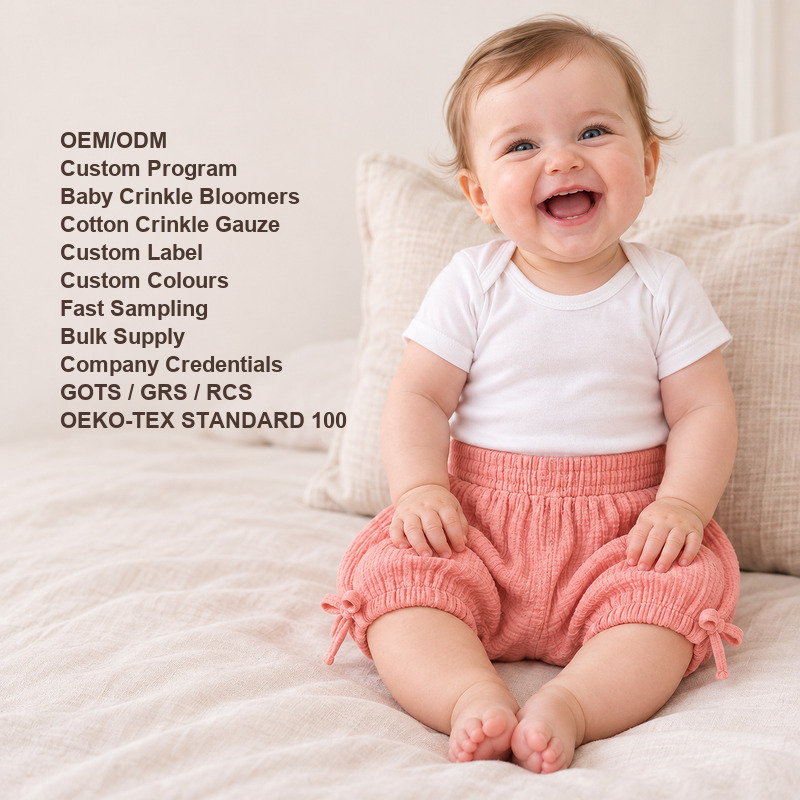
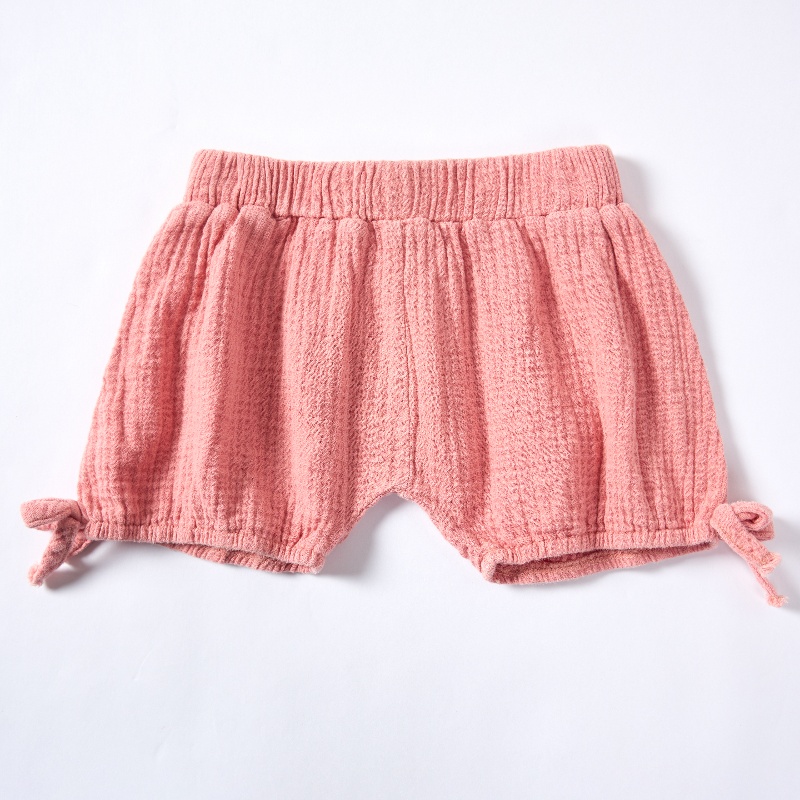
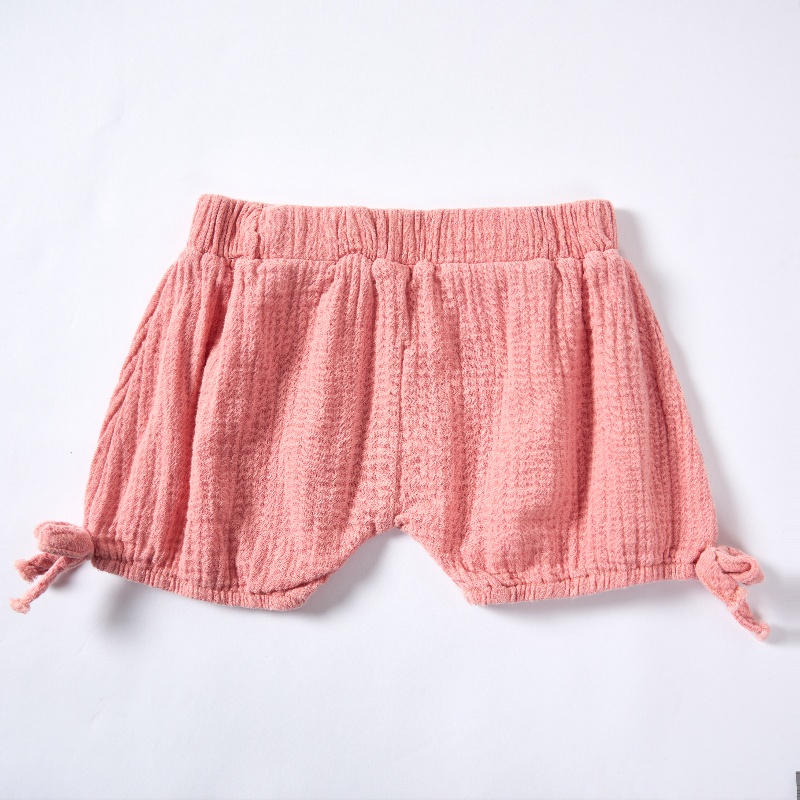
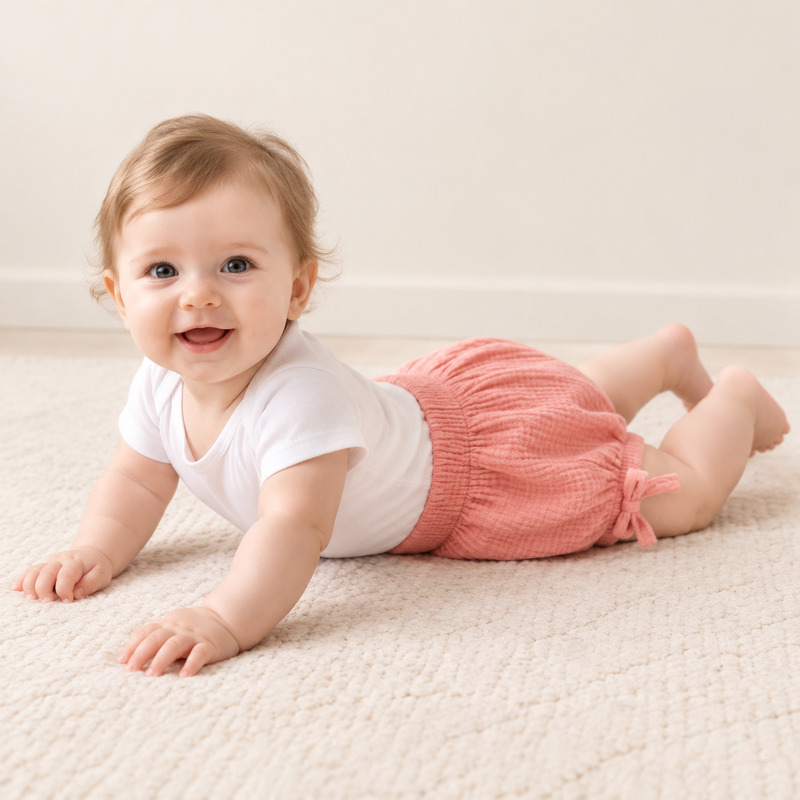
Baby bloomer shorts in a double-layer crinkled cotton, 135 gsm, plant dyed to a peach rose with sappanwood (苏木) and madder (茜草) alone: a gathered paperbag waist on elastic, a full leg that closes at the thigh on encased elastic, and short self-fabric ties at the side seams.
Two reds and nothing else means the colour is built in passes rather than in one bath, because neither dye has a tannin layer to hold it and no metal is added. On flat poplin that is simply slower. On a crinkle it is a different problem: every pass is a wet-dry cycle, and each one leaves colour where the water left last — which in a creased cloth is the crease.
At a glance
1. Without a carrier, depth is repetition — and repetition is what a crinkle punishes
- There is no tannin pre-treatment here and no metal, so the two reds attach on their own affinity; a usable depth comes from going back into the bath several times rather than from one strong liquor.
- Each pass is a full wet-dry cycle, and a crinkled cloth feels every one of them. The crease is a fold that is wet, dried and folded again, and after several cycles it is less crisp than it was on the roll.
- So the number of passes is a process parameter, not an operator's judgement. It is fixed at strike-off, written into the dyeing route with the liquor ratio and the drying method, and repeated order to order.
- A strong single bath is the wrong answer even where the shade would allow it, because a concentrated liquor strikes the surface and leaves the yarn core pale — on a two-ply crinkle that reads as a garment that looks washed before it is worn.
- The ceiling on depth is fastness, not the bath. A deeper peach rose is available; it is simply not available at the wash and rub results this programme holds, so the shade is set where fastness still passes.
2. Colour migrates to where the water leaves last
- As a wet garment dries, dye travels with the water and stops where evaporation finishes — at a fold edge, at a seam, at the ridge of a crease.
- On a crinkle this happens on every crease at once, so a multi-pass recipe can develop a faint drawn line down each fold that is darker than the surface between the folds.
- That line is the signature of the route, not a fault in itself. What is controlled is how strong it reads: drying without tension, cloth opened out rather than dried in a bundle, and no forced heat that pulls water to the surface faster.
- It is judged on the crease, which is where it lives. A flat offcut cut from the same piece will not show it, so both the sealed standard and the inspection specimen are crinkled.
- It interacts with depth: the line is nearly invisible on a pale build and prominent on a heavy one, which is a second reason the shade is not pushed to the deepest the bath will allow.
3. Two plies, and the inner one is harder to reach
- A low-substantivity dye penetrates a double layer less readily than a tannin-loaded one, so the inner ply is where a weak pass shows first.
- The inner ply is not hidden. It appears at the waistband turn, at the leg turn and whenever the garment is turned inside out by a customer, so it is graded against the standard alongside the face.
- Where the difference is real, the answer is penetration rather than more dye: a longer wet-out before the first pass, and cloth that is opened in the bath rather than compressed.
- A two-ply cloth also dries from the outside in, so the inner ply stays damp longer and keeps migrating after the face looks dry; drying time is specified per weight rather than by touch.
- Both plies are checked at the seam where the two turn under, since a step there shows as a lighter band along the waist and the leg — the two places the eye goes first on a bloomer.
4. The ridges carry the most colour and take the most wear
- A crease ridge is where the cloth is densest in dye and most exposed to abrasion, because it is the part that touches everything: the nappy, the thigh, the floor when the child sits.
- On a colour that sits near the surface, the ridge is also where fading starts, and the fade path is a pale line following the fold rather than an overall lightening.
- So rubbing is tested through the crease, not only on the flat areas between creases, and the result is read against an unrubbed crinkled specimen rather than an unrubbed flat one.
- The direction of fading is recorded at the same time, because a peach rose that goes pale-pink on the ridges is a different after-sale conversation from one that goes dull or grey.
- Wash testing keeps a whole garment in the load, so the creases are worked the way a household works them rather than laid flat in a test bath.
5. Repeated wet cycles change the cloth before it is cut
- A crinkle relaxes a little with every wet-dry cycle, so cloth that has been through several passes arrives at the cutting table already changed from the greige it was measured as.
- Relaxation is therefore measured on the dyed lot, not on the greige, and the pattern allowance is taken from that measurement.
- The cut is left to rest before sewing, because a bloomer cut straight off a relaxed roll and one cut after resting are not the same garment, and the difference shows as length.
- Post-wash dimensions are what the customer experiences, so length, width and rise are specified in the relaxed state and confirmed after the wash sequence; the elastic waist keeps the garment up while the length quietly changes.
- The self-fabric ties are cut from the same piece as the body they hang on, because with a multi-pass recipe the spread between pieces is wider than on a single-bath shade, and a tie from a different pass is visible in daylight at the widest point of the garment.
6. Waist, legs and ties: the bulk and the safety items
- The waist gathers a double-layer cloth onto elastic — four plies plus elastic at one seam. It is graded and pressed to sit flat, and needle and feed are specified for the bulk, since a deflected needle marks a dyed crinkle in a way that cannot be pressed out.
- Elastic is specified as relaxed and stretched circumference per size at the waist and both leg openings, with recovery checked after repeated washing, because a gathered waist is under constant tension.
- Leg clearance is checked on the largest size first; in this size range the thigh grows faster than the waist, and a tight leg reads as a fit fault rather than a style.
- The side ties are a children's-wear item in their own right: short, attached at both ends, unable to form a loop, and held within the cord limit for the destination market, checked against the 13 cm figure used for this size range.
- Because the seams are the stiffest part of a soft garment, the tie attachment is bar-tacked into the seam rather than onto the surface, so the pull goes into the seam rather than into the cloth.
7. Tests, sizes, sampling and quoting
- Fabric tests at the shipped depth: light to ISO 105-B02, wash to ISO 105-C06 with a whole garment in the load, rubbing to ISO 105-X12 on flat areas and through creases, perspiration and saliva to ISO 105-E04 plus the destination market's saliva method, with colour read on both plies.
- Migration and crease line are recorded on the sealed standard and on the inspection specimen, both crinkled, so the effect is described rather than argued.
- Relaxation and dimension change after washing, recorded as length, width and rise before and after the wash sequence, with waistband and ties dimensioned in the relaxed state.
- Trim and safety checks: waist and leg elastic relaxed and stretched circumferences, elastic recovery after repeated washing, tie length against the cord limit, tie attachment strength, and a loop check on the finished garment.
- pH is measured on the garment and held between 4.0 and 7.5; phenol yellowing is checked to ISO 105-X18 on a specimen carrying the actual packing fold, with packaging specified free of BHT.
- Five sizes on a measurement chart: 6-9M, 9-12M, 12-18M, 24M and 36M move on waist, rise, leg opening and outseam, measured in the relaxed state and confirmed after washing.
- Sampling: 3-7 days from a confirmed tech pack, covering a dyed strike-off on the crinkled cloth with its pass count and drying method stated, a made-up bloomer washed once and re-measured, a fit check on the smallest and largest size with a nappy in place, an inner-ply colour check at the waist turn, elastic and tie checks, and a crease rub check.
- Bulk: 30-60 days from approval, planned per dyebath and per elastic lot, with cloth released only after both-ply colour, rub and relaxation results are in hand.
- MOQ: 300 pcs for a custom development covering cloth, shade, crinkle level, trim or fit; 50 pcs for a decorative process on a stock body; 100 pcs for stock cloth with your own logo and label. Mixed colour and size orders are quoted per order, and terms are confirmed against the current quotation.
Production runs with our production partner, Suzhou Shelmin Trade Co., Ltd.: founded 2017, 7,200 m² workshop, 8 lines, 200 staff, 6,000 pieces per day. Design confidentiality is held under NDA; buyer patterns, shades and prints are not re-used.
To quote, we need: target market and the Class I tests it requires, including the cord and tie requirement that applies there; whether you accept the crease line that a multi-pass build produces, or want the shade set lighter to minimise it; the wash and rub result the shade must hold, since that is what caps the depth; the crinkle level you want, as crease count and depth per unit; the acceptable post-wash length change; waist and leg elastic type with relaxed and stretched circumferences; tie finished length; lot certificates for both plants and for the thread; the pH target and the dyehouse water specification; packing method; and whether certification is to run in your brand name.