EN

OEM/ODM 100% Cotton Ruffle Baby Girl Dress | Eco-Friendly Plant-Dyed Toddler Sun Dress | Custom Sustainable Botanical Sleeveless Kids Pinafore | Wholesale Premium Private Label Boutique Children Apparel


- Overview
- OEM/ODM Ruffle Sleeveless Plant-Dyed Cotton Dress
- Recommended Products
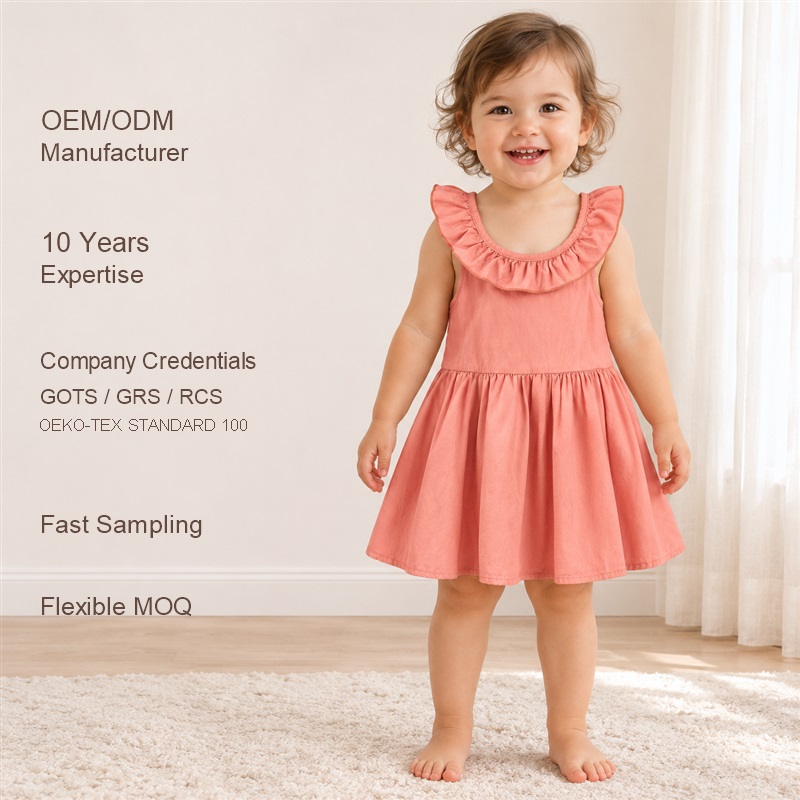
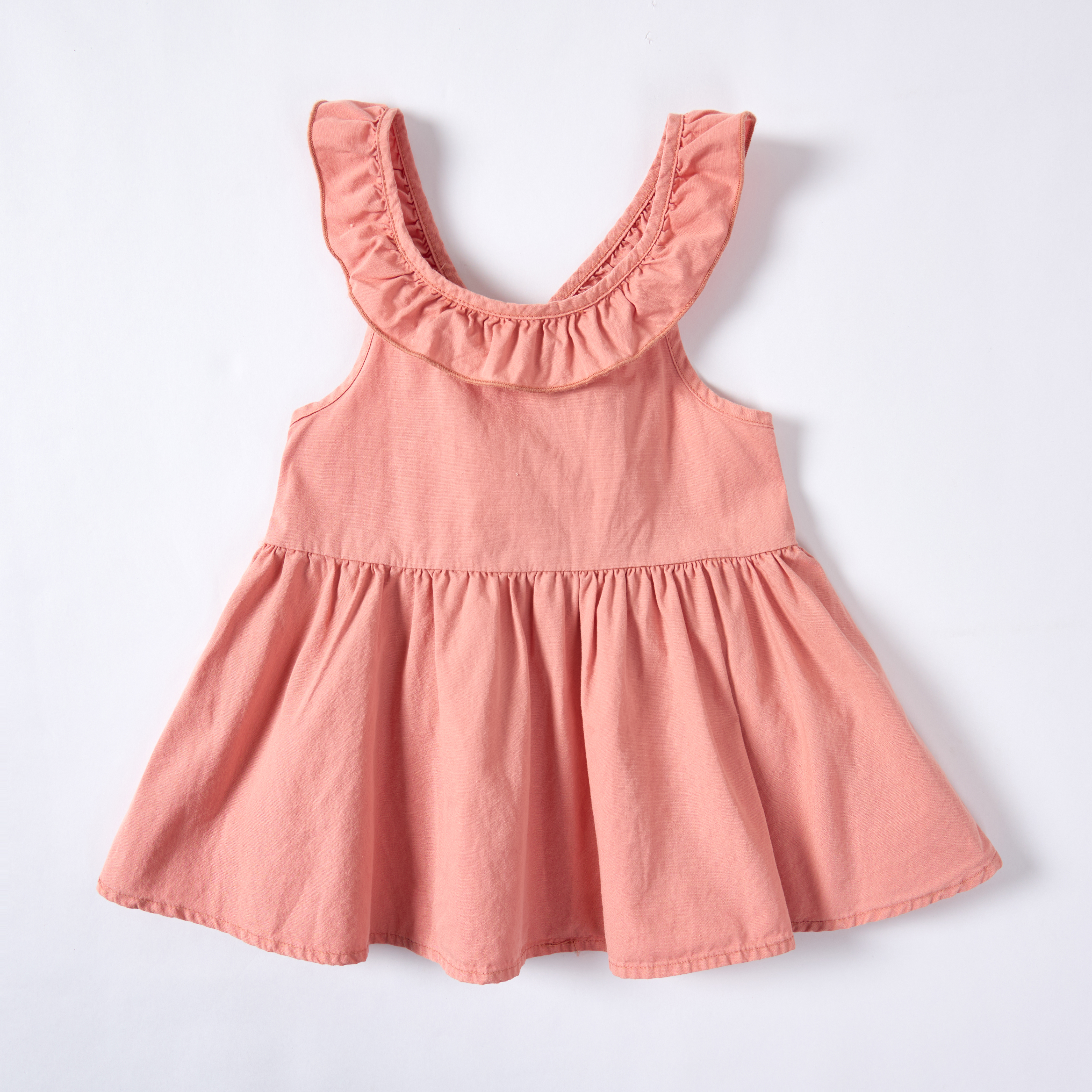
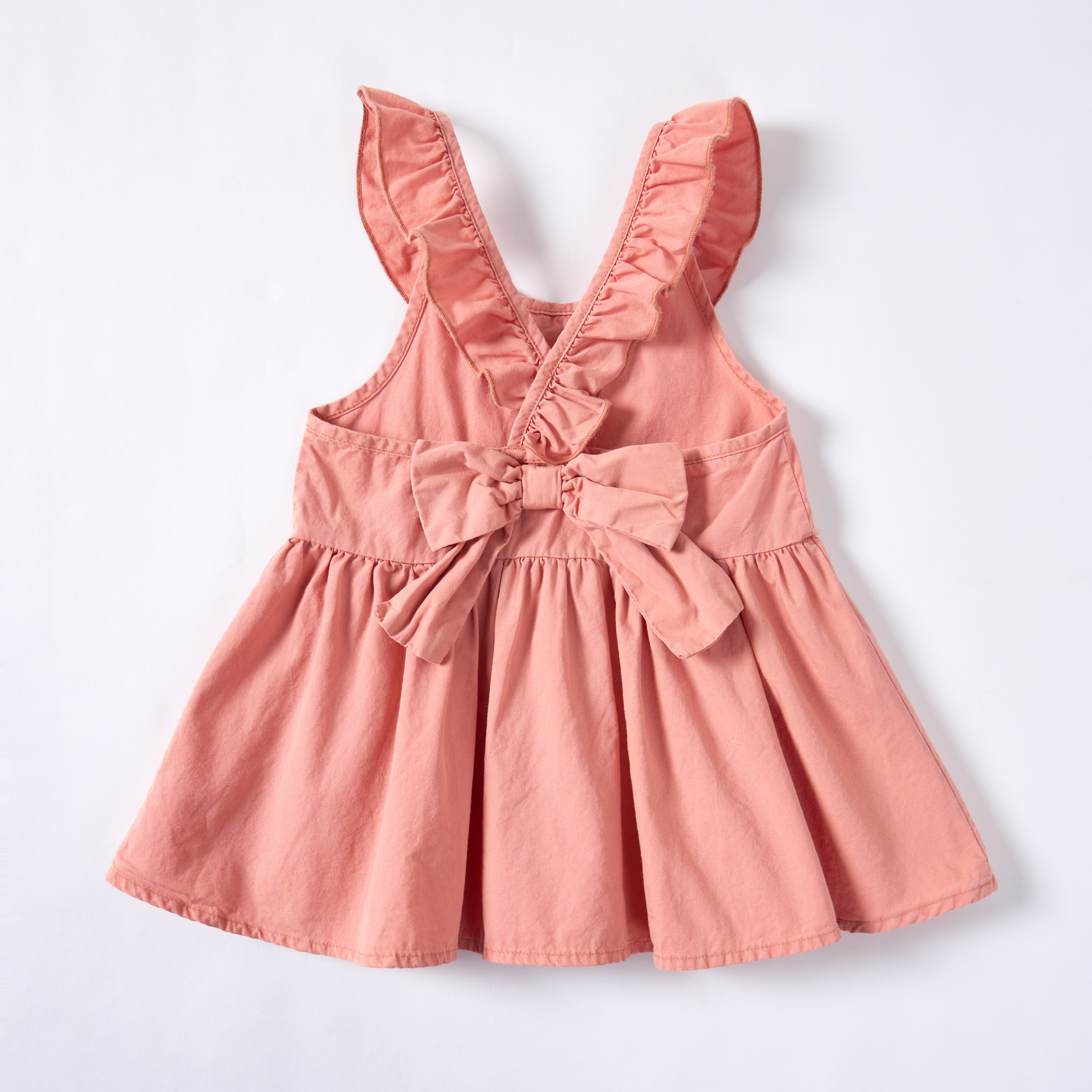
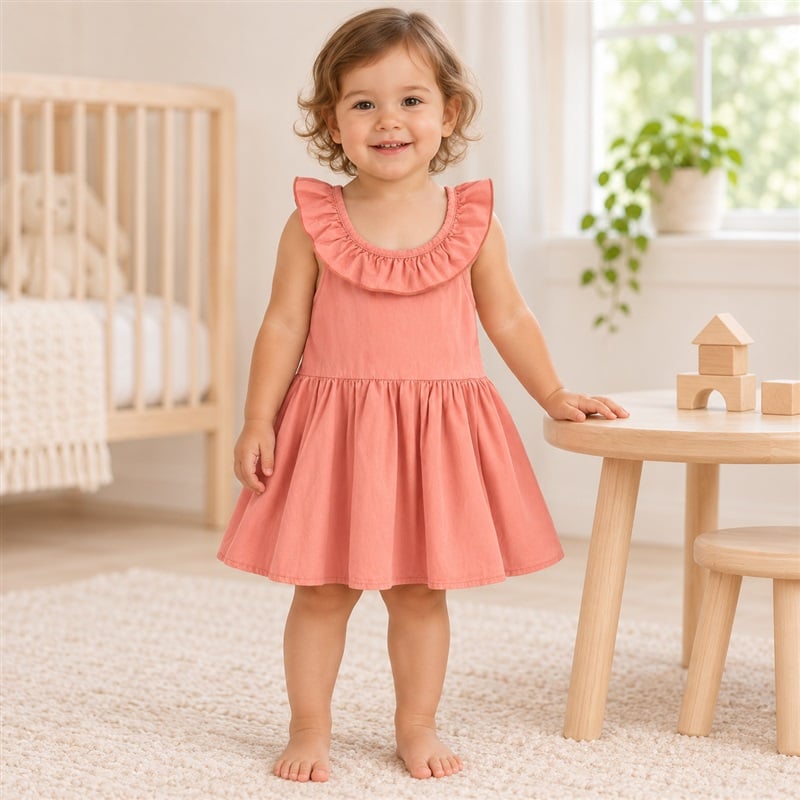
A sleeveless ruffle jumper dress in 125 gsm cotton poplin, plant dyed to a flat coral with sappanwood (苏木), madder (茜草) and pomegranate rind (石榴皮): a gathered ruffle following the neckline and armholes, a back that crosses and closes with one button, a stitched bow at the centre back waist, and a gathered A-line skirt from a waist seam.
The shade is level, which changes what the garment has to prove. On a flat colour there is no pattern to distract from a tonal difference, and this dress is built from four pieces of the same cloth — bodice, skirt, ruffle and bow. So the page is about one question: how the four pieces are kept at one shade, and what happens when they drift.
At a glance
1. The cloth: a flat colour with one texture
- Gathering is the only texture this dress has. On a mottled shade the pattern does the work; here the folds in the skirt and the ruffle are the whole visual event, which is why the gathers are distributed from marked quarters rather than by eye.
- A flat coral is judged across the whole garment, not panel by panel. The eye compares the bodice with the skirt and the ruffle with both, so a difference of half a shade reads as a fault even though each piece on its own would pass.
- 125 gsm holds both jobs at once. The bodice stands away from the chest without a lining and the skirt is light enough that the folds fall; the ruffle uses the same cloth cut on the bias so its roll matches the body.
- A plain weave keeps the tone continuous. No pile and no twill line means there is no directional shading across a panel, so the only tonal variation left is the one the dye put there — and the one the gathers create.
- Where this shade fails, it fails small. A cloud in the middle of a panel, a seam where two rolls met, or a bow that is a shade off: none of them look like a mistake in the photo, and all of them are obvious in the hand.
2. Three plants: one depth, everywhere
- The rind goes on first and evens the ground. Its ellagitannins give the buff the two reds sit on, and on a flat shade that base is what stops the coral reading thin at the folds.
- Sappanwood supplies the rose, madder the warmth, balanced on a strike-off; the pair is the same chemistry as our flat coral without rind, with the tannin layer added underneath.
- The target is one depth across the piece, not a depth per garment. A flat shade is dyed to a single level, so bath load, liquor circulation and dwell are set to keep the middle of the roll at the same depth as the selvedges.
- Depth is built in two draws. One heavy bath on this chemistry deposits unevenly and rinses back; two lighter draws reach the same depth with a flatter result.
- The reference is a sealed dyed sample of the finished cloth, with the tolerance fixed in the sample, and bulk judged under D65 rather than under the factory's own lights.
3. Four pieces, one shade
- Bodice, skirt, ruffle and bow are cut from the same dyed lot. That is the control: marker planning puts the four components inside one roll wherever the order allows, because components from two rolls are where a flat shade fails.
- A second roll is treated as a shade band, not as a match. Where the order needs more cloth than one roll, the new roll is checked against the sealed sample before cutting, and components are not split across the boundary.
- The ruffle and the bow are the parts that show a mismatch first. They sit against the bodice at a seam, which is exactly where a half-shade difference becomes visible; a skirt two shades off is noticed far later than a bow that is one.
- Matching is checked at three points: greige before dyeing (to confirm the roll is one quality), dyed lot against the sealed sample under D65, and cut components side by side on the table before sewing.
- Thread and button follow the cloth, not a colour card. Trim is matched against the dyed poplin, and on a flat coral a button that is a shade warm reads as a different colour rather than as a variation.
4. Levelness: where a flat coral fails
- Cellulose takes tannin unevenly if it is not fully wet out. A dry spot, a folded selvedge or a trapped air pocket becomes a lighter patch that only appears after the colour bath, when the piece can no longer be corrected.
- So wetting out is a step of its own, with cloth relaxed and entered open rather than folded, and load set below the vessel's limit so the middle of the roll takes as much as the edges.
- pH and water are the hue controls. Madder moves orange as a bath acidifies, sappanwood goes straw, and calcium in the water shifts madder toward a deeper, duller pink — so both are specified and logged with the batch.
- The rinse is part of the colour. Unfixed dye and residual tannin come off in the dyeworks, and the wash test runs on the finished dress rather than on a swatch, because the dress is what the customer washes.
- Fastness at the shipped depth: washing to ISO 105-C06 with a repeated-wash shade check, rubbing to ISO 105-X12, light to ISO 105-B02, perspiration and saliva to ISO 105-E04 and the destination market's saliva method.
5. Class I: what the article has to prove
- Class I is the class for articles under 36 months. 6-9M, 9-12M, 12-18M and 24M sit inside it by age; 36M is assessed as Class I because the article can be worn by a child under that age.
- The base fabric holds an OEKO-TEX Standard 100 certificate, and the Class I scope for this poplin, colourway and trim is confirmed against it at quotation, before any claim is published.
- Decoration adds file items, not just design items. Ruffle, bow, button and binding are listed as separate components, each with its own material and attachment test — the ruffle is a second layer against the skin, the bow is a part a baby can reach.
- A flat shade is easier to document and harder to hold. One depth means one fastness result covers the garment, which is why the levelness control sits upstream in the dyehouse rather than in inspection.
- Article items are checked on the finished dress: pH, formaldehyde and extractable heavy metals, with a nickel-release check where metal-touch trim is used.
- The material file carries the weight: rind, root and heartwood are agricultural, so heavy metals, pesticide residues and microbial load are screened at intake with a certificate of analysis per lot.
6. The ruffle and the bow
- The ruffle strip is cut on the bias. At 125 gsm a straight-cut ruffle stands stiffly away from the neck; bias gives the roll that falls, and the roll has to match the body of the dress because it is the same cloth.
- Gather ratio is the design decision. Too little and the ruffle pulls flat on the curve; too much and it ruffles into itself at the armhole, where the curve is tightest, so the ruffle is graded down at the underarm.
- The edge is a rolled hem, the hardest seam in the garment, and it is where a ruffle fails first — waving or twisting — so hem width and press are fixed on the sample.
- The ruffle goes on before the armhole binding is closed, so the gathered edge is enclosed rather than sitting on a finished edge; that is what keeps the inside clean against skin.
- The bow is stitched closed and tacked at four points to the waist seam. Loops are formed and stitched through, tails are short and finished, and the whole shape is tacked so there is nothing to pull loose or catch on a pram buckle.
- Tail length is measured, not eyeballed. A bow at the back of a garment in this age band is the case the children's cord standards address, so the taped end is measured and logged per size against the decorative cord and bow limits of EN 14682.
- It is an attachment rather than a closure, pull-tested as one at the same 70 N figure used for attached trim, with bow, stitching and waist seam assessed as a single unit, and the button checked against 16 CFR 1501 for the US market.
7. Sizes, sampling and quoting
- Five sizes, graded from measurements. 6-9M, 9-12M, 12-18M, 24M and 36M move on body measurements rather than a percentage step, because head and chest grow on a different curve from the waist at this age.
- The back opening, strap position and ruffle length are re-set per size, since the head-girth allowance decides whether the dress goes on and the ruffle has to clear the underarm at every size.
- The straps are the fit. With no sleeves, the strap sits on the shoulder blade and inboard of the armhole, wide enough that it does not roll when a child is lifted — with a ruffle sewn into the armhole beside it.
- The waist is a seam, gathered and topstitched before the bow is tacked over it, and seams run at 12-14 stitches per inch with the ruffle seam and waist seam the two places where that density is checked.
- Customization. Ruffle at the neckline only, or neckline and armholes; ruffle width and gather ratio; crossover back or centre-back placket; bow, flat sash or no decoration; gathered, pleated or plain A-line skirt; lined bodice.
- Sampling: 3-7 days from a confirmed tech pack, including a dyed strike-off, a component match check across bodice, skirt, ruffle and bow, ruffle and bow make-up on the smallest and largest size, the bow tail measurement, a first wash trial, and pull tests on button and bow.
- Bulk: 30-60 days from approval, planned per dyebath; a split delivery is quoted as two batches because the bath is the unit of shade control.
- MOQ: 300 pcs for a custom development — cloth, shade, trim or fit; 50 pcs for a decorative process on a stock body; 100 pcs for stock cloth with your own logo and label. Mixed colour and size orders are quoted per order, and terms are confirmed against the current quotation.
Production runs with our production partner, Suzhou Shelmin Trade Co., Ltd.: founded 2017, 7,200 m² workshop, 8 lines, 200 staff, 6,000 pieces per day. Design confidentiality is held under NDA; buyer patterns, shades and prints are not re-used.
To quote, we need: target market and the Class I tests it requires; whether the bow stays or becomes a flat sash; the shade tolerance you will accept; lot certificates for the three plants; the pH targets; the water specification; button material; packaging; and whether certification runs in your brand name.