EN


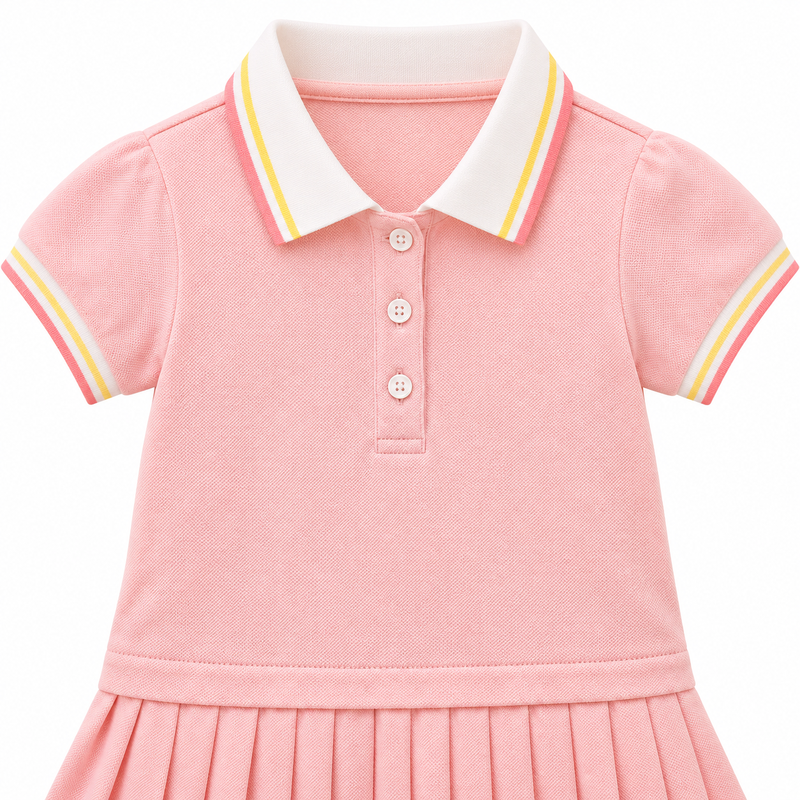
Girls’ Recycled Polyester Pleated Polo Dress with Short Sleeves and Striped Collar | OEM ODM Private Label Children’s Clothing


- Overview
- Kids Recycled Polyester Sports T-Shirt
- Recommended Products
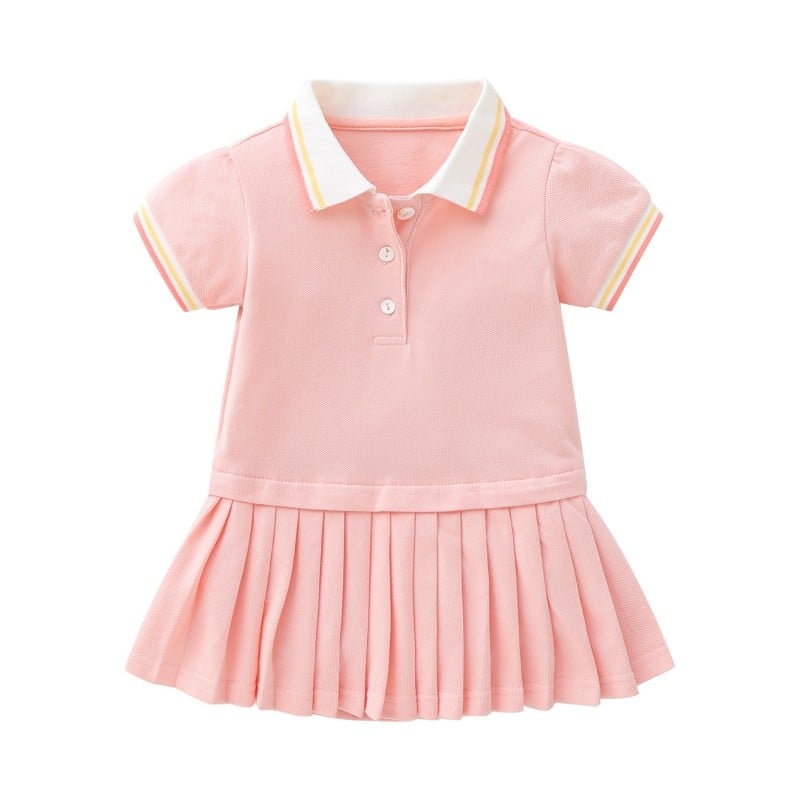
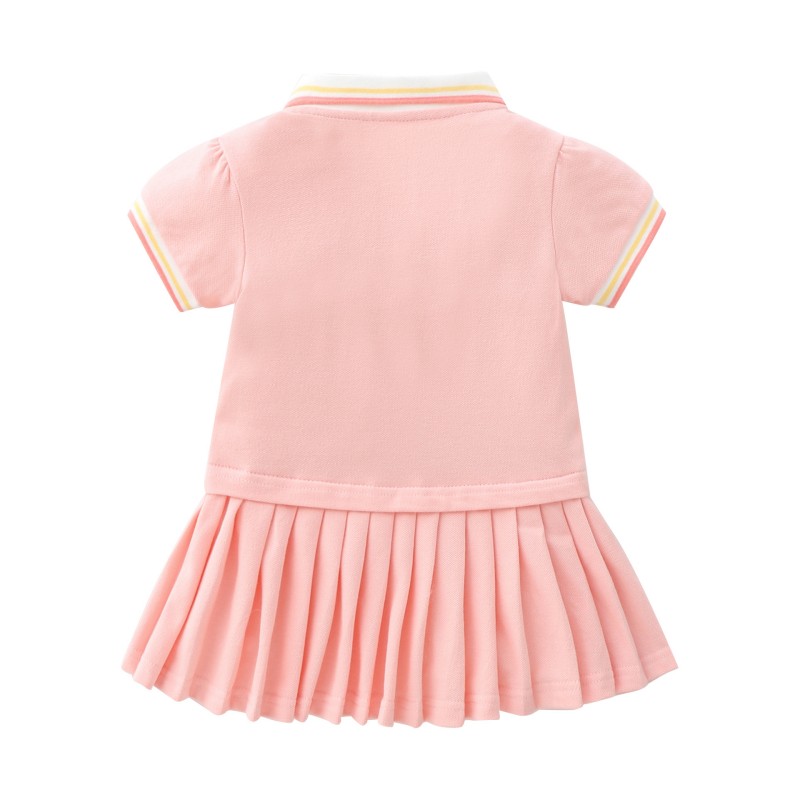
A polo dress in 100% recycled polyester: a piqué bodice with a white collar tipped in yellow and pink, tipped sleeve bands, a two-button placket, and a drop waist seam below which the skirt falls in knife pleats. Pale pink throughout.
This garment is two constructions joined at the waist: a knit that stretches above the seam, a pleated skirt below it whose character depends on the pleats staying where they were set. The collar is a third, a compound edge with a stripe in it; the colour work is a fourth, because four components have to read as one garment on a hanger.
At a glance

1. Fibre: piqué, and why the texture is the point
- rPET is the same polymer from a different feedstock. In a piqué it behaves as polyester: it wicks, dries quickly, holds dimension through washing and does not absorb water into the fibre.
- Piqué is a structure, not a finish. The raised wales and the open cells between them are knitted in, and those cells are why a piqué polo feels cooler than a flat jersey of the same weight: air moves through the structure rather than across a smooth surface.
- The same cells are where the cloth is thinnest. Piqué abrades first at the raised wale, which is why collar edges, plackets and the waist seam look tired first.
- Recovery is what a polo dress depends on. The bodice is pulled over the head and stretches at the placket, so a piqué that relaxes stops returning to shape and the placket gapes; recovery after washing is a specification, not an assumption.
- The percentage is a chain-of-custody claim. GRS covers recycled content with processing controls and chemical limits, RCS covers the recycled content alone, and both run on transaction certificates — so the claim holds only while the certificate names the seller, the article and the percentage.
2. Pleating a knit is not pleating a woven
- Pleats hold differently in a knit. In a knit the loops can shift, so a pleat set into it is softer at the edge and drifts more in wear; a woven of the same fibre takes a sharper crease and keeps it, because there is no loop structure to move.
- If the skirt is the same piqué as the bodice, the pleats are heat-set in a knit and the risk is that they walk — the fold migrates across the panel and the skirt develops a lean after a few washes. That is managed by setting at a firmer temperature and checking pleat position after washing, not by pressing harder.
- If the skirt is a firmer cloth, the colour match between bodice and skirt becomes the harder problem, because two different constructions take dye at different depths and read as two pinks even when the recipe is the same.
- The choice is a cost and a look decision. A piqué skirt keeps the dress reading as one fabric and one price point; a woven skirt holds a crisper pleat, at the cost of a two-cloth colour match and a two-cloth shrinkage match.
- Either way the pleats are set before the waist seam is closed, because setting shrinks the pleated panel and the waist measurement has to be taken after it, not before.
3. The drop-waist seam: the joint that carries the skirt
- The pleated skirt hangs from the bodice. All of its weight, plus the weight of whatever a child puts in it, is carried by one seam, and the knit above that seam will stretch under that load unless it is stabilised.
- So the waist seam is taped or banded. A strip of stable tape or a narrow band is sewn into the seam so the knit cannot extend; without it the bodice droops at the sides, the drop waist sinks, and the pleats hang from a moving line.
- The seam has to be elastic enough not to crack. Stabilising tape must be the soft kind that still gives with the knit; a rigid tape sewn into a knit seam is where the stitch line breaks first.
- The seam is where the two shrinkage rates meet. Bodice and skirt are washed and measured separately before the pattern is released; a waist seam that is right on the sample and puckered after the first wash is the classic failure of this style.
- Gathering or easing at the joint is deliberate. The skirt panel is wider than the bodice at the waist, so it is eased or pleated into the seam; how that fullness is distributed decides whether the pleats start straight down from the seam or fan out from it.
- The seam allowance is pressed down into the skirt, not up into the bodice, so the bulk sits where the pleats already have volume and does not ridge across the stomach.
4. Collar, tipping and placket: three compound edges
- A tipped collar is either knitted in or applied. Knitted-in tipping puts the stripe in the collar structure itself, so the edge stays flat and nothing can shrink away from it; applied tape is cheaper and is where the collar edge puckers, because the tape and the piqué take washing differently.
- The collar has to hold its shape without being stiff. A fusible in the collar gives a clean roll; too much and it stands away from the neck, too little and it flops after two washes, so the interlining is specified by weight.
- The collar is the part that is touched most. It sits against the neck, so the seam that joins collar to bodice is pressed away from the skin and its allowance is trimmed close rather than left to fold.
- The placket is a small garment in itself. It is cut, interfaced, folded and topstitched, and its width has to match the button spacing: a placket narrower than the buttons makes them sit on the edge and pull through under tension.
- Buttons are small parts and are tested as small parts. Retention is checked by pull test at the standard force for the market, together with any shank or thread that holds them; where a metal shank is used, nickel release is added to the test list.
- The placket must not gape. It is the entry point as well as the closure, and on a knit the placket edge stretches as the head passes through, so its length and its button count are set together with the neck opening rather than independently.
5. Colour: four components that have to read as one
- This dress is four colours in one approval: the pink bodice, the pink skirt, the white collar and bands, and the yellow and pink tipping.
- Bodice and skirt are approved as a pair. Two panels of the same pink in the same cloth still differ lot to lot, and on a dress the eye compares them across the waist seam at close range, which is where a mismatch is most visible.
- A narrow stripe shows a shade error differently. On a 4 mm tipping stripe there is no area for the eye to average, so a slight shift reads as "dirty" rather than as "a different pink"; the tipping yarn or tape is therefore approved against the collar, not against the body.
- White next to pink is a fastness question. The collar is where pink dye transfer would show first, and it shows in the wash rather than at the counter, so fastness is tested on the assembled dress.
- Pale pink on piqué reads from the wales. The texture catches light unevenly, so a level dyeing looks slightly deeper in the cells than on the raised wale; approval is taken on the sewn bodice under two light sources rather than on a flat swatch.
6. Size: 2A–8A, and what the block has to hold
- The range steps across two chemical classes. The 2A size is for a child under 36 months and is assessed as Class I; 4A and above is Class II, with the certificate set issued to cover both or the range split into two orders with two limit sets.
- The neck opening is the entry point, through a placket that is only partly open, so the opening is measured on a head form at both ends of the range rather than taken from a standard polo block.
- The drop waist position grades with the body, not with age: a seam at the natural waist at 2A and at the hip at 8A changes the whole proportion, so its position is set as a fraction of the torso at each size.
- Skirt length and pleat depth grade together, so the proportion of bodice to skirt stays constant rather than the skirt growing faster than the child.
- The sample is checked with the arms raised and sitting down, because the drop waist seam and the pleat start are the two places where a polo dress shows a fit fault.
7. Customization, sampling and what we need to quote
- Skirt. Knife pleats as shown; box pleats; a gathered skirt instead of pleated.
- Collar. Tipped collar as shown; a plain white collar; a self-colour collar; a contrast under-collar.
- Placket. Two buttons as shown; three buttons; a concealed placket.
- Sleeve. Tipped band as shown; a plain sleeve; a long sleeve for the older sizes.
- Cloth for the skirt. Same piqué as the bodice; a firmer woven for a crisper pleat.
- Colour. Pale pink with white and yellow tipping as shown; other grounds with all four components approved as a set.
- Packing. Polybag with size sticker; hanger; woven or printed label, satin care label, hangtag.
- Sampling. 3–7 days from a confirmed tech pack, with the pleats set, the waist seam closed and the bodice checked on a head form and a body; wash trials on bodice and skirt separately.
- Bulk lead time. 30–60 days from approval by quantity and dye lot schedule; rush production is quoted per order.
MOQ: 300 pcs for a custom development — custom fabric, colour, collar or fit; 50 pcs for a decorative process added to a stock body; 100 pcs for stock fabric with your own logo and label. Mixed colour and size orders are quoted per order. These are standing programme terms, confirmed against the current quotation.
Production runs with our production partner, Suzhou Shelmin Trade Co., Ltd.: 7,200 m² workshop, 8 lines, 200 staff, 6,000 pieces per day. Design confidentiality is held under NDA; buyer patterns and colourways are not re-used.
To quote, we need: target market; cloth weight for bodice and skirt and whether the skirt is the same piqué; pleat type, width and depth; collar construction — knitted-in or applied tipping; button size and material; placket length; whether a lining or shorts are added under the skirt; packaging; and whether certification runs in your brand name.