EN

Kids’ Recycled Polyester Dinosaur Print Hooded Jacket with Full Zip and Elastic Cuffs | OEM ODM Private Label Children’s Outerwear


- Overview
- Kids’ Recycled Polyester Dinosaur Jacket | OEM ODM
- Recommended Products
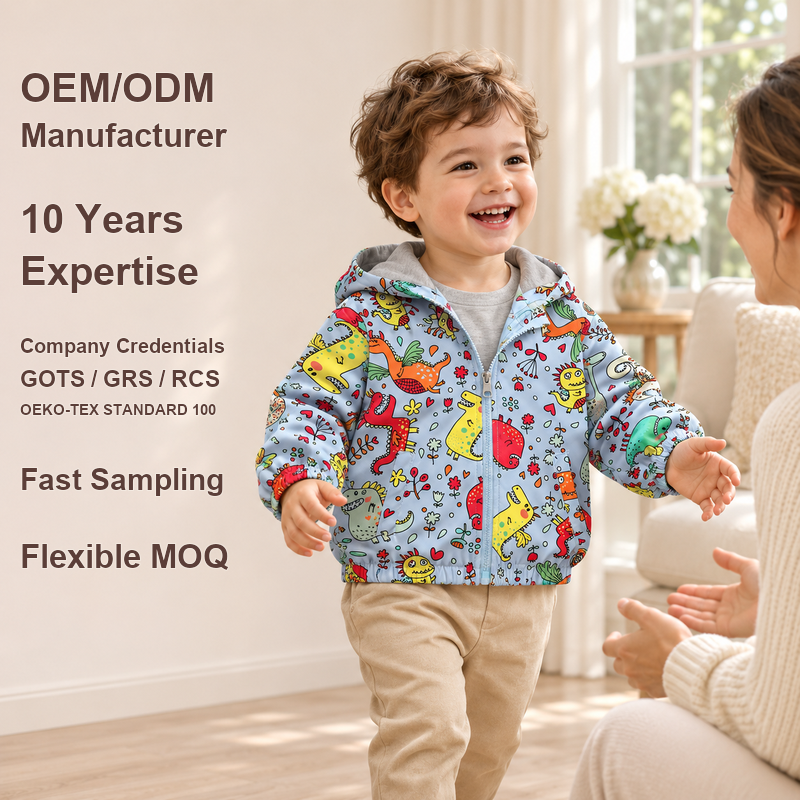
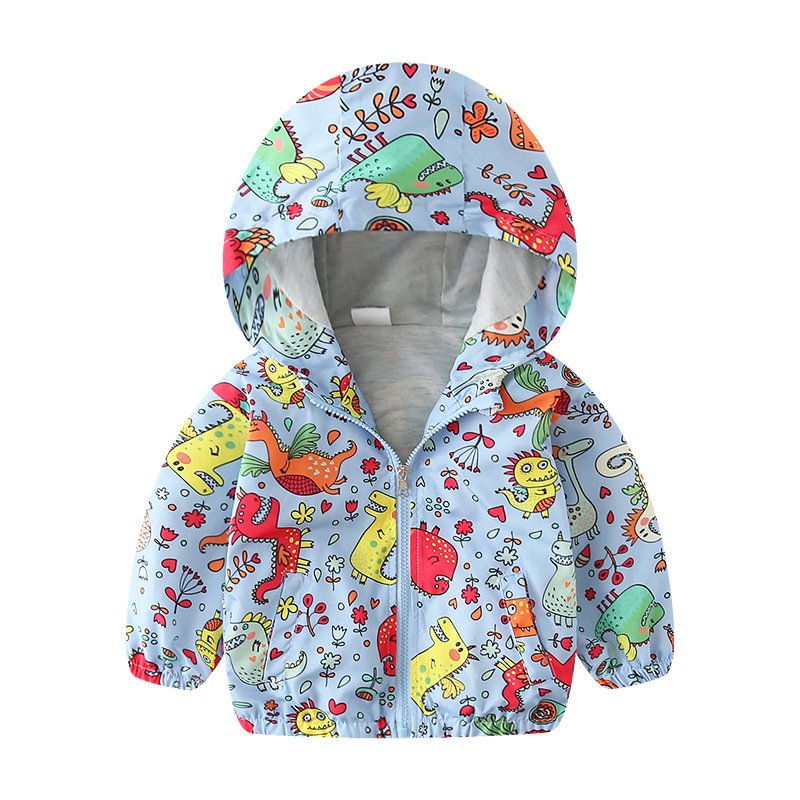
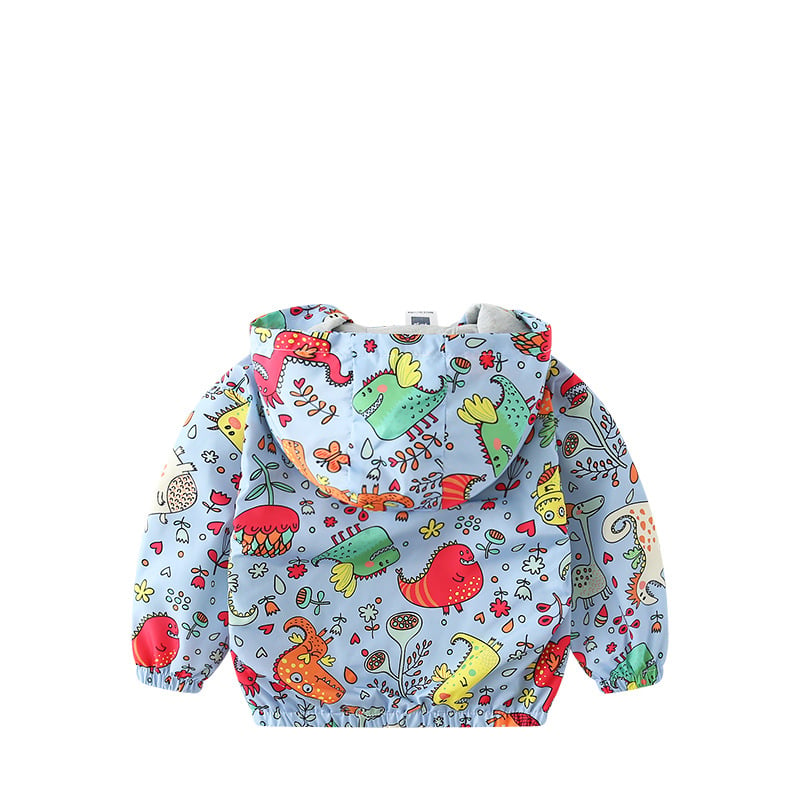
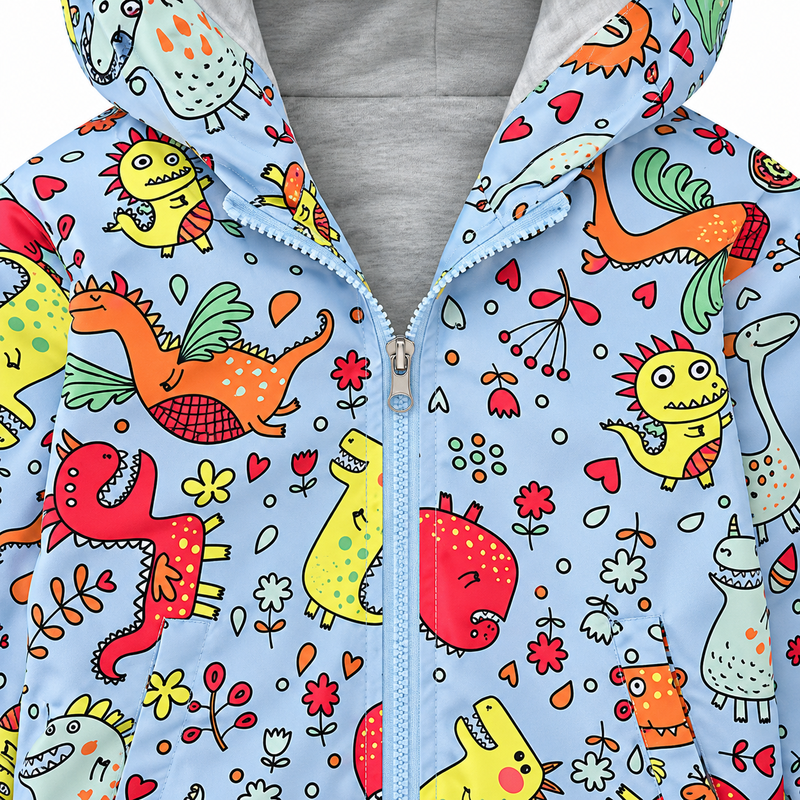
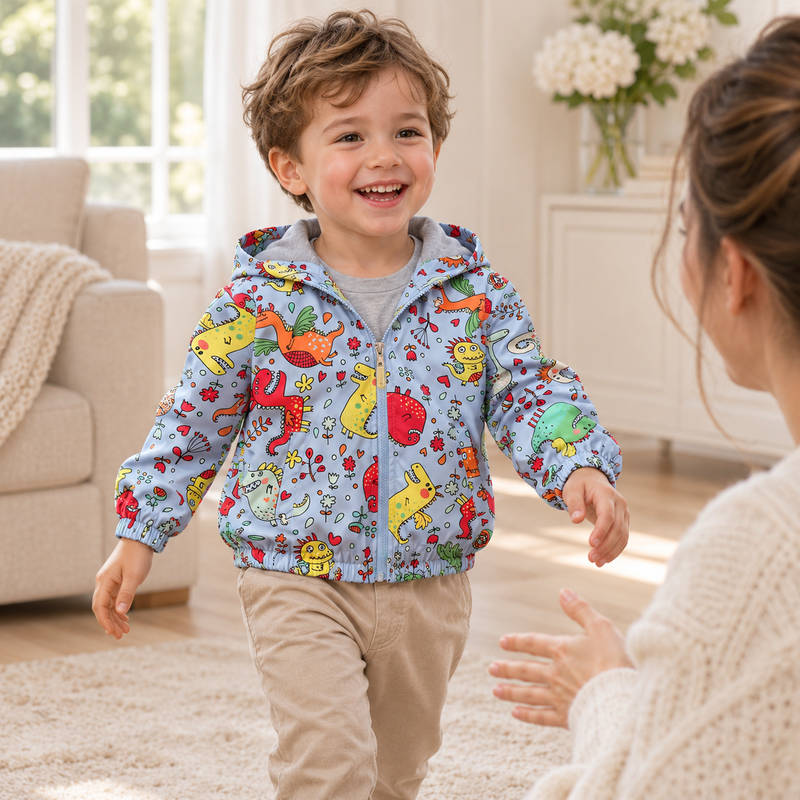
A hooded jacket in a 100% recycled polyester woven, printed all over with dinosaurs, flowers and hearts on a pale blue ground; a grey melange knit lining, a full-length zip and a hood without a drawcord.
On this garment the print is not decoration applied to a product, it is the product. That changes what the cloth can be, what the colour range can be, and — through one mechanism most buyers never ask about — what the lining has to be.
At a glance
1. Fibre: the print decides the fibre
- Sublimation printing needs polyester. The process turns disperse dye into a gas and drives it into the fibre, and it only bonds to polyester; on cotton the dye has nothing to enter and the image washes out. So on a print like this, the recycled polyester is not a preference, it is the requirement.
- rPET is the same polymer from a different feedstock, which is why it takes the same print: the dye enters the fibre the same way, at the same temperature, with the same result.
- The percentage is a chain-of-custody claim. GRS covers recycled content with processing controls and chemical limits, RCS covers the recycled content alone, and both run on transaction certificates — so the claim holds only while the certificate names the seller, the article and the percentage.
- The shell still has to behave as a shell. It needs enough body to hold the hood and the zip line, and enough drape to fall from the shoulder; print quality does not compensate for a cloth that is too soft for the style.
- The lining is a separate decision from the shell. The grey melange knit shown is chosen for hand and for what it does to the print behind it, and its composition is set per order rather than inherited from the shell.
2. How the print is made, and what it cannot do
- The dye goes into the fibre, not onto it. Sublimation prints the design onto transfer paper and drives it into the cloth under heat, so there is no layer on the surface: no hand, no cracking at folds, no plastisol edge lifting after washing.
- That also means the print cannot be felt or peeled, which is the difference a buyer notices first when comparing this to a pigment print at the same price.
- The colour range is narrower than screen printing. Fluorescents and some very saturated oranges are outside what disperse dye reaches on polyester, so a design that relies on a true neon will come back duller than the artwork.
- A pale ground is the hardest ground. On a pale blue like this one, uneven transfer reads as cloudiness rather than as a pattern, so paper, pressure and temperature are controlled and the background is inspected as its own quality item, not as empty space.
- The cloth shrinks under the transfer heat, so cut sizes are corrected for it; a pattern that ignores the shrinkage comes back short in the body and the sleeve after printing.
- Print density varies across a busy design, and that matters where a UV claim is involved: dense dark areas and pale open areas do not transmit alike, so any rating is issued for the garment, not for the artwork.
3. Print and seams: what lines up and what does not
- An all-over print needs no matching. That is its advantage over a placed motif: panels are cut from anywhere on the roll and the garment still reads as one design, which is why AOP is cheaper to cut than a check or a stripe.
- But the left and right front will not align across the zip. They come from different parts of the roll, so the design breaks at the centre; on a busy print nobody sees it, and it is agreed at approval rather than discovered at the inspection.
- A solid zip tape interrupts the print by design. On a printed ground the tape is a deliberate line: white here, but a tape matched to the ground, or a contrast tape, changes the garment's whole reading, so the tape colour is an approval item.
- Seams cut through motifs. Where a seam lands on a face or a dinosaur, the motif loses its edge; seam placement is chosen on the strike-off with the print in view, not on a plain block.
- The hood is the one place where a print is judged up close. It frames the face, so the print density and the lining edge around the face are checked on the finished piece.
4. Dye migration: why the lining is grey
- Sublimation dye can move after it is printed. Disperse dye that has entered the fibre can migrate again under heat and humidity, which is why a printed polyester stored in a hot warehouse is the classic case of a print that passed inspection and arrived shadowed.
- The lining is the surface it would show on. A white or very pale lining under a dense print is where a migrated shade reads as dirt; a grey melange lining absorbs that risk, which is a practical reason for the colour as well as an aesthetic one.
- Storage and shipping conditions are part of the specification. Time, temperature and how the garments are packed are agreed with the buyer, because a print that survives a fast shipment can fail a slow one in a hot season.
- Migration is tested, not assumed. The finished garment is checked after a heat-ageing trial, with the lining inspected against the shell, before a bulk order is released.
- Wash fastness is a different question from migration. Once fixed, a sublimation print holds its colour through washing far better than a surface print; the failure mode to guard against is heat and time, not the laundry.
5. Lining and hand: two cloths with two behaviours
- A knit lining under a woven shell moves differently. The shell has no stretch and the jersey does, so the lining is cut shorter than the shell and with less ease; cut to the same length, it bags below the hem within a few wears.
- The lining is what makes the jacket wearable in heat. A woven shell against skin feels clammy; a knit lining moves moisture off the skin, which is the difference between a jacket a child keeps on and one that comes off in five minutes.
- The lining edge at the hood and the cuffs is the visible finish. It is bagged or turned, and how it is turned decides whether the lining peeks out at the sleeve.
- Lining and shell are washed and measured separately before the pattern is released, because two cloths that shrink differently will show it at the hem and the cuff first.
- No drawcord at the hood, and none needed. Cord rules for children's clothing restrict hood and neck cords, and the hood holds by its cut.
6. Size: 2A–8A, and what the block has to hold
- The range steps across two chemical classes. The 2A size is for a child under 36 months and is assessed as Class I; 4A and above is Class II, with the certificate set issued to cover both or the range split into two orders with two limit sets.
- A jacket is sized over clothes. The block allows for a jumper underneath in the larger sizes, so the chest is graded with that layering in mind rather than as a tee.
- Sleeve length is judged with the arm raised, because the cuff has to stay at the wrist at full reach; this is the dimension that fails first on a child's jacket.
- Body length clears the hip, so the jacket does not ride above the waistband when a child bends.
- The hood opening grades with the head, and the sample is fitted at both ends of the range where hood depth, sleeve reach and hem coverage are judged together.
7. Customization, sampling and what we need to quote
- Print. All-over as shown; a placed motif per size; a chest print on a solid body.
- Print method. Sublimation as shown; a pigment or plastisol print where a neon is essential, with the hand and cracking that come with it.
- Lining. Grey melange knit as shown; a mesh lining; a printed lining.
- Hood. Fixed hood as shown; a higher collar; a fold-away hood.
- Front. Full zip as shown; a half-zip anorak; a press-stud placket for the smallest size.
- Trim. White zip tape as shown; tape matched to the ground; a contrast tape.
- Packing. Polybag with size sticker; hanger; woven or printed label, satin care label, hangtag.
- Sampling. 3–7 days from a confirmed tech pack, with a printed strike-off on the production cloth, a heat-ageing trial on the finished jacket and a wash trial on the lining; print and migration testing is booked separately and added to the schedule.
- Bulk lead time. 30–60 days from approval by quantity and print run; rush production is quoted per order.
MOQ: 300 pcs for a custom development — custom fabric, print, colour or fit; 50 pcs for a decorative process added to a stock body; 100 pcs for stock fabric with your own logo and label. Mixed colour and size orders are quoted per order. These are standing programme terms, confirmed against the current quotation.
Production runs with our production partner, Suzhou Shelmin Trade Co., Ltd.: 7,200 m² workshop, 8 lines, 200 staff, 6,000 pieces per day. Design confidentiality is held under NDA; buyer patterns, prints and colourways are not re-used.
To quote, we need: target market; artwork and whether any colour is a true fluorescent; shell weight and weave; whether the print is sublimation or surface; lining composition and weight; zip tape colour; packing and shipping conditions for the print; and whether certification runs in your brand name.