EN

Kids Organic Cotton 2 Piece Outfit Set, Printed Long Sleeve Top and Pants for Babies and Children | Custom Printed Kids Clothing Manufacturer OEM ODM Private Label


- Overview
- Kids Organic Cotton Printed 2 Piece Outfit Set
- Recommended Products
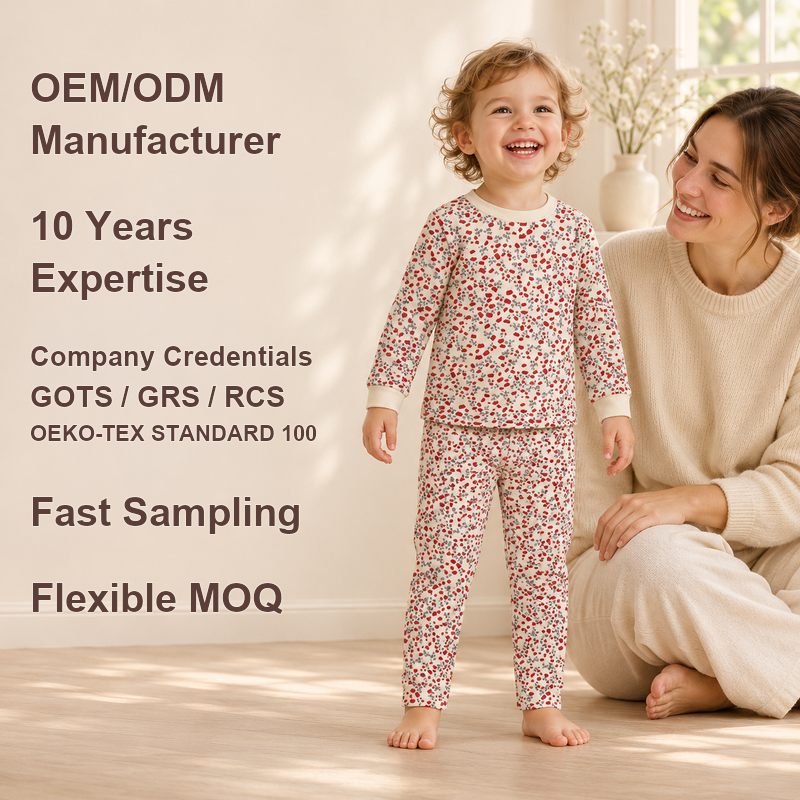
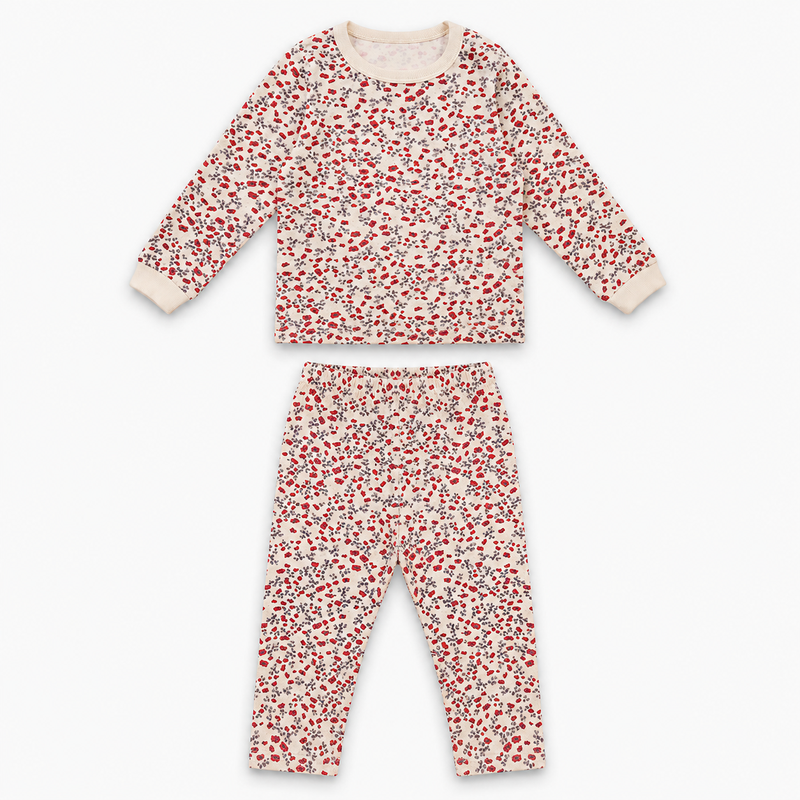
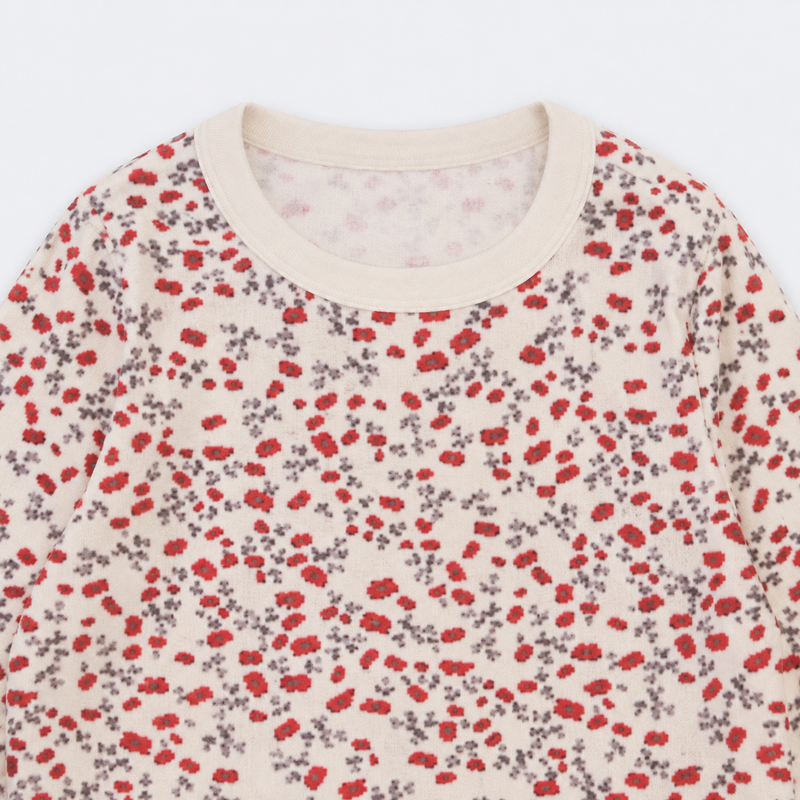
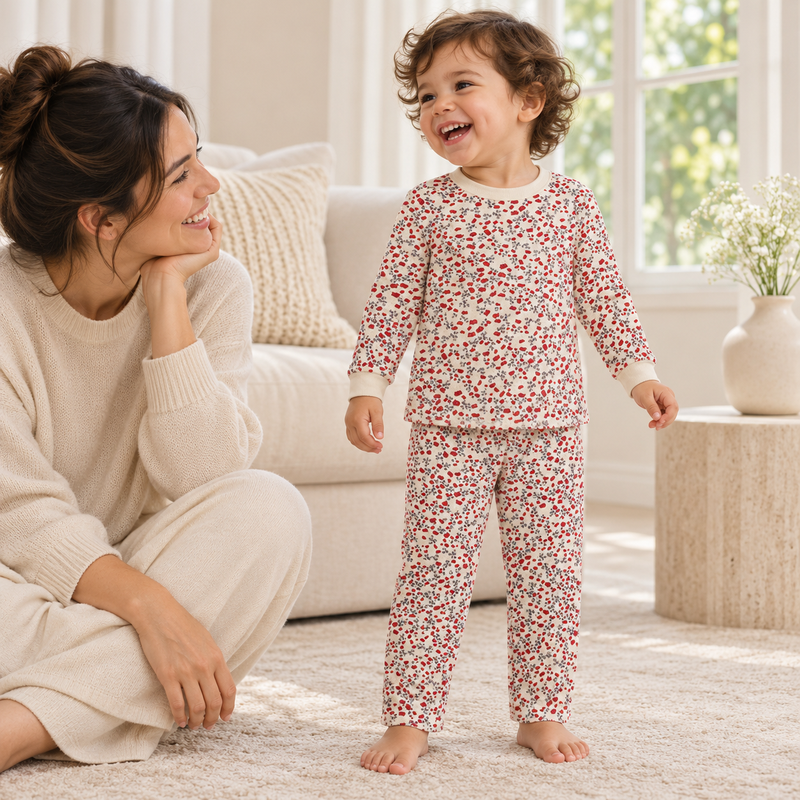
A two-piece set in a cream organic cotton jersey with an allover red ditsy print: a long-sleeve top with a cream rib neckband and cream rib sleeve cuffs, and a straight-leg pant with a covered elastic waist and a plain hem.
At a glance
1. Fibre: organic cotton, and the fabric choice for a set
- Organic is a chain of custody, not a fibre description. GOTS covers the fibre and the processing, OCS covers the content only; the certificate names the trader and the product category. This page quotes organic cotton and makes no certification claim.
- A two-piece set is washed as one garment, so both pieces should be the same substrate. Jersey and interlock print differently and shrink differently; mixing them inside one set is how the top and the bottom stop matching after a month.
- Interlock is the usual choice for a set at this age — smoother face, less edge curl on the neckband and cuffs, and it holds a fine print better than a light jersey.
- Weight is fixed on the tech pack, not left to the mill: a set that is too light will not survive the wash frequency of the first year.
- Cotton shrinks, and each piece has to be measured. Body length, sleeve length and inseam are checked separately on the washed sample; a top that shrinks a centimetre more than its pant reads as a mismatched set.
2. Category: the label decides the test programme
- Sold as nightwear, this garment enters a different regime. In the US, children's sleepwear in sizes 0–6X falls under the sleepwear flammability rules, where the snug-fitting route allows an untreated garment within defined fit criteria and requires specific labelling and testing; in the EU, children's nightwear is assessed for burning behaviour.
- Sold as daywear or loungewear, it is apparel, and the relevant route is the general wearing-apparel flammability test, confirmed per order with the laboratory.
- We hold no flammability report for this article, so no claim is made either way. If the buyer wants a sleepwear programme, it is quoted as a separate development with its own testing and its own label set.
- The decision comes before the label is printed, because the wording on the label and the copy on the listing are what create the obligation. "Sleep", "pyjama" and a bedtime image are the triggers, not the pattern.
3. Size: 6–36M, one class, two garments to grade
- The whole range sits inside Class I. Every size in 6–36M is for a child under 36 months, so there is no class split and no second certificate set — unlike a range that runs from 2A upward.
- The set is graded as a pair. Top length and pant inseam grade together; a set that grades well in the top and short in the leg lands as a mismatched outfit at 30M.
- Sizes are stated by height and weight. In the EU an infant size is a height; in the US the infant market still buys on weight bands. Both appear on the graded spec so the two agree.
- At the small end the head still governs. A 6–12M child's head is large relative to the shoulders, so the neckline clearance is checked on a head form at the smallest size, not scaled by eye from the largest.
4. Construction: neckline, waist and hem
- The neckline is a rib band with no closure, so the band opening has to pass a head. At 6–12M a lap shoulder or a shoulder snap is the practical variant, quoted separately; without one, the band is cut to the widest opening the smallest size will tolerate.
- The rib band's length ratio is the whole tension. Long and the neckline waves, short and it cups and pulls the shoulder line; the ratio is set on the sample and repeated per size.
- Rib cuffs on the sleeve stop the sleeve riding up under a cardigan and give a growing allowance; the cuff is cut with negative ease and pre-shrunk with the body.
- The waist is covered elastic, anchored at the side seams. There is no cord, which is the right answer for a garment up to 36 months; a free-floating elastic twists inside the casing after a few washes, so it is caught at both sides.
- The plain pant hem needs a deeper turn. A straight-leg pant with no cuff is hemmed with an allowance that a parent can let down once; the hem is coverstitched so it extends with the knit.
- Seams and needle control. Four-thread overlock pressed flat, with the seat seam kept flat because it is the one that rubs; 100% needle detection on finished pieces, one-for-one exchange at every break with the machine stopped, work within 2.5 m re-screened twice, needle-free area enclosed, 2 m deep, single entry.
5. Print: one repeat, two garments
- The repeat has to be identical on both pieces, because it is read as one outfit. Two repeats that are close but not the same is the most common way a printed set looks like a mismatched pair on the shelf.
- The ditsy scale is checked on the smallest panel. Small motifs on a 6M top and a long pant leg give different visual densities; the artwork is set so the density still reads the same at both ends of the range.
- The small elements fail first. The berry shape, the stem and the leaf edge are what show when the print is a fraction off register, and they are the details that make a ditsy print look sharp or muddy.
- Red on cream bleeds visibly. Fastness is tested on the finished garment at grade 3-4 or better, including wet rub and washing with white cotton to catch staining; the print on the seat and inner leg is checked where it rubs.
- Strike off on the actual substrate. A print approved on jersey and run on interlock comes back with softer edges and a duller red; the strike-off is done on the fabric that will be cut.
6. Customization scope
- Sizing. 6–36M as quoted; a 3–24M narrowing; a 6–48M extension quoted separately.
- Fabric. Organic cotton jersey; interlock; a 1x1 rib for the cuffs and neckband.
- Top. Crew as shown; a lap shoulder; a shoulder snap; a henley opening.
- Pant. Straight leg with a plain hem as shown; a rib cuff; a footed version; a short leg for summer.
- Print. The ditsy shown; a larger repeat; a placement print; a solid colourway with contrasting rib.
- Packing. The set bagged together; a hanger card; a gift box; a two-pack; woven or printed label, satin care label, hangtag.
MOQ: 300 pcs for a custom development — custom fabric, print, colour or fit; 50 pcs for a decorative process added to a stock body; 100 pcs for stock fabric with your own logo and label. Mixed colour and size orders are quoted per order. These are standing programme terms, confirmed against the current quotation.
7. Sampling, lead times and what we need to quote
- Sampling. 3–7 days from a confirmed tech pack and fabric availability, including a strike-off, a neckband ratio approval and a waist elastic approval. A new print adds a round; rush sampling is quoted at a surcharge.
- Wash the sample before approving it. Per-piece shrinkage, the print on the seat and inner leg, and the elastic recovery inside the casing all appear after one wash.
- Sample cost. USD 30–100 per set, refunded against a bulk order of USD 5,000; development fee USD 50–200, refunded at USD 5,000.
- Bulk lead time. 30–60 days from approval by quantity, print and fabric lead time; rush production is quoted per order.
- Quality standard. AQL 2.5 for major defects and AQL 1.0 for critical; third-party inspection accepted, with print registration, neckband tension, elastic recovery and the Class I marking checked as fit and safety items.
- Payment. New customers 50% deposit and 50% before shipment; repeat customers can move to 30% / 70% against the bill of lading.
Production runs with our production partner, Suzhou Shelmin Trade Co., Ltd.: 7,200 m² workshop, 8 lines, 200 staff, 6,000 pieces per day. Design confidentiality is held under NDA; buyer patterns and colourways are not re-used.
To quote, we need: target market; whether the set is sold as daywear or nightwear, because that decides the test programme; the substrate; the print artwork and colour count; whether a shoulder opening is required at the small sizes; packaging; and whether certification runs in your brand name.