EN

Cotton Kids Zip-Up Sweatshirt & Jogger Set | Plant-Dyed OEM ODM Children’s Clothing Manufacturer


- Overview
- Kids' Plant-Dyed Eco-Chic Sweatsuit Set
- Recommended Products
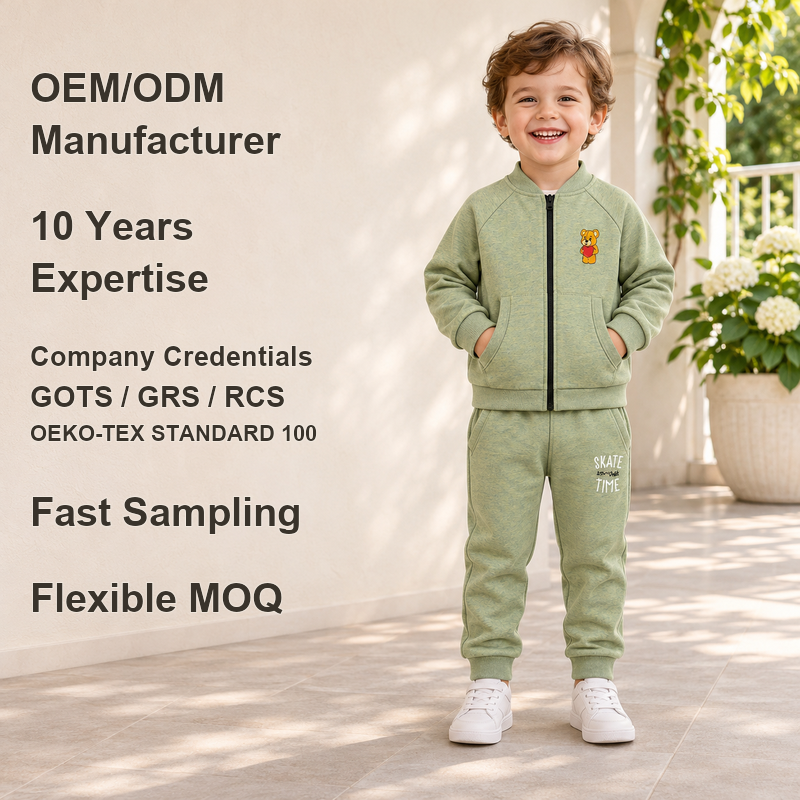
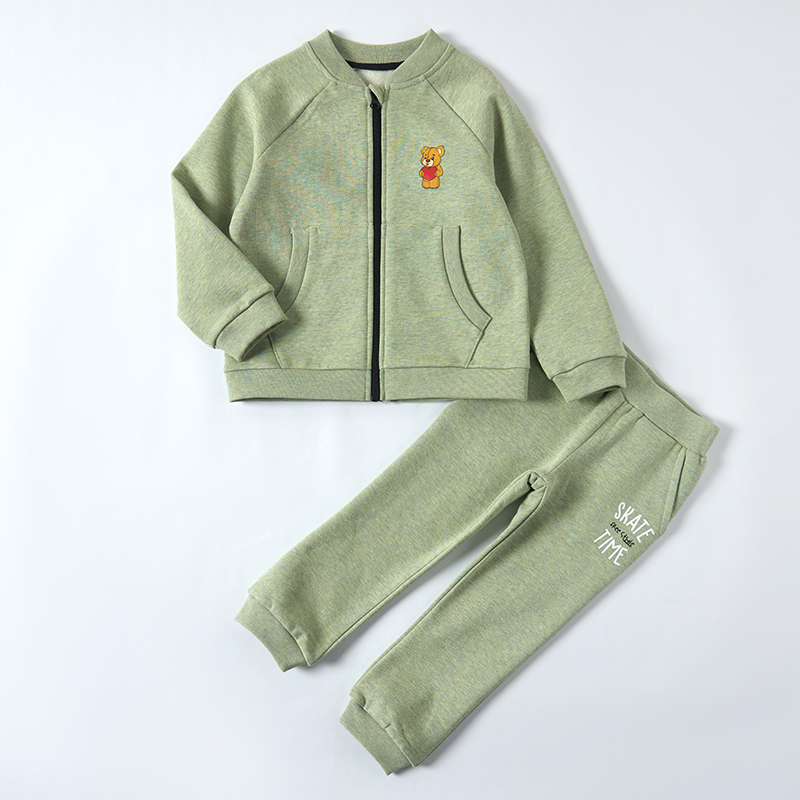
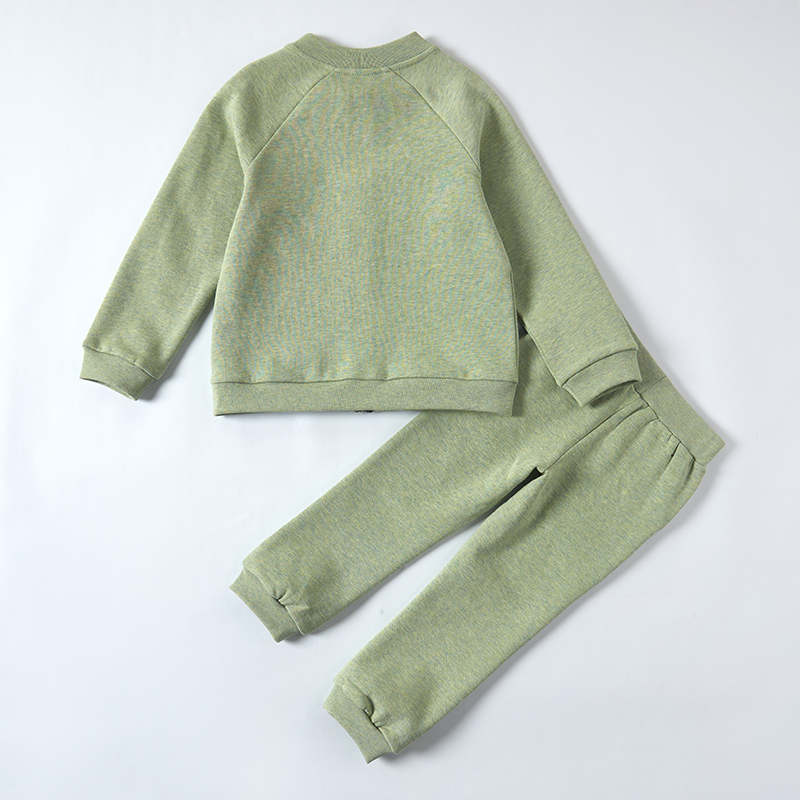
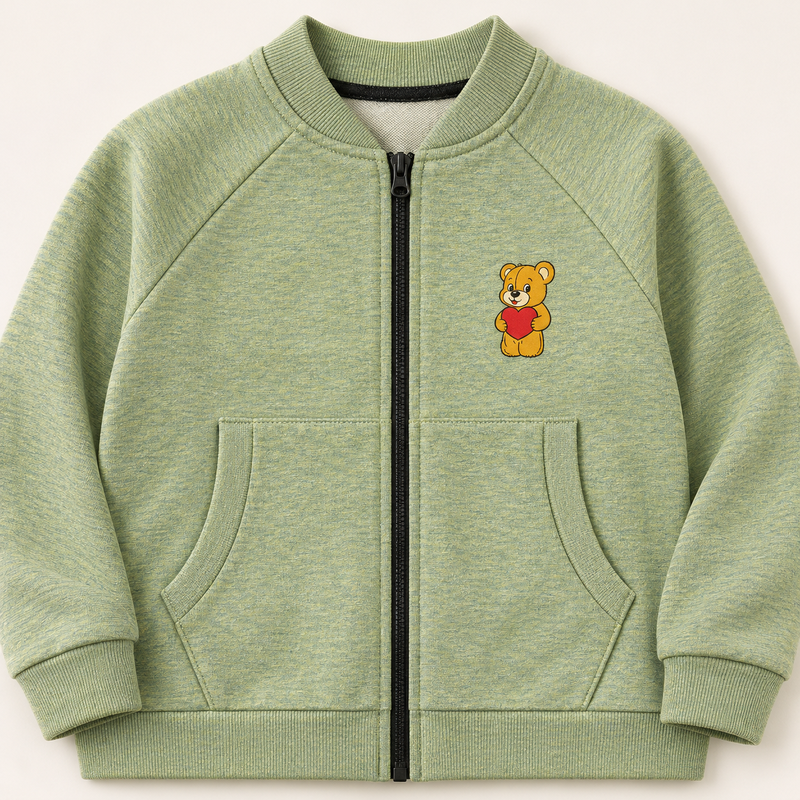
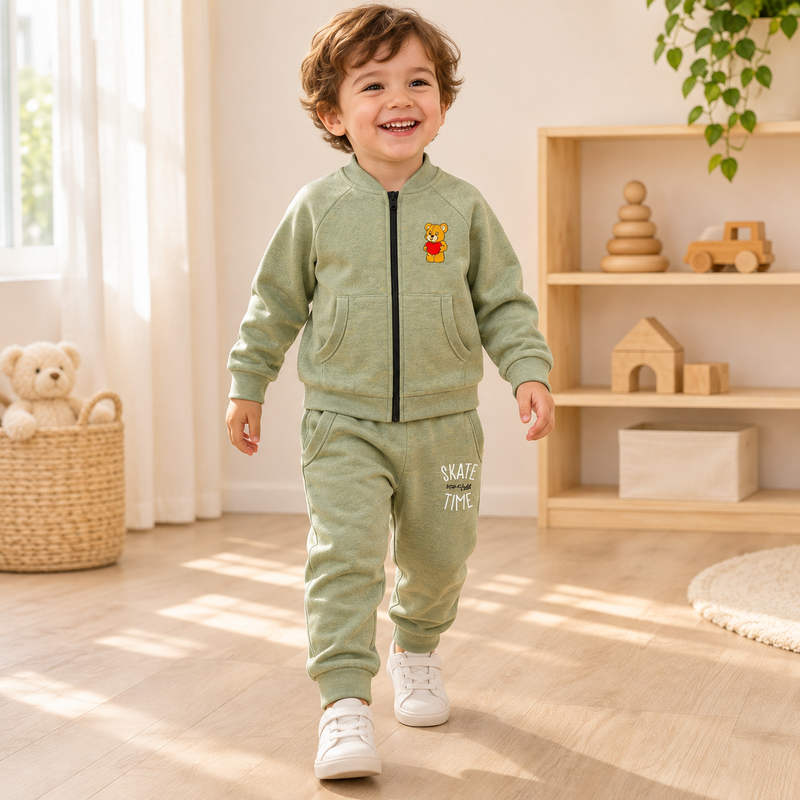
A zip-front jacket and jogger set in 280 gsm brushed cotton flannelette, plant dyed to a sage green with sophora buds and Isatis indigo: a rib stand collar, raglan sleeves, rib cuffs and hem, a black zip, a chest print and a print down one leg.
The jacket and the jogger are cut from the same cloth and they are not the same garment to make. One is a light outer layer that is taken off and put on; the other is worn against a seat, a knee and a floor for a whole day. That difference, plus a black zip this palette cannot produce and pockets cut into a cloth with no body of its own, is what the page is about.
At a glance
1. Same cloth, two wear profiles
- A set is two garments, not one design in two pieces. The jacket is handled at the cuffs and the zip, and it spends most of its life being taken off; the jogger takes weight at the seat, abrasion at the knee and dirt at the cuff.
- So the two are specified differently even on the same roll. Heavier reinforcement at the jogger's seat and knee is unnecessary on the jacket, and the jacket's cuff and hem rib is firmer than the jogger's because it has to hold a shape rather than grip a leg.
- 280 gsm brushed cotton is an outer layer on both. It traps air in the raised pile, so the set is warm without being thick; the jacket is cut with room for a jumper underneath, and the jogger with room for movement at the knee.
- The jogger's knee is the first place to show wear on a brushed cloth, because brushing weakens the surface against abrasion and a knee goes down on the ground many times a day.
- The set is dyed together and cut together, so the two garments read as one colour on a rail; the shade is approved on jacket body and jogger leg side by side.
2. The black zip: black is outside this palette
- Two dyestuffs give this range a narrow palette. Sophora gives yellow, indigo gives blue, and the sequence produces greens; black is not in the range at all, because a true black needs iron and a tannin-rich dyestuff rather than the pair used here.
- So a black zip tape is a deliberate import. It is a synthetic element that could not be dyed in the bath, and choosing it in black rather than matching it declares that rather than hiding it — the tape reads as a design line down a pale ground.
- The alternative is to match the tape to the average of the approved range. That works on a zip that is meant to disappear, and it never disappears completely on a plant-dyed ground, because the ground itself is never flat.
- The tape is set after dyeing and washing, since the bath would attack it and the cloth has to be at its finished shrinkage before the zip is measured in.
- The zip ends at the collar, so the top stop, the collar seam and the zip puller are checked together: that junction is where a zip on a soft cloth pulls away first.
3. The chest motif, and pockets cut into a soft cloth
- A small motif is a placed print, not a repeat. One bear cannot run across the roll, so it is positioned on each front panel per size; on this jacket the zip is the datum it is set from, because the zip is the straight line the eye already follows.
- A flat image on a curved chest distorts at its edges. The motif is placed toward the flatter part of the panel rather than out toward the armhole, where the cloth curves away and the print would stretch.
- A welt is a slit cut across soft cloth. On brushed flannelette the mouth has no body of its own, so it gapes open and ripples after the first wash unless the welt carries a stay or an interlining; that strip is what keeps the pocket reading as a pocket.
- The bag behind the mouth has to be anchored. A pocket bag on a soft front panel swings and pulls the panel out of shape when it is used, so it is secured at the side seam and at the waist rather than only at the mouth.
- The pocket stops short of the hem rib. A bag that reaches the rib doubles the bulk where the rib already grips, and the hem then stands away from the body.
- The two pockets are judged against each other. Welt angle, mouth length and height above the hem are measured on both sides, because a pair on one garment is compared closely.
- Print and cloth are approved together, because a pale ink on a heather sage ground depends on the outline holding, and brushing softens the outline first.
4. The rib collar: a third knit at a third gauge
- The collar is not the body. It is a rib knitted at a different gauge to give it recovery and stand, so it is a third cloth on the garment after the brushed body and the rib cuffs.
- It holds its shape by structure, not by interfacing. A stand collar in a firm rib stands on its own; adding a fusible to a rib collar stiffens the edge and makes it feel like a shirt collar instead.
- It is attached to a brushed body that has more give than the collar, so the neckline seam is where the two rates meet; the collar is set with the body eased rather than stretched, or the collar ripples after the first wash.
- The collar is the part that touches the neck, so its seam is pressed away from the skin and its depth is set so the zip's top stop sits below the chin rather than against it.
- The collar shrinks differently from the body, so it is washed and measured before the neckline is set, and the finished neck is measured on a head form rather than flat.
5. The leg: a vertical word, a pocket and a cuff that bends
- The jogger is the half that gets knelt on. The leg print is set vertically on a panel that flexes at the knee, so it sits above or below the knee and never across the crease, where the word would break into the fold.
- Letters fail differently from a motif. A filled counter in an E or an O closes up first on a brushed ground, and a letter that loses its counter reads as a smudge rather than as a design choice, so the type is tested at the smallest size in the run.
- Letter spacing is fixed on the artwork, not at the machine. A word printed on a stretch knit spreads when the garment is worn, so the spacing is set on the file and checked on the printed panel.
- A print on a brushed leg also rubs. The inside of the print area is checked after washing at the point where the knee bends, because that is where a film lifts first.
- The side pocket is a load point on a soft cloth. A pocket on a brushed jersey-weight flannelette pulls the side seam out of line when it is used, so the bag is anchored at the waistband and the pocket mouth is reinforced.
- The rib cuff is what keeps the leg where it was put. It is specified by width and recovery, and its recovery is checked after washing, because a relaxed cuff lets the leg drop over the shoe.
- The waist is elasticated with no drawcord. Cord rules for children's clothing restrict waist cords at this age, and an elasticated waist removes the need: the jogger holds by recovery and nothing hangs at the front.
6. Size: 2Y–8Y, and what the block has to hold
- The range is Class II throughout. Every size is above 36 months, so the set is assessed as Class II under OEKO-TEX Standard 100, with the certificate covering the dyed cloth, the rib and the prints.
- The jacket is sized over a layer, since it is worn as an outer layer indoors and over a tee outdoors; the chest is graded with that layer in mind.
- Sleeve length is judged with the arm raised, because the rib cuff has to stay at the wrist at full reach — the dimension that fails first on a child's jacket.
- The jogger is sized on the seat and the rise, with the knee placed where the child's knee actually is at each age rather than scaled uniformly.
- The set is fitted as a pair, with the jacket hem and the jogger rise checked together so the two do not fight at the waist.
7. Customization, sampling and what we need to quote
- Set. Zip jacket and jogger as shown; a sweatshirt instead of the jacket; a shorts version of the jogger.
- Zip. Black tape as shown; tape matched to the ground; a metal-look slider where the market allows it.
- Collar. Rib stand collar as shown; a rib crew; a hood.
- Print. Buyer artwork at the chest as standard; a leg print; a woven badge instead of a print.
- Shade. Sage green as shown; a deeper green with more indigo; a yellow-only version with no indigo.
- Packing. Polybag with size sticker; hanger; woven or printed label, satin care label, hangtag.
- Sampling. 3–7 days from a confirmed tech pack, with a dyed strike-off, a crocking check on the indigo, a wash trial on both print areas and a type-legibility check at the smallest size.
- Bulk lead time. 30–60 days from approval by quantity and dyebath schedule; the bath is planned per batch, so a split delivery is quoted as two batches.
MOQ: 300 pcs for a custom development — custom cloth, shade, print or fit; 50 pcs for a decorative process added to a stock body; 100 pcs for stock cloth with your own logo and label. Mixed colour and size orders are quoted per order. These are standing programme terms, confirmed against the current quotation.
Production runs with our production partner, Suzhou Shelmin Trade Co., Ltd.: 7,200 m² workshop, 8 lines, 200 staff, 6,000 pieces per day. Design confidentiality is held under NDA; buyer patterns, shades and prints are not re-used.
To quote, we need: target market and the fastness tests it requires; your artwork for the chest print and whether any colour in it is a true fluorescent; whether the zip tape is black or matched; the rib gauge for the collar; the mordant route for the yellow and the dip count for the indigo; whether the two garments are dyed in one batch; packaging; and whether certification runs in your brand name.