EN

OEM/ODM Tie-Dye 100% Cotton Baby Girl Dress | Eco-Friendly Plant-Dyed Ruffle Toddler Sun Dress | Custom Sustainable Botanical Coral Pink Kids Pinafore | Wholesale Premium Private Label Boutique Children Apparel


- Overview
- OEM/ODM Tie-Dye Plant-Dyed Cotton Ruffle Dress
- Recommended Products
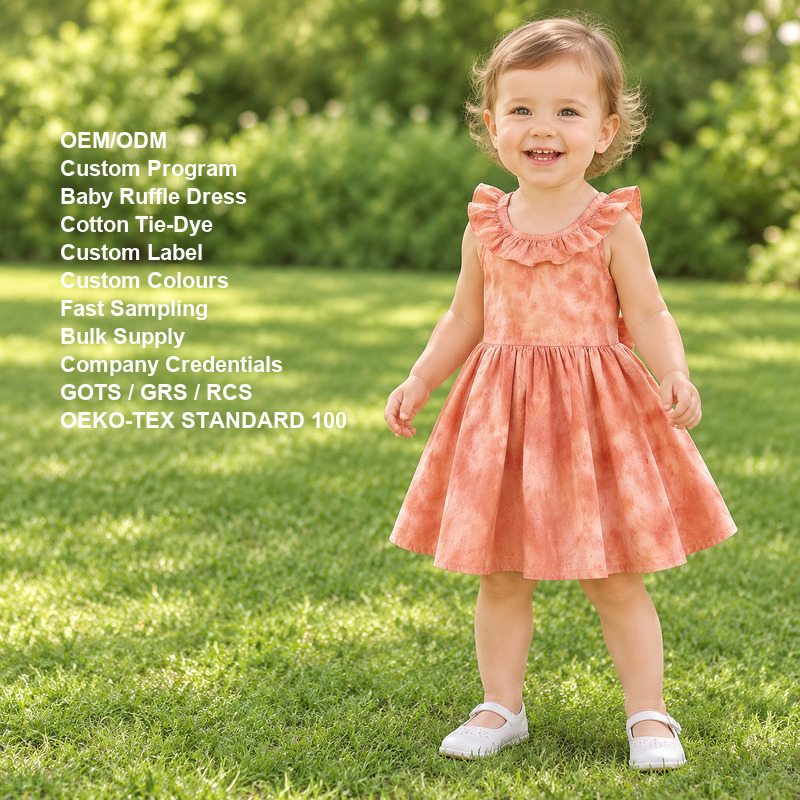
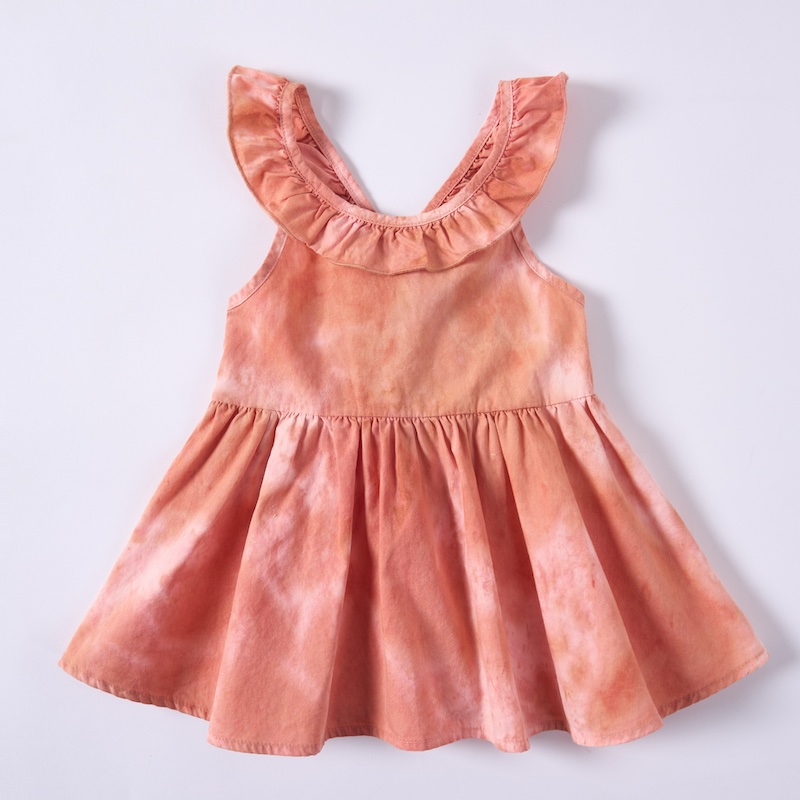
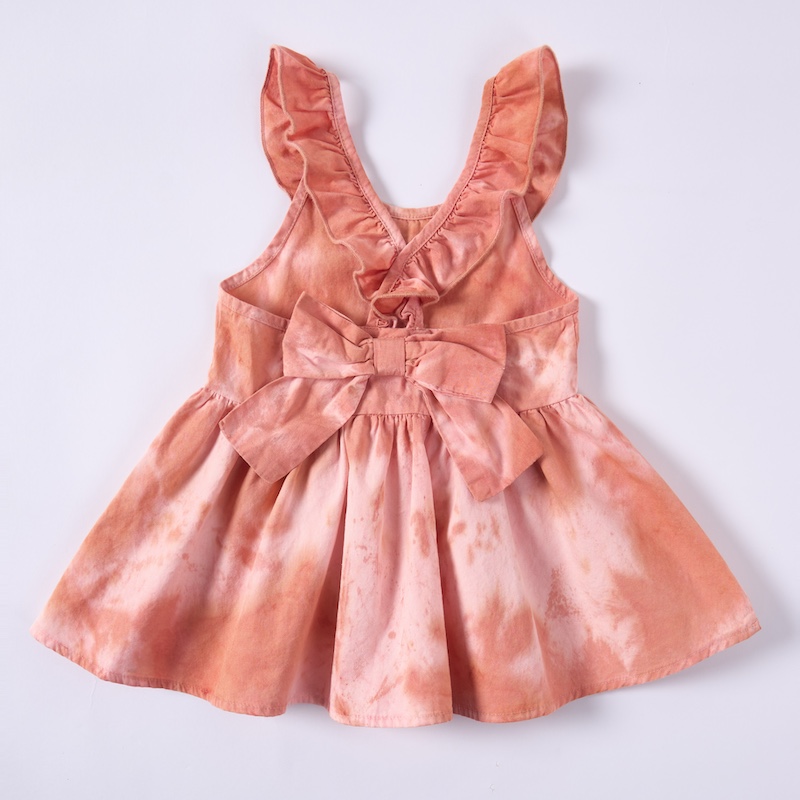
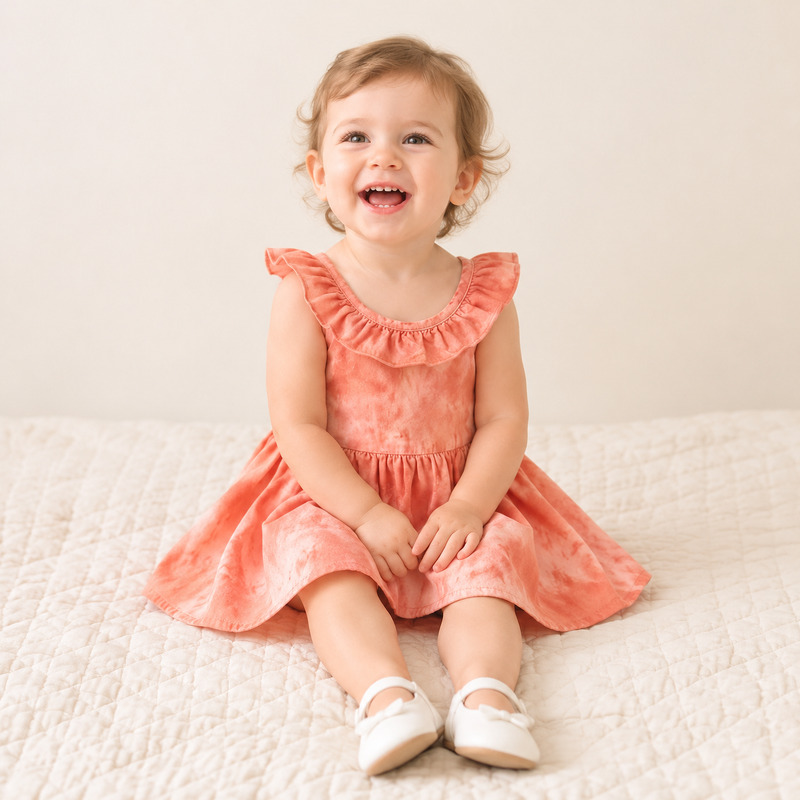
A sleeveless ruffle jumper dress in 125 gsm cotton poplin, plant dyed to a mottled terracotta coral with sappanwood (苏木), madder (茜草) and pomegranate rind (石榴皮): a gathered ruffle following the neckline and armholes, a back that crosses and closes with one button, a stitched bow at the centre back waist, and a gathered A-line skirt from a waist seam.
Two decorative elements change what this garment has to answer for. A ruffle is a second layer of cloth held on a curve, and a bow at the back is exactly the kind of loose-looking decoration the children's cord standards are written about. So the page covers the mottled shade briefly and spends its length on the ruffle, the bow, and the rules each of them brings.
At a glance
1. The shade: two depths, built in the bath
- The mottle is a concentration difference, not a print. Areas held tighter in the fold take more liquor and read deeper; the colour is one recipe at two depths, and there is no registration edge anywhere on the piece.
- Load is set higher than for a flat shade. With two depths in the cloth, the mid tone has to be pushed deeper than the final average suggests, or the dress reads washed out.
- The rind is what keeps the pale passages warm. Its tannin gives the buff the two reds sit on, and when a family runs cold the rind percentage is the first thing adjusted.
- The acceptance rule is unchanged: the mottle follows the fold map, a pale patch with a hard edge is a defect, and a blotch that stops at a seam means the panels were matched badly at cutting.
- Approval is by a family of five pieces, because no two pieces are identical and a single sealed sample would set an unreachable target.
2. The ruffle: a second layer on a curve
- The strip is cut on the bias. At 125 gsm a straight-cut ruffle stands stiffly away from the neck; bias gives a roll that falls, which is the difference between a ruffle that reads soft and one that reads like a frill on a curtain.
- Gather ratio is the whole design decision. Too little and the ruffle pulls flat on the curve; too much and it ruffles into itself at the armhole, where the curve is tightest.
- The edge is a rolled hem, and it is the hardest seam in the garment. A rolled hem on a bias strip at this weight is where a ruffle fails first — it waves, or it twists — so the sample is where the hem width and the press are fixed.
- The ruffle goes on before the armhole binding is closed, so the gathered edge is enclosed rather than sitting on top of a finished edge; that is what keeps the inside clean against a baby's skin.
- It adds a layer where the armhole is smallest. The ruffle is graded down at the underarm so it does not bunch into the armpit when a child is carried, and the strap still has to sit on the shoulder blade with the ruffle in place.
- On a mottled cloth, the ruffle reads as a tonal accent rather than a match. A narrow bias strip has no room to carry the pattern of the bodice, and forcing a match produces a ruffle that looks cut from a different piece; the rule is that the ruffle sits inside the family range, not that it repeats the panel behind it.
3. The bow: a decoration, sewn shut
- The bow is stitched closed and tacked down. Loops are formed and stitched through, and the whole shape is tacked to the waist seam at four points, so there is nothing to pull loose or to catch on a pram buckle.
- Its tails are short and finished, and they are measured. A bow at the back of a garment for this age band is the case the children's cord standards address, so the taped end length is measured and logged per size against the decorative cord and bow limits of EN 14682 rather than left to look right.
- It is an attachment, not a closure, so it is pull-tested as one: the same 70 N figure we work to for attached trim, with the bow, its stitching and the waist seam assessed as a single unit.
- The bow is cut from the same mottled cloth and accepts a different pattern. It will not match the centre back panel, which is normal on this shade and is checked as part of the family rather than against the panel behind it.
- It sits at the waist seam rather than above it, so it covers the gathered seam allowance and does not load the bodice; on a dress this light, a heavy bow placed higher would pull the back out of shape when the child sits.
4. Class I: what the article has to prove
- Class I is the class for articles under 36 months. 6-9M, 9-12M, 12-18M and 24M sit inside it by age; 36M is assessed as Class I because the article can be worn by a child under that age.
- The base fabric holds an OEKO-TEX Standard 100 certificate, and the Class I scope for this poplin, colourway and trim is confirmed against it at quotation, before any claim is published.
- Decoration adds items to the file, not just to the design. Ruffle, bow, button and binding are listed as separate components, each with its own material and attachment test, because a ruffle is a second layer against the skin and a bow is a part a baby can reach.
- A pale passage is still a dyed passage, so fastness is run on the lightest approved passage rather than the deepest: washing to ISO 105-C06 with a repeated-wash check, rubbing to ISO 105-X12, light to ISO 105-B02, perspiration and saliva to ISO 105-E04 and the saliva method the destination market applies.
- Article items are checked on the finished dress: pH, formaldehyde and extractable heavy metals, with a nickel-release check where metal-touch trim is used.
- The material file carries the weight: rind, root and heartwood are agricultural, so heavy metals, pesticide residues and microbial load are screened at intake with a certificate of analysis per lot.
5. Fit: straps, back opening, waist
- The straps are still the fit. With no sleeves, the strap has to sit on the shoulder blade and inboard of the armhole, wide enough that it does not roll when a child is lifted — and it has to do that with a ruffle sewn into the armhole beside it.
- The back opening is sized on head girth. A crossover back with one button passes over the head, so the opening is checked against head girth plus a working allowance on every size, and that allowance places the button.
- The crossover is a fixed overlap, not a tie. Two panels cross and button once; there are no free ends and no cord at the neck or back, which is the first thing the cord standard looks at.
- The waist is a seam. Fit comes from the block rather than from elastic, and the skirt is gathered onto the seam with the allowance pressed down and topstitched before the bow is tacked over it.
- Seams run at 12-14 stitches per inch, with the gathered ruffle seam and the waist seam the two places where that density is checked on the finished piece.
6. Making it: what the decoration costs in time
- The ruffle is the slowest operation in the dress. Bias cutting, rolled hem, gathering to a marked ratio and setting to a curve is four handling steps on one narrow piece, and it is where a run loses time if the strip is cut short.
- The bow is made off the machine and attached at the end, after the waist seam is pressed and topstitched, so it covers the seam allowance cleanly and the tacks land on flat cloth rather than on gathers.
- Pressing order matters more than usual. Ruffle first, on a curved form, then the bodice, then the waist seam; pressing the bodice first flattens the ruffle roll and it never comes back.
- Inspection adds three checks to the standard list: ruffle gather even along its length, ruffle roll not twisted at the underarm, and bow symmetry with the tails level on the finished piece.
- AQL 2.5 for major defects, 1.0 for critical. Needle control: 100% detection on finished pieces; needles exchanged one-for-one at every break with the machine stopped; work in progress within 2.5 m re-screened twice; needle-free area enclosed, at least 2 m deep, single entry.
7. Sizes, customization, sampling and quoting
- Five sizes, graded from measurements. 6-9M, 9-12M, 12-18M, 24M and 36M move on body measurements rather than a percentage step, because head and chest grow on a different curve from the waist at this age.
- The back opening, strap position and ruffle length are re-set per size, since the head-girth allowance decides whether the dress goes on, and the ruffle has to clear the underarm at every size.
- Customization. Ruffle at the neckline only, or neckline and armholes; ruffle width and gather ratio; buttoned crossover back or centre-back placket; bow, flat sash or no decoration; gathered, pleated or plain A-line skirt; lined bodice.
- Shade. Terracotta cloud as shown; a rosier family with more sappanwood; a deeper clay with more rind and a fuller load. Each family is approved on its own five pieces.
- Sampling: 3-7 days from a confirmed tech pack, including the mottled strike-off and family board, a ruffle and bow make-up on the smallest and largest size, the bow tail measurement against the cord limits, a first wash trial, and pull tests on button and bow.
- Bulk: 30-60 days from approval, planned per dyebath and judged batch by batch against the same family board rather than against the previous batch.
- MOQ: 300 pcs for a custom development — cloth, shade, trim or fit; 50 pcs for a decorative process on a stock body; 100 pcs for stock cloth with your own logo and label. Mixed colour and size orders are quoted per order, and terms are confirmed against the current quotation.
Production runs with our production partner, Suzhou Shelmin Trade Co., Ltd.: founded 2017, 7,200 m² workshop, 8 lines, 200 staff, 6,000 pieces per day. Design confidentiality is held under NDA; buyer patterns, shades and prints are not re-used.
To quote, we need: target market and the Class I tests it requires; whether the bow stays or the sash is replaced by a flat band; the accepted tonal range; lot certificates for the three plants; the pH targets; the water specification; button material; packaging; and whether certification runs in your brand name.