EN

OEM/ODM Vintage 100% Cotton Smocked Baby Girl Dress | Eco-Friendly Plant-Dyed Toddler Dress | Custom Sustainable Botanical Ruffle Collar Kids A-Line Dress | Hand-Smocked Boutique Children Apparel Wholesale


- Overview
- OEM/ODM Smocked Plant-Dyed Cotton Girl Dress
- Recommended Products
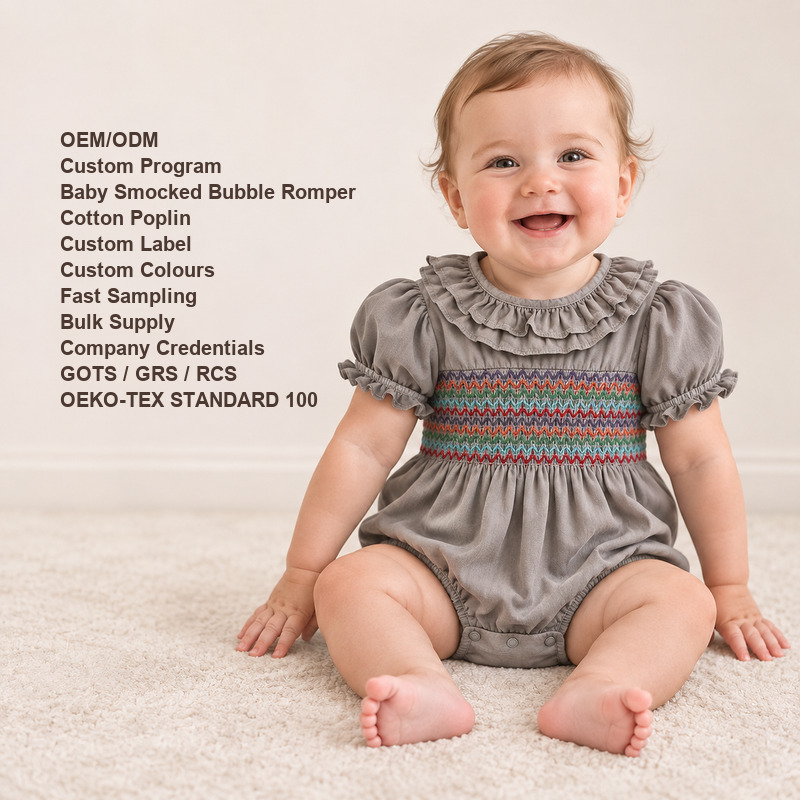
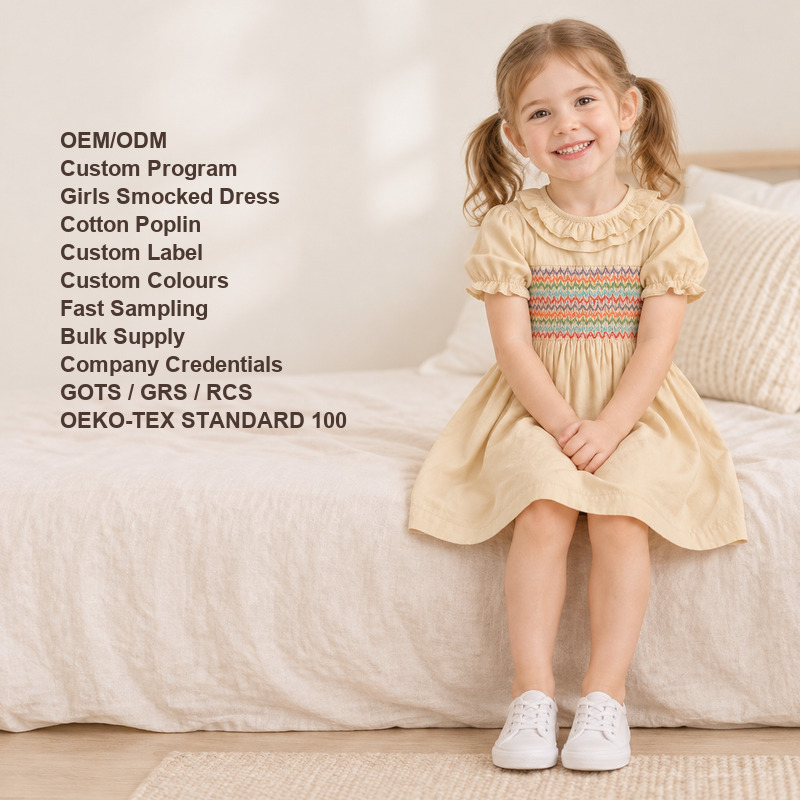
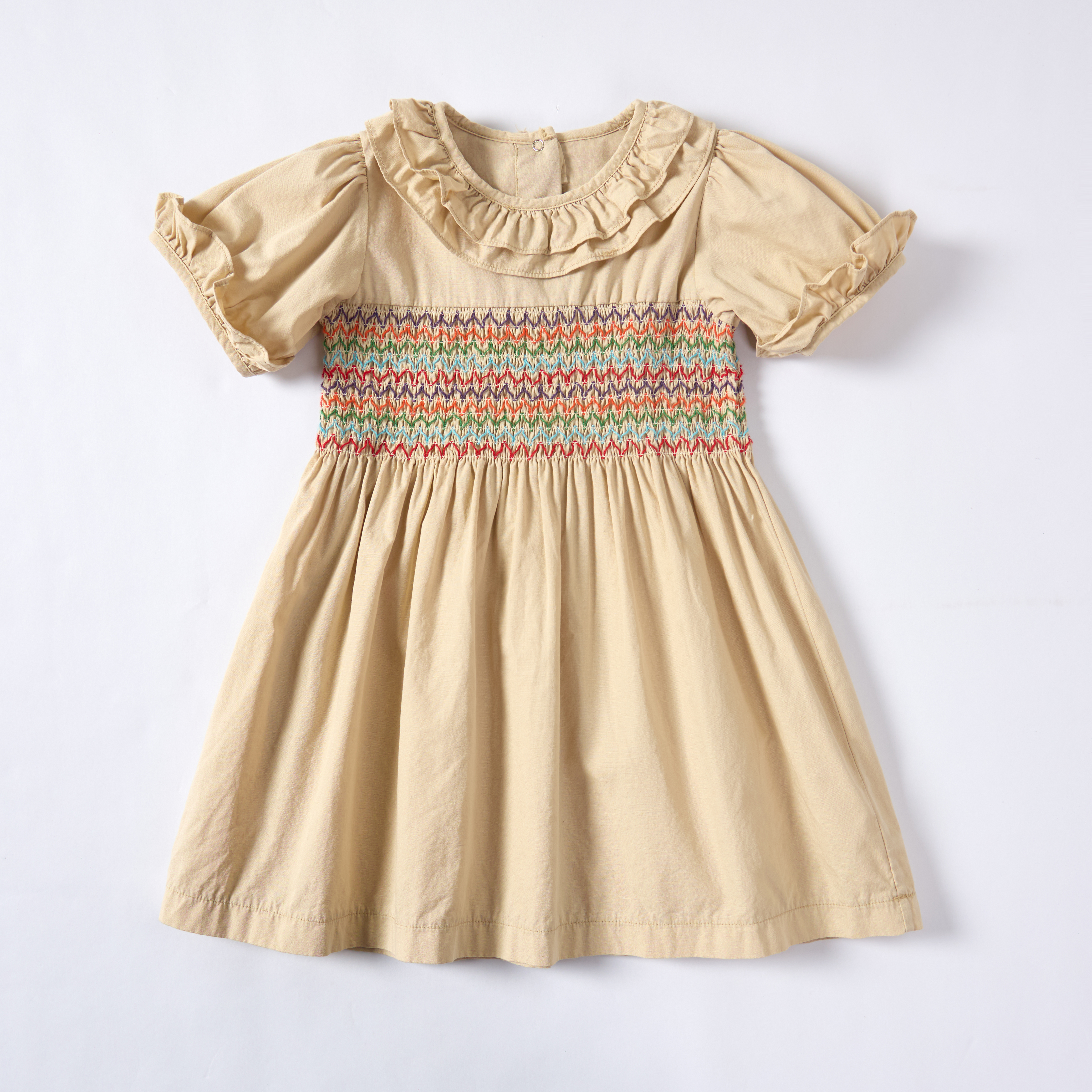
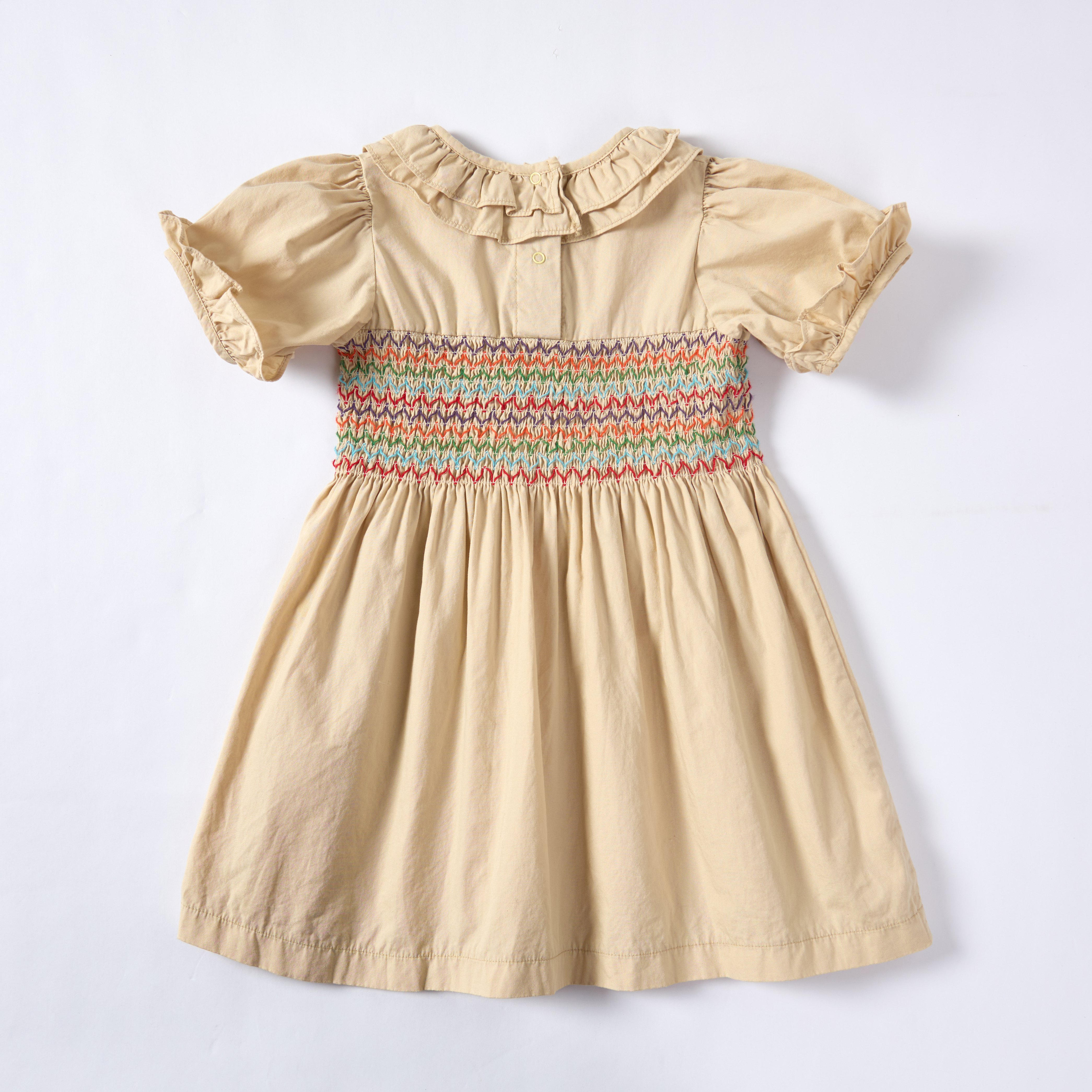
A short-sleeve smocked dress in 125 gsm cotton poplin, plant dyed to a warm sand with sappanwood (苏木) and pomegranate rind (石榴皮) alone: a double ruffle collar, puff sleeves gathered into a ruffle cuff, a smocked bodice worked in rows of wave stitch, a short back placket with one button, and a gathered skirt hung from the smocked panel.
Two points shape everything below. In this recipe the rind is not a pre-treatment that is rinsed away — it is half the colour, and it is the only thing holding the sappanwood to the cotton, because no metal mordant is added. And because both dyes come from the same bath, hue and depth are not independent: what adjusts one moves the other.
At a glance

1. Two plants, one bath, and the pH between them
- The rind does two jobs at once. Its ellagitannins give the buff the whole shade sits on, and they are also the tannin layer the sappanwood bonds to. On cotton, without a metal mordant, that double role is what makes a two-plant recipe possible at all.
- Sappanwood is the variable, and it is pH that steers it. Brazilin reads yellow-tan on the acid side and shifts red to mauve as the bath moves alkaline. So a warmer shade is pushed by lowering pH, not by adding a third dyestuff — and every half point of pH is visible on a pale ground.
- Depth and hue cannot be moved separately. More rind gives a deeper, more yellow cloth, against which the same sappanwood reads cooler. The recipe is therefore fixed as a ratio and a pH window, not as two independent doses.
- Water is a recipe ingredient. Hardness and iron content shift both the rind extraction and the final hue, so the dyehouse works to a stated water specification and a water change is treated as a recipe change.
- The bath ends at the garment, not the bath. Finished pH is measured on the dress and brought back into the 4.0-7.5 range before packing, which is the band that suits an article worn against infant skin.
2. Dyed in the piece, before the pleats are set
- Cloth is dyed, then cut. Smocking is worked on finished, cut panels, so shade has to be closed first: re-dyeing after the pleats are set means re-doing the pleats, and the panel never returns to the same width.
- Shrinkage is resolved on the dyed lot. Wet processing moves a poplin, and a panel that continues to shrink after smocking tightens the entry to the dress. Dyed lots are measured against the greige length before the cutting table sees them.
- One bath, one shade, one size run. An order split across two baths is two shades on a ground this pale, so production is planned per bath and per thread lot; a split shipment is quoted as two batches rather than promised as one colour.
- The standard is a sealed piece of finished cloth. Re-orders are matched to the retained standard under D65, not to the previous shipment, which is what stops a shade from drifting across seasons.
- Shade is read at the panel, not the roll. Selvedge-to-selvedge variation shows first where panels are cut narrow and paired, so panels are cut in pairs from the same position across the width.
3. The smocked panel is the opening
- Gather ratio is sized against a head, not a waist. The panel is gathered to roughly two and a half to three times its finished width, and the ratio is set per size against the head circumference of that size with clearance: the smaller the size, the more of the total stretch the entry consumes.
- Rows are counted and pitched, not estimated. Wave stitch is worked over pre-gathered cloth in a fixed number of rows at a fixed pitch, locked at both ends, so the panel behaves as one elastic unit rather than a series of separate bands.
- Rectangularity is a fit dimension. Rows that drift, or gathering that varies across the width, pull the panel into a trapezoid and the skirt hangs off-centre; width is checked at three points per panel.
- The panel-to-skirt join takes the load. That seam carries the whole skirt and sits under continuous tension, so it is specified with a reinforcing stitch and checked for puckering on every garment.
- Recovery is the acceptance test. The panel is stretched and released on the sample and again after five washes; a panel that stays stretched is a dressing failure, and it is rejected at that stage rather than at the fitting.
4. Two ruffles, two different behaviours
- The collar ruffle runs on a curve. Its gather is distributed along a shorter arc than a skirt hem at a lower ratio; pushed further it stands at the centre front instead of lying flat, which is the usual failure on a double-tier collar.
- A second tier is cut narrower for a reason. At 125 gsm, two layers of poplin plus a neckline seam is already bulk at the centre back, so the upper tier is reduced and the neckline seam is pressed open and graded rather than left bulky.
- The cuff ruffle is cut on the bias so it rolls. Poplin on the bias has little stretch of its own, so the roll comes from the cut and the hem width, not from elastic; cuff band width, and whether the band carries elastic, is fixed in the tech pack because it changes the finished sleeve length.
- Sleeve head gather is set in two passes. A tight plain weave resists easing, and a single pass leaves a pleat where the gather was pushed; the head is distributed against the armhole in two runs and checked for a flat cap.
- Ruffle hems are narrow and unforgiving. A narrow turned hem on this weight shows its stitching if tension drifts, so hem width and needle size are specified per ruffle and checked as a pair — collar against cuff — on the same garment.
5. What the plant dye does not cover
- The ground is plant dyed; the smocking is not. Five saturated tones across the bodice come from conventional dyed threads. The plant-dyed element is the ground cloth, and the page describes it that way.
- Thread is a skin-contact component. It runs across the whole bodice, so it is specified and tested to the same restricted-substance limits as the cloth, with a supplier declaration held per lot.
- Colour is approved on the dyed cloth, not on a card. A warm sand changes how a red or a green reads, so the five-tone palette is signed off against the actual dyed panel, and thread count per row is fixed because a heavier thread covers more of the plant-dyed ground.
- The button is a small part and is tested as one. One button on the back placket at 70 N retention, checked against 16 CFR 1501 for the US market, with the button's own material and finish declared.
- The 100% cotton claim describes the shell. Threads, button and fusible are declared separately in the fibre content and on the care label, per the destination market's labelling rule.
6. Light, wash, and the two ways a pale ground fails
- Sappanwood fades toward ochre, not toward grey. Brazilin is light-sensitive, and the honest expectation on a pale ground is a gradual shift to a paler tan; light fastness is run to ISO 105-B02 at the shipped depth so the direction and extent of that shift are known before a colour is approved.
- The second failure is a halo from the thread. A saturated thread against a pale warm ground can crock or bleed, and the mark it leaves is permanent.
- So the panel is tested as built: rubbing to ISO 105-X12 in both directions across the smocked area, washing to ISO 105-C06 with the panel included in the load, and a bleed comparison of washed against unwashed panel for halo on the ground.
- Washing is done on the finished dress. The risk depends on how tightly the thread sits against the cloth, which only exists once the rows are worked, so a swatch result does not stand in for it.
- Ground-cloth fastness runs in the same pass: perspiration and saliva to ISO 105-E04 plus the destination market's saliva method, pH on the garment, and a phenol-yellowing check to ISO 105-X18 because pale plant-dyed shades are the ones that yellow in storage — which is why packaging is specified free of BHT.
7. Sizes, sampling and quoting
- Five sizes, graded on body measurements. 6-9M, 9-12M, 12-18M, 24M and 36M move on measured chest, length and head size rather than a percentage step, and the smocked panel is re-set per size because stretch does not grade like a seam.
- Customization. Double or single ruffle collar; plain neckline; smocking row count and stitch pattern; thread palette from one tone to five; puff sleeve, plain short sleeve or sleeveless; one or two buttons; gathered, pleated or plain skirt; a deeper tan with more rind.
- Shades within the two-plant recipe. A paler buff with less sappanwood; a warmer sand at the acid end of the pH window; a deeper tan with more rind at the same pH. Each is sampled at its own depth, and the thread palette is approved on that cloth.
- Sampling: 3-7 days from a confirmed tech pack, covering a dyed strike-off against the retained standard, one smocked panel in the agreed palette, a stretch-and-recovery check before and after five washes, crock and bleed on the smocked area, a button pull test, and a fit check on the smallest and largest size.
- Bulk: 30-60 days from approval, planned per dyebath and per thread lot, with the dyed lot released only after shrinkage, pH and fastness results are in hand.
- MOQ: 300 pcs for a custom development covering cloth, shade, smocking, trim or fit; 50 pcs for a decorative process on a stock body; 100 pcs for stock cloth with your own logo and label. Mixed colour and size orders are quoted per order, and terms are confirmed against the current quotation.
Production runs with our production partner, Suzhou Shelmin Trade Co., Ltd.: founded 2017, 7,200 m² workshop, 8 lines, 200 staff, 6,000 pieces per day. Design confidentiality is held under NDA; buyer patterns, shades and prints are not re-used.
To quote, we need: target market and the Class I tests it requires; the shade target — paler, warmer or deeper — and whether the sealed standard travels with the order; the thread palette and count; smocking row count and stitch; lot certificates for both plants and for the thread; the pH target and the water specification; packaging, including the BHT question; and whether certification is to run in your brand name.