EN

OEM/ODM Tie-Dye 100% Cotton Kids Zip Hoodie | Eco-Friendly Plant-Dyed 290gsm French Terry Children Jacket | Custom Sustainable Botanical Coral Pink Toddler Sweatshirt | Wholesale Private Label Boutique Outerwear


- Overview
- OEM/ODM 290gsm Plant-Dyed Cotton Kids Zip Hoodie
- Recommended Products
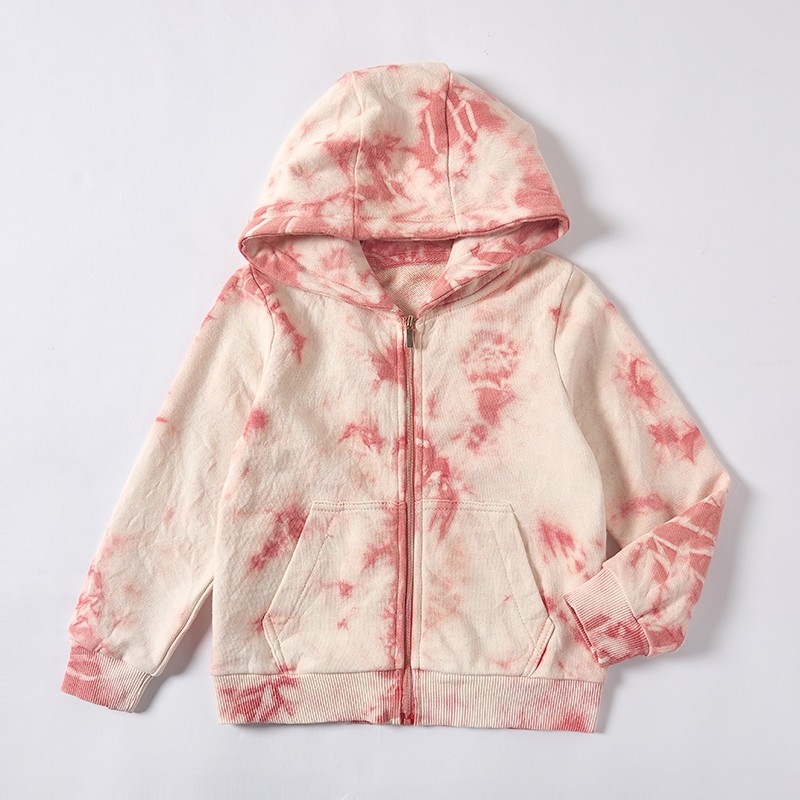
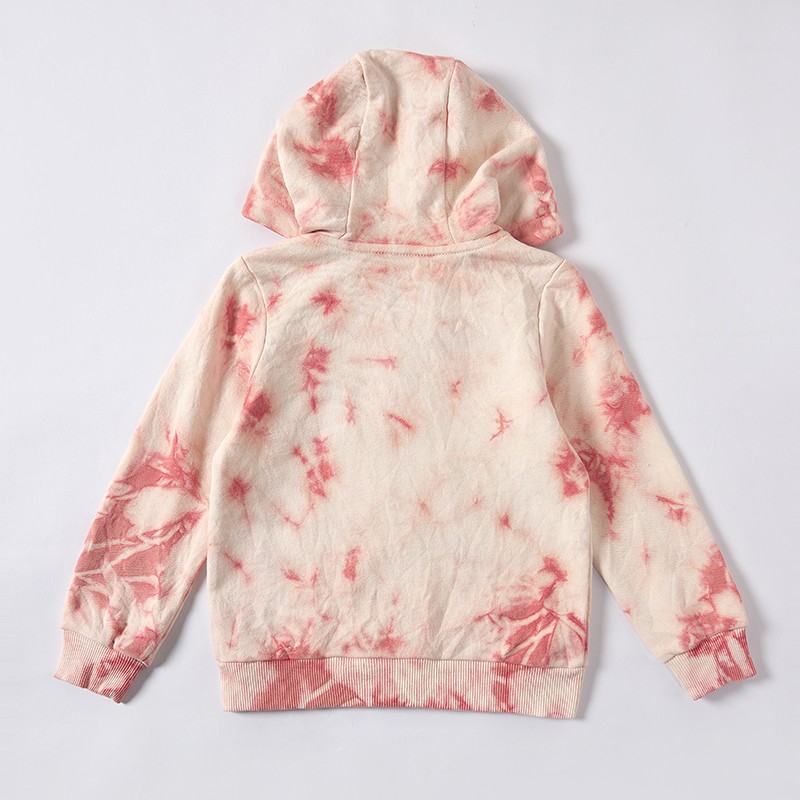
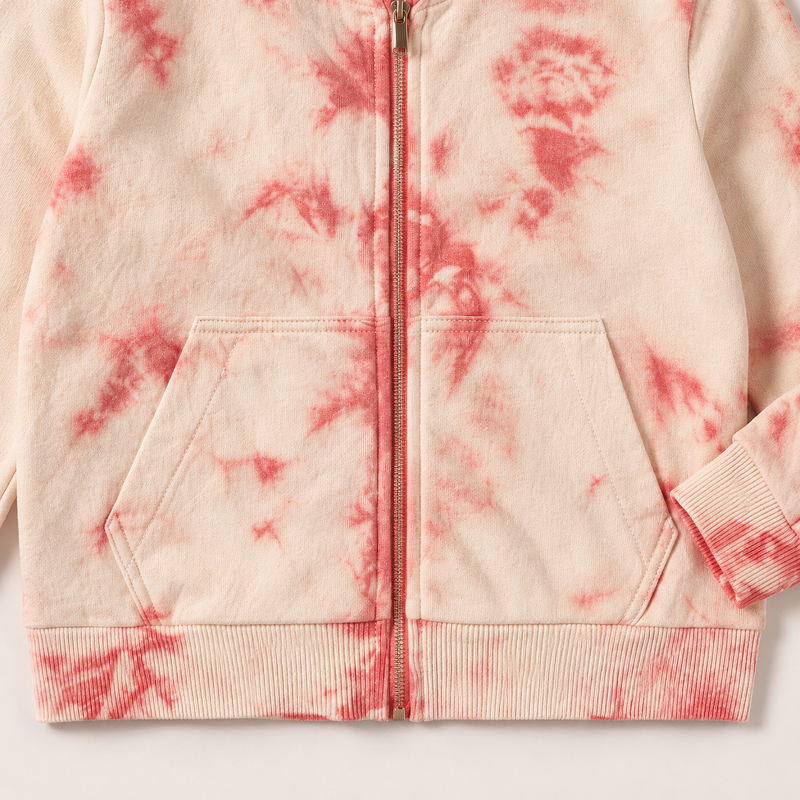
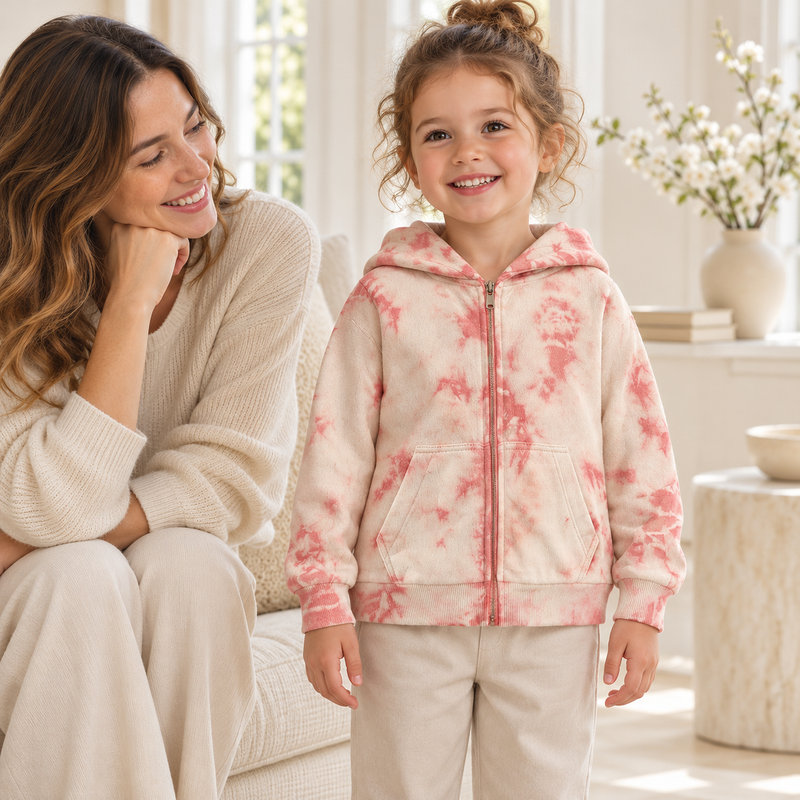
A zip hoodie in a 290 gsm cotton terry, dyed with logwood (苏木) and madder (茜草) to a mottled rose on an undyed cream ground: hood, full-length zip, kangaroo pockets, rib cuffs and a rib hem band.
Production on this style concentrates in three places: the dyebath and the water, which set both the colour and its fastness; the colour approval, which is bought as a range rather than a shade; and the trim booking, which is matched to the shell's average tone before the zip is ordered. The weight, the hood and the zip are conventional work — the dye is where the schedule and the inspection attention go.
At a glance
1. Fibre and weight: 290 gsm terry, and what that gives you
- 290 gsm is a winter weight. Loop-back terry at this weight holds a hood shape and takes a zip with a straight front edge, which is why hoodies are built at this weight and t-shirts are not.
- The loop back takes colour more softly than the face. The paler reverse is part of the hand of a heavy terry; both sides are shown at approval so the tone difference reads as a design feature rather than a surprise on delivery.
- A straight zip front starts with the fabric, not the zip. The body is pre-shrunk and the front edge is measured after wash, so the zip runs straight after the first laundry.
- Weight carries the silhouette. At 290 gsm the body sits away from the child and the hood keeps its shape; the weight is fixed on the tech pack so the proportion stays the same across the range.
- The base cloth is undyed to begin with. A plant-dye programme starts on a clean, unscoured cotton ground, because the cream in the photo is part of the colour rather than a background to it.
2. The dye: how logwood and madder work together
- Logwood (苏木) and madder (茜草) are two chemistries in one bath. Logwood heartwood moves from violet to blue-black as pH and water change; madder root brings the rose and brick tones. Layered on a cream cotton ground, they produce the mottled pink in the photo.
- Cotton holds plant colour through the tannins in the dyestuff. This recipe works that way, with no added mordant: the bath is logwood, madder and water, and the depth that comes out is the depth the plants give.
- Three variables are controlled per batch — dyestuff, water and temperature curve. They are recorded on every batch sheet because they are the levers that hold the colour.
- Depth comes from dyestuff and time. The pale rose in the reference is what this recipe delivers; a deeper shade is a different recipe, quoted after a dye trial.
- Every piece carries its own mottle. The bath moves through a heavy loop-back in its own way, the fabric is handled wet, and oxidation during drying leaves its mark: that is the character of the dye, and approval is set up as a range with a reference photo.
3. Evidence: the documents behind a plant-dye article
- Plant dye is documented rather than certified. The three things a buyer can audit are the dye recipe, the batch sheet and the finished-article test results — and those are what travel with every order.
- The wording used is the recipe itself: plant-dyed with logwood and madder in water, no added mordant, batch traceable. The batch sheet — materials, water, temperature curve, piece count — is the document behind it.
- Fastness is the number the programme is built around. Light and wash are tested on the finished article, and the accepted grade is fixed with the buyer before bulk so the target is known from the start rather than after the first season.
- The standard tests run alongside. Heavy metals in the substrate and in any coating, colour change after washing, small-part security: plant dye adds a fastness check on top of the usual set.
- Colour and burning behaviour are separate questions. The apparel flammability route is confirmed per order with the laboratory, and that confirmation is issued with the order documents.
4. Colour control: buying a range, not a shade
- The approval object is a range. Depth, mottle scale and the amount of cream left showing are agreed against a set of photographs of front, sleeve and hood from one accepted piece, plus a physical master sample.
- The batch is the unit of consistency. Dyebath volume, fabric weight per batch, temperature curve, dyestuff lot and water are recorded; 30–50 pieces is the working batch size on a heavy terry, which is what keeps the spread inside the approved range.
- A reference photograph settles the reading. Front, sleeve and hood are shot on the same setup, so a piece can be compared to the master without a light booth argument.
- Both sides are shown at approval. Loop back takes colour more softly than the face; agreeing that at the sample stage is what keeps it a feature.
- Trims are matched to the shell's average tone. Rib cuffs and hem go through the same bath and mottle with the body; the zip tape, thread and labels are matched to the average, which is what makes the garment read as one colour. The match is fixed before the zip is ordered.
5. Construction: hood, zip and pockets
- The hood carries no drawcord. On children's upper outerwear a hood cord is the first thing an audit looks for, so this style is built without one: a two-panel hood with a bound edge.
- The front zip is sized to the finished body. Nylon coil, a zip guard at the top so the slider sits clear of a chin, a backing behind the teeth, and a length ordered to the pre-shrunk body so the front stays flat.
- Kangaroo pockets are cut on the bias of the panel, so the opening sits flat at this weight, with the mouth reinforced where hands go in and out.
- Rib cuffs and hem are pre-shrunk with the body and cut with negative ease, so the hem keeps its line through repeated washing.
- Seams and needle control. Four-thread overlock pressed flat; 100% needle detection on finished pieces, one-for-one exchange at every break with the machine stopped, work within 2.5 m re-screened twice, needle-free area enclosed, 2 m deep, single entry.
6. Size: 2–8A, and a line at 36 months
- The range covers two chemical classes. The 2A sizes are for a child under 36 months and are assessed as Class I; 3A and up is Class II. The certificate set is issued to cover both, or the range is split into two orders with two limit sets.
- Age is merchandising, height is the spec. In the EU a kids' size is a height in centimetres, in the US an age band; both appear on the graded spec so a 2–8A run stays consistent.
- The hood is graded on the head. Depth and opening grade separately from the body, so the hood sits over a head with hair and stays back when it is up.
- Sleeve length grades on arm length, which keeps a 2A a short sleeve and an 8A a full one from the same block.
- The pocket scales with the body width, so the proportion reads the same at both ends of the range.
7. Customization, sampling and what we need to quote
- Colour. Logwood and madder as shown; a madder-heavy brick; a logwood-heavy violet; a deeper shade quoted after a dye trial, with the depth you want confirmed on the trial piece.
- Weight. 290 gsm as quoted; 320 gsm for a heavier winter version; 260 gsm for a lighter one.
- Construction. Hood as shown; a collar instead of a hood; a half-zip; a plain hem instead of rib.
- Trim. Tonal-average zip tape; a neutral tape; a contrast tape; the drawcord-free hood edge as shown.
- Packing. Sold alone or in a two-piece set; polybag with header, hanger card, gift box; woven or printed label, satin care label, hangtag.
- Sampling. 3–7 days from a confirmed tech pack plus a dye trial; a new shade adds a round, and a dye trial is booked against a batch so what you approve is what runs.
- Approval includes one wash, where shrinkage at the zip, the paler reverse, rib recovery and fastness are checked together.
- Bulk lead time. 30–60 days from approval by quantity and dye batch schedule; rush production is quoted per order.
MOQ: 300 pcs for a custom development — custom fabric, dye recipe, colour or fit; 50 pcs for a decorative process added to a stock body; 100 pcs for stock fabric with your own logo and label. Mixed colour and size orders are quoted per order. These are standing programme terms, confirmed against the current quotation.
Production runs with our production partner, Suzhou Shelmin Trade Co., Ltd.: 7,200 m² workshop, 8 lines, 200 staff, 6,000 pieces per day. Design confidentiality is held under NDA; buyer patterns and colourways are not re-used.
To quote, we need: target market; whether the 2A sizes stay in the range; the depth and mottle you want, with a reference photo if you have one; confirmation that the no-mordant recipe is fixed; the weight; trim treatment; packaging; and whether testing runs in your brand name.