EN

OEM/ODM Custom Pet Tie-Dye Tank Top | 100% Cotton Organic Plant-Dyed Dog Vest | Eco-Friendly Non-Toxic Botanical Dye Cat Apparel for Private Label | Sustainable Breathable Puppy Shirt | Wholesale Pet Clothing Manufacturer


- Overview
- Indigo Tie-Dye Pet Vest, Plant Dyed Cotton | OEM
- Recommended Products
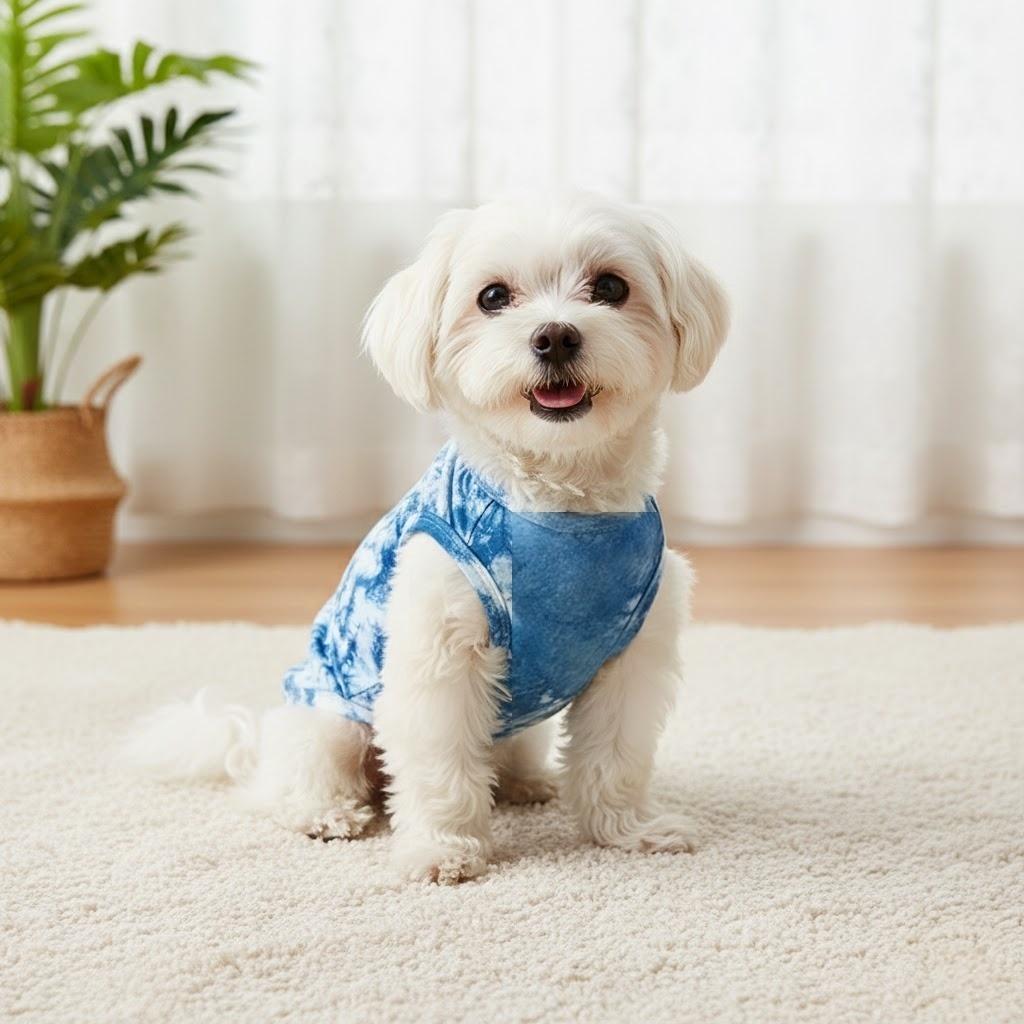
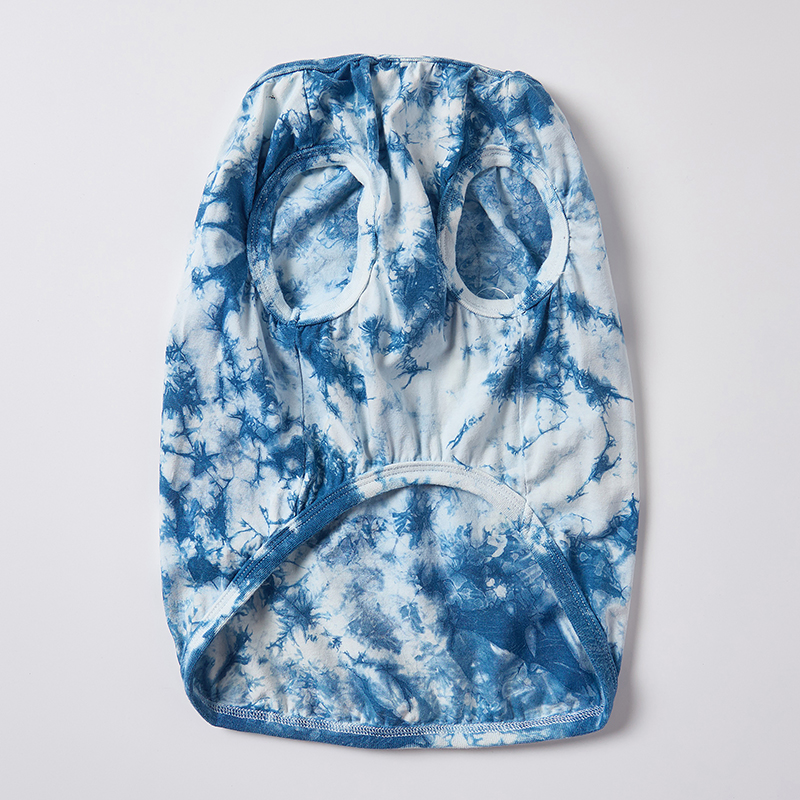
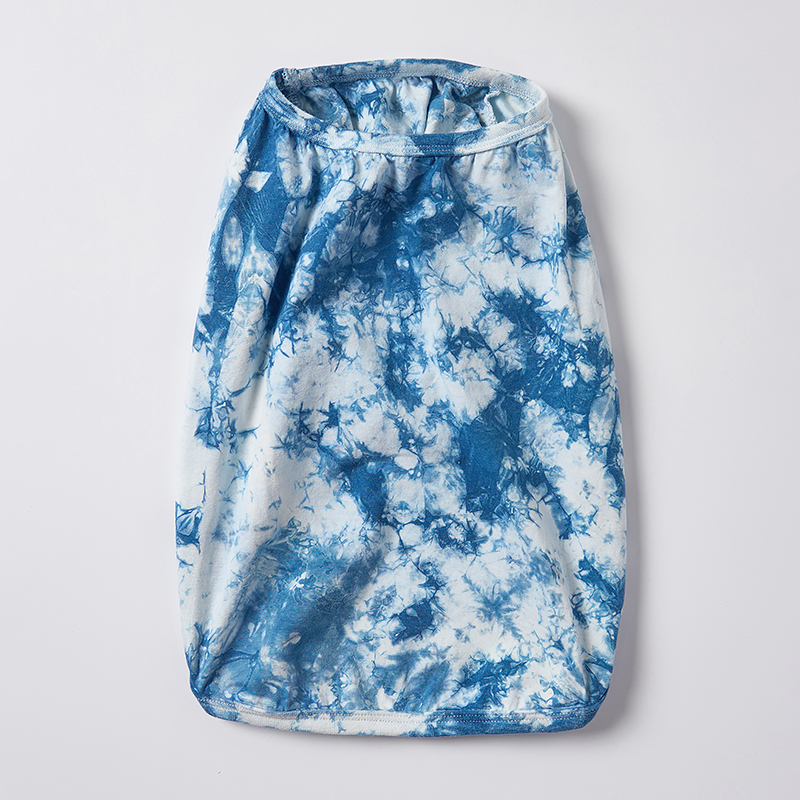
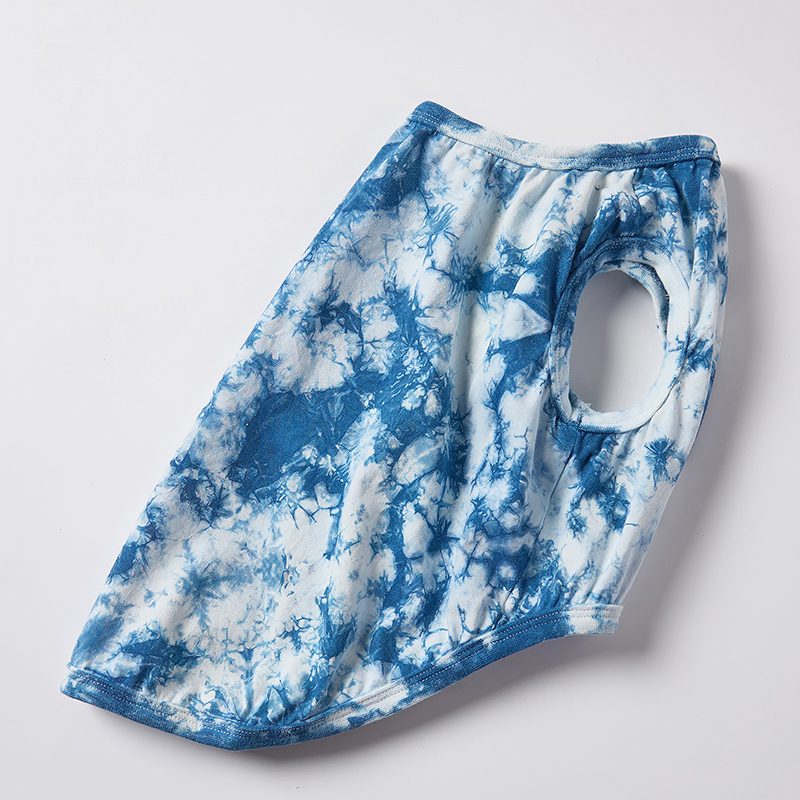
A sleeveless vest for a small dog or a cat: a 100% cotton knit body with a neck opening, two leg openings, a belly opening and a hem, every one of them bound with a strip of the same cloth, the whole garment dyed in one indigo bath from Isatis.
The single most useful thing to know about it is that the body and its bindings came out of that bath at two different depths, and the reason is arithmetic rather than design. A binding is the cloth folded on itself and then turned, so the edge carries three layers where the body carries one; between those layers the liquor has less room to work, and the strip therefore reads one step paler than the field beside it. The pale ring that outlines every opening in the flat view is not a contrast trim. It is the layer count.
At a glance
1. The binding is paler because it is three layers, not one
- A bound edge is not a strip laid over a surface. The strip is folded, the opening is enclosed, and the result is a rim three layers deep where the body is a single layer, with the whole rim turned and stitched down.
- Between those layers the liquor has less room, so the same bath that saturates the body cannot saturate the rim, and the rim comes out lighter: not a different colour, the same colour at a lower depth.
- That is why every opening reads as a pale band. The effect follows the opening exactly and survives washing, because it is a property of the construction rather than of the pattern.
- The body shows the opposite behaviour in the same photograph. It is a single layer, freely exposed, and it takes the full depth of the vat; the contrast between field and rim is therefore produced by layer count alone.
- Which means the rim cannot be specified as "same colour as the body". What is being ordered is the cloth, the bath and the layer count; the pale ring comes with the construction, and matching it by eye to the field is not a thing that can be asked for.
2. The pattern on the binding is the same idea at a smaller scale
- Because the strip is narrow and folded, it cannot hold the pattern the body holds. A resist needs room to form one shape; a strip twenty-something millimetres wide has none, so what appears on the rim is a compressed, finer version of the same motif.
- The result reads as a second material. Across a seam the field stops and the rim starts at a finer scale, and at a normal viewing distance the two look like different cloths even though they were cut from one bolt and dipped in one bath.
- The rim also carries its own pale core, since the crest of the fold is the most compressed point on it; so a single rim can show dark at the fold lines and pale along its ridge.
- This is where a buyer's eye most often misjudges the garment: the trims look like a deliberate accent, and an order placed to "match the trim" against a body swatch produces something that reads as a mismatch.
- The honest specification is a reference for each: one approved piece of body cloth and one approved piece of binding, both from the same bath, both retained.
3. Where the needle went, the dye could not
- A seam compresses the cloth it joins, and along the stitch line the two layers are pressed together, so the liquor that reached everything else did not reach the line itself.
- On the sample the seams read as fine pale lines through the field, most visible where a curve is bound and where the belly opening meets the body: a thin, even thread of lighter cloth that traces the construction.
- Those lines are a record of the order of operations. A garment sewn after dyeing carries no such lines, and a garment sewn before dyeing carries them everywhere; reading them is how the route is established from a photograph.
- For the buyer they are the cheapest visible evidence of quality, because a pale line that wanders, thickens or disappears means the seam allowance moved under the needle, and that shows up before any measurement does.
- They also cannot be removed. Colour can be pushed deeper but a line pressed into the cloth by a needle stays where it is, so the seam line is one of the few features of the garment that is genuinely permanent.
4. A rim that does not give, on a body that does
- The bound rim has almost no stretch, for the same reason it is pale: three layers, stitched down, with no room to move.
- The body around it does stretch, and keeps stretching, because cotton knit relaxes through wear and washing and settles into a slightly larger shape than it was cut.
- So the two parts of the garment drift apart in use. The openings keep their circumference and the body eases outward, and the surplus has to go somewhere: into the gathers above each binding, which deepen a little with every wash.
- That is worth writing into the care route, since a garment that starts calm at the openings will read softer after a season, and a buyer who expects the flat photograph to be the permanent state will read the change as a fault.
- It also argues for fitting the dyed, washed garment rather than the greige one, because the openings and the body only reveal their true relationship after both have been through the bath and one wash.
5. Indigo sits on the surface, and the rim is the surface
- The pigment in an indigo dye sits near the fibre surface rather than inside it, which is what makes the depth possible with so few passes and what makes abrasion the main risk to the colour.
- On this garment the abrasion lands on the bindings first: a foreleg swings inside its opening all day, the head passes the neck twice a day, and the belly opening rubs against the ground when the animal lies down.
- So the palest parts of the garment are also the most exposed, and they will show wear before the field does; a rim that has gone slightly fuzzy at the leg openings after a season is the normal path for indigo, not a defect in the dyeing.
- The interior face is dyed too, because a bath wets the whole piece, and on a pet garment the interior is the wearing surface; that is where loose pigment shows first and where crock is read.
- The two surfaces therefore age at different rates, which is worth knowing before choosing a deep shade: the deeper the field, the more visible the contrast as the rims lighten.
6. Two numbers carry the fit, and one of them is a distance
- Chest girth comes first, because the vest closes nowhere and cannot be adjusted; a body that is wrong cannot be rescued by any other measurement.
- The second is a distance rather than a circumference: from the neck opening to the leg openings. On a garment with no sleeves this is the whole of the shoulder fit, and it decides whether the front legs emerge where they swing or where they do not.
- The belly opening's length is the third, and it is the one that decides whether the vest rides up when the animal sits, because the belly opening is what the body of the garment is anchored to underneath.
- The bound rims set the tolerances, since a rim that gives almost nothing means a millimetre at the leg opening is felt; so leg opening diameter is quoted as a measured value with a tolerance, not as a size range.
- All of these are measured on the dyed, washed garment, after the gathers have settled, rather than on the pattern.
7. Sizes, sampling and quoting
- Two sizes graded on measurements: S and M move on chest girth, back length, neck opening, the neck-to-leg distance, leg opening diameter, belly opening length, hem depth and binding width.
- Customization. The fold pattern and the number of dips, which set the depth and the read of the pattern; the binding width, which sets both the pale ring and how much the rim gives; whether the binding is cut from the same bolt as the body; the neck-to-leg distance; leg opening diameter; belly opening length; hem depth; and the length of the body.
- Sampling: 3-7 days from a confirmed tech pack, covering a tied set of two or three pieces approved on the dipped, oxidised and washed result; body cloth and binding approved as two separate references from the same bath; both sizes worn standing, sitting and walking; every opening measured after washing; crock read on the interior and at the leg openings; and each rim checked for a binding that lies flat rather than cupping.
- Bulk: 30-60 days from approval, tied and dipped in batches with the dip count and dwell recorded per batch, bindings cut in one run per size and drawn from the same dyed lot as the body, each batch compared against a retained cloth reference; AQL 2.5 major and 1.0 critical.
- MOQ: 300 pcs for a custom development covering cloth, depth, fold pattern or fit; 50 pcs for a decorative process on a stock body; 100 pcs for stock cloth with your own logo and label. Mixed colour and size orders are quoted per order.
Production runs with our production partner, Suzhou Shelmin Trade Co., Ltd.: founded 2017, 7,200 m² workshop, 8 lines, 200 staff, 6,000 pieces per day. Design confidentiality is held under NDA; buyer patterns, shades and tie layouts are not re-used.
To quote, we need: destination market and what it requires for pet textiles; the dyehouse documentation for the indigo and the vat; the fold pattern and dip count, with two reference pieces if you have them; whether the binding is taken from the same dyed lot as the body; the binding width; chest girth, back length and the neck-to-leg distance for S and M; leg opening diameter; belly opening length; hem depth; the certificate held for the cloth and the scope you need; the lot certificate for the dyestuff; the pH target and the dyehouse water specification; packing method; and whether certification is to run in your brand name.