EN

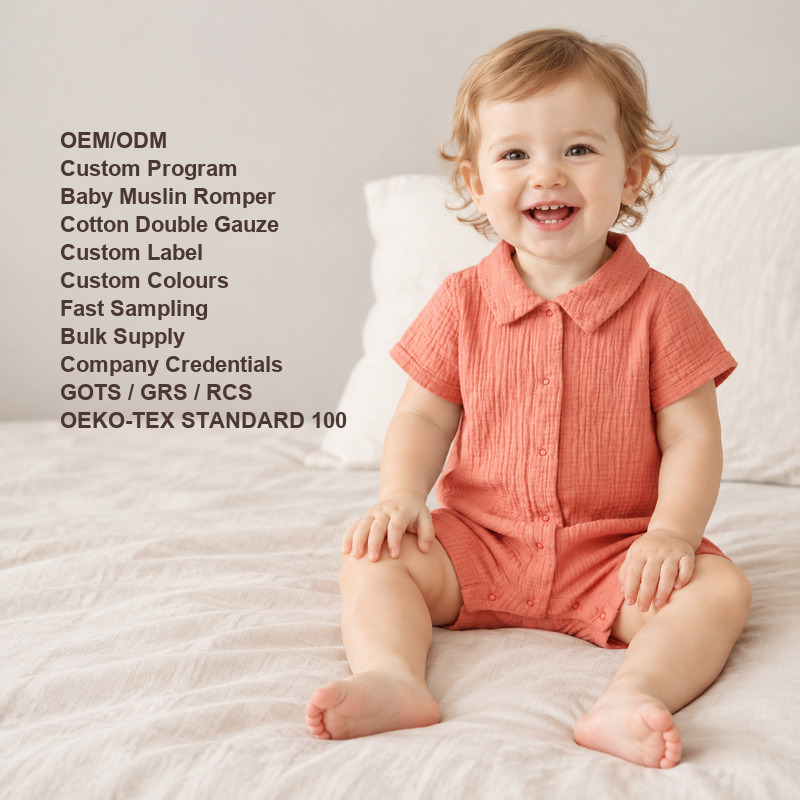

OEM/ODM 100% Cotton Double-Layer Wrinkled Gauze Baby Romper | 135gsm Eco-Chic Plant-Dyed Infant Jumpsuit | Sustainable Short Sleeve Button-Up Newborn Crepe Bodysuit Wholesale


- Overview
- OEM/ODM 135gsm Plant-Dyed Cotton Baby Romper
- Recommended Products
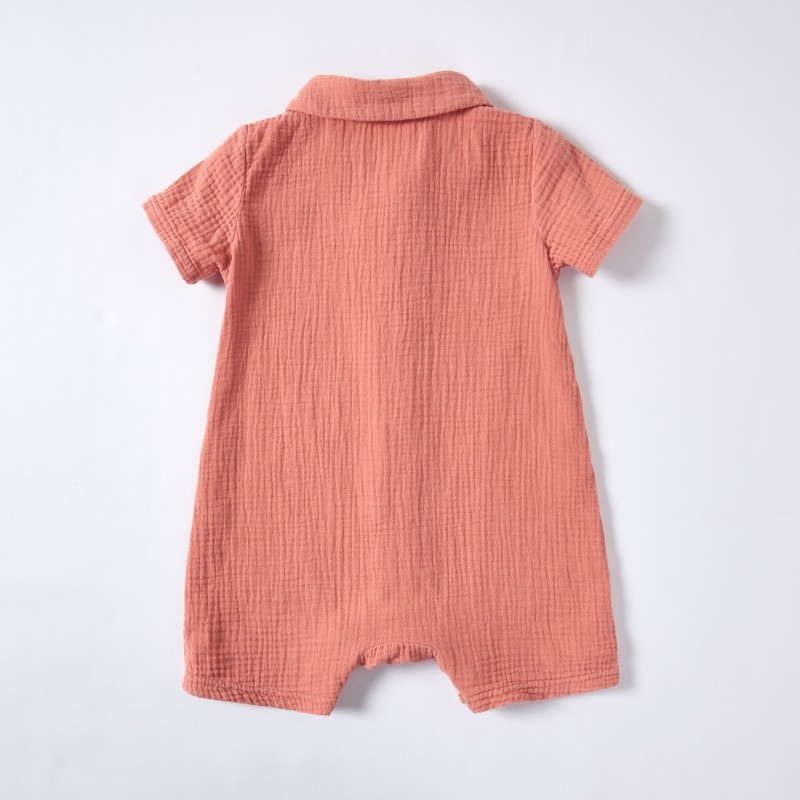
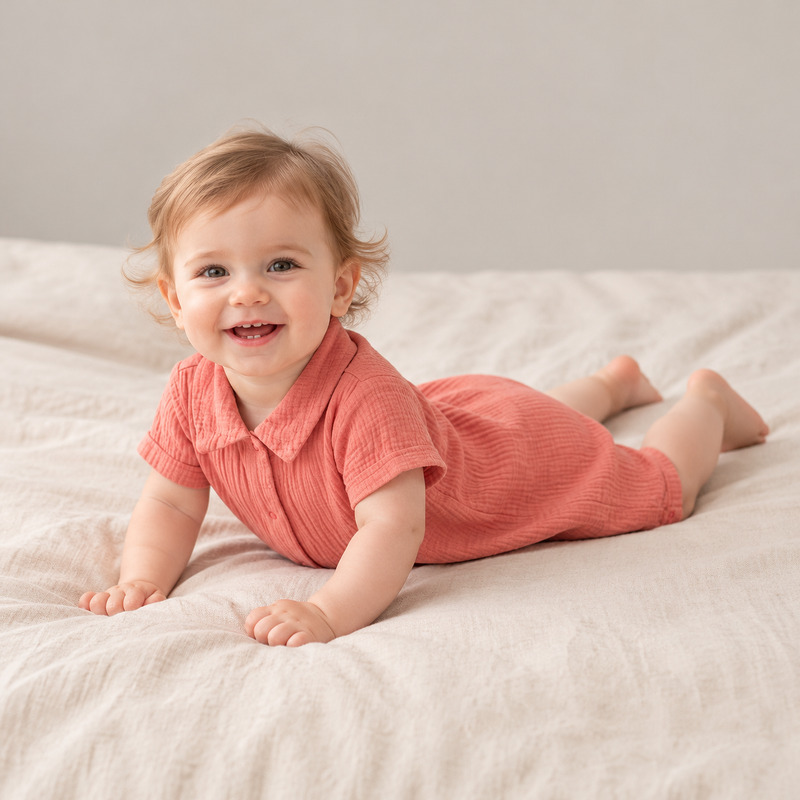
A short-sleeve shirt romper in a double-layer crinkled cotton, 135 gsm, dyed to a clay coral with sappanwood (苏木), madder (茜草) and pomegranate rind (石榴皮): a shirt collar, a full centre-front placket on snaps, fold-back sleeve cuffs, straight short legs with a snapped crotch, and no elastic at the leg openings.
This is the piece in the range that does the most to a cloth that has no straight lines in it. A placket, a collar point and a cuff are all cut on grain and pressed into an edge, and on a two-ply crinkle each of them becomes a smooth band on a textured ground. That contrast is the design; the work is deciding where the band stops, and keeping the band straight enough that the eye trusts it.
At a glance
1. Straight lines on a cloth that has none
- A crinkle has no straight edge anywhere, so every pressed line on this garment is a decision rather than a default: the placket, the collar edge and the cuff are the three places where the make imposes one.
- Each of them reads as a flat band against the texture, and on a mid-depth coral the band is slightly lighter than the cloth around it, because a flat surface reflects light where a crinkle scatters it.
- That is the design on this piece, and it is written into the approval so it is not read as a defect fifteen hundred pieces in: a band that is straight, even in width and intentional reads as construction, while the same band wavering reads as a fault.
- The rule that follows is simple and it is the one that gets broken: the band must never appear where it was not planned. A press mark from the sewing room, a fused patch on the inside or a hem pulled flat all leave the same signature.
- So the bands are specified by width and checked by measurement, since "it looks about right" on a textured cloth is a judgement the eye cannot make consistently along a one-metre placket.
2. The placket is the only straight line the customer sees
- Cut on grain, or it twists. A placket cut slightly off grain looks acceptable flat and then twists after the first wash, and no amount of pressing holds it, because the twist comes back with the cloth.
- The width is fixed from neck to hem, because the eye uses this one line to judge the whole garment; a placket that narrows at the bottom reads as a garment cut crooked even when every other seam is true.
- Whether the placket is interlined is a specification, not a habit. Interlining holds the line but flattens the texture under it, and on a two-ply crinkle that flattening spreads a little wider than the placket itself, so the decision is made against a made-up sample rather than on the table.
- The placket's inside face is visible whenever the garment is opened, which is several times a day on a baby; so the inside is finished and read as a face, not as a backing.
- Both edges are checked for a straight line under a rule, at the top, the middle and the bottom, before and after the wash sequence.
3. Snap spacing and snap distance are two separate numbers
- Spacing decides whether the placket gapes. Too far apart and the cloth between two snaps bows open at the chest, which on a crinkle is worse than on a flat cloth because the texture adds its own spring to the bow.
- Distance from the edge decides whether the snap tears through. Too close to the edge and the snap pulls out under load; too far and the edge rolls away from the body.
- Both are set against the cloth and the snap, not copied from a flat-poplin pattern, and both are checked on the finished garment after washing rather than on the unwashed sample.
- Each snap leaves a compression ring in the texture, because the setting press flattens the crinkle around the part. On coral this reads as a small halo; it is expected, and it is graded for evenness rather than treated as a stain.
- Retention is tested as a small part: the snap is pulled to its Class I requirement on the finished garment, with the placket layers in place, since a snap that holds in a swatch can fail where four plies meet.
4. A collar point has to sit on a springy edge
- The collar is two plies turned at the point, and a two-ply crinkle does not want to turn sharply: the point either curls up or blunts, and it does it at the tip first.
- So the point is trimmed, turned and pressed to a defined shape, and both points are checked against each other for symmetry, because a pair that differs by a few millimetres is the first thing a buyer sees at the neck.
- The collar carries the same flat-band logic as the placket, and where it is interlined the interlining stops short of the point so the tip keeps a little softness instead of standing out as a hard triangle on a soft garment.
- The neck opening must pass the head, and because the placket opens fully this is a measurement on the closed garment rather than a stretch calculation; it is checked on the smallest size with the garment buttoned.
5. Cuffs and leg openings are doubled bands
- The fold-back cuff doubles the cloth at the sleeve end, so the sleeve hem is four plies of a two-ply cloth, and the band that results is the widest flat area on the garment.
- The legs are straight and finished with a cuff, not elastic, so the leg opening is a measurement rather than a recovery: it must clear the thigh with a nappy on, and it does not close up again afterwards.
- The crotch is a snapped opening, which is where the garment is handled most; the placket stack, the leg cuff and the crotch snaps meet in the same corner, so the bulk there is trimmed in steps and pressed rather than sewn harder.
- The leg cuff is also where the inside face shows most, so both faces are read there as well as at the placket.
6. Two plies, and where the difference shows
- Every band on this garment is a place where the cloth turns over, and a half step between the two plies becomes a visible edge at a turn rather than a soft shading on a flat area.
- So both faces are read at the placket turn, the collar roll and the leg cuff, with the two faces side by side, before and after washing.
- The inside of the placket is the most exposed inside face in the range, because it is on show every time the garment is opened, so it is graded to the same standard as the outside rather than to a lining standard.
- Where a roll falls outside the stated relationship it is not pushed through, since nothing done at the sewing stage can correct a two-faced difference.
7. Tests, sizes, sampling and quoting
- Fabric tests at the shipped depth: light to ISO 105-B02, wash to ISO 105-C06 with a whole garment in the load, rubbing to ISO 105-X12 on the outside face, on the inside face and through creases, perspiration and saliva to ISO 105-E04 plus the destination market's saliva method, with colour read on both plies.
- Construction checks: placket straightness under a rule at three points, placket width from neck to hem, snap spacing and edge distance measured on the garment, snap retention at its Class I requirement with the full placket stack, gaping at the chest after washing, compression-ring evenness, collar point symmetry and shape, cuff and leg-opening dimensions, and bulk control at the crotch corner.
- Two-face checks: the stated inside/outside relationship read at the placket turn, the collar roll and the leg cuff, before and after washing, plus a transfer rub from the inside face onto a white cotton reference.
- pH is measured on the garment and held between 4.0 and 7.5; extractable heavy metals are tested on the finished garment; phenol yellowing is checked to ISO 105-X18 on a specimen carrying the actual packing fold, with packaging specified free of BHT.
- Safety checks: snaps tested as small parts on the finished garment, neck opening measured on the closed garment on the smallest size, leg opening measured with a nappy in place, and confirmation that the garment carries no cords, ties or toggles.
- Five sizes on a measurement chart: 6-9M, 9-12M, 12-18M, 24M and 36M move on chest, body length, sleeve, leg opening and crotch depth, graded from measurements rather than by percentage.
- Sampling: 3-7 days from a confirmed tech pack, covering a dyed strike-off with route and rinse stated, a made-up romper with the placket, collar and cuffs finished as production, a wash-and-remeasure with placket straightness and width marked, a snap spacing and gaping check after washing, a snap retention pull, a fit check over a nappy on the smallest and largest size, an inside-out view, a two-face read at the three turns, and a compression-ring review.
- Bulk: 30-60 days from approval, planned per dyebath, with the placket, collar and cuff operations kept as a defined sequence so the bands are made the same way in every batch.
- MOQ: 300 pcs for a custom development covering cloth, shade, crinkle level, trim or fit; 50 pcs for a decorative process on a stock body; 100 pcs for stock cloth with your own logo and label. Mixed colour and size orders are quoted per order, and terms are confirmed against the current quotation.
Production runs with our production partner, Suzhou Shelmin Trade Co., Ltd.: founded 2017, 7,200 m² workshop, 8 lines, 200 staff, 6,000 pieces per day. Design confidentiality is held under NDA; buyer patterns, shades and prints are not re-used.
To quote, we need: target market and the Class I tests it requires; whether the flat placket, collar and cuff bands are accepted as the design, since that is what this garment does to a crinkle; whether the placket is interlined and to what width; snap type, spacing and edge distance, or the spacing you want us to test; collar point length and whether the interlining stops short of the point; cuff depth and leg-opening dimension for each size; the crinkle level you want, as crease count and depth per unit; lot certificates for the three plants and for the thread; the pH target and the dyehouse water specification; packing method; and whether certification is to run in your brand name.