EN

OEM/ODM 100% Cotton Double-Layer Wrinkled Gauze Baby Girl Skirt | Eco-Friendly Plant-Dyed 135gsm Toddler A-Line Mini Skirt | Custom Sustainable Organic-Feel Kids Boutique Summer Apparel Wholesale


- Overview
- OEM/ODM 135gsm Plant-Dyed Cotton Baby Skirt
- Recommended Products
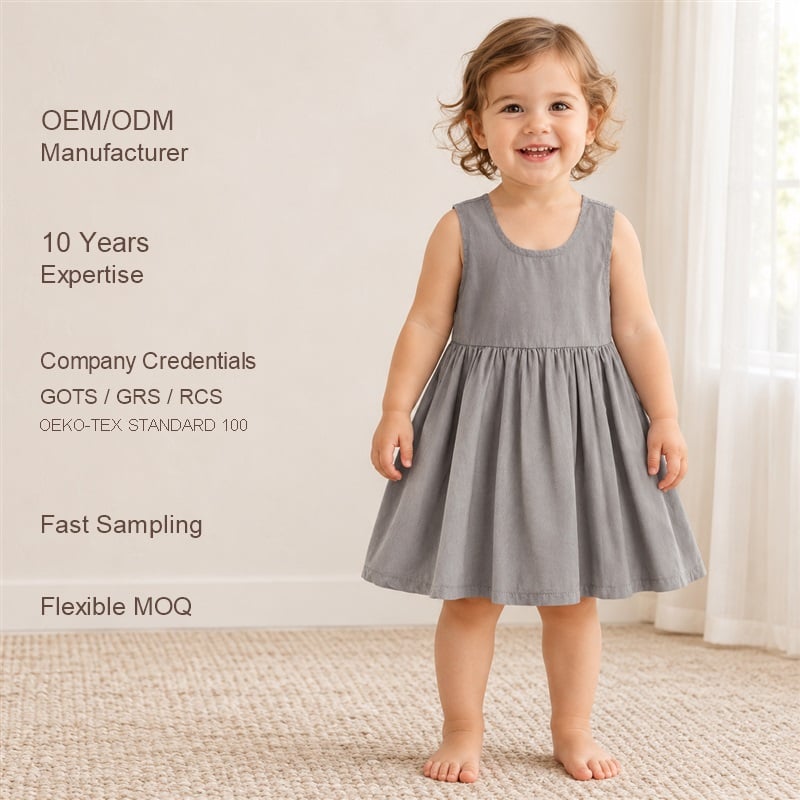
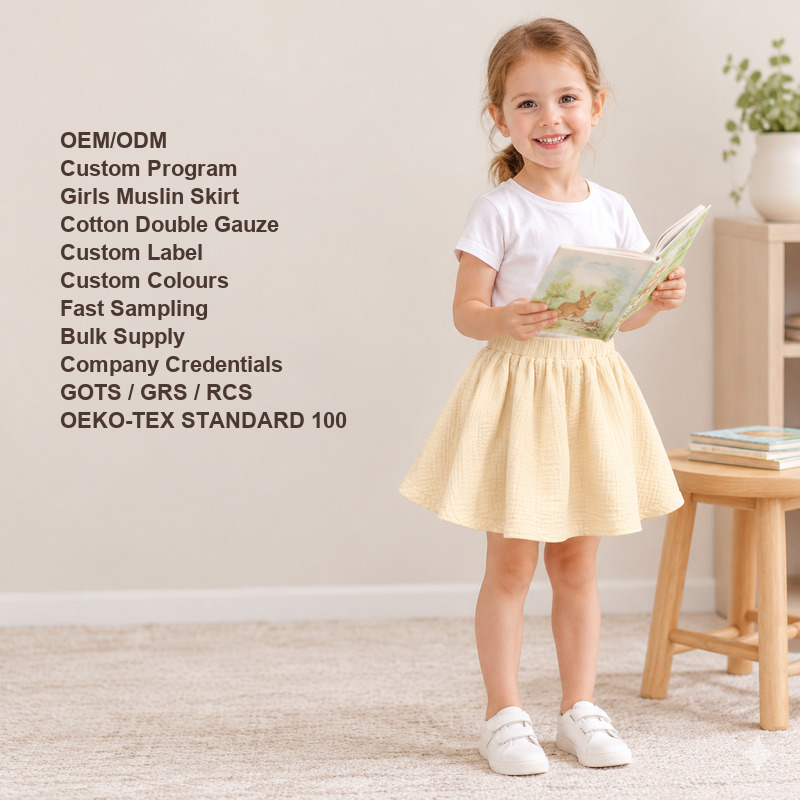
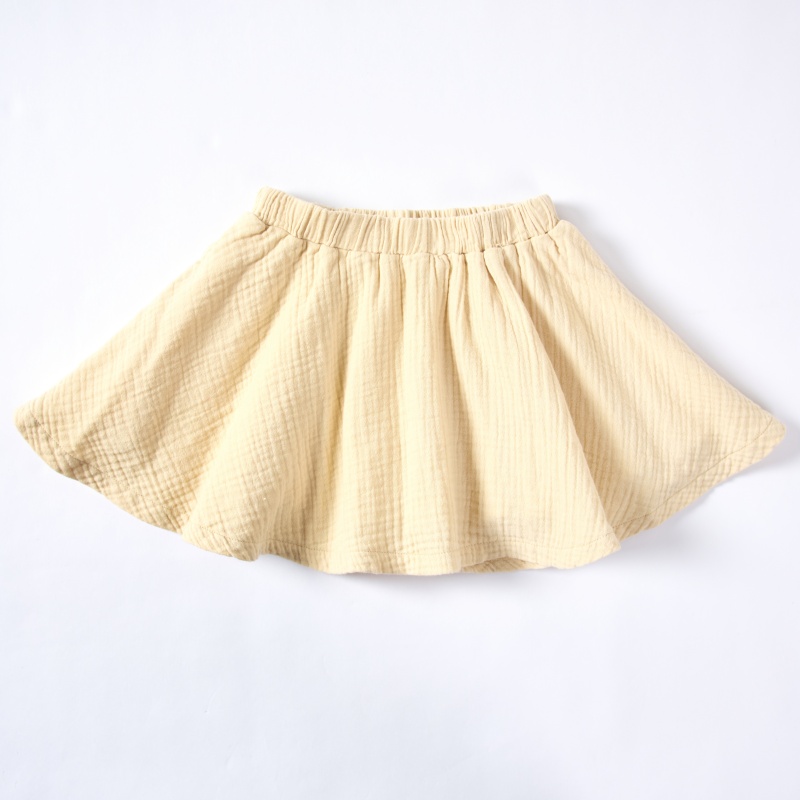
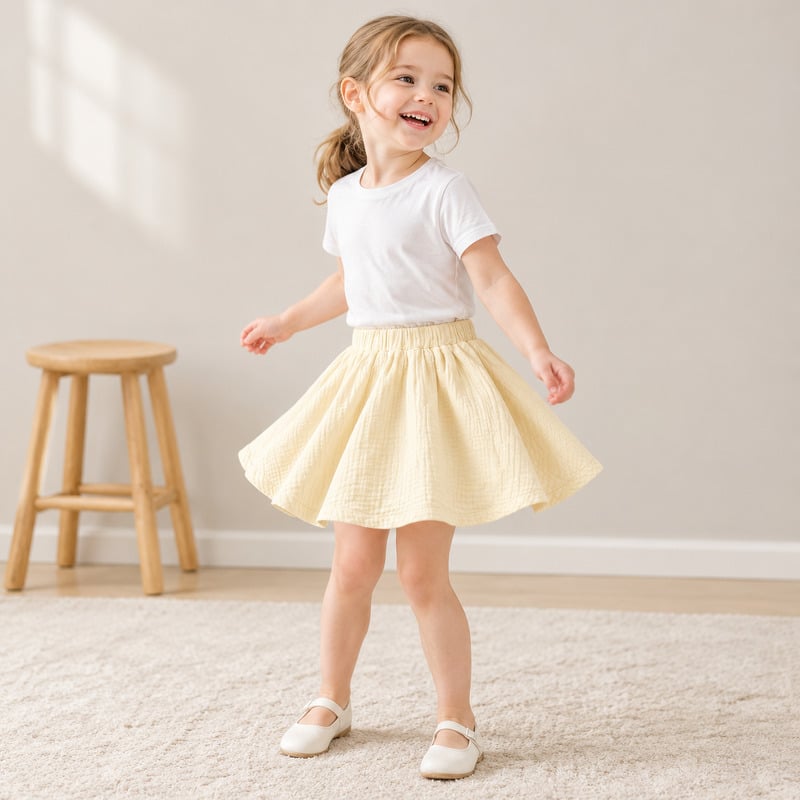
A gathered baby skirt in a double-layer crinkled cotton, 135 gsm, dyed to a clotted cream with sappanwood (苏木), madder (茜草) and pomegranate rind (石榴皮): a gathered elastic waist in a self tunnel, a flared body, a narrow hem, and no cords, ties or fastenings anywhere on the garment.
The shape is the same as the grey version; the colour changes what the garment is judged on. Cream is the tone that records the floor, and a skirt on a crawling baby is the garment that meets the floor. So this page is about the two things a pale skirt is bought on after a month of wear: what the hem looks like, and what happens when someone tries to clean it.
At a glance
1. Cream records the floor, and a skirt meets the floor
- Between crawling and walking the hem is in contact with the ground most of the day, and cream is the tone that keeps a record of it: a grey line appears along the bottom edge where a mid grey would show nothing.
- The second place is the front of the skirt, which is where hands, food and whatever is on them land; a flared skirt presents that area to the eye rather than folding it away.
- Neither is a defect in the make. They are the price of the shape and the tone together, and the honest way to handle them is to say so in the care wording rather than to sell the garment as though a cream hem stays cream.
- The hem is therefore finished and tested as a wear part: abrasion against an unrubbed specimen, and a soiling check recorded per colourway so a buyer knows what a month of crawling does before the first order is placed.
- The practical answer in the sample room is a slightly shorter skirt on this colourway, since length that clears the floor most of the time soils far less than length that sweeps it.
2. Spot cleaning is the second wear mechanism
- A cream hem invites local cleaning, and local cleaning is rubbing: a cloth, a stain bar, a thumb, in one place, with water.
- On a colour that sits near the surface, that rubbing takes colour as well as soil. The result is a pale patch at the hem, in the most visible band of the garment, and it appears in the first month rather than the first year.
- So the check is a wet rub at the hem, not only the standard crock test on a flat area: the hem is rubbed wet against a white cloth, and the colour loss is read against an unrubbed hem from the same panel.
- The care wording steers away from the behaviour that causes it: wash the whole garment rather than the hem, cool water, no chlorine bleach, no softener, and if a mark has to be dealt with, dab it with cool water rather than scrubbing it.
- This is a place where the instruction is part of the product. A cream skirt sold without that sentence generates returns that no inspection would have prevented.
3. A flared skirt is the largest pale surface in the range
- A skirt made of panels has more visible cloth per garment than any other piece here, so a shade difference has more room to be seen.
- A step between panels runs down a seam on a flared body, where it is far more visible than the same step on a bodice, because the seam is long, curved and catches light at a different angle from the panels either side.
- So panels are cut in pairs from adjacent positions across the roll, and the pair is kept together through sewing rather than mixed into the bundle.
- The layout is planned around the shade, with the deepest and lightest areas of a roll assigned to panels that sit apart in the finished garment, rather than letting the two ends of a roll meet at one seam.
- Where a roll cannot be paired cleanly, it is cut for a smaller size instead of being spread across a large panel, which keeps the mismatch off the most visible seam.
4. What the hem hides and what it shows
- A flared skirt has grain in every direction, so the hem drops unevenly, and a double-layer crinkle takes up that drop at a different rate in each ply.
- On cream the drop itself is hard to see, because the texture interrupts the line the eye would follow on a flat cloth; that does not make the hem level.
- So level is measured at marked points around the hem, on the hanging garment and again after washing, rather than judged by looking.
- What cream shows instead is the soil line just above the hem, and what it also shows is a hem that has been pressed flat: a smooth band on cream reads as a paler stripe, less strongly than on grey but in the same place.
- The hem is therefore pressed under rather than flat, and inspected in raking light along the edge, because that is the angle at which a flattened band and a wavy hem both show.
5. The waist carries the garment and prints its own line
- There is one support point: the waist seam takes the whole body of cloth plus whatever a baby does to it.
- A crinkle is light but springy, so the gathers push back and the seam is built for a cloth that resists being gathered; the tunnel is stitched so the elastic cannot roll, and the stitching is set for the bulk of four plies.
- On cream the elastic leaves a mark. After washing, a tunnel that is tight enough to grip also presses a pattern into the gathered cloth, and on a pale ground that shows as a set of fine horizontal lines at the waist.
- Tunnel width and elastic width are therefore specified together, with enough clearance that the elastic grips without printing, and the check is made after the wash sequence rather than on the sample before it.
- Elastic is specified by relaxed and stretched circumference per size, with recovery tested, because a waist that relaxes turns a fitting question into a skirt around the ankles.
6. Fit, construction and the points a buyer should confirm
- The waist sits high, above the nappy line, so the skirt hangs from the smallest part of the torso and does not work its way down as the child moves.
- A skirt rides up when a baby crawls, because nothing holds it down; that is a property of the shape rather than a fault in the make, so the garment is presented as a layer over a nappy cover or bloomers and sampled that way.
- It carries no cords, ties, toggles, buttons or snaps, so its trim list is the waist elastic alone; that is a genuine advantage on a garment that reaches the floor and is worn by a crawling child.
- Length is specified in the hanging state after the drop period, and a re-order is measured the same way rather than cut to the same pattern length.
- The hem allowance, stitch and differential feed are specified together, because a narrow hem on a curved, two-ply, springy edge is the hardest seam on the garment and the one where a flat band appears.
7. Tests, sizes, sampling and quoting
- Fabric tests at the shipped depth: light to ISO 105-B02, wash to ISO 105-C06 with a whole garment in the load, rubbing to ISO 105-X12 on flat areas and through creases, perspiration and saliva to ISO 105-E04 plus the destination market's saliva method, with colour read on both plies.
- Hem checks: wet rub at the hem against an unrubbed hem from the same panel, abrasion against an unrubbed specimen, level at marked points before and after washing, and a raking-light inspection for a flattened band.
- Soiling and cleaning behaviour are recorded per colourway, and the care wording is checked against what the sample actually does rather than written to a template.
- pH is measured on the garment and held between 4.0 and 7.5; phenol yellowing is checked to ISO 105-X18 on a specimen carrying the actual packing fold, with packaging specified free of BHT.
- Trim and safety checks: waist elastic relaxed and stretched circumference per size, recovery after repeated washing, a print check at the waist after washing, tunnel stitching integrity, and confirmation that the garment carries no cords, ties, toggles or small parts.
- Both plies are graded at the hem turn and the waist turn, since a step between plies shows at an edge before anywhere else.
- Five sizes on a measurement chart: 6-9M, 9-12M, 12-18M, 24M and 36M move on waist, skirt length and hem circumference, measured in the hanging state after the drop and confirmed after washing.
- Sampling: 3-7 days from a confirmed tech pack, covering a dyed strike-off with its route and rinse stated, a made-up skirt hung for its drop period and hemmed, a wash-and-remeasure with hem level marked, a fit check over a nappy cover on the smallest and largest size, a wet rub at the hem, a waist print check after washing, and a both-ply read at both turns.
- Bulk: 30-60 days from approval, planned per dyebath and per panel pairing, with cloth released only after colour, rub, level and print results are in hand.
- MOQ: 300 pcs for a custom development covering cloth, shade, crinkle level, trim or fit; 50 pcs for a decorative process on a stock body; 100 pcs for stock cloth with your own logo and label. Mixed colour and size orders are quoted per order, and terms are confirmed against the current quotation.
Production runs with our production partner, Suzhou Shelmin Trade Co., Ltd.: founded 2017, 7,200 m² workshop, 8 lines, 200 staff, 6,000 pieces per day. Design confidentiality is held under NDA; buyer patterns, shades and prints are not re-used.
To quote, we need: target market and the Class I tests it requires; the crinkle level you want, as crease count and depth per unit; the skirt length you are targeting, and whether a shorter length is acceptable on this colourway for soiling; whether the care wording may name cool-water whole-garment washing and dabbing instead of spot rubbing; the acceptable post-wash length change and hem level tolerance; waist elastic type and relaxed and stretched circumference, with the tunnel width; whether the skirt is sold alone or as a set with a nappy cover; lot certificates for the three plants and for the thread; the pH target and the dyehouse water specification; packing method; and whether certification is to run in your brand name.