EN

OEM/ODM 100% Cotton Organza Girls Lace Dress Natural Plant Botanical Dyed Tie Dye Kids Bell Sleeve Scalloped Princess Dresses Custom Wholesale Private Label


- Overview
- OEM Custom Cotton Organza Plant Dyed Girls Lace Dress
- Recommended Products
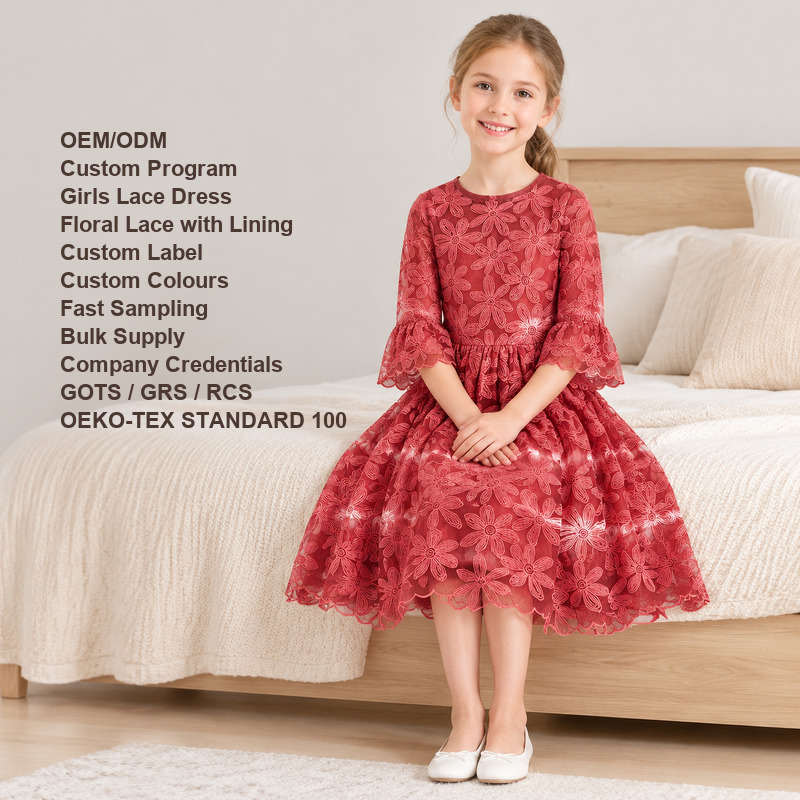
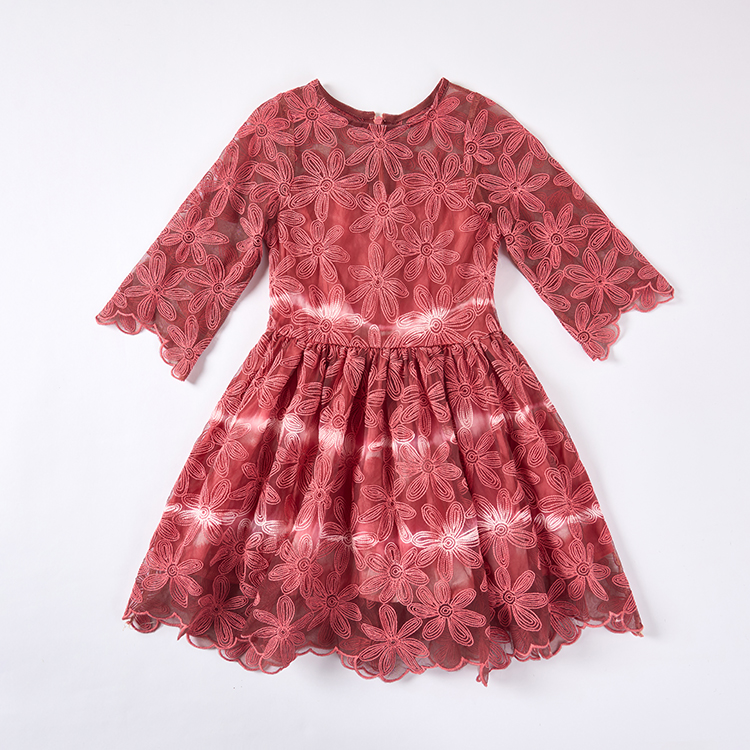
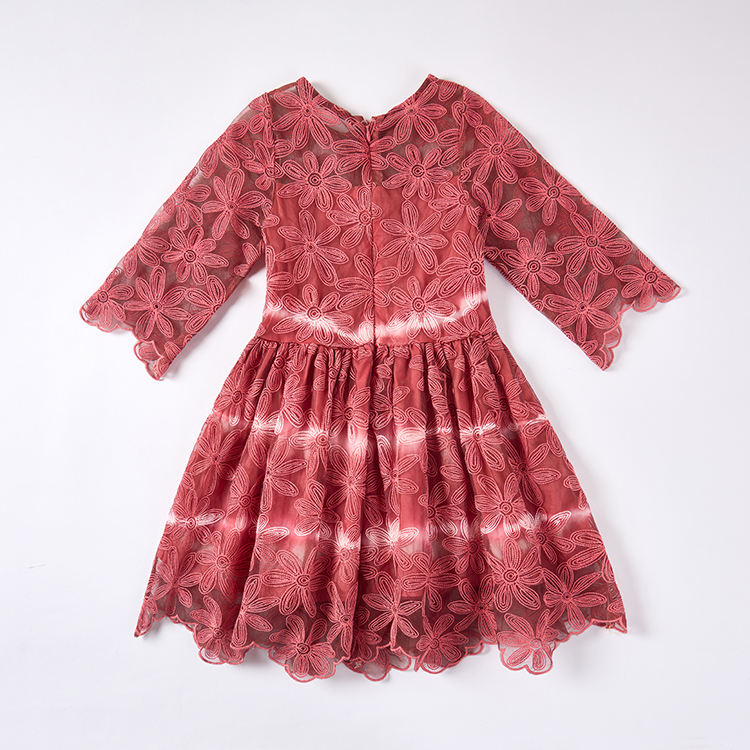
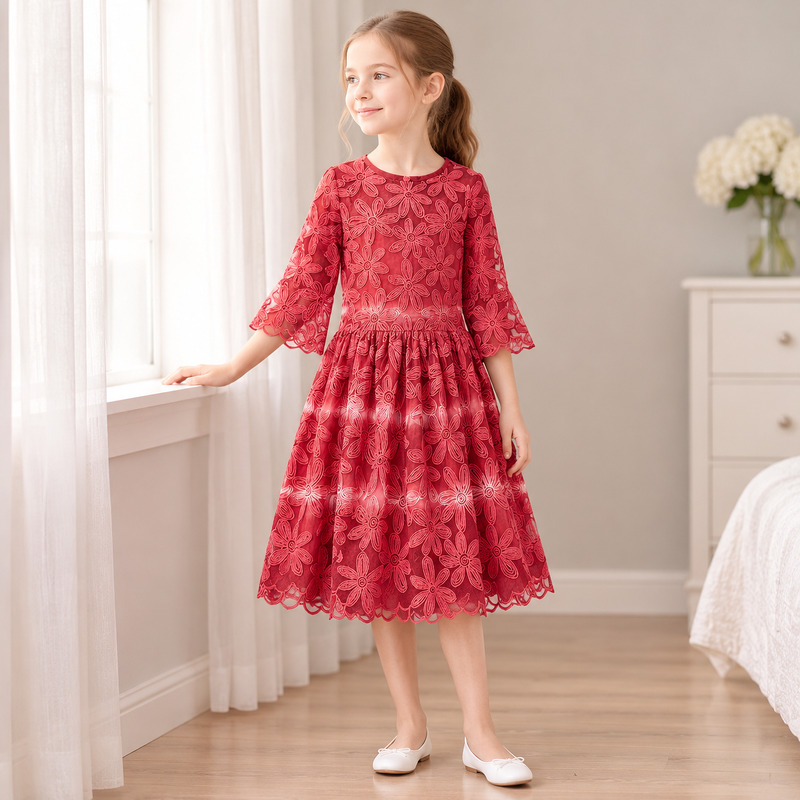
A lace dress in cotton floral embroidery on an organza ground, plant dyed to a rosewood with sappanwood (苏木) and madder (茜草), no added mordant: a round neckline bound in solid cotton, three-quarter set-in sleeves, a fitted bodice joined to a gathered skirt at the waist, an invisible zip at the centre back, and edges finished by the lace's own stitched scallop rather than by a hem.
Two things separate this from a plain dyed dress. The first is that the bath holds two fibres — the cotton of the embroidery and the organza of the ground — which take the same dyestuff to different depths, and that difference is what makes the flower legible. The second is that the pale bands are the garment's own doing: the dress was tied at the waist, at the sleeve openings and through the skirt before it went into the bath, so the resist pattern is generated by its construction and changes with its size.
At a glance
1. Two fibres in one bath, and the gap between them is the design
- The embroidery is cotton and the ground is organza, so the same dyestuff sits on cellulose and on protein in one dip. They do not reach the same depth, and they do not read at the same opacity.
- The ground comes out a step deeper and more transparent, the embroidery lighter and denser. That contrast is what makes a lace flower read at three metres; a cloth dyed to one flat value loses the motif and looks like printed net.
- So the ground is the reference and the embroidery is read against it, not the other way round, because the ground covers the larger area and sets the colour of the dress.
- The sheer ground is read twice. Its depth is the colour of the layer in front plus whatever shows through from behind, so the bodice and the skirt read as two values of the same cloth, which is why approval is on the made-up dress.
- The fibre of the ground is fixed with the fabric order. A protein ground takes these dyestuffs alongside the cotton; a synthetic ground takes none of them and stays pale, which is a different dress, not a lighter one.
2. The pale bands are the garment's own construction
- On this sample the pale line sits at the waist, at the sleeve openings and along the folds of the skirt — the points where the dress was tied or compressed before it went into the bath. The band is neither a print nor a fade; the liquor was held out there.
- That makes the pattern a product of the pattern room as much as of the dyehouse. Move the waist seam and the band moves with it; deepen the gather and the band widens.
- It also makes the pattern size-specific. A 5Y waist is a different circumference from a 3Y, so the tie sits at a different scale on the body, and the band on a child is not the band on the sample scaled up.
- Pale is a value, not an absence. The band is the same cloth at low take-up, so it carries the same dye chemistry and is judged on contrast against the deep areas rather than on whiteness.
- Where a band falls matters more than how pale it is. A band at the waist reads as a sash line; the same band a hand's width lower reads as a mistake, so its position is a specified dimension, agreed per size on the sample.
3. The scallop is the hem, and it is stitched rather than cut
- The sleeve and skirt edges are the lace's own scallop, worked in a dense satin stitch, so there is no allowance to turn and no hem to press. The edge is finished in the embroidery.
- That makes the skirt length the scallop line, not a cut line. Length is changed by where a motif row falls, in whole repeats; cutting between repeats shortens the dress and leaves a scallop that no longer closes.
- The scallop is also the wear point. It is a stitched edge with nothing behind it, so it abrades before the cloth does; abrasion is tested on the edge, not on the middle of a panel.
- Repeat and sweep are planned together per size. The skirt is gathered, so the scallop spacing at the hem changes with the gather ratio; a repeat that reads evenly on 3Y crowds on 8Y.
- The neckline is the exception and is bound in solid cotton, because a scalloped edge has no straight run to bind and a raw organza edge at a child's neck is not a finish.
4. The waist seam cuts the motif, and the gather is bulk
- Bodice and skirt are joined at a seam the embroidery crosses, so the seam is planned on the motif repeat, with the flower rows either side set so the join reads as a design line rather than a slice.
- Organza gathers as volume rather than as drape. The cloth holds its fold, so the waist is the bulk point of the dress and the seam allowance there is the thickest place on the garment.
- So the allowance is graded and pressed flat, and the seam is finished narrow, because a fold of allowance at the waist shows through the sheer skirt below it as a dark line.
- The gather ratio is set per size against the skirt sweep, not carried over from the bodice width; the ratio is what decides whether the skirt hangs or stands away.
- The motif is screened before the seam is sewn. A flower cut through its centre at the waist reads as damage at the one line the eye follows all the way round.
5. A sheer cloth shows every seam inside it
- Seams are French seamed and trimmed narrow, since an overlocked edge reads straight through an organza ground; the inside of this dress is as visible as the outside.
- The centre-back zip is concealed, and the tape is the part to get right: a visible zip tape on a sheer ground is a mark that cannot be corrected afterwards, only re-made.
- The armhole is the second bulk point after the waist, because a set-in sleeve in a stiff ground stacks its allowance against the shoulder seam; it is graded and pressed over a ham rather than flat.
- Thread colour is matched to the deep ground, not to the pale band, so the seams read as shadow rather than as stitching.
- Every dress passes needle detection at the end of the line, with the scallop edge hand-checked as well, since a dense satin edge is where a broken tip lodges.
- Pressing is the last risk: a hot iron glazes a sheer ground and flattens the embroidery, so the dress is pressed at low heat from the inside, with the scallop left off the iron.
6. Class II, and a deep rose on a thin ground
- 3Y, 5Y and 8Y sit in Class II, not Class I, because the article is for children over 36 months; the Class II scope for this cloth, colourway and trim is confirmed against the certificate at quotation.
- The two components are tested separately. Embroidery and ground hold different amounts of the same dyestuff, so wash, rub and light are run on each and reported apart; an average would describe neither.
- Light changes contrast before it changes shade. A rose built without a metal salt on a thin ground is the case to watch: motif and ground move at different rates, so a garment can lose its flower before it looks faded.
- Washing runs on the made-up dress, with the scallop edge and the waist seam in the load, and the deep areas are read against their own unwashed counterparts rather than against a card.
- Phenol yellowing to ISO 105-X18 runs on a specimen carrying the packing fold with packaging free of BHT, because a rose holding tannin is one of the shades that moves in the box.
7. Sizes, sampling and quoting
- Three sizes graded on measurements: 3Y, 5Y and 8Y move on chest, bodice length, waist position, skirt length and sleeve length. Skirt length is set in whole scallop repeats, so the grade is not a straight percentage.
- The tie position is graded with the waist, since the pale band is a dimension to be placed, not an effect to be hoped for.
- Customization. Sleeve length and edge treatment; plain or scalloped neckline detail; lining in cotton voile, or unlined as sampled; tie points and band width; motif scale; and the depth of the rose, each sealed on its own reference pair.
- Sampling: 3-7 days from a confirmed tech pack, covering a dyed strike-off on both components with its reference pair, a made-up dress with bound neck, concealed zip, waist seam and scallops finished as production, a wash-and-remeasure with the pale band re-read, crock on both components and on the scallop edge, light on deep and pale, a zip check and a fit check at 3Y and 8Y.
- Skin-contact tests run with the same lot: perspiration to ISO 105-E04, pH measured on the garment and held between 4.0 and 7.5, and extractable heavy metals tested on the finished garment rather than on the greige.
- Bulk: 30-60 days from approval, planned per tie batch and per dyebath, since each size is tied at its own circumference and the layout follows the motif repeat; AQL 2.5 major and 1.0 critical.
- MOQ: 300 pcs for a custom development covering cloth, shade, resist, trim or fit; 50 pcs for a decorative process on a stock body; 100 pcs for stock cloth with your own logo and label. Mixed colour and size orders are quoted per order.
Production runs with our production partner, Suzhou Shelmin Trade Co., Ltd.: founded 2017, 7,200 m² workshop, 8 lines, 200 staff, 6,000 pieces per day. Design confidentiality is held under NDA; buyer patterns, shades and prints are not re-used.
To quote, we need: target market and the Class II tests it requires; the fibre of the organza ground, since a protein ground takes the plant dyes and a synthetic one does not; whether the rose is built by dip count or with a mordant, since that changes depth and the light fastness you can promise; tie points and band width per size; motif repeat and scallop pitch; lining or unlined; zip type; lot certificates for both plants and for the embroidery; the pH target and the dyehouse water specification; packing method; and whether certification is to run in your brand name.