EN

OEM/ODM Custom Pet Apparel | 100% Cotton Organic Plant-Dyed Dog Tank Top | Eco-Friendly Non-Toxic Botanical Tie-Dye Cat Vest for Private Label | Vibrant Yellow Sustainable Puppy Shirt | Wholesale Pet Clothing Manufacturer


- Overview
- Plant Dyed Cotton Pet Vest, Coral Shell | OEM
- Recommended Products
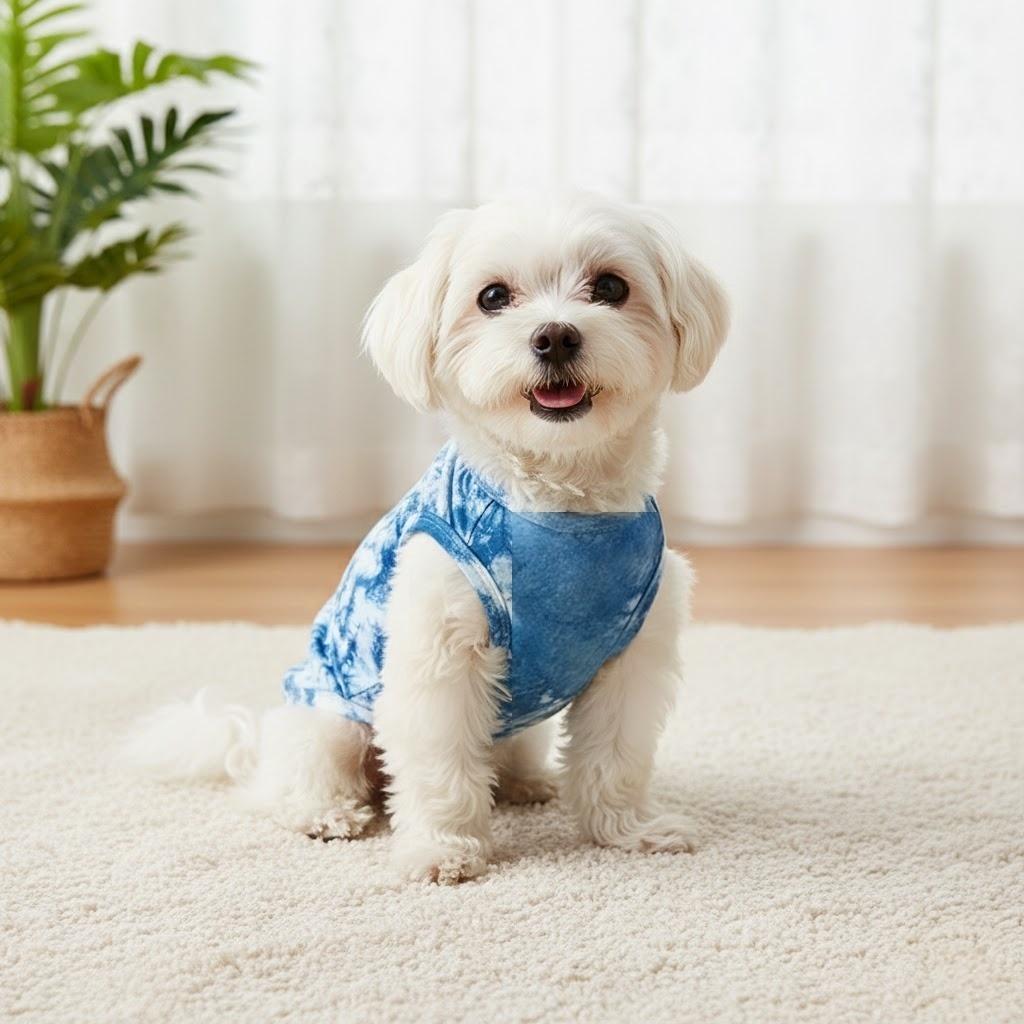
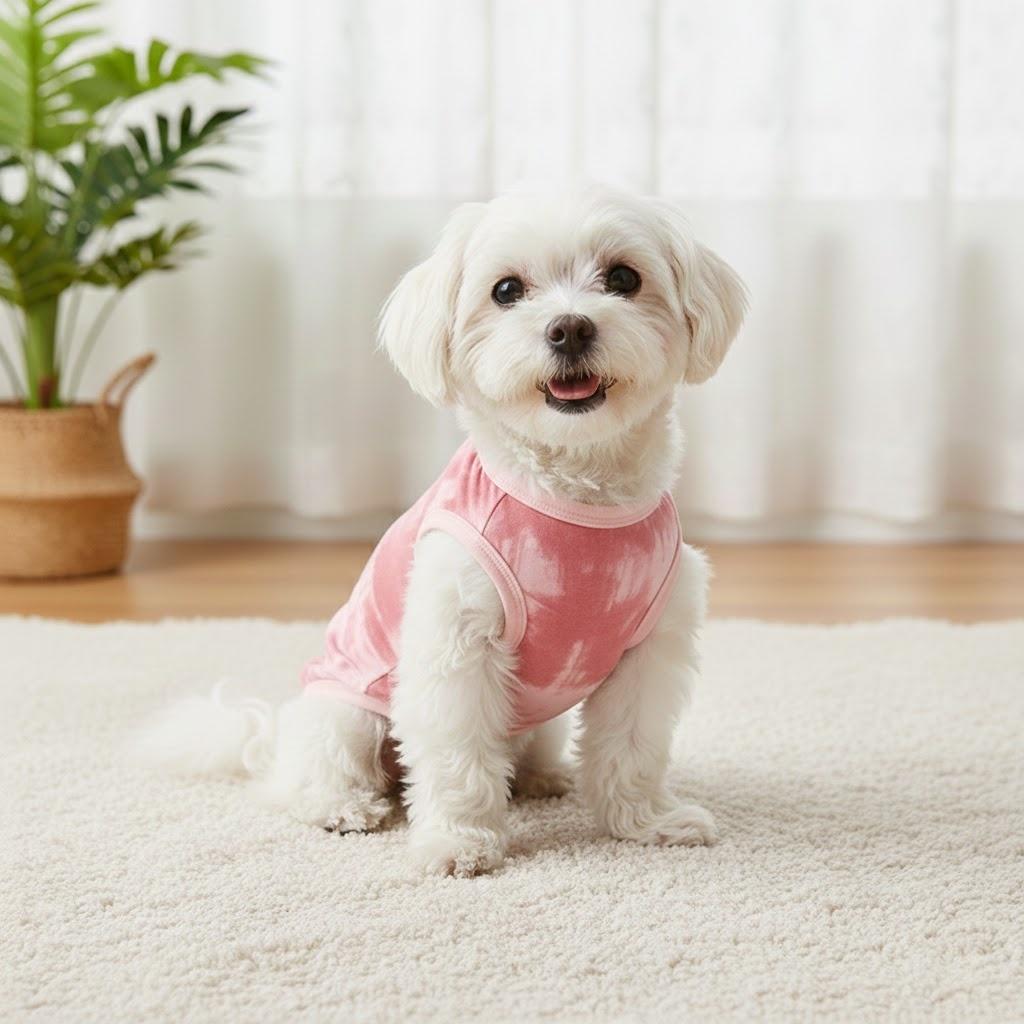
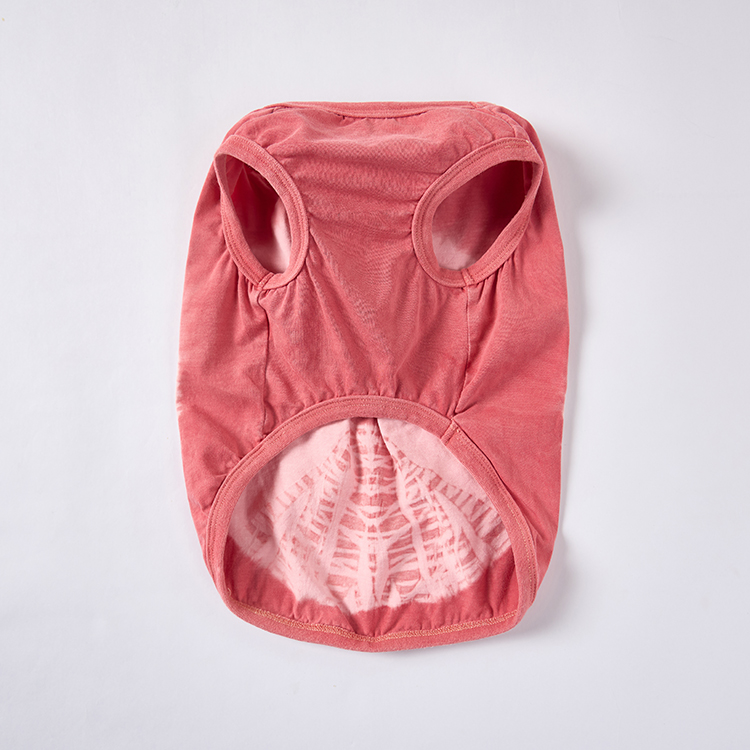
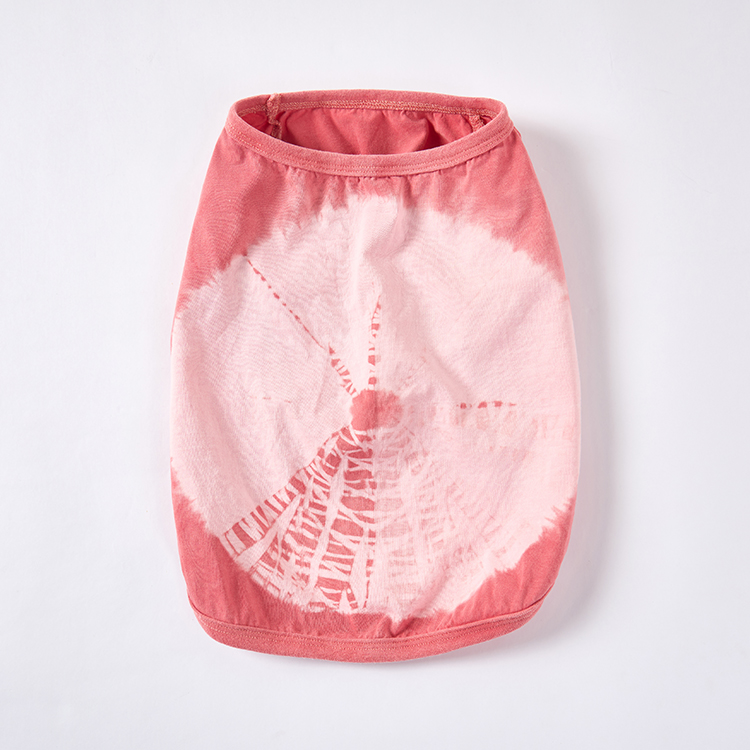
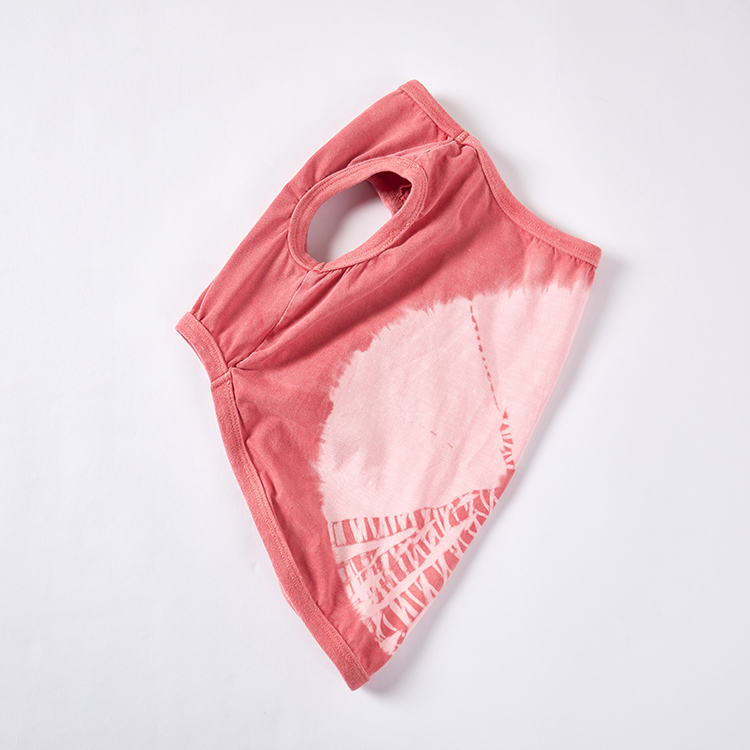
A sleeveless vest for a small dog or a cat, in a 100% cotton knit dyed with sappanwood (苏木) and madder (茜草): a bound neck opening, two bound front-leg openings, a long bound belly opening, and a solid coral outside with a paler, laddered inside that shows through the belly gap when the vest is laid flat.
Two things make this garment different from a child's tee, and both matter more than the pattern. The first is that the inside is a wear face: it rubs against the coat, it is reachable by the tongue, and on this vest it is visibly paler and differently textured from the outside. The second is that the vest has no fastening at all, so it goes on over the head and comes off the same way, and everything that holds its shape is a binding.
At a glance
1. The inside is a wear face
- On a garment for an animal the inside is not hidden: it lies against the coat, it moves with every step, and it is the face a tongue can reach.
- On this vest the inside is visibly paler than the outside and carries a laddered marking, which is what the reverse of the cloth looks like where the colour did not reach as deeply, or what a second layer looks like where one is used; which of the two it is, is confirmed on a cut sample rather than argued from a photograph.
- That difference is a specification item, not a curiosity: a buyer who turns the vest inside out sees a different colour, so either the difference is declared as part of the product or the inside is dyed to match, which is a different process.
- The belly opening puts the inside on display even when the vest is worn, since the gap is wide and the inner face shows through it; that is why the inside is finished as a face and not as a back.
- No loose thread, no knot and no untrimmed seam end is acceptable on the inside, because there is nothing between the animal and the inside of the garment.
2. Four openings, four bindings, and the binding is the frame
- The vest has four openings — neck, two legs, belly — and every one is bound with a strip of the same cloth, folded over the edge and coverstitched.
- Nothing else holds the shape: there is no seam structure to speak of, so the four bindings act as a frame, and a vest with one binding left off does not lie flat.
- Binding also stiffens, so each opening keeps its shape instead of curling: the neck stands away from the throat, the leg openings stay round rather than collapsing onto the shoulder.
- That stiffness is a fit variable, because a bound leg opening has less give than the knit it surrounds; the leg opening's position and diameter decide whether the animal can move its shoulder freely.
- The binding is also where the garment wears out, since it is the edge that rubs, and it is where crock and abrasion are read rather than in the middle of the panel.
- The belly binding takes the most movement, because it bends with the animal's flank on every step, and it is checked with the vest on a form rather than flat.
3. Two sizes, two measurements
- Two sizes cannot cover a population, so the size chart has to say which measurement governs and which one follows.
- Chest girth governs, because the vest closes nowhere: if the girth is wrong the vest either rides up the shoulders or hangs off the ribs, and no other measurement can correct it.
- Back length follows, and it decides where the belly opening ends; a back that is too long puts the opening past the hind legs, a back that is too short leaves it in front of them.
- Leg opening position is the third number and the one buyers underestimate, since it is set relative to the neck, and a few millimetres of movement changes whether the front legs step freely.
- So the two sizes are approved as a pair on a form, with the girth, the back length and the distance from neck to leg opening written down together, and the pair is what a buyer sees rather than either size alone.
- A third size is a pattern change rather than a grade, because at some point the leg opening has to move rather than grow; that is quoted as a separate development.
4. A pull-over with nothing to chew
- There is no hook-and-loop tape, no button, no zip, no cord and no toggle anywhere on this vest, which is the simplest position available for an animal that will mouth what it can reach.
- The consequence is that the neck opening has to pass the head, so it is sized from the head rather than from the throat, and it is the reason the neck binding has to be soft enough to slide over ears without catching.
- It also means there is no adjustment: the fit is entirely in the girth and the two openings, so the size chart is doing the work a fastener would otherwise do.
- The neck binding is the part that is handled most, both when the vest goes on and when it comes off, so it is checked for recovery rather than only for appearance.
- Nothing on the vest is a small part, which is stated plainly because it is the one place where the design is doing compliance work rather than decoration.
5. Where fastness is actually read
- Rub fastness is read on the inside and on the bindings, not in the middle of the outside panel, because those are the faces that move against the coat and against the animal.
- The belly binding is the first place to check, since it is the edge that bends most and the one nearest the tongue.
- The neck binding is the second, because it is gripped on every dressing and undressing.
- Colour that comes off on a pale coat shows at once, which makes a pet garment less forgiving than a child's on the same shade, and it is the reason the inside's depth is a decision rather than a by-product.
- The pale inside is also the detector for anything that moves in the wash, since a shift shows there as a change of contrast against the outer face rather than as a change of shade.
6. What is fixed here, and what is confirmed at quotation
- Fixed by the brief and the sample: the composition as 100% cotton, the two dyestuffs, the construction, the four bindings and the absence of hardware described on this page.
- Not asserted here: the mordant route, any certification for the cloth, the requirements that apply to pet textiles in the destination market, and the test list. Pet apparel does not map onto the children's-wear classes, so the requirements are read per market and confirmed at quotation against documents rather than stated on a page.
- This page also makes no claim about an animal's health or safety, and none about suitability beyond fit; those are the buyer's declarations to make once the documents are in hand.
- The mordant changes what can be claimed, not only what is seen: with no mordant the shade is built by repetition, with one the depth arrives faster at a different light fastness, and the two are different products.
- The inside's depth and the binding's shade are the two components that need their own line in the specification, because both are visible and both are handled.
7. Sizes, sampling and quoting
- Two sizes graded on measurements: S and M move on chest girth, back length, neck opening, leg opening diameter and the distance from neck to leg opening.
- Customization. The inside's depth, either the natural paler reverse declared as the product or a matched inside quoted as a second pass; binding width and its shade; neck opening sized from the head; leg opening position; belly opening length; the knit's gauge; and the mordant route quoted as two products, each sealed on its own reference set.
- Sampling: 3-7 days from a confirmed tech pack, covering a dye strike-off with its reference pair, a cut sample showing the reverse face so the paler inside is either confirmed or explained, a made-up vest with all four bindings finished as production, both sizes fitted on a form with girth, back length and neck-to-leg measured, the belly and neck bindings read for recovery, crock on the inside and on each binding, a wash-and-remeasure of the bindings and of the inside's contrast, and the inside inspected for thread ends.
- Bulk: 30-60 days from approval, planned per bath and per binding run, with the binding shade and the inside's declared depth written into the specification so the second lot matches the first; AQL 2.5 major and 1.0 critical.
- MOQ: 300 pcs for a custom development covering cloth, shade, binding or fit; 50 pcs for a decorative process on a stock body; 100 pcs for stock cloth with your own logo and label. Mixed colour and size orders are quoted per order.
Production runs with our production partner, Suzhou Shelmin Trade Co., Ltd.: founded 2017, 7,200 m² workshop, 8 lines, 200 staff, 6,000 pieces per day. Design confidentiality is held under NDA; buyer patterns, shades and prints are not re-used.
To quote, we need: destination market and the requirements it applies to pet textiles; whether the paler inside is declared or matched, so both versions can be quoted; chest girth, back length and neck-to-leg distance for S and M; neck opening taken from the head measurement; binding width and shade; the knit's gauge; whether the mordant route is to be used; the certificate held for the cloth and the scope you need; lot certificates for both dyestuffs; the pH target and the dyehouse water specification; packing method; and whether certification is to run in your brand name.