EN

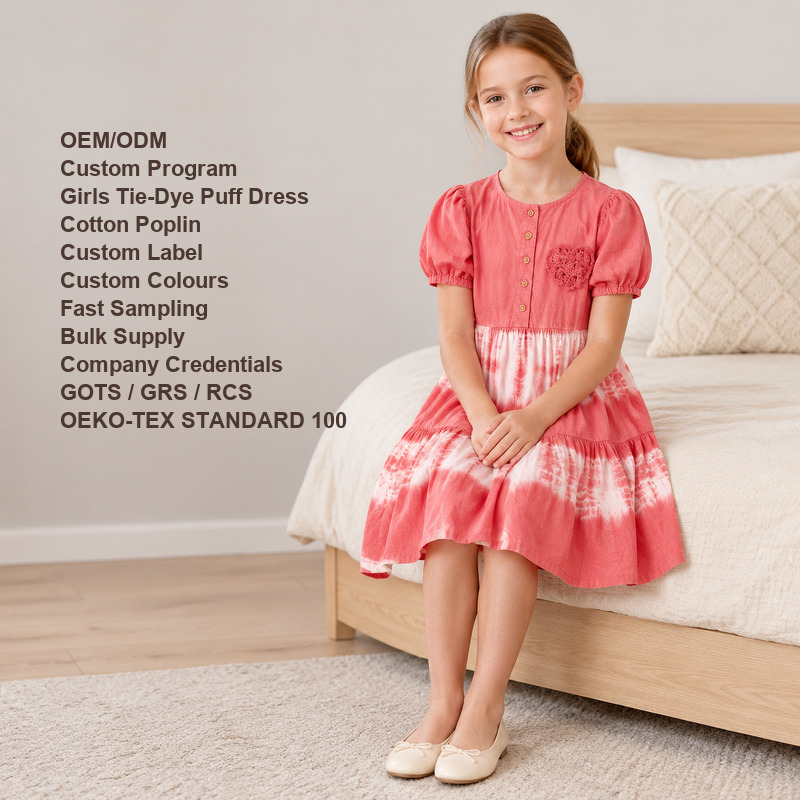
Custom Girls Cotton Tie Dye Tiered Dress Plant Dyed Puff Sleeve Boutique Dress OEM ODM Kids Clothing Manufacturer


- Overview
- Plant Dyed Tiered Cotton Dress, Coral Ladder | OEM
- Recommended Products
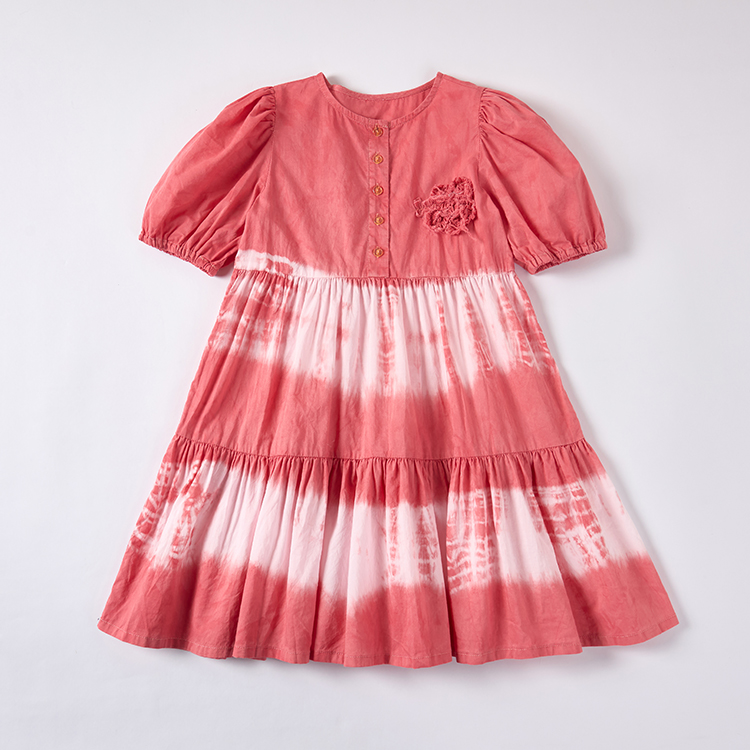
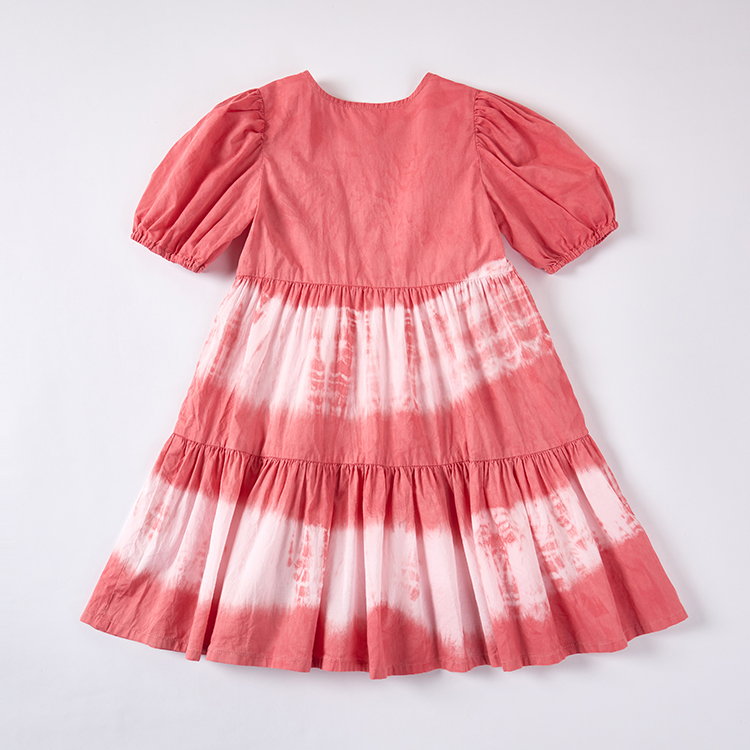
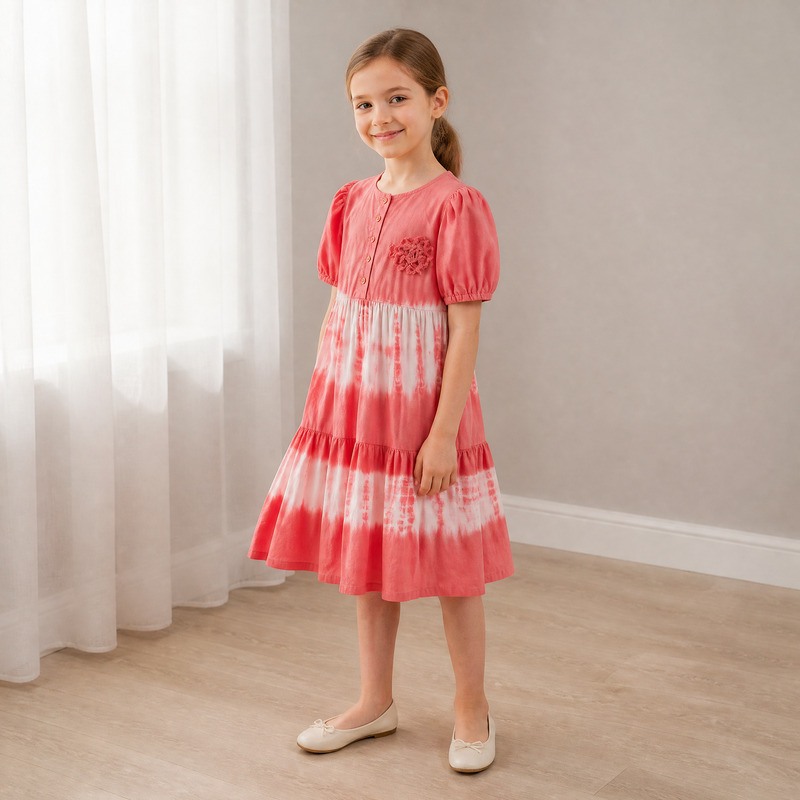
A short-sleeve dress in a 100% cotton cloth, dyed with sappanwood (苏木) and madder (茜草) to a coral that breaks into pale blocks across the skirt: a narrow placket with five buttons, a faced round neck, puff sleeves gathered into elasticated cuffs, a crocheted heart applied at the left chest, a gathered seam across the chest, and two tiers below it, each gathered.
The pale blocks look like a band running round the skirt, and at the tier seam they stop. That is not a dyeing fault. The skirt is two separate panels, cut from two different places on the dyed cloth and gathered at different ratios, so a band that crosses the seam is not something the dyeing can deliver, whatever the specification asks for.
At a glance
1. The pale blocks are a clamp and a fold, not a painted band
- The pale areas carry fine vertical striations, and those lines are the folds the cloth was pressed into while it was held out of the liquor.
- Their edges are straight or stepped rather than soft, which is the signature of a hard resist: a clamp, a fold or a bundle face holds the liquor away along a line.
- That fixes the character of the pattern at the sample, because neither more dips nor a longer soak softens a clamped edge into a gradient; the edge is a property of how the cloth was held, not of how long it was in the bath.
- The striations inside a block are the record of the fold count, and they are why two blocks of the same width can read differently: one is finely pleated, the other folded twice.
- So a block is specified by its edge, its striation density and its width, and not by a drawn outline; the sample is the reference and the specification describes what the sample shows.
2. A band does not cross a tier seam
- The skirt is two panels, an upper tier and a lower one, each cut as its own rectangle and gathered onto the piece above it.
- Each rectangle comes from a different place on the dyed cloth, so the pale block on the upper tier rarely meets a pale block on the lower one at the seam.
- Gathering then narrows both, so even a block cut from a continuous stretch would arrive at the seam at a different width on each side.
- What the garment shows is a block that ends at the seam, a tier below that begins in coral and carries its own pale band nearer the hem, and that is the honest description of what a tiered skirt does to a banded pattern.
- There are two ways to work with it: accept the break as a rule and let each tier carry its own band, or place the bands so the break reads as a rhythm, which means setting each band's position as a share of its own tier rather than as a distance from the hem.
- What is not available is a band that continues, and a specification written that way will be argued over at every inspection until one of the two routes is chosen.
3. Two ratios, two widths
- A gathered tier takes up cloth in proportion to its ratio, so the same block appears narrower on the tier with the higher ratio.
- The lower tier is always the fuller one, which means a block of a given width reads wider on the upper tier and narrower on the lower, and the difference is set by the ratios rather than by the dyeing.
- That is why block width is specified per tier, as a range measured on the made garment and not on the flat panel: the flat panel cannot show the effect at all.
- The gather also bends the striations, so a block that is parallel-sided on the flat panel arrives at the skirt with its striations fanning slightly where the gathers are tightest.
- Both effects are read on the hanging dress, because the gathers settle once the weight of the lower tier pulls on them.
4. The layout follows the pattern, not the marker
- The bodice is close to solid coral, while the skirt carries the pale blocks, and both come from the same dyed cloth.
- That means the garment is cut around where the resist sat: the bodice is taken from areas that were fully in the liquor, the tiers from the banded areas.
- So the marker is planned from the pattern rather than from the yield, and the cost of that planning shows up as cloth consumption rather than as an inspection issue.
- It also means the bodice can be made solid on purpose: a run that needs a solid bodice and a banded skirt is cut from the same pieces, with the tiers taking the banded length.
- Where the cloth offers less solid area than the bodice needs, the choice is to accept a faint block on the bodice or to take a second length of cloth; both are quoted rather than assumed.
5. Small elements on a large pattern
- The placket is a narrow band with five buttons, and it sits on the solid part of the bodice, so it does not compete with the pattern; its topstitching is the only straight line on the upper body and is read against the neck facing.
- The puff sleeve is gathered at the head and again into its cuff, so the sleeve carries two gathers and the cuff's elastic decides how much of the puff survives; the cuff is narrow, and it is the part that takes the wear.
- The crocheted heart is applied at the left chest, which makes it the one asymmetric element on the dress; it is a separate component in a thicker yarn, so it takes the dyestuff at its own rate and its shade is confirmed on the garment rather than assumed to follow the shell.
- The heart's outline is hand-stitched, so it is judged for a consistent edge rather than for a machined line, and its position is measured from the placket rather than from the side seam, because the placket is what the eye uses.
- The neck is finished with a narrow facing, which is a doubled layer over a light cloth; it is read for a clean outer edge and for a facing that does not roll into view.
6. What is fixed here, and what is confirmed at quotation
- Fixed by the brief and by the sample: the composition as 100% cotton, the two dyestuffs, the construction, the finishes and the trims described on this page.
- Not asserted here: the mordant route, the certification held for the cloth and its scope for this article and colourway, the chemical class that applies to the size range, and the test list. Each of these can be quoted by a buyer, so each is confirmed at quotation against documents rather than stated on a page.
- The mordant matters to the claim, not only to the colour: with no mordant the shade is built by repetition, and with one the depth comes faster at a different light fastness; the two routes are different products and are not interchangeable at the sample stage.
- The size range spans more than one class in the usual schemes, so the class that applies is read per size against the destination market, and the tests follow the market and the class rather than the page.
- The buttons and the cuff elastic are the two components that need their own declaration, since neither is the shell cloth and both are handled by a child; their material is confirmed by the supplier's document rather than described here.
7. Sizes, sampling and quoting
- Three sizes graded on measurements: 3Y, 5Y and 8Y move on chest, bodice length, placket length, sleeve, cuff opening, tier depths, tier ratios and hem sweep.
- Customization. Band behaviour per tier, either accepted as a break or placed as a share of each tier's depth; block width range per tier; striation density; placket length and button count; cuff depth; heart size and position; the mordant route, quoted as two products rather than one; and the class and test list per size, each sealed on its own reference set.
- Sampling: 3-7 days from a confirmed tech pack, covering a resist strike-off with its reference pair, a flat panel showing blocks with their edges and striations, a made-up dress with placket, neck facing, cuffs and both tiers finished as production, band position measured on each tier and written down separately, block width measured per tier on the hanging dress, a wash-and-remeasure of the tiers and of the cuff elastic, crock on a block edge and on the solid ground, and the heart's position measured from the placket.
- Bulk: 30-60 days from approval, planned per resist bundle and per bath, with the marker laid out from the pattern and the band positions written per tier so the second lot starts from a number rather than from a photograph; AQL 2.5 major and 1.0 critical.
- MOQ: 300 pcs for a custom development covering cloth, shade, resist, tiering or fit; 50 pcs for a decorative process on a stock body; 100 pcs for stock cloth with your own logo and label. Mixed colour and size orders are quoted per order.
Production runs with our production partner, Suzhou Shelmin Trade Co., Ltd.: founded 2017, 7,200 m² workshop, 8 lines, 200 staff, 6,000 pieces per day. Design confidentiality is held under NDA; buyer patterns, shades and prints are not re-used.
To quote, we need: target market and the class and test list it requires per size; whether the mordant route is to be used, so the two versions can be quoted side by side; whether the band is accepted as a break or placed per tier; block width range and striation density; placket length and button count; cuff depth; heart size and position; the certificate held for the cloth and the scope you need; lot certificates for both dyestuffs; the pH target and the dyehouse water specification; packing method; and whether certification is to run in your brand name.