EN

OEM/ODM Girls Dress | 100% Cotton Mesh Organic Plant-Dyed Kids Tulle Skirt | Eco-Friendly Non-Toxic Botanical Dye Eyelet Lace Toddler Apparel for Private Label | Sustainable Breathable Children Boutique Clothing Wholesale


- Overview
- Custom Plant-Dyed Cotton & Mesh Girls Boutique Dress
- Recommended Products
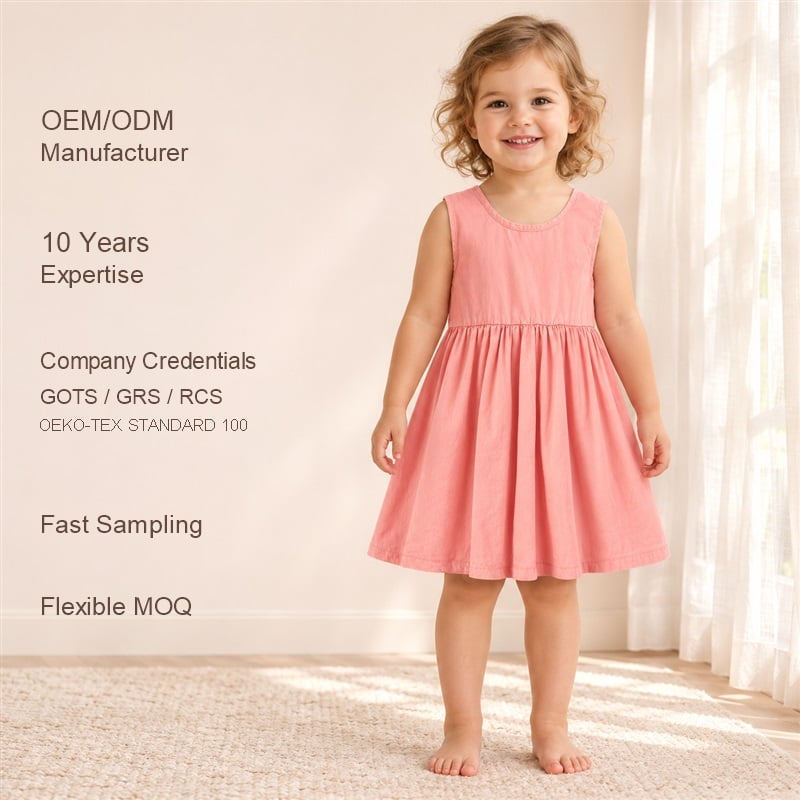
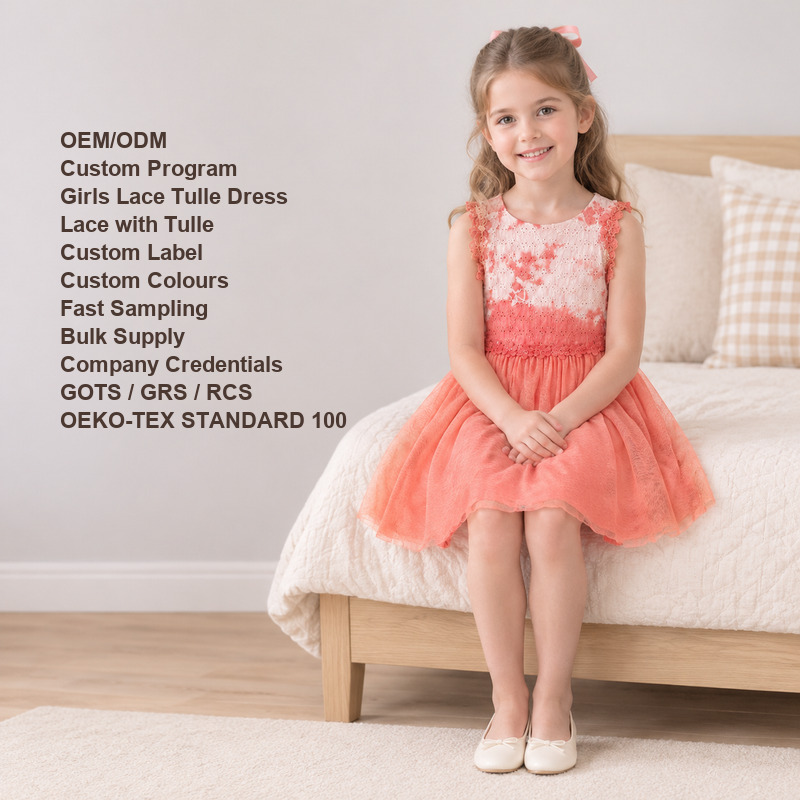
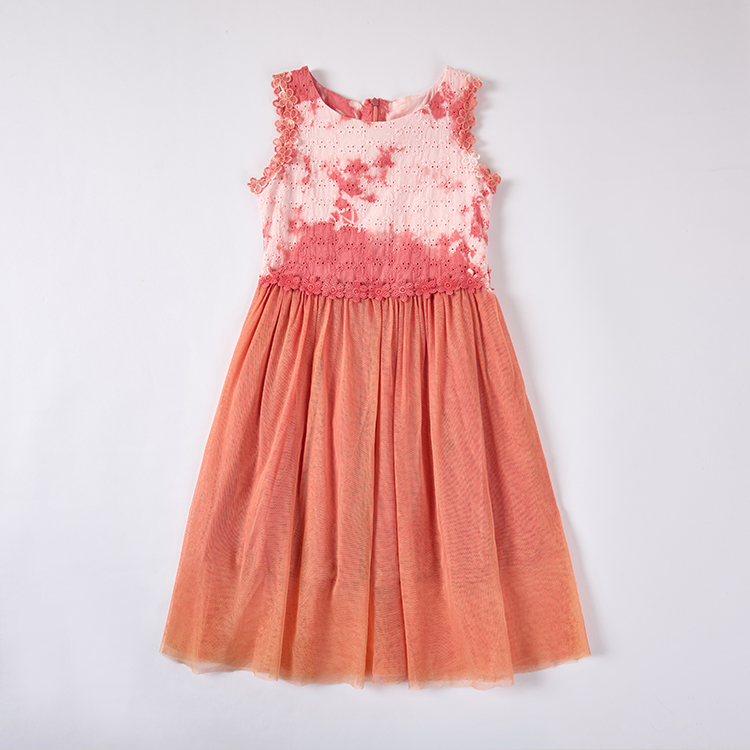
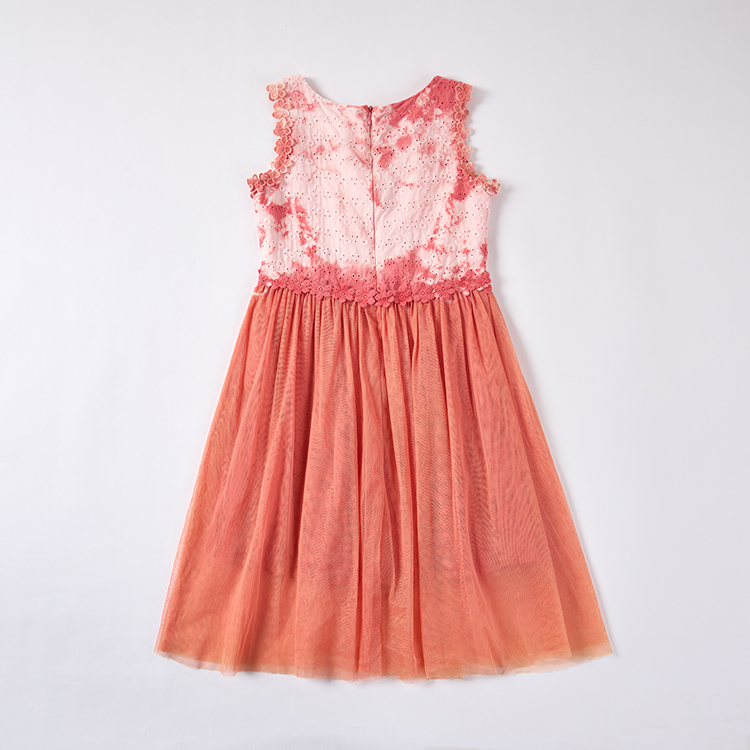
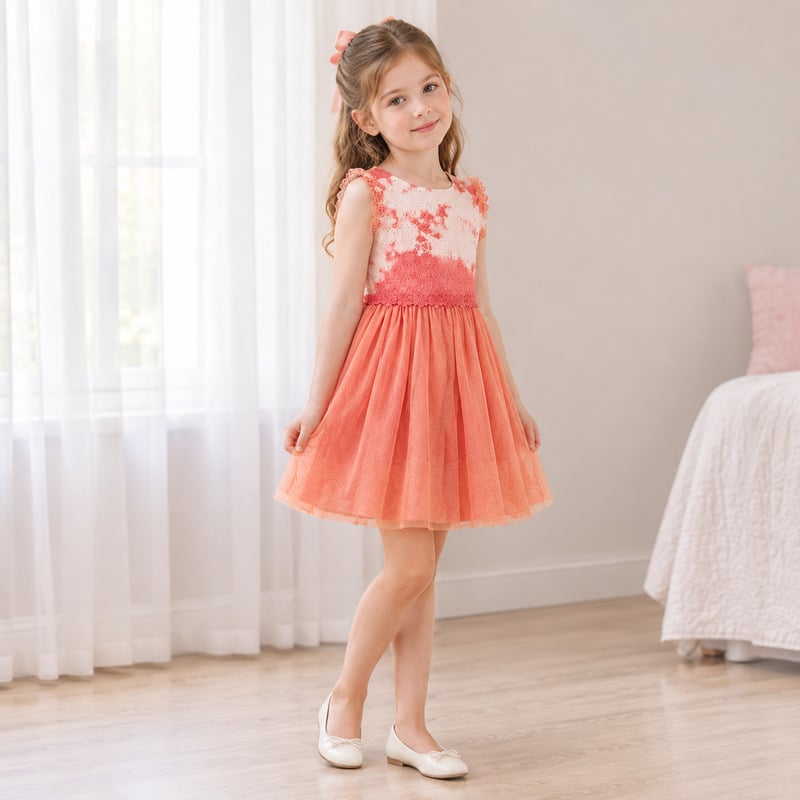
A party dress built from two cloths: a cotton eyelet bodice, dyed to a pale field carrying coral blotches with a dense embroidered border at its lower edge and scalloped lace flounces at the armholes, and a gathered fine mesh skirt that hangs over a dyed cotton lining.
The skirt is where the garment stops being one colour. A fine mesh, where it is a synthetic mesh, takes no plant colour at all, so the coral you see below the waist is not mesh: it is the dyed lining, filtered through the mesh. That single fact governs the shade approval, the washing behaviour and what the words "plant dyed" refer to on this dress.
At a glance
1. The skirt is two cloths making one colour
- The mesh does not take the dyestuff, so every bit of coral below the waist sits in the lining and reaches the eye through the mesh.
- That makes the skirt colour a result rather than an input: mesh shade, mesh openness and lining shade combine into one visible colour, and none of the three alone predicts it.
- The mesh still has a shade of its own, and it is rarely neutral: a brightened white mesh cools the coral, an ecru mesh warms it, and both are sold as "mesh".
- So the mesh is specified as a lot with a shade, not as a component name, and the lot is kept for the order; a substitute lot on the second run is the most common cause of a skirt that reads different while nothing in the specification changed.
- Where a cotton bobbinet is used instead, the mesh does take the colour and the geometry changes with it: a cotton net is softer, hangs closer to the lining and costs differently. It is a separate quotation, not an upgrade.
2. The lining is what gets approved
- Since the mesh filters rather than colours, the approval is made on the assembly: lining square, mesh square, in that order, tacked together and read as one.
- Approving the lining flat is the mistake this dress invites, because a lining that is right on its own reads wrong under the mesh, and the deeper the coral the more the mesh pulls it toward the mesh's own cast.
- The dyed lining is read under daylight and under shop light, because a coral lining under a mesh loses saturation indoors faster than a solid coral does; a skirt approved under one light only is a skirt that ships and then disappoints.
- The blotch on the bodice is not the reference for the skirt. They are two different dyeing routes and two different depths, and the eye reads them as a pair of related corals rather than as a match.
- The lining is cut and sewn as a full skirt, so it carries the same gather as the mesh and the same weight; a lighter lining saves cost and changes the drape of the whole skirt.
3. Two layers, two shrinkages, one hem
- Cotton shrinks in the wash and a synthetic mesh does not, so a lining cut to the same length as the mesh will hang below it after the first wash.
- The lining is therefore cut short by the measured differential, and the differential is measured on the actual two cloths after a wash rather than assumed from the fibre content.
- The hem is where it shows first, as a coloured line creeping out from under the mesh; the same fault read from the inside is a lining edge that has dropped below the mesh edge.
- The waist is gathered with both layers together, so the two cloths are handled as one at the seam and the differential is taken out at the hem, where it can be trimmed at the last operation.
- The mesh hem is a clean cut rather than a folded allowance, because a fold on a fine mesh stiffens the edge and shows as a hard line; the cut edge is what gives the skirt its light finish, and it is inspected for a clean line the whole way round.
4. Eyelet is a pierced cloth, so a blotch is read on the field
- The bodice has holes in it, so the blotch is never seen on uninterrupted cloth: over the dot field, part of what the eye reads as colour is the shadow of the holes.
- That makes a blotch look stronger on the dot field than on the plain areas between motifs, and a swatch judged flat does not predict it.
- The embroidery is a second structure in the same cloth, with its own thread count and twist, so it takes the dyestuff at its own rate: the satin-stitched motifs read a step deeper than the ground they sit on, and that step is present before any blotch is added.
- The border at the waist reads deeper and more even than the field, and the reason is thread mass rather than a second dyestuff: the dense stitching holds more liquor than the open ground does.
- The blotch is accepted on the made-up bodice, in daylight, at reading distance, with the dot field and the border both in view; the flat panel is kept only as the record of what was dipped.
5. Three depths, and two of them have to agree
- The bodice field, the border and the armhole flounce are three depths on one garment, and only the border and the flounce can be matched to each other, because the field is mottled and offers nothing to match against.
- So the trims are approved as a pair: the scalloped armhole lace and the waist lace border, read together, on the same bench, from the same lot.
- A trim from a second lot is the fault that gets through, because both are deep and even, and a small step between them is invisible on the trim card and obvious at the waist where the two meet the border.
- The flounce is set into the armhole edge rather than applied over it, so the armhole seam sits under the scallop; that keeps the flounce sitting out instead of flattening, and it is the seam the eye looks at when the dress is worn.
- The scallop pitch is set per size, because the armhole grows with the size and a fixed number of scallops spreads them apart at 8Y.
6. What is on the garment, and what is not cotton
- "100% cotton" here refers to the bodice and the lining, and the mesh and any interlining are declared as their own components; the garment as a whole is not presented as all-cotton, and the material list is what a buyer's compliance team reads first.
- The neck tie is the one cord-like element, a narrow tie knotted at the centre front neck; it is specified short, with the knot fixed and the ends finished, or replaced by a stitched-down bow, and whichever route is chosen it is measured rather than assumed.
- The eyelet holes are a surface feature, not an opening: the bodice is lined, so nothing shows through the dot field, and the holes are checked for clean edges and for a thread that has not been cut beyond its ring.
- Class II applies: 3Y, 5Y and 8Y are for children over 36 months and the scope for these cotton cloths, colourway and trims is confirmed against the certificate at quotation; perspiration runs to ISO 105-E04, pH is measured on the garment and held between 4.0 and 7.5, extractable heavy metals are tested on the finished garment, and the mesh lot is declared with its fibre content.
- The mesh is the part that is washed hardest, because a fine mesh holds a crease and is usually rinsed by hand; the care route is written for the whole dress, not for the cotton alone.
7. Sizes, sampling and quoting
- Three sizes graded on measurements: 3Y, 5Y and 8Y move on chest, bodice length, waist, skirt length, lining length after the shrinkage differential, armhole and the scallop pitch on the flounces.
- Customization. Mesh openness and mesh lot shade; lining shade one or two steps deeper or paler; skirt length and fullness; border depth on the bodice; scallop pitch and flounce depth; a cotton bobbinet instead of a synthetic mesh as a separate quotation; the neck tie as a fixed knot or a stitched-down bow; and the blotch scale on the bodice, each sealed on its own reference set.
- Sampling: 3-7 days from a confirmed tech pack, covering a bodice strike-off with its reference pair, a mesh-and-lining assembly with two or three lining candidates under one mesh, read in daylight and in shop light, a made-up dress with bodice, flounces, waist border, gathered skirt, lining and mesh hem finished as production, a wash-and-remeasure of the lining differential, a shade check of the two trims as a pair, crock on the border and on a blotch edge, light on the bodice and on the skirt separately, and the neck tie measured and pulled.
- Bulk: 30-60 days from approval, planned per bodice dip, per lining dyebath and per mesh lot, with the mesh lot reserved against the order because a change of mesh lot changes the skirt colour without touching the specification; AQL 2.5 major and 1.0 critical.
- MOQ: 300 pcs for a custom development covering cloth, shade, mesh, trim or fit; 50 pcs for a decorative process on a stock body; 100 pcs for stock cloth with your own logo and label. Mixed colour and size orders are quoted per order.
Production runs with our production partner, Suzhou Shelmin Trade Co., Ltd.: founded 2017, 7,200 m² workshop, 8 lines, 200 staff, 6,000 pieces per day. Design confidentiality is held under NDA; buyer patterns, shades and prints are not re-used.
To quote, we need: target market and the Class II tests it requires; mesh fibre, mesh count and mesh lot with its shade; the lining shade you want the skirt to read as; skirt length and fullness; the armhole flounce and waist border as one lot or two; scallop pitch per size; the neck tie route; blotch scale; lot certificates for both plants; the pH target and the dyehouse water specification; packing method; and whether certification is to run in your brand name.