EN

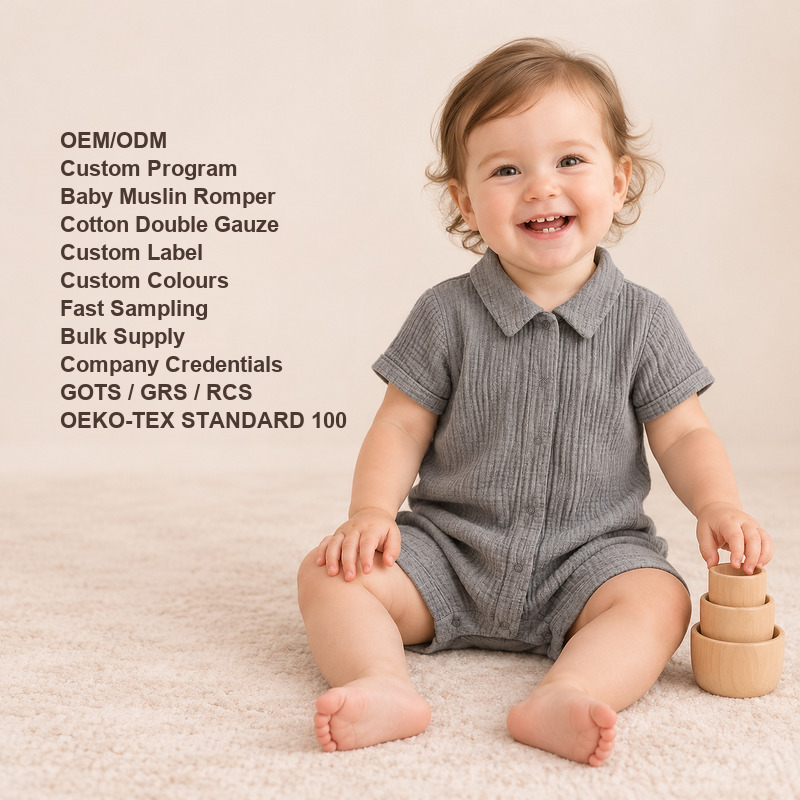
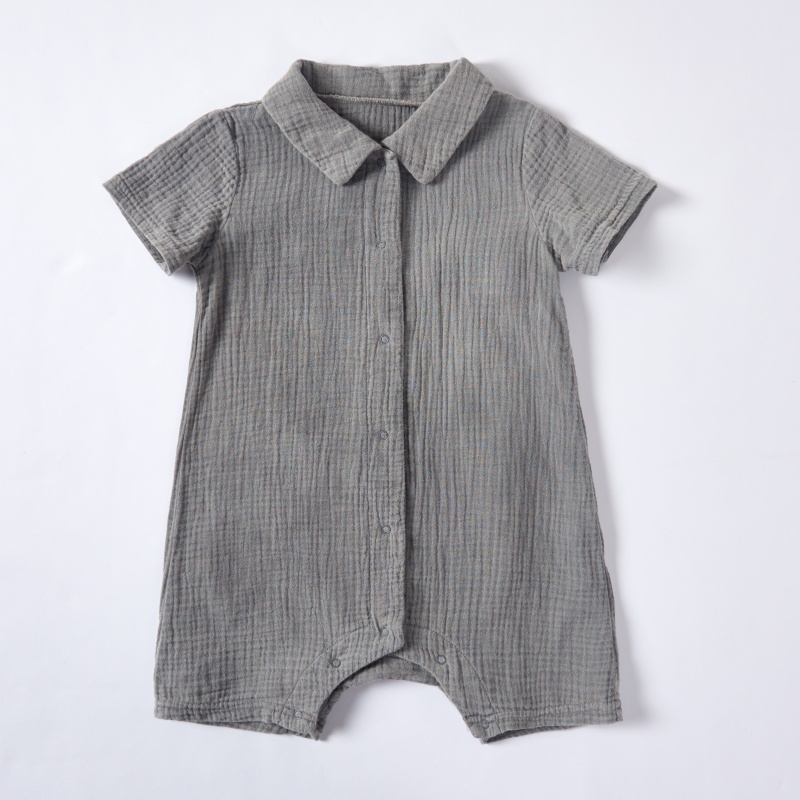
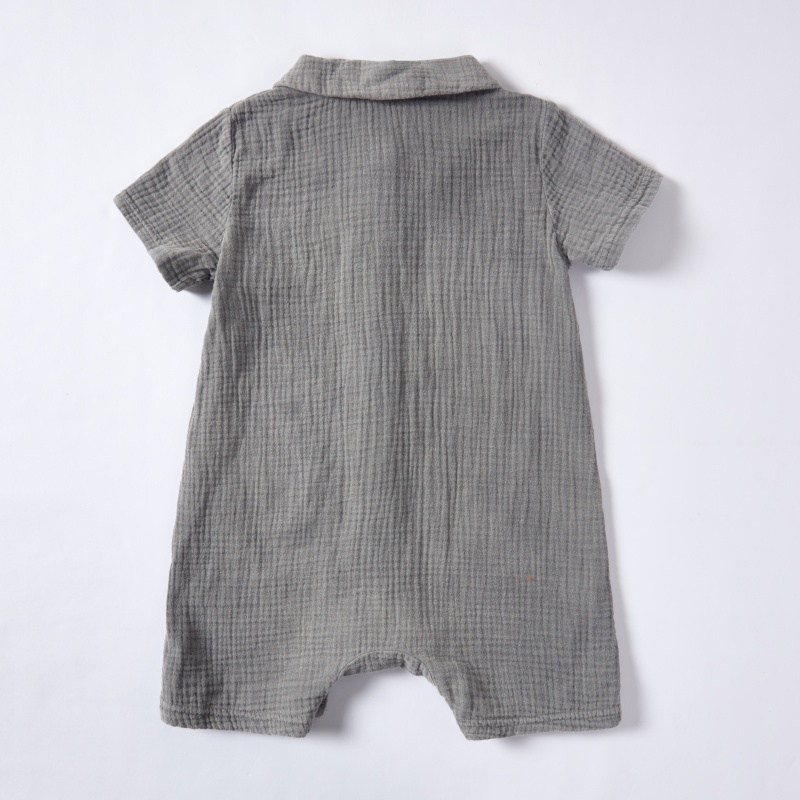
OEM/ODM 100% Cotton Baby Romper 135gsm Double Layer Wrinkled Muslin Jumpsuit Natural Plant Botanical Dyed Infant Toddler Short Sleeve One-Piece Outfits Custom Wholesale Private Label


- Overview
- OEM Custom 135gsm Cotton Wrinkled Muslin Baby Romper
- Recommended Products
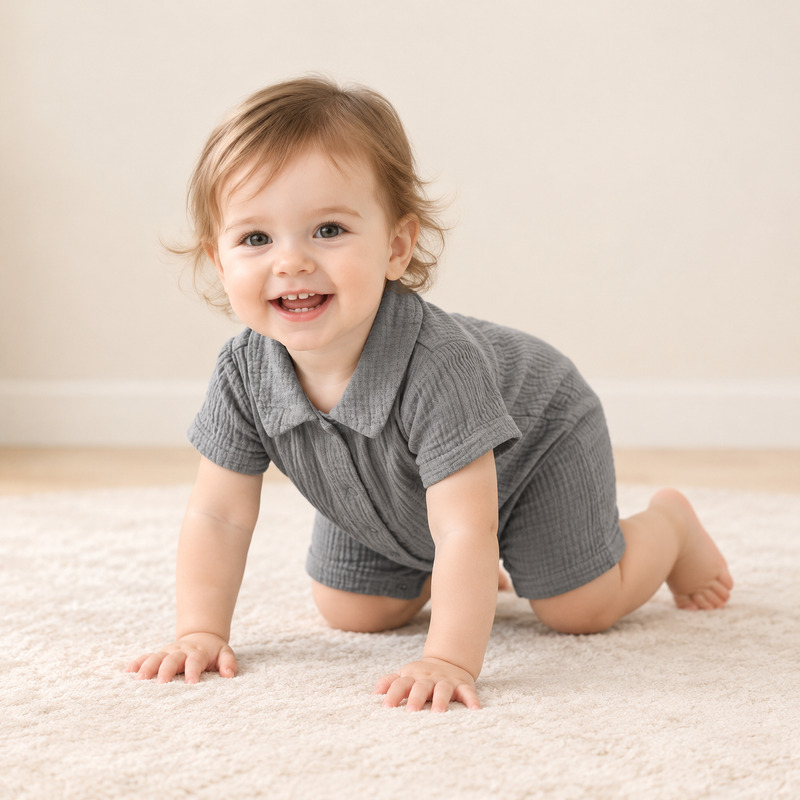
A short-sleeve shirt romper in a double-layer crinkled cotton, 135 gsm, dyed to a smoke grey with sappanwood (苏木) and pomegranate rind (石榴皮) and finished in a ferrous second bath: a shirt collar, a full centre-front placket on snaps, short sleeves with a turned hem, straight short legs with a snapped crotch.
Grey is the one colourway here that keeps moving after it leaves the bath, and this garment has two parts that are pressed while the rest is not. That combination is the whole page: the pressed parts and the unpressed parts of an iron-tannin grey do not settle at the same point, and the difference is only visible after the resting period — which is also the period in which the buyer is asked to approve.
At a glance
1. Grey keeps developing, and two parts of this garment are pressed
- The tannin goes into the cloth first and the iron develops the grey in a second bath, so the colour is a reaction rather than a deposit, and the reaction does not stop when the cloth leaves the liquor.
- It settles over the first days of resting, which is why the sealed standard is struck after the rest rather than off the line.
- On this garment the placket and the collar are pressed while the body is not, and pressing changes both the moisture history and the surface of the cloth.
- The result is that the pressed parts and the body do not arrive at the same end point at the same time, and a garment read too early can show a placket a step away from the body that closes up a week later — or the reverse.
- So the rest period is applied to the finished garment, not to the cloth, and the placket and collar are read against the body at the end of it.
2. The placket's inside face is the inner ply
- A double-layer cloth takes the iron bath from the outside in, so the outer ply develops more than the inner one; on most pieces the inner ply is hidden.
- On this garment it is not: the placket turns over along its whole length, and what shows on the turned face is the inner ply.
- So the expected difference between the two plies is written down rather than discovered, and it is checked at the placket turn with both faces side by side, before and after the rest.
- The collar roll and the sleeve hem turn get the same read, since they are the other two places where the cloth turns over on a visible edge.
- Where a roll falls outside the stated relationship it is not pushed through, because no sewing operation corrects a two-faced difference in a colour that is still developing.
3. Iron firms the cloth, and this garment bends it hardest
- Tannin-iron chemistry firms cellulose, and overdosed it embrittles it, with the damage appearing first where the cloth flexes repeatedly.
- The placket fold is the longest repeated flex on the garment, and the crotch corner is the sharpest; between them they cover the two worst cases on a child's romper.
- So the iron dose is capped as a ratio to the tannin measured on the cloth, the rinse is verified before packing, and strength is tested against undyed cloth from the same greige lot with the placket fold and the crotch corner included rather than averaged into a body result.
- The collar point is the third case, because a point is a tight turn on the same cloth; a point that cracks or furs at the tip after washing is the visible form of an overdose.
- The rest period is also when an overdose shows itself, since a cloth that has been over-ironed stiffens further as it dries out, and a placket that was acceptable on the table can read as boardy a week later.
4. The ring of every snap reads as a pale disc
- Setting a snap presses the crinkle flat in a ring, and on a smoke grey that ring catches light and reads as a pale disc rather than as a shadow.
- On a placket with a snap every few centimetres this becomes a repeated motif, so it is graded as a pattern rather than as a series of individual marks: even spacing, even size, and no ring larger than its neighbours.
- Retention is tested as a small part on the finished garment, with the full placket stack in place, because a snap that holds in a swatch can fail where four plies meet.
- Edge distance and spacing are set against this cloth rather than copied from a flat-poplin pattern, since spacing decides whether the placket gapes and distance decides whether it tears out.
- The tear-out signature on grey is a frayed pale halo, which reads as a defect in the cloth rather than as hardware, so the margin on edge distance is wider here than the minimum the test would allow.
5. What grey hides, and what it insists on showing
- Smoke grey hides soiling better than any cream in the range, which is why it is the practical colour for a garment a baby wears while eating.
- It hides unevenness less well than a mid coral, because there is no hue for the eye to rest on; a step between panels or between plies reads as a line rather than as a variation.
- And it shows a water mark. A drop that dries on the placket leaves a faint ring, so the placket is pressed dry through a cloth rather than spot-damped, and the care wording says cool whole-garment washing rather than local work.
- The collar seat is where all three of these meet: it is the piece at the face, it is pressed, and it is where a nappy or a bib brushes against the cloth.
- So the collar seat is read last in the approval, after the rest, in daylight and under D65, against the body panel directly below it.
6. Placket, hems and the fit above them
- The placket is cut on grain and its width is held from neck to hem, because on a grey the band is the line the eye follows and a twist shows as a soft edge that will not press out.
- The sleeve and leg hems are turned hems on a springy two-ply edge, so each is a fold and the depth is set rather than minimum; the legs carry no elastic, so the leg opening is a measurement that clears the thigh with a nappy on.
- The neck opening is measured on the closed garment on the smallest size, since the placket opens fully and dressing does not rely on stretch.
- The inside of the placket is finished as a face, because on this colourway the turned face is the inner ply and it is the face a reviewer sees first.
- Bulk is trimmed in steps at the crotch corner, where the placket stack, the leg hem and the snaps meet.
7. Tests, sizes, sampling and quoting
- Fabric tests at the shipped depth: light to ISO 105-B02, wash to ISO 105-C06 with a whole garment in the load, rubbing to ISO 105-X12 on the outside face, on the inside face and through creases, perspiration and saliva to ISO 105-E04 plus the destination market's saliva method, with colour read on both plies.
- Route checks: iron dose recorded as a ratio to tannin measured on the cloth; rinse verified before packing; strength to ISO 13934-1 and ISO 13937-2 against undyed same-lot cloth with the placket fold, the crotch corner and the collar point included; and the pressed/unpressed relationship read on the finished garment at the end of the rest period.
- Colour checks: the resting read taken on the finished garment under D65 against a sealed piece that has also rested, with the placket, the collar seat and a body panel read together; a both-ply read at the placket turn, the collar roll and the sleeve hem turn; and a water-mark check on the placket.
- Construction checks: placket straightness under a rule at three points, placket width from neck to hem, snap spacing and edge distance, gaping after washing, ring evenness as a pattern, collar point symmetry and tip condition after washing, hem depth, and bulk control at the crotch corner.
- pH is measured on the garment and held between 4.0 and 7.5; extractable heavy metals are tested on the finished garment, which is the relevant check for a ferrous colourway; phenol yellowing is checked to ISO 105-X18 on a specimen carrying the actual packing fold, with packaging specified free of BHT.
- Safety checks: snaps tested as small parts on the finished garment, neck opening measured on the closed garment on the smallest size, leg opening measured with a nappy in place, and confirmation that the garment carries no cords, ties or toggles.
- Five sizes on a measurement chart: 6-9M, 9-12M, 12-18M, 24M and 36M move on chest, body length, sleeve, leg opening and crotch depth, graded from measurements rather than by percentage.
- Sampling: 3-7 days from a confirmed tech pack, covering a dyed strike-off with its bath sequence and rest stated, a made-up romper rested for the full period before approval, a pressed/unpressed read at the end of the rest, a both-ply read at the three turns, a ring-pattern review, a wash-and-remeasure with the collar tip checked for furring, a snap retention pull, and a fit check over a nappy.
- Bulk: 30-60 days from approval, planned per dyebath with the rest period inside the lead time, and with the placket and collar pressed on the same plate setting in every batch so the pressed parts settle the same way.
- MOQ: 300 pcs for a custom development covering cloth, shade, crinkle level, trim or fit; 50 pcs for a decorative process on a stock body; 100 pcs for stock cloth with your own logo and label. Mixed colour and size orders are quoted per order, and terms are confirmed against the current quotation.
Production runs with our production partner, Suzhou Shelmin Trade Co., Ltd.: founded 2017, 7,200 m² workshop, 8 lines, 200 staff, 6,000 pieces per day. Design confidentiality is held under NDA; buyer patterns, shades and prints are not re-used.
To quote, we need: target market and the Class I tests it requires; whether approval can wait until the rest period has run, since a pressed placket and an unpressed body are not comparable before it; the acceptable difference between the two plies at the placket turn and the collar roll; whether the snap ring may read as a repeated pale motif on this colourway; snap type, spacing and edge distance; collar point length and tip trimming; hem depth at sleeve and leg, and leg-opening dimension per size; the crinkle level you want, as crease count and depth per unit; lot certificates for the two plants and for the thread; the pH target and the dyehouse water specification; packing method; and whether certification is to run in your brand name.