EN

OEM/ODM Custom Pet Hoodie | 100% Cotton Indigo Plant-Dyed Dog Sweatshirt | Eco-Friendly Non-Toxic Botanical Tie-Dye Cat Apparel for Private Label | Sustainable Breathable Puppy Pullover with Hood | Premium Pet Supplier


- Overview
- Custom Indigo Plant-Dyed Tie-Dye Cotton Pet Hoodie
- Recommended Products
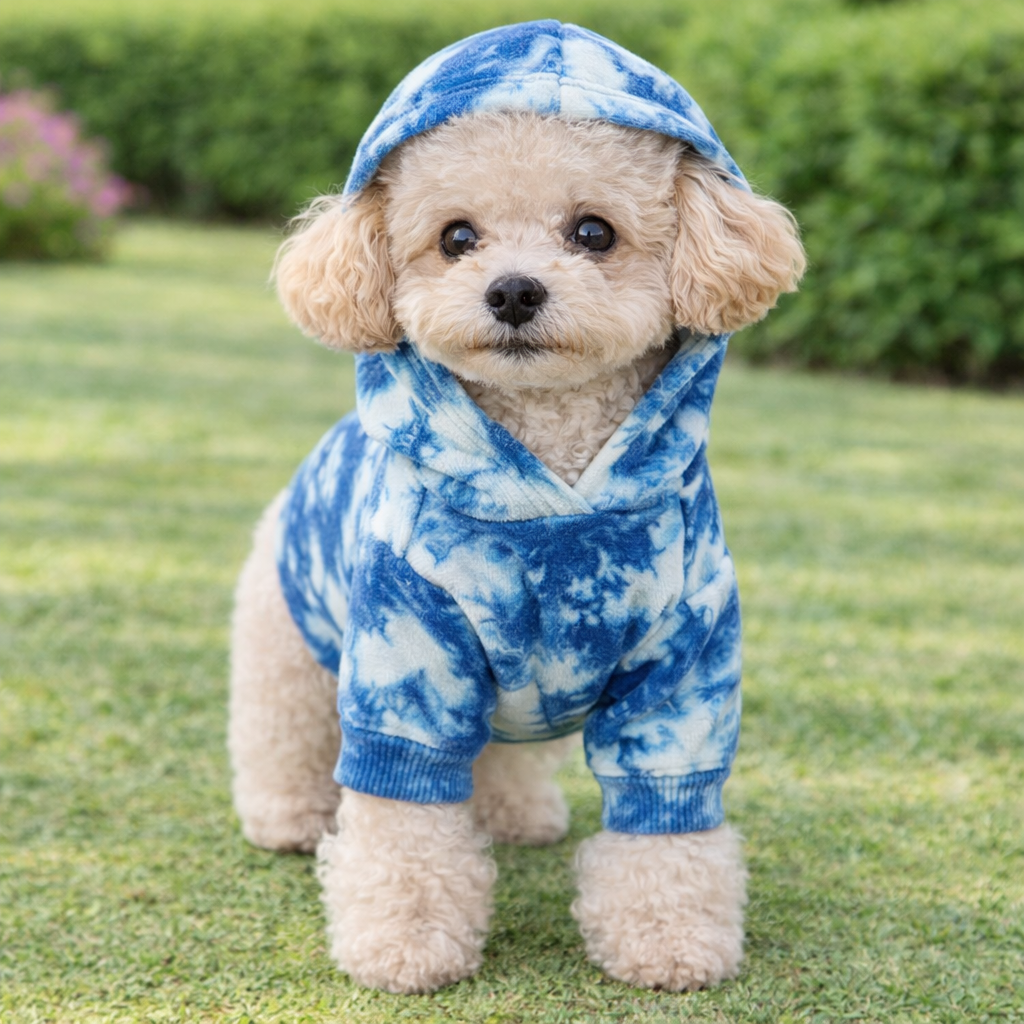
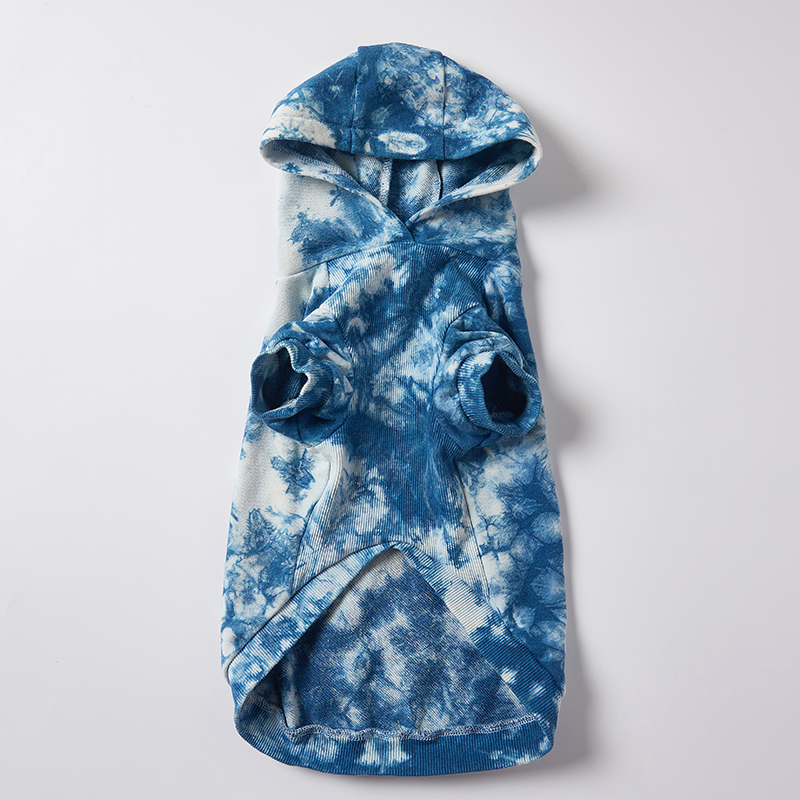
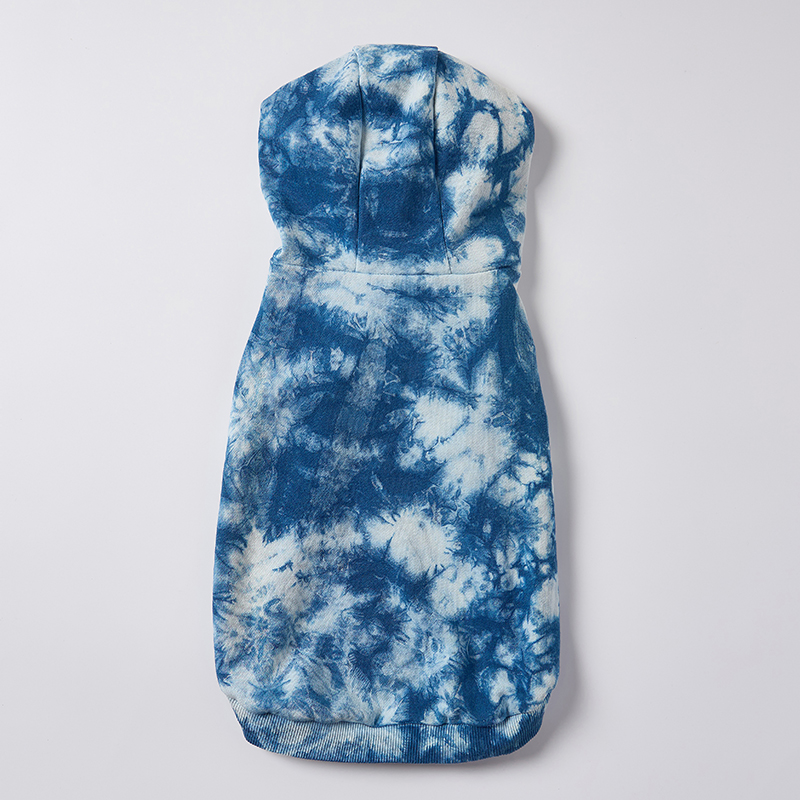
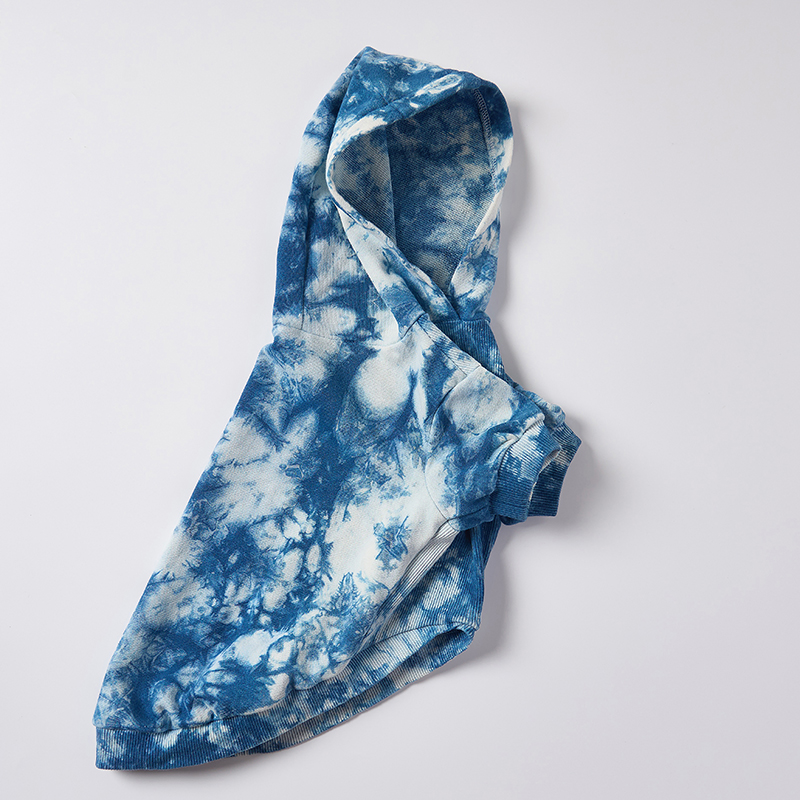
A hooded sweatshirt for a small dog or a cat, in a 100% cotton knit with a fine vertical wale, dyed entirely in indigo from Isatis: a two-piece hood with a folded band, a crossed front that closes nowhere, two sleeves ending in rib cuffs over the front legs, and a long underside opening finished with rib.
The pattern is not a print and was not painted on. It is a map of compression. The cloth was folded, pressed and held while it went into the vat, and what came out is a record of where it was pinched and where it stayed loose: the blue is the cloth that the liquor reached, and the white is the cloth that was pressed too tightly for the liquor to wet it. Everything unusual about this garment follows from that one fact, including why its cuffs come out darker than its body and why its inside carries a different pattern from its outside.
At a glance
1. The white is a record of compression
- Folded cloth cannot be wetted where the fold is tight, so the white passages are not missed patches of cloth: they are the places where the ply was pressed hard enough that the liquor never arrived.
- That makes the edge of a white vein a depth rather than a line. The dye did not stop at a drawn boundary but penetrated the bundle to a certain distance and no further, which is why the boundaries fan, branch and thin instead of running straight.
- The white islands inside the blue are the same fact at a smaller scale: a spot where the cloth stayed pinched while everything around it relaxed.
- It also explains the soft halo. Where the liquor arrived late or weakly, the blue is paler before it stops, so every white vein is bordered by a gradient rather than a step.
- Nothing here was drawn, masked or sprayed, which is why no two pieces carry the same pattern: the resisting tool is the cloth's own folds.
2. What a tie can be asked to repeat
- A position cannot be repeated, but a fold can. The order names the fold pattern, the number of bundles, the scale of the white veins and the share of surface left white; those four reproduce a family of pieces.
- Approval is on a set rather than on one garment, because a tie-dye range is judged the way it is actually sold: two or three pieces side by side, and the question is whether they read as one product.
- Depth and pattern are separate dials. The number of dips sets how deep the blue goes; the fold sets where the white falls. Either can be changed without the other, which is why they are quoted separately.
- The white share is the number buyers underestimate: a dyed-in-the-bundle garment reads much darker as the white falls, and the same fold pattern at half the white looks like another product on a shelf.
- A tie is also a capacity question, since every bundle is opened, dipped and re-tied by hand, which is why the technique carries a minimum and a longer sampling window than a print.
3. Indigo depth is counted in dips, and every dip needs air
- Indigo does not dye the fibre in one pass. It is brought into a soluble reduced state, taken up by the cloth, and only becomes blue when the air oxidises it back into an insoluble pigment on the fibre, so a depth is reached by repeating the cycle rather than by adding dyestuff.
- Each cycle is dip, lift, hang, oxidise, and only then the next dip, which puts the cost of a deep shade into the number of cycles and the labour in them rather than into the dyestuff alone.
- The resist survives the repetition because the compressed core never wets, so a twelve-cycle navy keeps the same white veins it had at two cycles; that is what allows a deep shade and a crisp resist on the same piece.
- Because the pigment stays near the surface rather than inside the fibre, a deep indigo sits where abrasion happens, which is why rub fastness is read at the cuffs and inside rather than mid-back.
- The shade is also set by how long each piece hangs, so dwell belongs in the written route: two batches hung for different times are two shades from the same vat.
4. In a vat the rib comes out darker than the body
- On this garment the rib is the darkest element. The cuffs, the rear hem, the opening binding and the hood band read almost as solid colour while the body stays mottled.
- That is not a design choice but a consequence: rib is denser than jersey and the bands are doubled, so the same liquor loads more pigment into them, and the folds that make the pattern cannot form inside a band that is already compressed.
- It inverts the usual reading of a garment: the plain parts become the solid passages and the patterned parts the field, so cuffs and binding draw the eye first; a quiet edge means asking for the rib to be treated separately, a route decision with its own cost.
- It also means the rib cannot be used to judge the body shade. A cuff and a sleeve from the same bath are two different colours, and the reference for the body is a flat piece of the body cloth.
- The practical instruction: approve rib and body as two references, which is how they are cut and sewn anyway.
5. Both faces are dyed, and the reverse is not a mirror
- A bath wets the whole piece, so the inside is dyed too, unlike a technique that works one face; the reverse seen through the cuff opening and the underside opening is blue as well.
- But it carries a different pattern. Each face of the cloth sat at a different depth in the bundle, so the pressure it met was different, and the inside therefore holds its own arrangement rather than a copy of the outside.
- On a pet garment the inside is the wearing surface, because it is the face that meets the coat, so the reverse is where any loose pigment shows first and where crock is read.
- It is also the face that gets damp, since a garment worn against fur sees more moisture than one worn over a shirt, so the wash route is written for the inside.
- That makes the reverse a specification line rather than a hidden detail: if the inside pattern is unacceptable, it is a change to how the bundle is built, not something corrected at inspection.
6. A wet knit moves, so the fit is set after the dye
- Cotton knit relaxes through repeated wet cycles, so the measurements that matter are the dyed ones rather than the greige ones, and a garment dipped and oxidised repeatedly keeps settling for the first washes; the pattern is therefore cut against a dyed dimension and all fitting is done after a wash.
- Fit is set by the forelegs. A dog does not swing a foreleg from a fixed socket: the leg moves under a shoulder blade that slides, so the armhole does not sit where a human armhole sits and a sleeve drafted on human logic binds at the first stride. Depth and angle carry the pattern, not length, and it is checked on a moving animal.
- The hood's front edge is a measurement. The folded band sets how far forward it can travel, a centimetre puts it on the brow and another covers the eyes, and because the hood carries weight at the neck the rear hem's rib tension is tuned against it.
- The rib carries four jobs and none is decoration: the cuffs grip, the rear hem holds the body back, the opening binding keeps the underside from curling and the hood band keeps the hood off the eyes, each with its own tension target measured after washing.
7. Sizes, sampling and quoting
- Two sizes graded on measurements: S and M move on chest girth, back length, neck opening, hood depth and hood opening circumference, sleeve set and angle, cuff diameter, and the length of the underside opening.
- Customization. Fold pattern and bundle count; the scale of the white veins; the share of surface left white; the number of dips and the target depth; whether the rib is dyed with the body or treated separately; the whole-garment route against a piece-dyed route, which changes the pattern at every seam; sleeve length and set; cuff diameter in its relaxed and stretched states; hood depth and the position of its front edge; and the length of the underside opening.
- Sampling: 3-7 days from a confirmed tech pack, covering a tied set of two or three pieces approved on the dipped, oxidised and washed result; body and rib approved as two separate references; both sizes fitted on a moving animal with the hood up; cuff measured relaxed, stretched and pulled over a paw; rub fastness read on the inside and at the cuffs after the first wash; every rib re-measured after washing; and the opening binding checked for an edge that does not curl.
- Bulk: 30-60 days from approval, tied and dipped in batches with the dip count and dwell recorded per batch and each batch compared against a retained cloth reference; AQL 2.5 major and 1.0 critical.
- MOQ: 300 pcs for a custom development covering cloth, depth, fold pattern or fit; 50 pcs for a decorative process on a stock body; 100 pcs for stock cloth with your own logo and label. Mixed colour and size orders are quoted per order.
Production runs with our production partner, Suzhou Shelmin Trade Co., Ltd.: founded 2017, 7,200 m² workshop, 8 lines, 200 staff, 6,000 pieces per day. Design confidentiality is held under NDA; buyer patterns, shades and tie layouts are not re-used.
To quote, we need: destination market and what it requires for pet textiles; the dyehouse documentation for the indigo and for the vat; the fold pattern and bundle count, with two reference pieces if you have them; the white share you will accept and the scale of the veins; the dip count and target depth; whether the rib is dyed with the body or separately; whole-garment or piece-dyed; chest girth, back length and neck-to-cuff for S and M; hood depth and its front edge position; cuff diameter in both states; the length of the underside opening; the certificate held for the cloth and the scope you need; the lot certificate for the dyestuff; the pH target and the dyehouse water specification; packing method; and whether certification runs in your brand name.